
Quick Synonym List
Closest alternatives
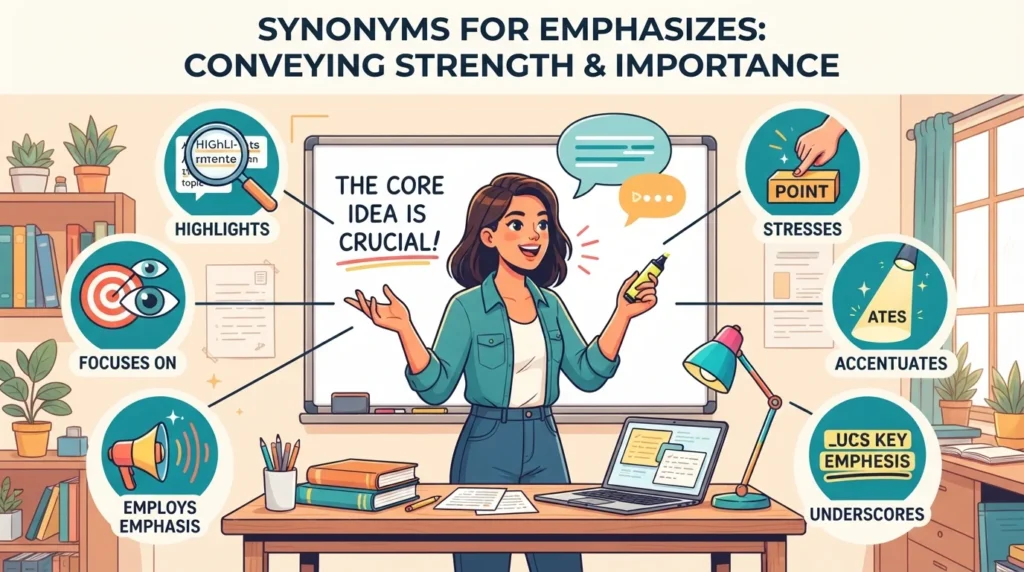
- Highlights
- Stresses
- Underscores
- Accentuates
- Reinforces
- Calls attention to
- Draws attention to
- Points out
- Gives prominence to
- Brings attention to
Formal and academic
- Underscores
- Stresses
- Highlights
- Accentuates
- Reinforces
- Demonstrates
- Illustrates
- Draws attention to
- Gives prominence to
- Calls particular attention to
Professional and business
- Highlights
- Underscores
- Stresses
- Reinforces
- Prioritizes
- Focuses on
- Brings into focus
- Identifies
- Draws attention to
- Gives priority to
Stronger or more forceful
- Stresses
- Underscores
- Accentuates
- Amplifies
- Reinforces
- Drives home
- Impresses upon
- Insists on
- Makes clear
- Calls particular attention to
Neutral and everyday
- Highlights
- Points out
- Shows
- Notes
- Mentions
- Calls attention to
- Draws attention to
- Focuses on
- Brings up
- Makes clear
What Does “Emphasizes” Mean?
Emphasizes is the third-person singular present form of emphasize.
It means to give particular importance, attention, or prominence to something.
For example:
“The report emphasizes the need for better training.”
This means the report gives special importance or attention to the need for better training.
Another example:
“The design emphasizes simplicity.”
Here, emphasizes means that the design makes simplicity especially noticeable or central.
The word can therefore describe several related ideas:
- Giving an idea special importance
- Drawing attention to something
- Making a feature more noticeable
- Stressing a particular point
- Reinforcing an existing message
- Making something a priority
Because these meanings overlap, the best synonym depends on the sentence.
The Closest Synonyms for Emphasizes
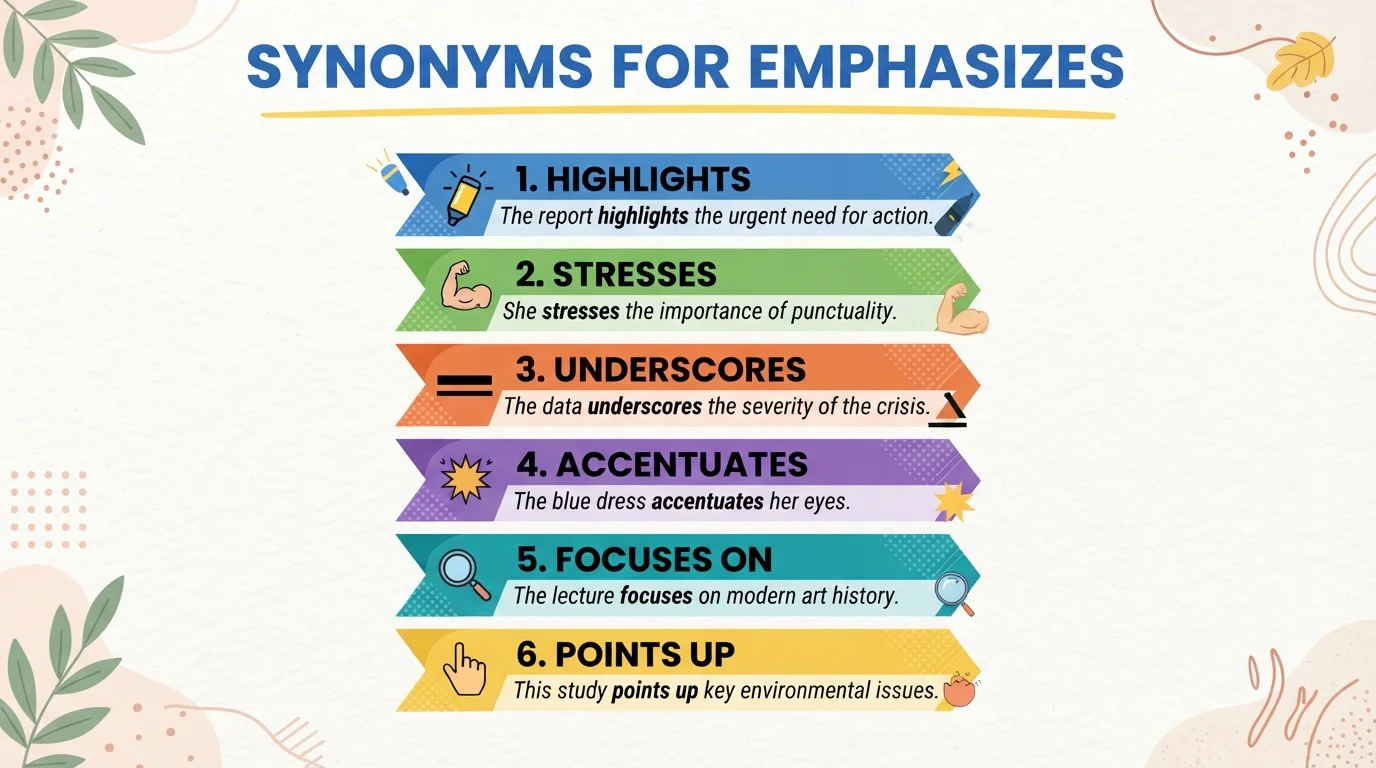
1. Highlights
Meaning: Gives special attention or makes something particularly noticeable.
Tone: Neutral, professional.
Best for: Reports, articles, presentations, explanations, and general writing.
Example:
“The study highlights the importance of early intervention.”
Difference:
Highlights is probably the most flexible everyday alternative to emphasizes. It often sounds slightly less forceful.
2. Stresses
Meaning: Gives strong importance or attention to something.
Tone: Neutral to formal.
Best for: Arguments, warnings, instructions, academic and professional writing.
Example:
“The report stresses the need for immediate action.”
Difference:
Stresses often sounds more forceful or urgent than highlights.
Compare:
“The report highlights the need for action.”
“The report stresses the need for action.”
The second suggests stronger emphasis.
3. Underscores
Meaning: Emphasizes something clearly, often by showing its importance or significance.
Tone: Formal and professional.
Best for: Academic writing, reports, journalism, business communication, and formal analysis.
Example:
“The findings underscore the importance of accurate data.”
Difference:
Underscores is very close to emphasizes but has a distinctly formal written style.
4. Accentuates
Meaning: Makes a particular quality or feature more noticeable or prominent.
Tone: Formal.
Best for: Visual descriptions, design, writing, art, physical features, and stylistic analysis.
Example:
“The lighting accentuates the building’s architectural details.”
Difference:
Accentuates often means making a feature stand out rather than simply saying that it is important.
5. Reinforces
Meaning: Makes an idea, message, belief, or effect stronger.
Tone: Neutral to formal.
Best for: Arguments, evidence, messages, policies, lessons, and conclusions.
Example:
“The results reinforce the need for better safety measures.”
Difference:
Reinforces suggests that something strengthens an existing idea. It is not always a direct synonym for emphasizes.
6. Calls Attention To
Meaning: Directs attention toward something.
Tone: Neutral.
Best for: Reports, warnings, articles, presentations, and explanations.
Example:
“The report calls attention to gaps in the current system.”
Difference:
This phrase focuses on directing attention, not necessarily saying that something is especially important.
7. Draws Attention To
Meaning: Makes people notice or consider something.
Tone: Neutral and versatile.
Example:
“The article draws attention to the environmental consequences.”
Difference:
Very close to calls attention to. It can sound slightly more descriptive and less forceful than stresses.
8. Points Out
Meaning: Directs attention to a particular fact, detail, or issue.
Tone: Neutral to conversational.
Best for: Explanations, discussions, everyday writing, and straightforward prose.
Example:
“The author points out several problems with the proposal.”
Difference:
Points out usually identifies something specific rather than giving it sustained importance.
9. Gives Prominence To
Meaning: Gives something a more noticeable or important position.
Tone: Formal.
Best for: Design, media, writing, advertising, reports, and professional communication.
Example:
“The campaign gives prominence to customer safety.”
Difference:
This emphasizes visibility or position as well as importance.
10. Brings Into Focus
Meaning: Makes something clearer, more noticeable, or more central.
Tone: Neutral to formal.
Example:
“The investigation brings the issue of workplace safety into focus.”
Difference:
This expression often suggests that something becomes clearer or receives renewed attention.
Emphasizes for Importance
When emphasizes means “says that something is particularly important,” these are useful alternatives:
- Highlights
- Stresses
- Underscores
- Accentuates
- Reinforces
- Gives importance to
- Gives prominence to
- Calls attention to
- Draws attention to
- Makes a point of
- Places emphasis on
- Puts emphasis on
- Gives particular attention to
- Makes clear
- Brings into focus
Example
“The teacher emphasizes the importance of practice.”
“The teacher highlights the importance of practice.”
“The teacher stresses the importance of practice.”
“The teacher underscores the importance of practice.”
“The teacher draws attention to the importance of practice.”
All are grammatical, but they differ slightly in tone and strength.
Emphasizes in Academic Writing
Academic writing frequently uses emphasizes to show that a source, study, author, or finding gives special importance to an idea.
Useful alternatives include:
- Highlights
- Underscores
- Stresses
- Reinforces
- Demonstrates
- Illustrates
- Draws attention to
- Brings into focus
- Points to
- Shows
- Establishes
- Makes clear
Example
Original:
“The study emphasizes the importance of early education.”
“The study highlights the importance of early education.”
“The study underscores the importance of early education.”
“The study reinforces the importance of early education.”
Be careful with demonstrates and establishes. These can make a stronger claim than emphasizes because they suggest that the evidence actually shows or establishes something.
Emphasizes in Business Writing
In professional communication, emphasizes is useful when describing priorities, messages, values, or strategic goals.
- Highlights
- Underscores
- Stresses
- Reinforces
- Prioritizes
- Focuses on
- Gives priority to
- Brings attention to
- Draws attention to
- Places emphasis on
Example
“The new policy emphasizes customer satisfaction.”
Possible alternatives:
“The new policy prioritizes customer satisfaction.”
“The new policy highlights customer satisfaction.”
“The new policy places greater emphasis on customer satisfaction.”
These are not identical.
Prioritizes suggests that customer satisfaction is given greater rank or priority.
Highlights mainly says that attention is drawn to it.
Emphasizes can cover either idea depending on context.
Emphasizes in Visual Design
When something makes a visual feature stand out, accentuates can be more precise than emphasizes.
Example
“The color scheme emphasizes the central image.”
Possible alternatives:
“The color scheme accentuates the central image.”
“The color scheme highlights the central image.”
“The design draws attention to the central image.”
Difference
- Emphasizes — gives special importance or attention
- Accentuates — makes a feature more noticeable
- Highlights — makes something stand out
- Draws attention to — directs the viewer’s attention
For visual contexts, accentuates and highlights are often more natural.
Emphasizes in Speech
When someone gives extra force to a point while speaking, useful alternatives include:
- Stresses
- Underscores
- Insists on
- Repeats
- Calls attention to
- Makes clear
- Drives home
- Places emphasis on
Example
“The speaker emphasizes the importance of honesty.”
Possible alternatives:
“The speaker stresses the importance of honesty.”
“The speaker drives home the importance of honesty.”
The last option is much more informal and forceful.
Emphasizes vs. Highlights
These two words are extremely close.
Emphasizes
Focuses on giving something importance or special attention.
“The report emphasizes the need for reform.”
Highlights
Focuses on making something noticeable or especially prominent.
“The report highlights several problems.”
Both can often work, but highlights is especially natural when identifying particular findings, features, or examples.
Emphasizes vs. Stresses
Stresses generally sounds stronger.
“The doctor emphasizes the importance of exercise.”
“The doctor stresses the importance of exercise.”
The second sentence can suggest greater urgency or force.
Use stresses when the speaker strongly wants the reader or listener to take a point seriously.
Emphasizes vs. Underscores
These are close synonyms, especially in formal writing.
“The evidence emphasizes the importance of preparation.”
“The evidence underscores the importance of preparation.”
Underscores has a more formal, polished style and is especially common in reports, journalism, and academic prose.
Emphasizes vs. Reinforces
The difference is subtle but important.
Emphasizes gives special attention to an idea.
Reinforces makes an existing idea or message stronger.
Compare:
“The report emphasizes the importance of safety.”
“The new evidence reinforces the importance of safety.”
The first says the report gives safety special attention.
The second says the evidence strengthens an existing conclusion about safety.
Emphasizes vs. Prioritizes
These are not interchangeable.
Emphasizes means gives special importance or attention.
Prioritizes means places something ahead of other things in importance, attention, or action.
Compare:
“The company emphasizes employee well-being.”
This means the company gives it significant attention.
“The company prioritizes employee well-being.”
This suggests that employee well-being is treated as a priority when making decisions.
Emphasizes vs. Accentuates
Accentuates is more specialized.
Use it when something makes a feature especially noticeable.
“The lighting accentuates the room’s architectural features.”
Use emphasizes for broader importance:
“The report emphasizes the need for better planning.”
Emphasizes vs. Points Out
Points out usually identifies a specific fact or detail.
“The author points out a problem with the method.”
Emphasizes suggests that the author gives that issue particular importance.
“The author emphasizes the importance of methodological accuracy.”
A person can point something out without emphasizing it.
Emphasizes vs. Demonstrates
These verbs make different claims.
Emphasizes says something gives special attention to an idea.
Demonstrates says something provides evidence or shows how something works or is true.
Compare:
“The study emphasizes the need for further research.”
“The study demonstrates the effectiveness of the treatment.”
Do not replace emphasizes with demonstrates unless the evidence actually supports that stronger meaning.
True Synonyms vs. Related Alternatives
| Word/Phrase | Relationship | Strength | Tone | Interchangeable? |
|---|---|---|---|---|
| Highlights | Very close synonym | Moderate | Neutral | Often |
| Stresses | Very close synonym | Strong | Neutral/formal | Often |
| Underscores | Very close synonym | Strong | Formal | Often |
| Accentuates | Contextual synonym | Moderate | Formal | Sometimes |
| Reinforces | Near synonym | Moderate/strong | Professional | Sometimes |
| Calls attention to | Phrase-level synonym | Moderate | Neutral | Often |
| Draws attention to | Phrase-level synonym | Moderate | Neutral | Often |
| Points out | Related alternative | Mild/moderate | Neutral | Sometimes |
| Gives prominence to | Formal alternative | Strong | Formal | Sometimes |
| Prioritizes | Related but distinct | Strong | Professional | Not always |
| Demonstrates | Related but distinct | Strong | Academic | No |
| Illustrates | Related but distinct | Moderate | Academic | No |
| Shows | Broad alternative | Variable | Neutral | Sometimes |
| Reinforces | Near synonym | Strong | Professional | Sometimes |
| Drives home | Idiomatic alternative | Strong | Informal | Sometimes |
Stronger Alternatives to Emphasizes
If you want to make the sentence sound more forceful, consider:
Stresses
“The report stresses the urgency of the situation.”
Underscores
“The findings underscore the need for immediate action.”
Drives home
“The example drives home the importance of preparation.”
Insists on
“The policy insists on strict compliance.”
Be careful with insists on because it suggests a forceful demand rather than simple emphasis.
Makes Clear
“The evidence makes clear that additional safeguards are needed.”
This is stronger because it suggests that the evidence establishes a clear conclusion.
Softer Alternatives to Emphasizes
For a less forceful tone, use:
- Notes
- Mentions
- Points out
- Draws attention to
- Shows
- Highlights
- Focuses on
- Refers to
Example
Stronger:
“The report stresses the risks.”
Neutral:
“The report highlights the risks.”
Softer:
“The report notes the risks.”
These choices can subtly change the tone of your writing.
Sentence Transformations
1. Academic writing
Original:
“The study emphasizes the importance of regular exercise.”
Alternative:
“The study underscores the importance of regular exercise.”
Why:
Underscores gives the sentence a formal academic tone.
2. Professional writing
Original:
“The report emphasizes customer satisfaction.”
Alternative:
“The report highlights customer satisfaction.”
Why:
Highlights is natural and professional without sounding overly formal.
3. Strong warning
Original:
“The doctor emphasizes the importance of following the instructions.”
Alternative:
“The doctor stresses the importance of following the instructions.”
Why:
Stresses suggests stronger urgency.
4. Visual design
Original:
“The lighting emphasizes the sculpture’s shape.”
Alternative:
“The lighting accentuates the sculpture’s shape.”
Why:
Accentuates is more precise for making a visual feature stand out.
5. Business priority
Original:
“The company emphasizes employee development.”
Alternative:
“The company prioritizes employee development.”
Why:
Prioritizes suggests employee development receives a high position among competing goals.
6. Direct attention
Original:
“The article emphasizes the environmental consequences.”
Alternative:
“The article draws attention to the environmental consequences.”
Why:
The alternative focuses on directing the reader’s attention rather than assigning strong importance.
7. Specific detail
Original:
“The author emphasizes several weaknesses in the argument.”
Alternative:
“The author points out several weaknesses in the argument.”
Why:
Points out is more direct and specific, while emphasizes suggests those weaknesses receive particular importance.
8. Strengthening an idea
Original:
“The new evidence emphasizes the importance of accurate measurements.”
Alternative:
“The new evidence reinforces the importance of accurate measurements.”
Why:
Reinforces indicates that the evidence strengthens an existing conclusion.
9. Formal report
Original:
“The findings emphasize the need for further research.”
Alternative:
“The findings underscore the need for further research.”
Why:
Underscore is especially natural in formal reports and analytical writing.
10. Informal explanation
Original:
“The example emphasizes how important preparation is.”
Alternative:
“The example drives home how important preparation is.”
Why:
Drives home is informal and strongly stresses the point.
Common Collocations With Emphasizes
Common patterns include:
- emphasizes the importance of
- emphasizes the need for
- emphasizes the role of
- emphasizes the value of
- emphasizes the significance of
- emphasizes the benefits of
- emphasizes the importance of
- emphasizes a point
- emphasizes a difference
- emphasizes the relationship between
- emphasizes the need to
- emphasizes the importance of being
- emphasizes the role played by
- emphasizes the central role of
- emphasizes the importance placed on
Examples
“The report emphasizes the need for reform.”
“The teacher emphasizes the importance of practice.”
“The design emphasizes simplicity.”
“The study emphasizes the role of early intervention.”
Grammar and Usage
Emphasizes is the third-person singular present form of emphasize.
Correct
“The report emphasizes the importance of safety.”
“The teacher emphasizes the main point.”
“The design emphasizes the central feature.”
Other forms
- Emphasize — base form
- Emphasizes — third-person singular present
- Emphasized — past tense
- Emphasizing — present participle/gerund
- Emphasis — noun
Common structure
emphasize + noun
“The report emphasizes safety.”
emphasize + the importance of + noun/-ing
“The report emphasizes the importance of safety.”
“The report emphasizes the importance of following procedures.”
emphasize + that-clause
“The report emphasizes that safety must remain a priority.”
Common Mistakes
Mistake 1: Treating every synonym as identical
Highlights, stresses, underscores, reinforces, and prioritizes overlap but are not interchangeable in every context.
Mistake 2: Using “accentuates” for abstract ideas
Accentuates is especially natural when making a quality or feature more noticeable.
“The lighting accentuates the colors.”
For an argument or policy, emphasizes, highlights, or underscores is usually more natural.
Mistake 3: Using “prioritizes” when you only mean “mentions”
“The report prioritizes climate change.”
This suggests climate change receives a higher priority.
If you only mean that the report gives it attention, use:
“The report highlights climate change.”
Mistake 4: Using “demonstrates” as a simple synonym
Demonstrates suggests evidence or proof.
“The study demonstrates that the method works.”
This is stronger than:
“The study emphasizes the importance of the method.”
Do not make the stronger claim unless the evidence supports it.
Mistake 5: Overusing “underscores”
Underscores is useful, but repeated use can make formal writing sound repetitive or formulaic.
Alternate naturally among highlights, stresses, draws attention to, and reinforces when the meaning genuinely changes.
Mistake 6: Using “drives home” in formal writing
This idiom is natural in conversation and informal writing.
For a formal report, use:
“The findings underscore the importance of preparation.”
rather than:
“The findings drive home the importance of preparation.”
Mistake 7: Confusing emphasis with proof
Emphasizing an idea does not necessarily prove it.
A source can emphasize a claim without demonstrating that the claim is true.
This distinction matters in academic and analytical writing.
When “Emphasizes” Is Actually the Better Word
You do not need to replace emphasizes every time it appears.
Keep it when you mean that someone or something gives special importance or attention to an idea and no more specific meaning is needed.
For example:
“The report emphasizes the importance of transparency.”
This is concise, natural, and precise.
Changing it to:
“The report accentuates the importance of transparency.”
makes the sentence sound unnecessarily formal.
Likewise:
“The teacher emphasizes the main point.”
is usually clearer than:
“The teacher gives prominence to the main point.”
A synonym is useful when it adds precision, changes register, or avoids repetition—not simply because the original word appears twice.
How to Choose the Right Alternative
| If you mean… | Use… |
|---|---|
| Give general special attention | Emphasizes |
| Make something noticeable | Highlights |
| Give strong importance | Stresses |
| Make significance especially clear | Underscores |
| Make a feature stand out | Accentuates |
| Strengthen an existing idea | Reinforces |
| Direct attention toward something | Draws attention to |
| Identify a specific point | Points out |
| Give something greater rank | Prioritizes |
| Make something visually prominent | Highlights / accentuates |
| Establish or show through evidence | Demonstrates |
| Explain with an example | Illustrates |
| Make a point very forcefully | Drives home |
| Mention without strong emphasis | Notes |
Editor’s Choice
Highlights
The most versatile alternative for general and professional writing.
Stresses
Best when you want stronger emphasis or urgency.
Underscores
An excellent formal and academic alternative.
Reinforces
Best when something strengthens an existing idea or conclusion.
Draws Attention To
Useful when the main idea is directing the reader’s or audience’s attention to something.
These choices are not interchangeable in every sentence. Choose according to the exact relationship between the subject and the idea being emphasized.