
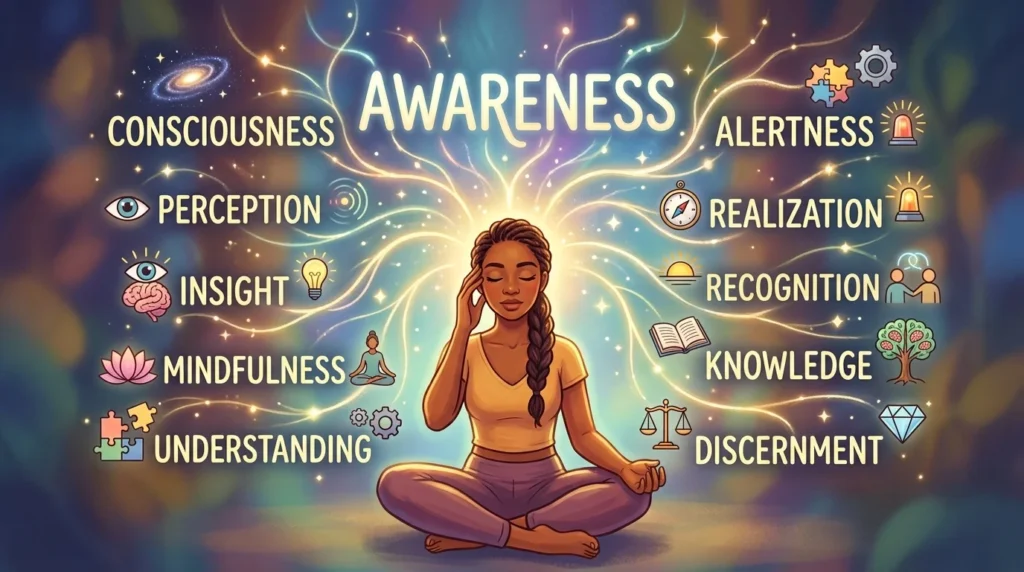
Quick Synonym List
Closest everyday alternatives
- Knowledge
- Understanding
- Recognition
- Consciousness
- Realization
- Perception
- Familiarity
- Notice
For noticing or paying attention
- Attentiveness
- Attention
- Observation
- Alertness
- Mindfulness
- Vigilance
- Watchfulness
For understanding an issue
- Insight
- Comprehension
- Appreciation
- Grasp
- Recognition
- Acquaintance
For becoming aware
- Realization
- Discovery
- Recognition
- Detection
- Identification
- Acknowledgment
Formal or professional alternatives
- Consciousness
- Recognition
- Acknowledgment
- Understanding
- Familiarity
- Perception
- Appreciation
- Knowledge
What Does “Awareness” Mean?
Awareness generally means knowing about something, noticing something, or having a conscious understanding of it.
For example:
The campaign increased awareness of the issue.
Here, awareness means that more people know about and recognize the issue.
But awareness can describe several related ideas:
- Knowledge — knowing that something exists or is true
- Consciousness — being mentally conscious of something
- Recognition — identifying or acknowledging something
- Understanding — knowing what something means or involves
- Perception — noticing or becoming conscious of something
- Attentiveness — actively paying attention
- Insight — deeper understanding of a situation
- Familiarity — having knowledge or experience with something
These words overlap, but they are not interchangeable in every sentence.
1. Knowledge
Meaning: Information or facts that someone knows.
Tone: Neutral and highly versatile
Best for: Facts, subjects, information, general understanding
Example:
The program aims to increase public knowledge of climate risks.
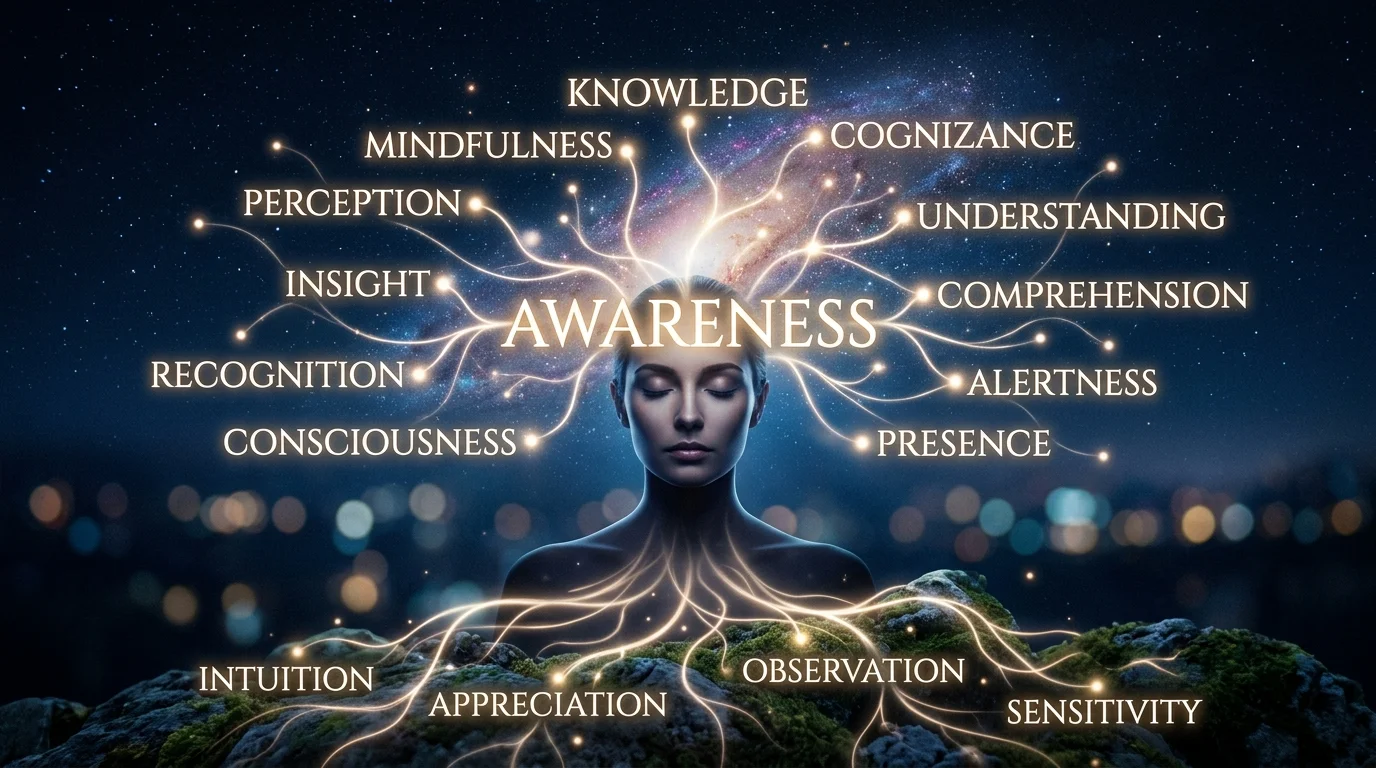
Awareness vs. knowledge
Awareness often means simply knowing that something exists or matters.
Knowledge usually suggests more information or factual understanding.
awareness of the problem
knowledge of the problem
Both work, but knowledge can imply a deeper body of information.
2. Understanding
Meaning: Knowledge of what something means, how it works, or why it happens.
Tone: Neutral
Best for: Issues, concepts, situations, processes
Example:
The training improved employees’ understanding of workplace safety.
Choose understanding when you want to emphasize comprehension rather than simple recognition.
Awareness → “I know this exists.”
Understanding → “I know what it means and how it works.”
3. Consciousness
Meaning: The state of being conscious of something; also the condition of being awake and mentally aware.
Tone: Formal, academic, philosophical
Best for: Social issues, mental states, philosophy, psychology, collective concerns
Example:
The movement helped raise public consciousness about inequality.
Consciousness is often more abstract or formal than awareness.
4. Recognition
Meaning: Knowing, identifying, or acknowledging something as important, real, or familiar.
Tone: Neutral to formal
Best for: Problems, achievements, patterns, risks, contributions
Example:
There is growing recognition of the need for reform.
Recognition is especially useful when awareness involves acknowledging something.
Compare:
awareness of the problem
means people know about it.
recognition of the problem
can suggest that people acknowledge its existence or importance.
5. Realization
Meaning: The point at which someone becomes aware of or understands something.
Tone: Neutral
Best for: Sudden discoveries, personal understanding, important facts
Example:
She came to the realization that the plan would not work.
A useful distinction:
- awareness = the state of knowing
- realization = the process or moment of becoming aware
6. Perception
Meaning: The way someone notices, interprets, or understands something.
Tone: Neutral to formal
Best for: Opinions, situations, social issues, sensory awareness
Example:
Public perception of the issue has changed.
Perception is not simply awareness. It includes how something is interpreted or understood.
7. Familiarity
Meaning: Knowledge of or experience with something.
Tone: Neutral
Best for: Subjects, systems, tools, places, procedures
Example:
Applicants should have some familiarity with spreadsheet software.
Use familiarity when someone has encountered something enough to know how it works or recognize it.
8. Notice
Meaning: The act of becoming aware of something by seeing, hearing, or paying attention to it.
Tone: Everyday and conversational
Best for: Specific observations and immediate awareness
Example:
Did you notice the change in his behavior?
Notice is usually more natural than awareness in ordinary conversation.
9. Attention
Meaning: The act of focusing the mind on something.
Tone: Neutral
Best for: Tasks, details, warnings, communication
Example:
The warning deserves your attention.
Difference
Awareness means knowing or noticing.
Attention means actively focusing on something.
You can be aware of a problem without paying much attention to it.
10. Attentiveness
Meaning: The quality of paying close attention.
Tone: Neutral to formal
Best for: People, customer service, behavior, details
Example:
Her attentiveness to small details prevented several errors.
This is more active than general awareness.
11. Mindfulness
Meaning: Deliberate awareness and attention to one’s present experience.
Tone: Neutral, wellness-related, psychological
Best for: Thoughts, emotions, behavior, present-moment attention
Example:
Mindfulness can involve greater awareness of your thoughts and emotions.
Mindfulness is more specific than awareness because it usually involves intentional present-moment attention.
12. Alertness
Meaning: The state of being mentally attentive and ready to notice possible problems or changes.
Tone: Neutral
Best for: Safety, security, driving, emergencies, work
Example:
Drivers need to maintain a high level of alertness.
Use alertness when awareness involves being ready to respond.
13. Vigilance
Meaning: Careful and continuous attention, especially to danger or problems.
Tone: Formal
Best for: Security, safety, medicine, risk management
Example:
Constant vigilance is required in high-risk environments.
Vigilance is stronger and more active than ordinary awareness.
14. Watchfulness
Meaning: Careful attention to possible danger, change, or problems.
Tone: Formal or literary
Best for: Safety, security, observation
Example:
Increased watchfulness was recommended during the storm.
It is close to vigilance, but often sounds less technical.
15. Insight
Meaning: A deep or clear understanding of something.
Tone: Neutral to formal
Best for: Problems, behavior, causes, complex situations
Example:
The report provides valuable insight into consumer behavior.
Insight is not merely awareness. It implies depth of understanding.
awareness → knowing
insight → understanding something more deeply
16. Comprehension
Meaning: The ability to understand something.
Tone: Formal, academic
Best for: Reading, concepts, instructions, academic subjects
Example:
The lesson improved students’ comprehension of the topic.
Use this when understanding itself is the focus.
17. Appreciation
Meaning: A clear understanding of the value, importance, or nature of something.
Tone: Neutral to formal
Best for: Importance, complexity, value, culture, art
Example:
The course gave students a greater appreciation of local history.
Here, appreciation means more than knowing that history exists; it suggests understanding its value or significance.
18. Acknowledgment
Meaning: Acceptance or recognition that something exists, is true, or is important.
Tone: Formal
Best for: Problems, contributions, facts, responsibility
Example:
The report includes an acknowledgment of the risks involved.
This is useful when awareness involves openly admitting or recognizing something.
19. Observation
Meaning: The act of noticing or carefully watching something.
Tone: Neutral to formal
Best for: Research, behavior, changes, events
Example:
Careful observation revealed a pattern in the data.
Observation involves actively examining something rather than simply knowing about it.
20. Detection
Meaning: The discovery or identification of something, especially something difficult to notice.
Tone: Technical, formal
Best for: Problems, disease, fraud, errors, security threats
Example:
Early detection of the problem prevented further damage.
Detection is more specific than awareness because it suggests finding something that was not previously identified.
21. Identification
Meaning: Recognizing or establishing exactly what something or someone is.
Tone: Formal, professional
Best for: Problems, causes, people, objects, risks
Example:
Early identification of potential risks can improve planning.
Use this when awareness requires determining what something is.
22. Acquaintance
Meaning: Some knowledge or familiarity with a subject.
Tone: Formal
Best for: Academic and professional writing
Example:
The position requires an acquaintance with basic accounting principles.
It normally means limited or general familiarity rather than deep expertise.
23. Grasp
Meaning: A clear understanding of something.
Tone: Neutral
Best for: Concepts, problems, instructions, ideas
Example:
She quickly gained a grasp of the new system.
Grasp is more informal than comprehension and often suggests a practical understanding.
24. Acumen
Meaning: The ability to understand and make good judgments in a particular area.
Tone: Formal, professional
Best for: Business, finance, management, strategy
Example:
His financial acumen helped the company identify new opportunities.
Acumen is not a direct synonym for awareness. It implies skillful understanding and judgment.
25. Sensitivity
Meaning: Awareness of and responsiveness to something.
Tone: Neutral to formal
Best for: Social issues, emotions, cultural differences, risks
Example:
Cultural sensitivity is important when working with international teams.
This emphasizes not only awareness but also careful responsiveness.
26. Responsiveness
Meaning: The ability or willingness to react appropriately to something.
Tone: Professional, formal
Best for: Organizations, systems, customer service, changing conditions
Example:
The company improved its responsiveness to customer concerns.
It is related to awareness but goes beyond it by emphasizing reaction or action.
27. Consciousness of
Meaning: A formal way of expressing awareness of something.
Tone: Formal, academic, philosophical
Example:
His consciousness of social expectations influenced his behavior.
This construction is useful when discussing abstract or mental states.
28. Cognizance
Meaning: Knowledge or awareness of something.
Tone: Very formal, legal
Best for: Legal, official, formal writing
Example:
The organization took cognizance of the concerns raised by employees.
This is a genuine synonym, but it can sound stiff in ordinary writing.
29. Heed
Meaning: Attention given to a warning, advice, or instruction.
Tone: Formal
Best for: Warnings, advice, instructions
Example:
The company failed to heed the warning signs.
Heed is not simply awareness. It implies paying attention and taking something seriously.
30. Mind
Meaning: To pay attention to or take notice of something.
Tone: Everyday
Best for: Warnings, instructions, behavior
Example:
Mind the warning signs.
This is conversational and cannot replace the noun awareness in most grammatical structures.
31. Knowledgeability
Meaning: The state of having considerable knowledge.
Tone: Formal, less common
Best for: Describing expertise or information
Example:
Her knowledgeability in the field was clear.
In most modern writing, knowledge, expertise, or understanding will sound more natural.
32. Conscious attention
Meaning: Deliberate mental attention to something.
Tone: Formal
Best for: Psychology, education, reflective writing
Example:
The exercise requires conscious attention to breathing patterns.
This is more specific than general awareness.
33. Alert consciousness
Meaning: A state of being consciously attentive and responsive.
Tone: Formal, literary
Best for: Specialized or philosophical writing
This is a phrase-level alternative rather than a common everyday synonym.
34. Presence of mind
Meaning: The ability to remain aware and think clearly in a difficult or unexpected situation.
Tone: Neutral to formal
Best for: Emergencies, pressure, unexpected events
Example:
She showed remarkable presence of mind during the emergency.
It is related to awareness but also includes calm thinking and quick judgment.
35. Conscious recognition
Meaning: Deliberate recognition of something.
Tone: Formal
Best for: Psychology, academic writing, reflective discussion
Example:
Change often begins with conscious recognition of a problem.
This is more precise when you want to emphasize deliberate recognition rather than passive awareness.
36. Self-awareness
Meaning: Awareness of one’s own thoughts, emotions, behavior, strengths, and limitations.
Tone: Neutral to formal
Best for: Personal development, psychology, leadership
Example:
Strong self-awareness can help people understand their reactions.
Do not use self-awareness as a synonym for general awareness; it specifically concerns oneself.
37. Public awareness
Meaning: The extent to which members of the public know about an issue.
Tone: Neutral, professional
Best for: Campaigns, education, health, social issues
Example:
The campaign aims to raise public awareness of recycling.
Related alternatives include:
- public knowledge
- public understanding
- public recognition
- public consciousness
But each emphasizes something slightly different.
38. Awareness vs. Understanding
These are among the most frequently confused alternatives.
| Word | What it emphasizes | Example |
|---|---|---|
| Awareness | Knowing something exists or matters | awareness of the problem |
| Understanding | Knowing what something means | understanding the problem |
| Knowledge | Information or facts | knowledge of the problem |
| Insight | Deep understanding | insight into the problem |
| Recognition | Identifying or acknowledging it | recognition of the problem |
Simple rule
If the idea is “I know about it,” use awareness.
If the idea is “I understand it,” use understanding.
If the idea is “I understand it deeply,” use insight.
Awareness vs. Consciousness
Awareness is usually the more natural everyday word.
awareness of one’s surroundings
Consciousness is broader and often more abstract.
consciousness of one’s place in society
Use consciousness when the discussion is philosophical, psychological, social, or highly formal.
Awareness vs. Recognition
These words overlap but are not identical.
Awareness of the risk
You know the risk exists.
Recognition of the risk
You identify or acknowledge the risk.
“Recognition” can imply a more active acceptance of something as real or important.
Awareness vs. Realization
The difference is mainly about state vs. moment/process.
She has awareness of the problem.
This describes an existing state of knowledge.
She had a realization that the problem was serious.
This describes the point at which she came to understand it.
Awareness vs. Attention
These are especially easy to confuse.
I am aware of the noise.
You know the noise exists.
I am paying attention to the noise.
You are actively focusing on it.
You can have awareness without sustained attention.
Awareness vs. Mindfulness
Mindfulness is a more deliberate form of awareness, especially of present experiences.
Awareness of your breathing can happen naturally.
Mindfulness involves deliberately observing your breathing.
Therefore, mindfulness is not a universal replacement for awareness.
Awareness vs. Familiarity
Familiarity implies some prior experience or knowledge.
I have awareness of the software.
This means I know it exists or know something about it.
I have familiarity with the software.
This suggests I have enough experience with it to recognize or use it.
Formal Synonyms for Awareness
For formal, academic, or professional writing, consider:
- Consciousness
- Recognition
- Acknowledgment
- Understanding
- Perception
- Familiarity
- Appreciation
- Cognizance
- Comprehension
- Identification
Example
Less precise:
The study increased awareness of the issue.
More specific:
The study increased understanding of the issue.
Or:
The study increased recognition of the issue.
Or:
The study improved public knowledge of the issue.
The best version depends on what the study actually changed.
Professional and Business Synonyms
In workplace writing, these alternatives can make your meaning more specific:If you mean…Consider…
Academic Writing
Academic writing often benefits from distinguishing different levels of awareness.
General awareness
Students demonstrated awareness of the issue.
Factual knowledge
Students demonstrated knowledge of the issue.
Deeper understanding
Students demonstrated understanding of the issue.
Critical insight
Students developed insight into the issue.
Recognition
Students showed recognition of the issue’s broader implications.
This makes the writing more precise than repeatedly using awareness.
Synonyms for “Raise Awareness”
“Raise awareness” is a common phrase, but the best alternative depends on the intended result.
Common alternatives
- Increase awareness
- Build awareness
- Promote understanding
- Increase knowledge
- Educate people about
- Draw attention to
- Highlight
- Bring attention to
- Promote recognition
- Inform the public about
- Increase visibility of
- Put the issue on people’s radar
Examples
The campaign aims to raise awareness of online safety.
Could become:
The campaign aims to increase knowledge of online safety.
Or:
The campaign aims to promote understanding of online safety.
Or:
The campaign aims to draw attention to online safety risks.
These versions do not mean exactly the same thing.
Synonyms for “Increase Awareness”
Depending on the context:
- Increase knowledge
- Improve understanding
- Promote recognition
- Build familiarity
- Draw attention to
- Highlight
- Educate
- Inform
- Bring attention to
- Increase visibility
- Promote consciousness
Example
The workshop increased awareness of workplace hazards.
More specific:
The workshop improved employees’ understanding of workplace hazards.
If the goal was simply to make people notice the hazards:
The workshop drew attention to workplace hazards.
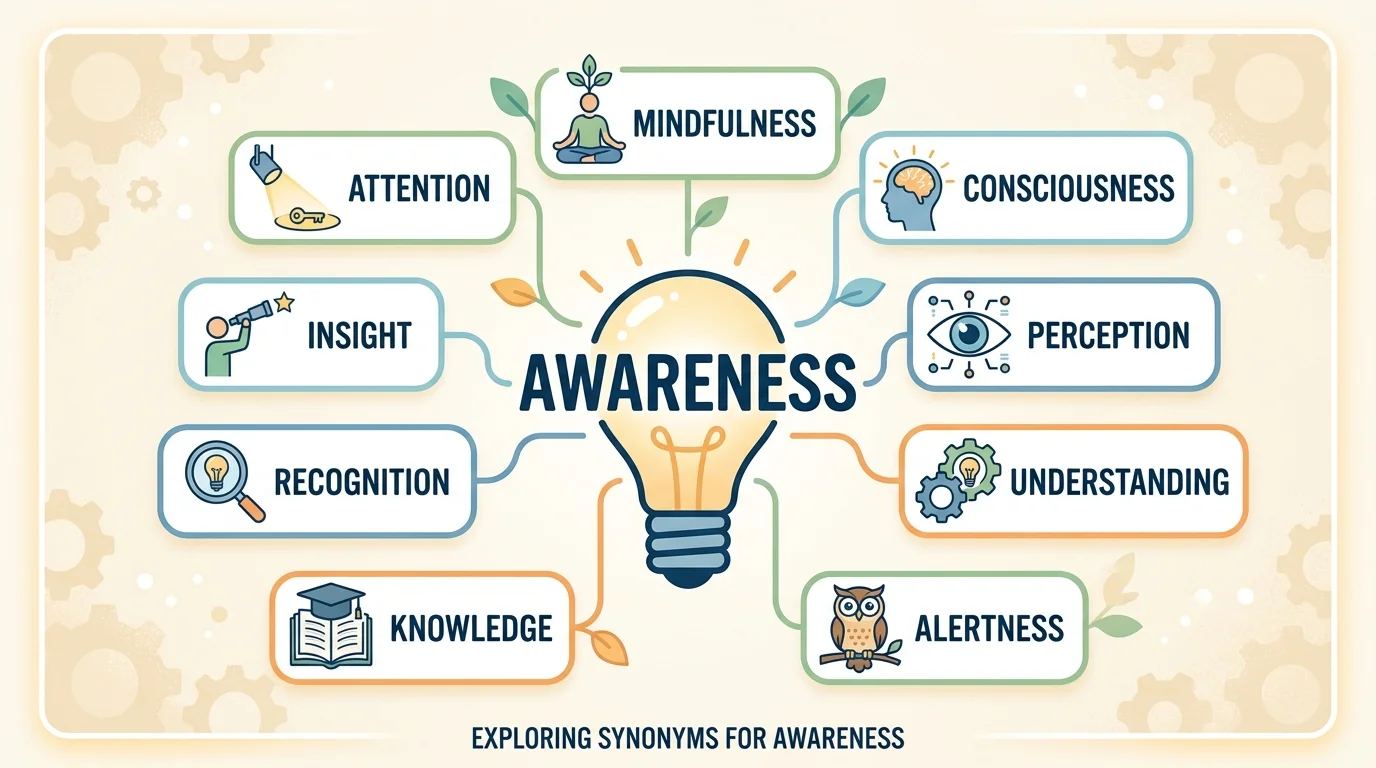
Sentence Transformations
1. Awareness of the problem
Original:
The team has awareness of the problem.
Better:
The team has knowledge of the problem.
Why: “Knowledge” is more natural when referring to what the team knows.
2. Awareness of the risks
Original:
Employees need greater awareness of workplace risks.
Alternative:
Employees need greater understanding of workplace risks.
Why: Use “understanding” if employees need to know what the risks mean and how they operate.
3. Raise awareness
Original:
The campaign seeks to raise awareness of road safety.
Alternative:
The campaign seeks to promote understanding of road safety.
Why: This suggests education rather than simply making people notice the issue.
4. Awareness of cultural differences
Original:
Cultural awareness is essential for the team.
Alternative:
Cultural sensitivity is essential for the team.
Why: “Sensitivity” emphasizes responding respectfully to cultural differences, not merely knowing they exist.
5. Awareness of one’s emotions
Original:
Awareness of your emotions can improve communication.
Alternative:
Self-awareness of your emotions can improve communication.
Why: The focus is specifically on recognizing one’s own internal state.
6. Awareness of a change
Original:
She became aware of the change.
Alternative:
She noticed the change.
Why: “Notice” is more natural for an immediate observation.
7. Awareness of the issue
Original:
There is growing awareness of the issue.
Alternative:
There is growing recognition of the issue.
Why: “Recognition” emphasizes acknowledgment of the issue as real or important.
8. Awareness of the subject
Original:
The students have some awareness of the subject.
Alternative:
The students have some familiarity with the subject.
Why: “Familiarity” suggests that they have encountered the subject before.
9. Awareness of the consequences
Original:
He lacked awareness of the consequences.
Alternative:
He lacked understanding of the consequences.
Why: “Understanding” is better if he failed to comprehend what the consequences would be.
10. Awareness of warning signs
Original:
Drivers need greater awareness of warning signs.
Alternative:
Drivers need greater alertness to warning signs.
Why: “Alertness” emphasizes active attention and readiness to respond.
Common Collocations With “Awareness”
These phrases are natural and widely useful:
Awareness of
- awareness of risks
- awareness of the problem
- awareness of the issue
- awareness of changes
- awareness of consequences
- awareness of one’s surroundings
- awareness of emotions
- awareness of cultural differences
Types of awareness
- public awareness
- social awareness
- environmental awareness
- cultural awareness
- political awareness
- self-awareness
- consumer awareness
- brand awareness
- health awareness
- safety awareness
- situational awareness
With verbs
- raise awareness
- increase awareness
- improve awareness
- develop awareness
- build awareness
- promote awareness
- create awareness
- demonstrate awareness
- show awareness
- lack awareness
- gain awareness
Common Mistakes
1. Assuming awareness means deep understanding
Someone can be aware of a subject without understanding it well.
I am aware of quantum physics.
This does not mean:
I understand quantum physics.
2. Using “knowledge” in every situation
Knowledge can imply information or facts, while awareness can mean simple recognition.
awareness of a growing problem
often sounds more natural than:
knowledge of a growing problem
when the focus is public recognition.
3. Confusing awareness with attention
You can be aware of something without actively focusing on it.
She was aware of the noise but continued working.
4. Using mindfulness as a general synonym
Mindfulness usually implies intentional present-moment attention.
It is narrower than awareness.
5. Using consciousness in casual writing
“Consciousness” can sound overly formal in ordinary sentences.
Instead of:
I have consciousness of the problem.
say:
I am aware of the problem.
6. Confusing recognition with realization
Recognition often means identifying or acknowledging something.
Realization usually describes coming to understand something.
recognition of the pattern
realization that the pattern mattered
7. Using familiarity to mean expertise
Familiarity only suggests some knowledge or experience.
familiarity with Excel
does not necessarily mean:
expertise in Excel
8. Treating “raise awareness” as interchangeable with “educate”
A campaign can raise awareness without providing detailed education.
Educate implies teaching or providing knowledge.
When Not to Replace “Awareness”
Sometimes awareness is the most accurate word.
Keep it when you mean a general state of knowing or recognizing something:
Public awareness of the issue is increasing.
Replacing it with consciousness may make the sentence unnecessarily formal.
Likewise:
She had an awareness of the risks.
does not necessarily mean she had detailed knowledge, deep understanding, or active vigilance.
Choose the alternative only when it adds the specific meaning you intend.
Which Synonym Should You Choose?
Use knowledge when:
You mean factual information.
Use understanding when:
You mean comprehension.
Use consciousness when:
You mean a conscious mental or social state, especially in formal writing.
Use recognition when:
You mean identifying or acknowledging something.
Use realization when:
You mean the moment of becoming aware.
Use perception when:
You mean the way something is noticed or interpreted.
Use familiarity when:
You mean some previous knowledge or experience.
Use attention when:
You mean actively focusing on something.
Use alertness when:
You mean readiness to notice and respond.
Use vigilance when:
You mean sustained attention to possible danger.
Use mindfulness when:
You mean deliberate awareness of present experience.
Use insight when:
You mean deep understanding.
Use appreciation when:
You mean understanding the value or importance of something.
Use acknowledgment when:
You mean openly recognizing that something exists or is true.
Use detection when:
You mean finding something previously unnoticed.
Use sensitivity when:
You mean awareness combined with appropriate responsiveness.
Editor’s Choice
These are not ranked as objectively “best.” Each fits a different meaning of awareness.
Knowledge — best for factual information.
Understanding — best for comprehension.
Recognition — best for acknowledgment or identification.
Insight — best for deep understanding.
Familiarity — best for prior exposure or experience.
Attentiveness — best for active attention.
Mindfulness — best for deliberate present-moment awareness.
Vigilance — best for continuous attention to risks or danger.
Consciousness — best for formal, philosophical, psychological, or social contexts.
Realization — best for the moment someone becomes aware of something.