
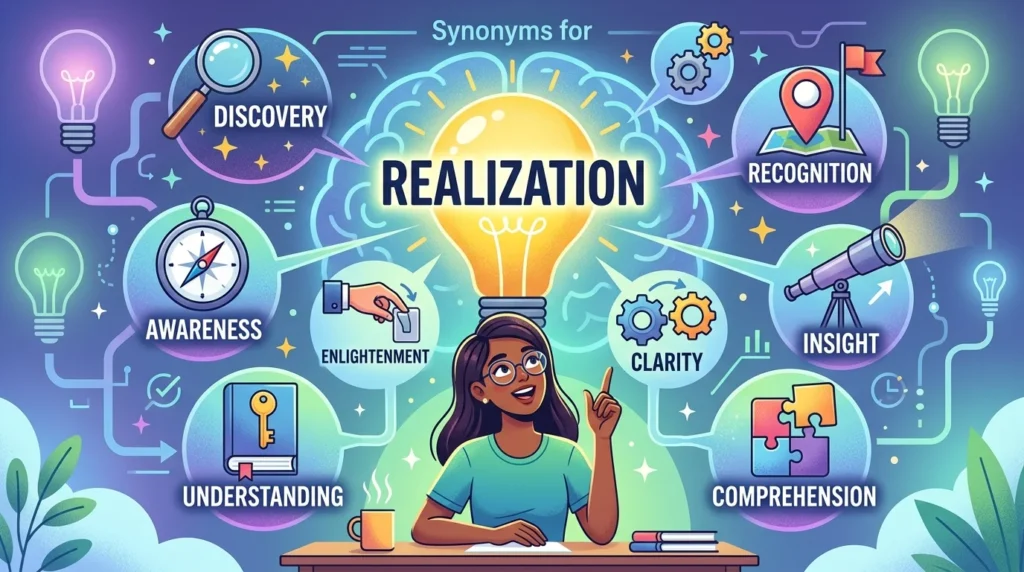
Quick Synonym List
Because realization has more than one meaning, the best alternative depends on the sentence.
Realization = becoming aware
- awareness
- recognition
- understanding
- insight
- comprehension
- discovery
- acknowledgment
- consciousness
- perception
- appreciation
- awareness of
- grasp
- knowledge
- apprehension
Realization = sudden understanding
- insight
- revelation
- discovery
- breakthrough
- epiphany
- awakening
- recognition
- understanding
- lightbulb moment
- moment of clarity
Realization = accepting a fact
- acknowledgment
- recognition
- acceptance
- awareness
- admission
- appreciation
- understanding
Realization = making something happen
- achievement
- fulfillment
- accomplishment
- attainment
- completion
- execution
- implementation
- actualization
- materialization
- fruition
Formal alternatives
- recognition
- acknowledgment
- awareness
- comprehension
- attainment
- fulfillment
- achievement
- actualization
- implementation
- materialization
Informal alternatives
- insight
- discovery
- breakthrough
- epiphany
- lightbulb moment
- moment of clarity
- wake-up call
Important: Realization is not interchangeable with all of these words. Awareness focuses on knowing, insight on deeper understanding, recognition on identifying or accepting something, and achievement/fulfillment on making a goal or idea real.
What Does “Realization” Mean?
Realization is a noun with two main meanings.
Meaning 1: Becoming aware or understanding something
I came to the realization that I had made a mistake.
Here, realization means a point of awareness, recognition, or understanding.
Meaning 2: Making something real or achieving it
The realization of the project required years of planning.
Here, realization means the achievement, fulfillment, implementation, or actualization of an idea or goal.
These meanings are related to the verb realize, but they should not be treated as the same sense.
Realization as Awareness or Understanding
This is the most common meaning in everyday English.
1. Awareness
Awareness is often the closest general alternative when realization means becoming conscious of a fact or situation.
The realization that the deadline was tomorrow surprised me.
The awareness that the deadline was tomorrow changed our plans.
The words overlap, but there is a subtle difference.
Realization often suggests a moment or process of becoming aware.
Awareness usually describes the state of knowing or being conscious of something.
Best for
- general writing
- professional communication
- personal reflection
- social issues
- gradual understanding
2. Recognition
Recognition means identifying, noticing, or accepting something as true, important, or familiar.
Her realization of the problem came too late.
Her recognition of the problem came too late.
Recognition works well when someone identifies or acknowledges a fact.
Common collocations
- recognition of the problem
- recognition of the need
- recognition of the importance
- recognition of the risks
- recognition of reality
3. Understanding
Understanding refers to knowledge of the meaning, nature, or significance of something.
His realization of what had happened was immediate.
His understanding of what had happened was immediate.
These are not always identical.
Realization often suggests the moment when something becomes clear.
Understanding focuses more on the knowledge itself.
4. Insight
Insight means a deeper understanding of something, especially something that was not previously obvious.
The experience led to a realization about her priorities.
The experience gave her insight into her priorities.
Insight is often a better choice when the realization involves depth, meaning, or a new perspective.
Example
He had a realization about why he kept making the same mistake.
He gained insight into why he kept making the same mistake.
The second emphasizes deeper understanding.
5. Comprehension
Comprehension means the ability to understand something.
The realization of the concept took time.
The comprehension of the concept took time.
The second sentence is possible but often less natural.
Comprehension works best when discussing someone’s ability to understand:
- a text
- a concept
- instructions
- information
- a subject
It is usually not the best replacement for a sudden personal realization.
6. Discovery
Discovery is finding or learning something previously unknown.
Her realization that the data was incorrect changed the report.
Her discovery that the data was incorrect changed the report.
Discovery emphasizes finding new information.
Realization emphasizes becoming aware or understanding something.
A discovery can lead to a realization, but they are not always the same event.
7. Acknowledgment
Acknowledgment means recognizing or accepting that something exists or is true.
His realization of the problem was important.
His acknowledgment of the problem was important.
Acknowledgment is particularly useful when someone openly accepts a fact, problem, responsibility, or contribution.
Common uses
- acknowledgment of responsibility
- acknowledgment of the problem
- acknowledgment of the risks
- acknowledgment of the facts
- acknowledgment of the need for change
8. Consciousness
Consciousness can refer to awareness or knowledge of something.
The realization of the environmental impact came later.
Consciousness of the environmental impact came later.
This sounds more abstract and formal.
It is often useful in philosophical, psychological, cultural, or academic writing.
9. Perception
Perception refers to the way someone notices, understands, or interprets something.
The realization of the problem changed her behavior.
Her perception of the problem changed her behavior.
These are not exact synonyms.
Realization suggests becoming aware of something.
Perception concerns how something is understood or viewed.
10. Appreciation
Appreciation can mean recognition of the value, importance, or meaning of something.
His realization of the team’s contribution came later.
His appreciation of the team’s contribution came later.
Use appreciation when the new understanding involves recognizing value or significance.

Realization as a Sudden Moment of Understanding
Sometimes realization describes a sudden mental event.
I had a realization while driving home.
In this sense, useful alternatives include:
- insight
- revelation
- discovery
- epiphany
- breakthrough
- moment of clarity
- lightbulb moment
- awakening
11. Revelation
A revelation is something that becomes newly known or understood, often something surprising.
The realization was shocking.
The revelation was shocking.
Revelation can suggest that previously hidden information has become known.
It often has a stronger or more dramatic tone than realization.
12. Epiphany
An epiphany is a sudden moment of clarity or deep understanding.
She had a realization about what she wanted to do.
She had an epiphany about what she wanted to do.
Epiphany is especially appropriate when the realization feels sudden, powerful, or personally significant.
It can sound more dramatic than ordinary realization.
13. Breakthrough
A breakthrough is an important advance in understanding, solving a problem, or achieving something.
The realization helped the researchers solve the problem.
The discovery represented a breakthrough.
A breakthrough is not simply any realization. It normally implies meaningful progress.
Best for
- science
- research
- technology
- problem-solving
- personal progress
- business
14. Moment of Clarity
Moment of clarity is a phrase describing a point when something suddenly becomes clear.
I had a realization about what I needed to change.
I had a moment of clarity about what I needed to change.
This is natural in personal, reflective, and conversational writing.
15. Lightbulb Moment
Lightbulb moment is an informal expression for a sudden understanding or idea.
I had a realization while reading the article.
I had a lightbulb moment while reading the article.
It is conversational and should generally be avoided in highly formal writing.
16. Awakening
Awakening can describe a new awareness or understanding, particularly one involving beliefs, identity, values, or a broader perspective.
The experience led to a realization about social inequality.
The experience led to an awakening about social inequality.
Awakening has a more emotional, philosophical, or transformational tone.
Realization as Acceptance of a Fact
Sometimes realization means not merely understanding something but finally accepting its truth.
Useful alternatives include:
- acknowledgment
- recognition
- acceptance
- admission
- awareness
- understanding
Acceptance
Acceptance means acknowledging something as true, real, or unavoidable.
The realization that the project had failed was difficult.
The acceptance that the project had failed was difficult.
Acceptance goes beyond awareness. It suggests coming to terms with reality.
Admission
Admission means acknowledging something, especially something uncomfortable, embarrassing, or previously denied.
His realization that he was wrong changed his attitude.
His admission that he was wrong changed his attitude.
These are different:
- realization → he understood that he was wrong
- admission → he openly acknowledged that he was wrong
Realization as Achievement or Fulfillment
The second major meaning of realization is quite different.
The realization of the company’s vision took many years.
Here, realization means bringing an idea, goal, plan, or vision into reality.
Useful alternatives include:
- achievement
- fulfillment
- accomplishment
- attainment
- actualization
- implementation
- execution
- materialization
- completion
- fruition
17. Achievement
Achievement means successfully reaching a goal or producing a desired result.
The realization of the company’s vision was impressive.
The achievement of the company’s vision was impressive.
Achievement is often the most natural alternative when the emphasis is on successfully reaching a goal.
18. Fulfillment
Fulfillment means the completion or satisfaction of a goal, promise, ambition, or purpose.
The realization of her dream took years.
The fulfillment of her dream took years.
This is especially natural with:
- fulfillment of a dream
- fulfillment of a goal
- fulfillment of an ambition
- fulfillment of a promise
- personal fulfillment
19. Accomplishment
Accomplishment refers to something successfully completed or achieved.
The realization of the project was a major accomplishment.
Here, accomplishment emphasizes the successful result rather than the process of making an idea real.
20. Attainment
Attainment means successfully reaching a goal, level, or standard.
The realization of the objective required significant effort.
The attainment of the objective required significant effort.
Attainment is formal and common in academic, professional, and institutional writing.
Common collocations
- attainment of goals
- attainment of objectives
- educational attainment
- attainment of standards
21. Actualization
Actualization means making a possibility, idea, potential, or goal real.
The realization of his vision required substantial investment.
The actualization of his vision required substantial investment.
This is a close formal alternative in contexts involving ideas, potential, plans, or visions becoming real.
It is less common in ordinary conversation.
22. Implementation
Implementation means putting a plan, policy, system, or idea into practice.
The realization of the plan began in January.
The implementation of the plan began in January.
Implementation is more specific than realization.
Use it when the focus is on putting something into operation.
Common contexts
- implementation of a policy
- implementation of a strategy
- implementation of a plan
- implementation of a system
- implementation of reforms
23. Execution
Execution means carrying out a plan, task, design, or strategy.
The realization of the strategy depended on careful planning.
The execution of the strategy depended on careful planning.
Execution focuses on how a plan is carried out, not simply on whether an idea becomes real.
24. Materialization
Materialization means something anticipated, imagined, or expected becoming real or actually occurring.
The expected benefits never came to realization.
The expected benefits never materialized.
This is especially useful when an expected result does or does not actually occur.
25. Fruition
Fruition means the point at which a plan, effort, or idea produces its intended result.
Years of planning led to the realization of the project.
Years of planning eventually brought the project to fruition.
The phrase come to fruition is particularly common.
Comparison: Realization vs. Awareness
| Word | Main focus | Typical meaning |
|---|---|---|
| Realization | becoming aware | A fact suddenly becomes clear |
| Awareness | state of knowing | Being conscious of something |
| Recognition | identifying/accepting | Seeing something as true or important |
| Insight | deeper understanding | Seeing a deeper meaning |
| Understanding | knowledge | Knowing how or why something works |
| Discovery | finding something | Learning something previously unknown |
| Acknowledgment | accepting openly | Admitting or recognizing a fact |
Example
I had a realization that I needed to change.
This emphasizes the moment of becoming aware.
I became aware that I needed to change.
This emphasizes the state of knowing.
I gained insight into why I needed to change.
This emphasizes deeper understanding.
I recognized that I needed to change.
This emphasizes identifying or accepting the truth.
Comparison: Realization vs. Epiphany
These words overlap, but epiphany is more specific.
Realization can describe any point of becoming aware.
Epiphany usually suggests a sudden and significant insight.
I had a realization that I had forgotten my keys.
This is ordinary and natural.
I had an epiphany that I had forgotten my keys.
This sounds humorous or exaggerated because epiphany is usually associated with a more meaningful insight.
Comparison: Realization vs. Revelation
Revelation often involves something previously hidden or unknown becoming known.
The realization that he had misunderstood the instructions surprised him.
The revelation that the records were incomplete surprised him.
The first concerns personal understanding.
The second can suggest newly uncovered information.
Comparison: Realization vs. Recognition
Recognition often involves identifying or acknowledging something.
Her realization of the risks came too late.
Her recognition of the risks came too late.
Both work.
But:
He came to the realization that he was wrong.
sounds more personal and reflective.
He came to the recognition that he was wrong.
is grammatical but more formal and less natural.
Comparison: Realization vs. Fulfillment
These belong to different senses.
The realization of her dream was a major achievement.
Here, realization means making the dream real.
The fulfillment of her dream was a major achievement.
Fulfillment emphasizes satisfying or completing the dream.
For personal ambitions, fulfillment of a dream is often especially natural.

Comparison Table
| Alternative | Meaning | Tone | Best Use | Direct replacement? |
|---|---|---|---|---|
| Awareness | conscious knowledge | Neutral | General awareness | Often |
| Recognition | identifying or accepting | Neutral/formal | Facts/problems | Often |
| Understanding | knowledge of meaning | Neutral | Concepts/situations | Sometimes |
| Insight | deeper understanding | Neutral/formal | Personal/analytical | Sometimes |
| Comprehension | ability to understand | Formal | Information/concepts | Rarely |
| Discovery | finding something new | Neutral | New information | Sometimes |
| Acknowledgment | openly recognizing | Formal | Facts/responsibility | Sometimes |
| Revelation | surprising new knowledge | Strong | Hidden/new information | Sometimes |
| Epiphany | sudden deep insight | Neutral/informal | Personal insight | Only for strong realizations |
| Breakthrough | major advance | Neutral/formal | Research/problem-solving | Only in significant cases |
| Acceptance | coming to terms with truth | Neutral | Difficult facts | Sometimes |
| Achievement | successful result | Neutral | Goals/projects | Only in achievement sense |
| Fulfillment | completion/satisfaction | Neutral/formal | Dreams/goals | In achievement sense |
| Accomplishment | something successfully completed | Neutral | Goals/tasks | In achievement sense |
| Attainment | reaching a goal/standard | Formal | Academic/professional | In achievement sense |
| Actualization | making an idea real | Formal | Potential/visions | In achievement sense |
| Implementation | putting a plan into practice | Formal | Policies/plans | Context-dependent |
| Execution | carrying out a plan | Formal | Strategies/tasks | Context-dependent |
| Materialization | becoming real | Formal | Expected results | Context-dependent |
| Fruition | reaching intended result | Formal/literary | Plans/efforts | Context-dependent |
Formal Alternatives to “Realization”
For formal or professional writing, consider:
- awareness
- recognition
- acknowledgment
- comprehension
- insight
- attainment
- fulfillment
- actualization
- implementation
- materialization
- fruition
But do not choose the most formal-looking word automatically.
For example:
The realization that the figures were incorrect prompted an investigation.
is often clearer than:
The acknowledgment of the fact that the figures were incorrect prompted an investigation.
The simpler version may be more direct.
Academic Alternatives to “Realization”
Academic writing often benefits from specifying what kind of realization occurred.
Awareness
The study increased students’ awareness of the issue.
Recognition
The findings led to recognition of the problem.
Insight
The results provided new insight into the underlying mechanism.
Understanding
The research contributed to a better understanding of the process.
Achievement
The realization of the research objective required several stages.
Implementation
The implementation of the proposed framework occurred in three phases.
Specific nouns are often more precise than repeatedly using realization.
Professional Alternatives to “Realization”
If someone became aware of a problem
Use recognition or awareness.
The realization of the problem came late.
→ Recognition of the problem came late.
If a plan was put into practice
Use implementation.
The realization of the strategy began in June.
→ Implementation of the strategy began in June.
If a goal was successfully reached
Use achievement or attainment.
The realization of the objective was significant.
→ The achievement of the objective was significant.
If an idea became real
Use actualization or materialization.
The realization of the vision required new resources.
→ The actualization of the vision required new resources.
Informal Alternatives to “Realization”
In conversation, people often use phrases instead of formal nouns.
“It hit me”
It hit me that I had forgotten the appointment.
This is strongly conversational.
“I suddenly understood”
I suddenly understood why she had left.
This is clearer than forcing a synonym.
“A lightbulb moment”
I had a lightbulb moment while working on the problem.
This is casual and expressive.
“Moment of clarity”
I had a moment of clarity and finally understood the problem.
This is natural in personal or reflective writing.
“Wake-up call”
The experience was a wake-up call.
This suggests a realization that changes someone’s behavior or perspective, often because the situation is serious.
Sentence Transformations
1. General awareness
Original:
I came to the realization that I needed more experience.
Better Alternative:
I became aware that I needed more experience.
Why: Awareness is a natural alternative when the focus is simply becoming conscious of a fact.
2. Deeper understanding
Original:
The experience led to a realization about her priorities.
Better Alternative:
The experience gave her insight into her priorities.
Why: Insight emphasizes deeper understanding rather than simple awareness.
3. Acceptance
Original:
He eventually came to the realization that the plan had failed.
Better Alternative:
He eventually accepted that the plan had failed.
Why: Accepted emphasizes coming to terms with an unpleasant fact.
4. Formal acknowledgment
Original:
The realization of the risks changed the company’s strategy.
Better Alternative:
Recognition of the risks changed the company’s strategy.
Why: Recognition works well in formal or professional writing when the issue is identifying and acknowledging risks.
5. Sudden insight
Original:
She had a realization while reading the report.
Better Alternative:
She had an insight while reading the report.
Why: Insight suggests that she understood something meaningful or previously unclear.
6. Informal conversation
Original:
I had a sudden realization that I had left my phone at home.
Better Alternative:
It suddenly hit me that I had left my phone at home.
Why: It hit me is much more conversational and natural in casual speech.
7. Achievement
Original:
The realization of the company’s long-term goal took years.
Better Alternative:
The achievement of the company’s long-term goal took years.
Why: Achievement emphasizes successfully reaching the goal.
8. Implementation
Original:
The realization of the new policy began in January.
Better Alternative:
The implementation of the new policy began in January.
Why: Implementation specifically means putting a policy into practice.
9. Fulfillment
Original:
The realization of her dream brought her great satisfaction.
Better Alternative:
The fulfillment of her dream brought her great satisfaction.
Why: Fulfillment naturally describes a dream or ambition becoming fulfilled.
10. Unexpected result
Original:
The expected benefits never came to realization.
Better Alternative:
The expected benefits never materialized.
Why: Materialized is concise and natural when an expected result fails to appear.
Common Collocations With “Realization”
Realization + that-clause
- realization that something happened
- realization that something was wrong
- realization that something was true
- realization that something had changed
- realization that something was impossible
She came to the realization that she needed help.
Realization of + noun
- realization of a dream
- realization of a goal
- realization of a vision
- realization of the problem
- realization of the risks
- realization of the importance
- realization of potential
- realization of an ambition
- realization of a plan
Common verbs
- come to a realization
- have a realization
- reach a realization
- experience a realization
- lead to a realization
- bring about a realization
- prompt a realization
- trigger a realization
- cause a realization
Common Mistakes
1. Treating “realization” as always meaning “awareness”
It has another important meaning: making something real or achieving it.
The realization of her dream
Here, it means fulfillment or achievement, not awareness.
2. Using “epiphany” for every realization
An epiphany suggests a sudden and often significant insight.
A small discovery does not necessarily deserve that word.
3. Confusing realization with discovery
A discovery involves finding something previously unknown.
A realization involves understanding or becoming aware of something.
4. Confusing realization with acknowledgment
Acknowledgment usually involves openly recognizing something.
A realization can happen privately without being communicated to anyone.
5. Using “implementation” for every achievement
Implementation means putting something into practice. It does not simply mean successfully achieving a goal.
6. Using “achievement” for mental awareness
I had an achievement that I was wrong.
This is incorrect.
Use:
I had a realization that I was wrong.
or:
I realized that I was wrong.
7. Overusing “realization of”
Sometimes a direct verb is clearer.
She came to the realization that the plan would fail.
can often become:
She realized that the plan would fail.
The shorter version is usually more direct.
When Not to Replace “Realization”
Realization is often the best word when you want to emphasize a moment of becoming aware.
I had a realization that changed my perspective.
The realization came suddenly.
He came to the realization that he had been mistaken.
It is also useful when the exact nature of the mental change is intentionally broad.
Replacing it with awareness may make the event sound more gradual.
Replacing it with insight may suggest deeper understanding than intended.
Replacing it with epiphany may make an ordinary realization sound dramatic.
Replacing it with discovery may imply that new information was found.
The original word is sometimes more precise because it leaves the exact nature of the mental shift open.
Which Synonym Should You Choose?
If you mean becoming aware
Use awareness.
If you mean identifying or accepting a fact
Use recognition.
If you mean deeper understanding
Use insight.
If you mean understanding information
Use understanding or comprehension.
If you mean finding something new
Use discovery.
If you mean openly recognizing something
Use acknowledgment.
If you mean a sudden, powerful insight
Use epiphany.
If you mean newly revealed information
Use revelation.
If you mean a major advance
Use breakthrough.
If you mean accepting a difficult reality
Use acceptance.
If you mean successfully reaching a goal
Use achievement or attainment.
If you mean fulfilling a dream
Use fulfillment.
If you mean putting a plan into practice
Use implementation.
If you mean carrying out a strategy
Use execution.
If you mean an idea becoming real
Use actualization or materialization.
If you mean an effort reaching its intended result
Use fruition.
Editor’s Choice: Useful Alternatives
These are not ranked by quality. Each fits a different meaning:
- Awareness — general consciousness of a fact
- Recognition — identifying or accepting something
- Insight — deeper understanding
- Discovery — finding or learning something new
- Acknowledgment — openly recognizing a fact
- Epiphany — sudden, significant insight
- Achievement — successfully reaching a goal
- Fulfillment — making a dream or ambition complete
The strongest choice depends on what kind of realization you mean, not simply on how formal the replacement sounds.