
Quick Answer
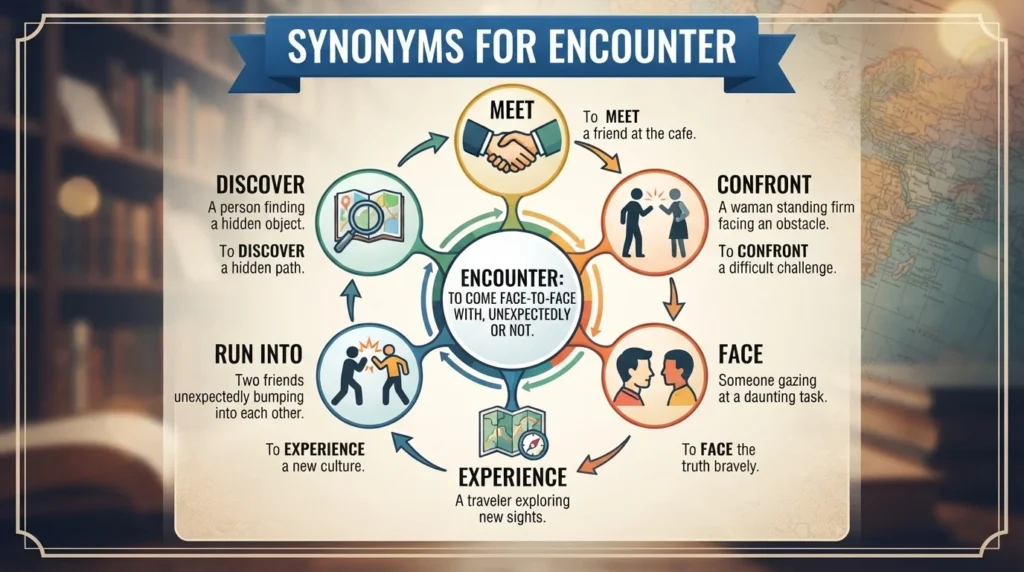
Common synonyms for encounter include meet, come across, run into, experience, face, confront, undergo, discover, find, deal with, experience, cross paths with, come upon, and stumble upon. For a difficult situation, face, confront, or deal with may work best. For meeting someone unexpectedly, use run into, come across, or cross paths with.
Quick Synonym Reference
| Alternative | Best meaning | Register | Direct replacement? |
|---|---|---|---|
| meet | meet a person | Neutral | Sometimes |
| come across | find or meet unexpectedly | Neutral | Often |
| run into | meet unexpectedly | Informal | Sometimes |
| cross paths with | happen to meet | Neutral | Sometimes |
| come upon | discover unexpectedly | Literary/neutral | Sometimes |
| stumble upon | discover by chance | Neutral | Sometimes |
| experience | go through an event or situation | Neutral | Often |
| face | deal with a difficult situation | Neutral | Often |
| confront | face something difficult directly | Strong/formal | Sometimes |
| undergo | experience a process or event | Formal | Sometimes |
| deal with | handle a problem or situation | Neutral | Often |
| discover | find something unexpectedly | Neutral | Sometimes |
| find | come across or discover | Neutral | Often |
| meet with | experience or have a meeting | Formal/neutral | Context-dependent |
| happen upon | find unexpectedly | Formal/literary | Sometimes |
| run up against | face an obstacle | Informal | No |
| come up against | face resistance/problem | Neutral | No |
| be faced with | have to deal with something | Neutral/formal | No |
| encounter opposition | face resistance | Neutral | — |
| encounter difficulties | experience problems | Formal/neutral | — |
| interaction | meeting/contact between people | Neutral | Noun only |
| meeting | coming together | Neutral | Noun only |
| confrontation | direct conflict | Strong | Noun only |
| experience | an event one goes through | Neutral | Noun only |
What Does “Encounter” Mean?
Encounter has both verb and noun forms.
As a verb
To encounter means to meet, find, experience, or face someone or something, often unexpectedly.
We encountered several problems during the project.
Here, encountered means experienced or faced.
She encountered an old friend at the airport.
Here, it means met unexpectedly.
The researchers encountered a rare species.
Here, it means came across or found.
As a noun
An encounter is a meeting or experience, especially one that is unexpected, unusual, difficult, or significant.
I had an unexpected encounter with an old colleague.
The hikers described their encounter with a bear.
The noun can also describe a direct confrontation:
The two teams had their first encounter of the season.
1. Synonyms for Encounter Meaning “Meet Someone”
When encounter means meeting a person, especially unexpectedly, these alternatives are useful.
Meet
Meet is the simplest and most general alternative.
I encountered Sarah at the conference.
I met Sarah at the conference.
Unlike encounter, meet does not necessarily suggest that the meeting was unexpected.
Come across
Come across means to find or meet someone or something unexpectedly.
I encountered an old friend downtown.
I came across an old friend downtown.
This is natural in everyday English.
Run into
Run into is an informal expression meaning to meet someone unexpectedly.
I encountered my former teacher at the mall.
I ran into my former teacher at the mall.
Use run into in conversation and casual writing, not in formal reports when a more neutral expression is preferable.
Cross paths with
Cross paths with emphasizes that two people happened to meet.
We encountered each other several times during the trip.
We crossed paths several times during the trip.
It can sound slightly more expressive or literary than meet.
Meet with
Meet with usually means to have a planned meeting, although context can give it other meanings.
The director encountered the committee yesterday.
The director met with the committee yesterday.
Be careful: meet with often implies an arranged or purposeful meeting, so it is not always a synonym for an unexpected encounter.
2. Synonyms for Encounter Meaning “Experience”
Sometimes encounter means to experience something.
Experience
Experience is one of the closest alternatives when something happens to you.
The company encountered significant delays.
The company experienced significant delays.
It is especially useful in professional and academic writing.
Undergo
Undergo means to experience something, usually a process, treatment, change, or difficult situation.
The patient encountered several complications.
The patient underwent several complications.
The second sentence is not natural because undergo normally describes a process or treatment, not every kind of problem.
A better example is:
The patient underwent surgery.
So undergo is related to encounter, but it is not a universal replacement.
Go through
Go through means to experience a process, period, or difficult situation.
She encountered a difficult period after losing her job.
She went through a difficult period after losing her job.
This is common and natural, especially in conversational English.
Live through
Live through means experience and survive a difficult or important event.
They encountered a devastating war.
They lived through a devastating war.
It emphasizes personal survival or endurance.
3. Synonyms for Encounter Meaning “Face a Problem”
This is one of the most important uses of encounter.
Face
Face means to have to deal with a problem, challenge, or difficult situation.
We encountered several technical problems.
We faced several technical problems.
Face is direct, natural, and widely useful.
Confront
Confront means to face something directly, often with a sense of challenge or conflict.
The organization encountered a serious ethical dilemma.
The organization confronted a serious ethical dilemma.
Confront is stronger than encounter because it can suggest actively dealing with something rather than simply coming across it.
Deal with
Deal with focuses on handling a problem.
The team encountered several customer complaints.
The team had to deal with several customer complaints.
This changes the meaning slightly: encounter describes what happened; deal with emphasizes the response.
Come up against
Come up against means to face resistance, difficulty, or an obstacle.
The project encountered strong opposition.
The project came up against strong opposition.
This is natural in both professional and general writing, although slightly more conversational.
Run up against
Run up against has a similar meaning but is more informal.
We encountered a serious budget constraint.
We ran up against a serious budget constraint.
4. Synonyms for Encounter Meaning “Discover or Find”
When you encounter something unexpectedly, discover, find, or come across may be better.
Discover
Discover emphasizes finding something previously unknown or unnoticed.
Researchers encountered an unusual pattern.
Researchers discovered an unusual pattern.
Discover often suggests that the finding is significant.
Find
Find is the simplest everyday alternative.
We encountered a problem in the system.
We found a problem in the system.
It is usually more direct and less formal.
Come upon
Come upon means discover or find unexpectedly.
They encountered a beautiful hidden valley.
They came upon a beautiful hidden valley.
It can sound somewhat literary.
Stumble upon
Stumble upon emphasizes accidental discovery.
She encountered an interesting article while browsing.
She stumbled upon an interesting article while browsing.
It is especially useful when the discovery was completely unplanned.
Happen upon
Happen upon also means discover unexpectedly.
We encountered an old photograph in the archive.
We happened upon an old photograph in the archive.
This is less common in everyday speech than come across.
5. Synonyms for Encounter Meaning “Face an Opponent”
Encounter can describe meeting an opponent, competitor, enemy, or opposing force.
Face
The team encountered a strong opponent.
The team faced a strong opponent.
Confront
The soldiers encountered enemy forces.
The soldiers confronted enemy forces.
Confront suggests direct opposition or conflict.
Meet
The team will encounter its biggest rival next week.
The team will meet its biggest rival next week.
In sports, meet is especially natural.
Take on
Take on means compete against or accept a challenge from someone.
The champion encountered a new challenger.
The champion took on a new challenger.
This is more informal and often emphasizes competition.
Compete against
When the context is explicitly competitive:
The company encountered several major competitors.
The company competed against several major competitors.
The meaning changes slightly because compete against describes an ongoing competitive relationship rather than simply an encounter.

6. Synonyms for Encounter as a Noun
When encounter is a noun, the best alternative depends heavily on what happened.
Meeting
Use meeting when two or more people come together.
Their first encounter was brief.
Their first meeting was brief.
Interaction
Interaction focuses on communication or activity between people or groups.
The encounter between the customer and employee lasted five minutes.
The interaction between the customer and employee lasted five minutes.
Experience
Use experience when the encounter is being described as something someone went through.
It was an unsettling encounter.
It was an unsettling experience.
Confrontation
Use confrontation when there is conflict or direct opposition.
The encounter between the two groups became hostile.
The confrontation between the two groups became hostile.
Confrontation is much stronger than encounter.
Meeting by chance
For an unexpected meeting, you can use:
- chance meeting
- accidental meeting
- unexpected meeting
- chance encounter
- unexpected encounter
We had a chance encounter at the airport.
Encounter vs. Its Closest Alternatives
Encounter vs. Meet
Meet is broader and more neutral.
- meet = come together with someone
- encounter = meet or come across, often unexpectedly
I met John at the office.
This does not tell us whether the meeting was unexpected.
I encountered John at the airport.
This often suggests that seeing John there was unexpected.
Encounter vs. Experience
Encounter can mean experience, but the two words emphasize different things.
- encounter = come across something
- experience = go through something
We encountered several difficulties.
We experienced several difficulties.
Both work, but experience focuses more directly on what happened to the people involved.
Encounter vs. Face
- encounter = come across
- face = have to deal with
The company encountered financial difficulties.
The company faced financial difficulties.
The second version can suggest that the company had to respond to those difficulties.
Encounter vs. Confront
- encounter = come into contact with
- confront = face directly, often forcefully
The researchers encountered resistance.
The researchers confronted resistance.
The second sentence can suggest a more active response.
Encounter vs. Come Across
These are often close when encounter means unexpectedly finding something.
I encountered an interesting article.
I came across an interesting article.
Come across is more conversational. Encounter can sound more formal or neutral.
Comparison Table
| Word/Phrase | Main meaning | Tone | Strength | Best use | Interchangeable? |
|---|---|---|---|---|---|
| encounter | meet, find, or experience | Neutral/formal | Moderate | Broad contexts | — |
| meet | come together | Neutral | Low | People | Often |
| come across | find unexpectedly | Neutral | Moderate | People/things | Often |
| run into | meet unexpectedly | Informal | Moderate | Conversation | Sometimes |
| cross paths with | happen to meet | Neutral | Moderate | People | Sometimes |
| experience | go through | Neutral | Moderate | Events/problems | Often |
| face | deal with | Neutral | Moderate | Problems/challenges | Often |
| confront | face directly | Strong/formal | High | Conflict/problems | Sometimes |
| discover | find something new | Neutral | Moderate | Findings | Sometimes |
| stumble upon | discover accidentally | Neutral | Moderate | Unexpected discoveries | Sometimes |
| deal with | handle | Neutral | Moderate | Problems | No |
| undergo | experience a process | Formal | Moderate | Treatment/processes | Limited |
| run up against | face difficulty | Informal | Moderate | Obstacles | No |
| come up against | face resistance | Neutral | Moderate | Obstacles/opposition | No |
| interaction | contact between people | Neutral | — | Noun | Limited |
| confrontation | direct conflict | Strong | High | Conflict | Limited |
Synonyms by Context
In Everyday Conversation
Use:
- meet
- come across
- run into
- bump into
- cross paths with
- find
- stumble upon
Example:
I ran into an old friend at the grocery store.
This sounds more natural in casual speech than:
I encountered an old friend at the grocery store.
In Professional Writing
Use:
- encounter
- face
- experience
- deal with
- come up against
- encounter difficulties
- encounter challenges
- encounter obstacles
Example:
The project encountered several unexpected delays.
Or:
The project faced several unexpected delays.
In Academic Writing
Useful alternatives include:
- encounter
- experience
- observe
- observe unexpectedly
- discover
- identify
- come across
- face
- confront
Example:
Researchers encountered several limitations during the study.
Researchers identified several limitations during the study.
The second version is better if the emphasis is on recognizing the limitations rather than simply experiencing them.
In Business Writing
Common choices include:
- face
- encounter
- experience
- deal with
- confront
- come up against
- encounter challenges
- encounter resistance
- encounter difficulties
The company encountered supply-chain disruptions.
The company faced supply-chain disruptions.
Both are natural.
In Travel and Storytelling
Use:
- come across
- stumble upon
- come upon
- happen upon
- meet
- run into
- discover
- encounter
We encountered a small village deep in the mountains.
We stumbled upon a small village deep in the mountains.
The second version highlights the accidental nature of the discovery.
10 Sentence Transformations
1. Unexpected meeting
Original:
I encountered an old friend downtown.
Alternative:
I ran into an old friend downtown.
Why: Ran into sounds more natural in casual conversation.
2. Professional problem
Original:
The company encountered financial difficulties.
Alternative:
The company faced financial difficulties.
Why: Faced emphasizes the challenge the company had to deal with.
3. Unexpected discovery
Original:
We encountered an unusual object in the cave.
Alternative:
We came across an unusual object in the cave.
Why: Came across emphasizes finding something unexpectedly.
4. Research
Original:
The scientists encountered an unexpected result.
Alternative:
The scientists discovered an unexpected result.
Why: Discovered emphasizes the finding.
5. Conflict
Original:
The group encountered strong opposition.
Alternative:
The group confronted strong opposition.
Why: Confronted suggests directly dealing with the opposition.
6. Difficulty
Original:
The engineers encountered several technical problems.
Alternative:
The engineers experienced several technical problems.
Why: Experienced focuses on what happened to the engineers.
7. Casual meeting
Original:
We encountered each other at the station.
Alternative:
We crossed paths at the station.
Why: Crossed paths naturally describes an accidental meeting.
8. Accidental discovery
Original:
She encountered the old letter while cleaning.
Alternative:
She stumbled upon the old letter while cleaning.
Why: Stumbled upon strongly emphasizes accidental discovery.
9. Obstacle
Original:
The project encountered several obstacles.
Alternative:
The project came up against several obstacles.
Why: Came up against highlights resistance or difficulty.
10. Formal report
Original:
The team encountered unexpected delays.
Alternative:
The team experienced unexpected delays.
Why: Experienced is clear and professional when describing what happened.
Common Collocations with “Encounter”
Some combinations with encounter are especially natural.
Problems and difficulties
- encounter problems
- encounter difficulties
- encounter challenges
- encounter obstacles
- encounter complications
- encounter delays
- encounter setbacks
- encounter limitations
- encounter resistance
- encounter opposition
People and groups
- encounter a stranger
- encounter a friend
- encounter an opponent
- encounter a competitor
- encounter a rival
- encounter another group
Unexpected things
- encounter an unexpected situation
- encounter an unusual problem
- encounter an unfamiliar environment
- encounter a rare species
- encounter an unexpected result
Common noun phrases
- chance encounter
- unexpected encounter
- chance meeting
- face-to-face encounter
- personal encounter
- close encounter
- brief encounter
- memorable encounter
- hostile encounter
- difficult encounter
Common Mistakes
1. Treating every synonym as interchangeable
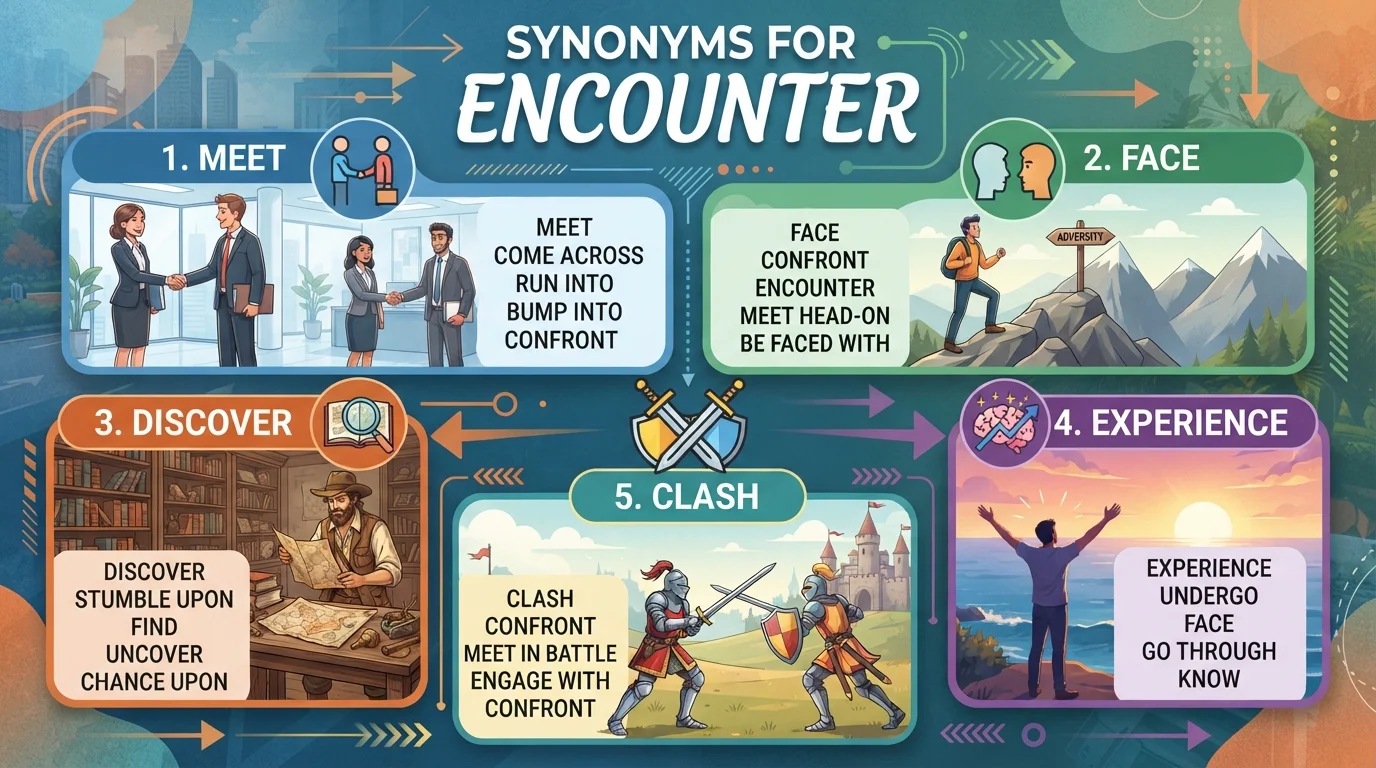
Encounter, meet, experience, and face overlap, but they do not always mean exactly the same thing.
2. Using “confront” for every encounter
Confront implies directly facing something, often a problem or conflict. It is stronger than encounter.
3. Using “undergo” for every experience
You can undergo surgery, treatment, training, or a transformation, but you would not normally say:
I underwent an old friend.
4. Assuming “encounter” always means a person
You can encounter:
- people
- problems
- challenges
- obstacles
- animals
- situations
- discoveries
- resistance
- opportunities
5. Confusing “encounter” with “confrontation”
An encounter may be peaceful or neutral. A confrontation normally involves conflict or opposition.
6. Using “run into” in highly formal writing
Run into is perfectly natural conversational English, but encounter, experience, or face may fit a formal report better.
7. Using “discover” when nothing was previously unknown
Discover often suggests finding something new or previously unnoticed. It may not fit every use of encounter.
8. Forgetting the accidental meaning
When an encounter is unexpected, expressions such as come across, run into, stumble upon, and cross paths with can communicate that nuance more clearly.
When “Encounter” Is Better Than a Synonym
Sometimes encounter is the most efficient word because it stays neutral.
Use encounter when you want to avoid specifying exactly how something happened.
The researchers encountered an unusual phenomenon.
This does not necessarily say whether they discovered it accidentally, actively searched for it, or had to deal with it.
Similarly:
We encountered several difficulties.
This is concise and professional. Replacing it with faced, experienced, or dealt with may add a specific nuance that you do not need.
Good writing is not about replacing a word simply because you have found a synonym. Replace encounter only when another word communicates your intended meaning more precisely.
A Simple Decision Guide
| If you mean… | Choose… |
|---|---|
| Meet someone generally | meet |
| Meet someone unexpectedly | run into / come across |
| Happen to meet someone | cross paths with |
| Find something unexpectedly | come across / stumble upon |
| Discover something new | discover |
| Experience an event | experience |
| Go through a difficult period | go through |
| Face a problem | face |
| Directly face a difficult issue | confront |
| Handle a problem | deal with |
| Face resistance | come up against |
| Experience a formal process | undergo |
| Meet an opponent | face / meet |
| Describe a neutral meeting | encounter |
| Describe a conflict | confrontation |
| Describe contact between people | interaction |
Editor’s Choice: The Most Useful Alternatives
If you want the most practical alternatives rather than a long thesaurus list, start with these:
- Meet — best for a person or general meeting.
- Come across — excellent for unexpected people or discoveries.
- Experience — best for events, problems, and situations.
- Face — best for difficulties and challenges.
- Confront — best when direct opposition or action is involved.
The key is to choose based on what actually happened, not simply on which word sounds more sophisticated.