
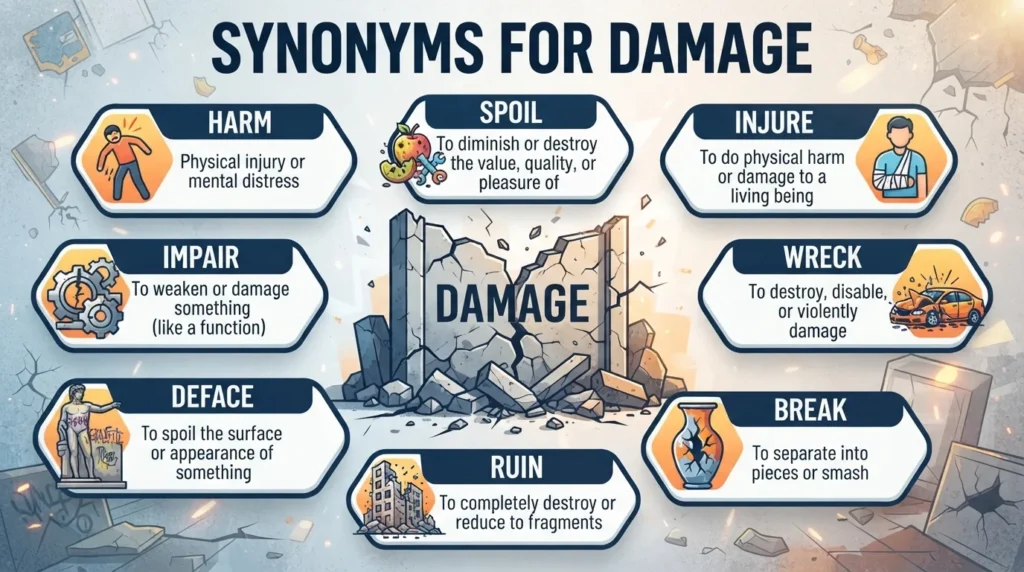
Quick Synonym Reference
| Alternative | Main meaning | Can replace “damage”? | Best context |
|---|---|---|---|
| harm | Negative effect or injury | Yes, often | General |
| destruction | Severe physical damage | Sometimes | Buildings, property, environments |
| injury | Physical or bodily harm | Sometimes | People, animals |
| impairment | Reduced function or ability | Often | Health, systems, performance |
| deterioration | Gradual worsening | Often | Condition, quality, materials |
| ruin | Severe damage making something unusable | Sometimes | Property, plans, objects |
| devastation | Extremely severe destruction | Sometimes | Disasters, communities |
| breakage | Physical damage causing something to break | Sometimes | Objects, equipment |
| defacement | Damage that spoils appearance | Sometimes | Buildings, monuments, property |
| degradation | Decline in quality or condition | Often | Materials, environment, systems |
| wear | Gradual damage from use | Sometimes | Equipment, surfaces, clothing |
| wear and tear | Ordinary gradual damage | Yes, in specific contexts | Objects, machinery |
| corrosion | Chemical deterioration | No, more specific | Metal |
| decay | Gradual physical breakdown | Sometimes | Wood, buildings, organic matter |
| breakdown | Failure or loss of functioning | Sometimes | Machines, systems |
| failure | Inability to function | Sometimes | Systems, equipment |
| loss | Negative financial or other consequence | Sometimes | Money, business, reputation |
| setback | Harm that delays progress | Contextual | Plans, projects, careers |
| disruption | Interference with normal activity | Contextual | Services, operations |
| destruction | Complete or extensive ruin | Contextual | Property, ecosystems |
| devastation | Widespread severe damage | Contextual | Disasters |
| ruination | Process or result of ruining | Sometimes | Property, reputation, plans |
| mutilation | Severe disfiguring damage | Narrow | Bodies, objects |
| deformation | Change in shape | Narrow | Materials, structures |
| distortion | Alteration from original form | Narrow | Images, signals, information |
| cracking | Formation of cracks | Narrow | Walls, materials |
| fracture | Break or crack | Narrow | Bones, materials |
| erosion | Gradual wearing away | Narrow | Soil, surfaces, values |
| scarring | Permanent visible damage | Narrow | Skin, landscapes |
| defect | Fault resulting from damage or production | Related | Products, machinery |
| malfunction | Failure to work properly | Related | Devices, systems |
| adverse effect | Negative consequence | Formal | Research, medicine, policy |
| negative impact | Harmful effect | Broad | Business, environment, society |
| detriment | Harm or disadvantage | Formal | Legal, professional |
| injurious effect | Harmful effect | Formal | Medical, legal |
| despoiling | Spoiling or stripping of something | Literary/formal | Land, environments |
| vandalism | Deliberate property damage | Specific | Buildings, public property |
| sabotage | Deliberate damage to prevent success | Specific | Equipment, operations |
What Does “Damage” Mean?
Damage can mean physical harm, deterioration, reduced function, destruction, or another negative effect.
It works as both a noun and a verb.
As a noun
The storm caused extensive damage to the roof.
As a verb
The storm damaged the roof.
The word is broad, which is why the right synonym changes depending on the type and severity of harm.
The Closest Synonyms for Damage
1. Harm
Harm is the broadest and most useful alternative to damage.
It means physical, emotional, financial, social, or other negative effect.
Smoking can harm your health.
The scandal caused serious harm to the company’s reputation.
Damage vs. harm
Damage often suggests something has been negatively affected or impaired.
Harm is broader and often focuses on the negative effect itself.
2. Destruction
Destruction is much stronger than ordinary damage.
It means causing something to be severely damaged or completely ruined.
The hurricane caused widespread destruction.
You would not normally use destruction for a minor scratch.
Strength
damage → serious damage → severe damage → destruction
3. Injury
Injury is appropriate when the damage affects a person’s or animal’s body.
The accident caused a serious injury to his leg.
It can also describe damage to a reputation or relationship in some formal contexts, but harm or damage is usually more natural there.
4. Impairment
Impairment means a reduction in function, ability, quality, or effectiveness.
The accident resulted in permanent impairment.
Water damage caused significant impairment of the electrical system.
This is particularly useful in medical, technical, scientific, and professional writing.
5. Deterioration
Deterioration means becoming worse in condition or quality, usually over time.
The building has suffered significant deterioration.
Poor maintenance led to the deterioration of the equipment.
Key distinction
Damage can happen suddenly.
Deterioration usually emphasizes gradual decline.
6. Ruin
Ruin means severe damage that destroys usefulness, value, or condition.
The flood ruined the furniture.
The scandal ruined his reputation.
As a noun:
The building was left in ruins.
Ruin is stronger and more final-sounding than ordinary damage.
7. Devastation
Devastation describes extremely severe or widespread destruction.
The earthquake caused widespread devastation.
It is especially common for:
- natural disasters
- war
- communities
- ecosystems
- large areas
It is much stronger than ordinary damage.
8. Degradation
Degradation means a decline in quality, condition, performance, or environmental health.
Soil degradation can reduce agricultural productivity.
The material showed signs of degradation.
This is common in science, engineering, environmental writing, and technical contexts.
9. Breakage
Breakage refers specifically to something being broken or damaged physically.
The company does not cover accidental breakage.
It is useful for:
- glass
- dishes
- equipment
- furniture
- mechanical components
10. Wear and Tear
Wear and tear means ordinary gradual deterioration caused by normal use.
The furniture shows signs of wear and tear.
It is not normally a synonym for sudden accidental damage.
Compare
- damage → can be accidental, deliberate, or unexpected
- wear and tear → gradual and usually associated with normal use
Synonyms for Different Types of Damage
Physical Damage
Useful alternatives:
- harm
- breakage
- destruction
- deterioration
- ruin
- degradation
- cracking
- fracture
- deformation
- defacement
- mutilation
- wear
- wear and tear
- decay
- corrosion
- erosion
Example
The storm caused extensive damage to the building.
The storm caused extensive destruction to the building.
The building suffered extensive structural damage.
The building suffered severe deterioration.
The best choice depends on the extent and cause.
Damage to Buildings and Property
Use:
- structural damage
- physical damage
- destruction
- deterioration
- ruin
- breakage
- defacement
- degradation
- vandalism
- wear and tear
Example
The fire caused extensive damage to the building.
More specific:
The fire caused extensive structural damage.
If someone deliberately damaged the property:
The building was damaged by vandalism.
If the damage resulted from ordinary aging:
The building showed significant deterioration.
Damage to People
For people, the most natural alternatives include:
- injury
- harm
- impairment
- trauma
- wound
- disability
- adverse effect
- physical harm
Example
The accident caused serious damage to his spine.
A more precise sentence might be:
The accident caused a serious spinal injury.
Or, depending on the medical meaning:
The accident resulted in permanent impairment.
Damage is broad; injury and impairment can provide more precise information.
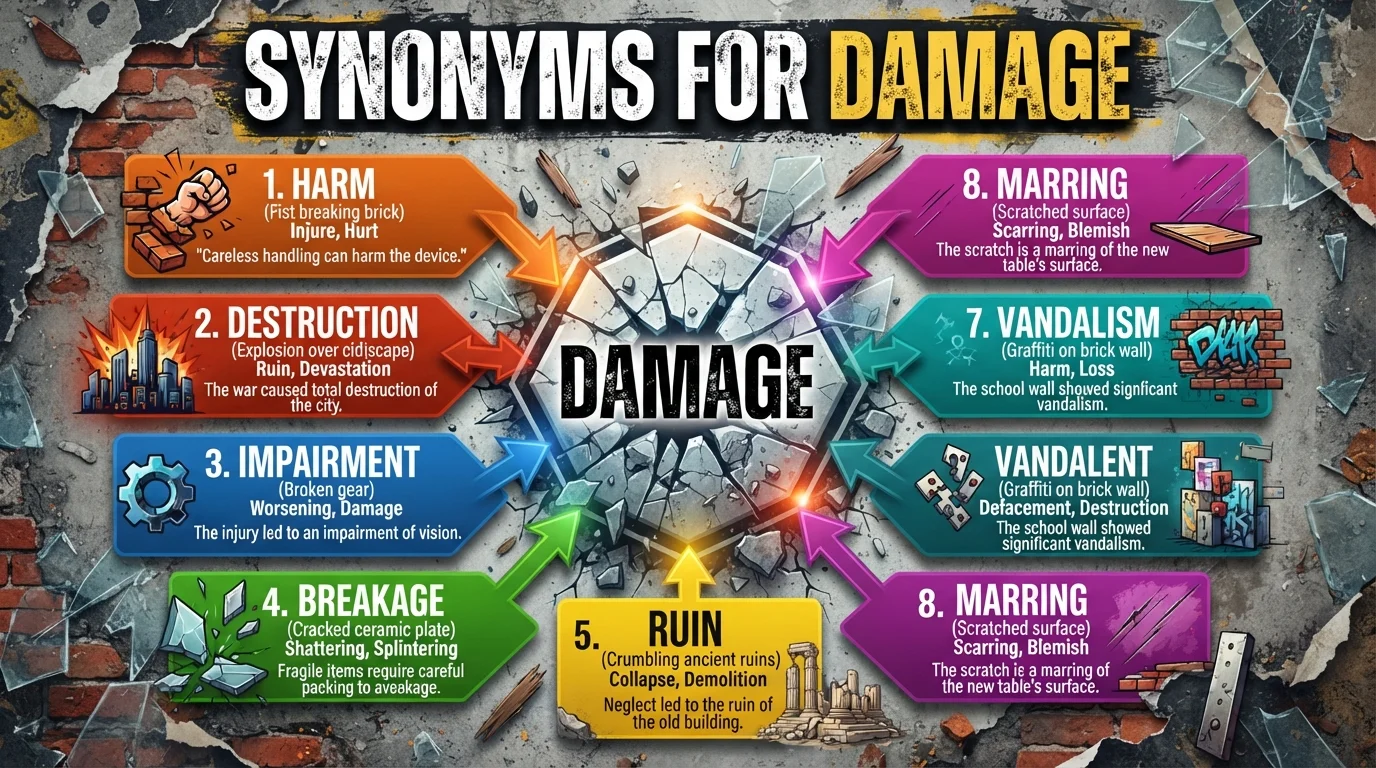
Emotional or Psychological Damage
Depending on the context, use:
- harm
- emotional harm
- emotional injury
- trauma
- distress
- hurt
- lasting effects
- adverse effects
- psychological harm
Example
The experience caused lasting emotional damage.
The experience caused lasting emotional harm.
The experience caused significant psychological distress.
The experience resulted in lasting trauma.
These are not interchangeable in every context. Trauma, for example, has a more specific meaning than general emotional damage.
Financial Damage
Useful alternatives include:
- financial loss
- monetary loss
- economic loss
- cost
- expense
- setback
- loss of revenue
- lost value
- financial harm
- adverse financial impact
Example
The company suffered significant financial damage.
More precise:
The company suffered significant financial losses.
The outage had a major financial impact.
The disruption resulted in substantial lost revenue.
Damage to Reputation
Use:
- harm
- reputational harm
- reputational damage
- loss of reputation
- discredit
- disrepute
- stigma
- tarnishing
- impairment of reputation
Example
The scandal caused serious damage to the company’s reputation.
Possible alternatives:
The scandal caused serious harm to the company’s reputation.
The scandal tarnished the company’s reputation.
The scandal damaged the company’s standing.
Tarnish is especially useful when you want to emphasize damage to a previously positive reputation or image.
Environmental Damage
Useful terms include:
- environmental harm
- environmental degradation
- destruction
- pollution
- ecological damage
- habitat loss
- ecosystem degradation
- contamination
- erosion
- deforestation
- depletion
These are more specific than damage.
Example
Industrial activity caused environmental damage.
More precise:
Industrial activity caused environmental degradation.
The spill caused water contamination.
Logging caused habitat loss.
The specific term is usually better when the type of environmental harm is known.
Damage to Technology and Equipment
Useful alternatives include:
- malfunction
- breakdown
- failure
- impairment
- deterioration
- breakage
- defect
- fault
- degradation
- physical damage
Example
The computer suffered water damage.
Depending on what happened:
The computer suffered hardware damage.
The system experienced a malfunction.
The device suffered a failure.
These words describe different things. A malfunction is a problem with operation; damage is a possible cause.
Damage Caused Deliberately
If the harm was intentional, consider:
- vandalism
- sabotage
- destruction
- defacement
- tampering
- mutilation
- wrecking
Vandalism
Deliberate damage to property.
The park was damaged by vandalism.
Sabotage
Deliberate damage or interference intended to prevent something from working or succeeding.
The equipment was damaged in an act of sabotage.
These are not general synonyms for damage; they specify intent and circumstances.
Damage Caused Gradually
Use:
- deterioration
- degradation
- wear
- wear and tear
- erosion
- corrosion
- decay
- weathering
- attrition
Examples
Years of exposure caused deterioration.
Moisture caused corrosion.
Repeated use caused wear and tear.
Water gradually caused erosion.
The specific word is better when you know the mechanism of deterioration.
Damage vs. Harm
These are among the closest alternatives, but their usage differs.
| Damage | Harm |
|---|---|
| Often suggests something has been negatively affected | Broader negative effect |
| Common for property and objects | Common for people, health, and relationships |
| Can mean physical deterioration | Can be physical, emotional, social, or financial |
| Often measurable | May be harder to measure |
Compare
The storm damaged the house.
The storm harmed the residents.
Both are possible, but each sounds more natural in its usual context.
Damage vs. Destruction
Damage does not necessarily make something unusable.
Destruction implies much more severe harm.
The storm caused minor damage.
The storm caused widespread destruction.
A broken window is damage.
A completely demolished building may be destruction.
Damage vs. Deterioration
The key difference is time and process.
Damage can occur suddenly:
The accident damaged the car.
Deterioration usually happens gradually:
Years of neglect caused the car’s deterioration.
Damage vs. Impairment
Impairment focuses on reduced ability or function.
The injury caused permanent impairment.
Damage is broader:
The injury caused permanent damage.
If the important point is that something can no longer function normally, impairment may be more precise.
Damage vs. Loss
Loss focuses on something being lost, reduced, or no longer available.
The company suffered significant financial losses.
Damage focuses on something being harmed.
The company suffered significant damage to its facilities.
Financial damage can produce financial loss, but the words describe different aspects of the situation.
True Synonyms vs. Related Alternatives
| Alternative | Relationship | Can Replace “damage”? | Tone | Best Context |
|---|---|---|---|---|
| harm | Very close synonym | Yes | Neutral | General harm |
| destruction | Stronger alternative | Sometimes | Neutral/formal | Severe physical damage |
| injury | Narrower synonym | Sometimes | Neutral | People/animals |
| impairment | Narrower synonym | Often | Formal | Function/ability |
| deterioration | Related synonym | Often | Formal | Gradual decline |
| ruin | Stronger alternative | Sometimes | Neutral | Severe damage |
| devastation | Much stronger | Sometimes | Strong | Widespread destruction |
| degradation | Contextual synonym | Often | Formal/technical | Quality/environment |
| breakage | Narrower synonym | Sometimes | Neutral | Broken objects |
| defacement | Narrower synonym | Sometimes | Formal | Appearance/property |
| wear and tear | Specific phrase | Sometimes | Neutral | Normal use |
| loss | Related consequence | Sometimes | Neutral/formal | Financial impact |
| setback | Related consequence | Sometimes | Neutral | Progress/plans |
| disruption | Related effect | Sometimes | Neutral/formal | Operations/services |
| vandalism | Cause/type of damage | No, generally | Neutral/legal | Deliberate property damage |
| sabotage | Specific deliberate damage | No, generally | Formal | Operations/equipment |
| corrosion | Specific process | No | Technical | Metals/materials |
| erosion | Specific process | No | Technical | Soil/surfaces |
| decay | Specific process | Sometimes | Neutral | Organic/material decline |
| malfunction | Related result | Sometimes | Technical | Equipment/systems |
10 Sentence Transformations
1. General harm
Original:
The decision caused significant damage to the community.
Alternative:
The decision caused significant harm to the community.
Why:
“Harm” is natural when people or communities experience a negative effect.
2. Severe physical damage
Original:
The earthquake caused extensive damage.
Alternative:
The earthquake caused widespread destruction.
Why:
“Destruction” communicates a much higher level of severity.
3. Gradual decline
Original:
The building suffered serious damage over the years.
Alternative:
The building suffered serious deterioration over the years.
Why:
“Deterioration” emphasizes gradual decline.
4. Bodily harm
Original:
The accident caused damage to his knee.
Alternative:
The accident caused a knee injury.
Why:
“Injury” is more precise for physical harm to a person.
5. Reduced function
Original:
The condition caused permanent damage to his vision.
Alternative:
The condition caused permanent visual impairment.
Why:
“Impairment” emphasizes reduced function.
6. Financial consequences
Original:
The company suffered major damage after the outage.
Alternative:
The company suffered major financial losses after the outage.
Why:
“Losses” identifies the financial consequence rather than the general harm.
7. Reputation
Original:
The scandal caused serious damage to the brand.
Alternative:
The scandal seriously tarnished the brand’s reputation.
Why:
“Tarnished” specifically communicates harm to reputation or public image.
8. Normal use
Original:
The furniture showed some damage after years of use.
Alternative:
The furniture showed some wear and tear after years of use.
Why:
“Wear and tear” indicates ordinary deterioration caused by use.
9. Deliberate property damage
Original:
The school suffered extensive damage overnight.
Alternative:
The school suffered extensive damage from vandalism overnight.
Why:
“Vandalism” adds the important fact that the damage was deliberate.
10. Environmental decline
Original:
The area has experienced severe environmental damage.
Alternative:
The area has experienced severe environmental degradation.
Why:
“Degradation” is a common technical term for decline in environmental quality.
Common Collocations with Damage
As a noun
- physical damage
- serious damage
- severe damage
- extensive damage
- significant damage
- major damage
- minor damage
- permanent damage
- lasting damage
- structural damage
- property damage
- environmental damage
- financial damage
- emotional damage
- reputational damage
- collateral damage
- water damage
- fire damage
- storm damage
- accidental damage
- intentional damage
- irreversible damage
- widespread damage
As a verb
- cause damage
- suffer damage
- sustain damage
- prevent damage
- reduce damage
- minimize damage
- repair damage
- assess damage
- inspect damage
- report damage
- reverse damage
- repair the damage
- limit the damage
Examples
The storm caused extensive damage.
Engineers inspected the structural damage.
The company took steps to minimize the damage.
The team assessed the financial damage.
Common Mistakes with Damage Synonyms
1. Using “destruction” for minor damage
A scratched table has been damaged; it has not necessarily been destroyed.
2. Using “injury” for objects
❌ The storm caused an injury to the building.
Use:
✓ The storm caused damage to the building.
Injury normally applies to people or animals.
3. Confusing deterioration with sudden damage
A machine that breaks after being hit has suffered damage.
A machine that becomes less effective after years of use may have undergone deterioration.
4. Using “malfunction” as a synonym for physical damage
A damaged computer may malfunction, but the two words describe different things.
- damage = physical or functional harm
- malfunction = failure to work properly
5. Calling every environmental problem “pollution”
Pollution is one type of environmental harm.
Other forms include:
- habitat loss
- erosion
- deforestation
- contamination
- degradation
- depletion
6. Using “loss” when something has only been damaged
If a car is scratched but still exists and works, it has suffered damage, not necessarily a complete loss.
7. Confusing damage with defect
A defect is a flaw or fault. It may exist from manufacturing or design and does not necessarily result from damage.
8. Using “wear and tear” for deliberate damage
Wear and tear usually describes ordinary deterioration from normal use.
Deliberate property damage is more appropriately described as vandalism or intentional damage, depending on the facts.
When Not to Replace “Damage”
Keep damage when you need a broad, neutral term and do not need to specify exactly what happened.
For example:
The storm caused extensive damage to the property.
This is useful when the precise forms of harm are not yet known.
Likewise:
The policy covers accidental damage.
Here, damage is the established and natural term. Replacing it with something more unusual could make the sentence less clear.
The goal is not to find the most sophisticated synonym. The goal is to find the most accurate word for the situation.
Which Synonym Should You Choose?
| If you mean… | Best choice |
|---|---|
| General negative effect | harm |
| Severe physical destruction | destruction |
| Harm to a person | injury |
| Reduced function or ability | impairment |
| Gradual worsening | deterioration |
| Something badly ruined | ruin |
| Widespread severe destruction | devastation |
| Decline in quality or condition | degradation |
| Something physically broken | breakage |
| Ordinary damage from use | wear and tear |
| Damage to appearance | defacement |
| Damage to metal from chemical action | corrosion |
| Wearing away of land/material | erosion |
| Organic/material breakdown | decay |
| Failure of a machine/system | malfunction |
| Financial consequences | loss |
| Harm that delays progress | setback |
| Deliberate property damage | vandalism |
| Deliberate operational damage | sabotage |
| Harm to reputation | tarnishing / reputational harm |
Editor’s Choice
If you only need a handful of alternatives, these cover the most useful meanings:
Harm — the broadest general alternative.
Destruction — for severe physical damage.
Deterioration — for gradual decline.
Impairment — for reduced function or ability.
Injury — for bodily harm.
These are not a ranking of “better” words. Each one fits a different meaning.