
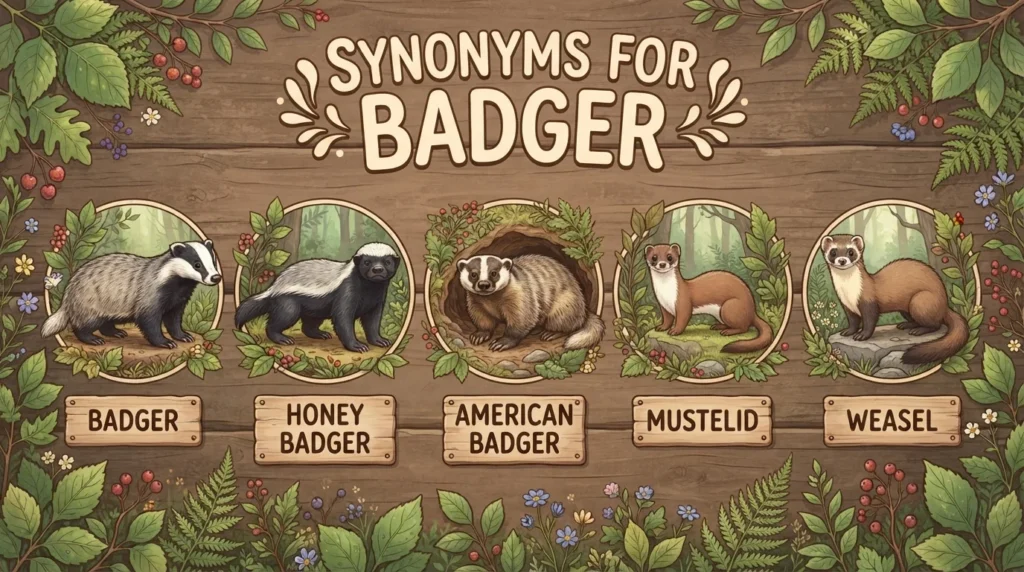
Quick List: Synonyms for “Badger”
Meaning “repeatedly bother”
- pester
- bother
- annoy
- hassle
- nag
- hound
- harass
- badger
- torment
- plague
- trouble
- harry
- importune
Meaning “repeatedly ask or pressure”
- press
- urge
- push
- prod
- coax
- persuade
- insist
- pressurize
- cajole
- solicit
- urge repeatedly
- push for
Meaning “keep demanding an answer”
- press
- question
- challenge
- probe
- pursue
- demand
- insist
- push for an answer
Informal alternatives
- pester
- bug
- hassle
- hound
- bug someone
- get on someone’s case
- keep after someone
- keep pushing
Animal meaning
- brock
- Eurasian badger
- American badger
- honey badger
Important: The animal names are not interchangeable in every context because different badger species have different names.
What Does “Badger” Mean?
Badger has two major meanings.
1. Badger as a verb
To badger someone means to repeatedly ask, pressure, bother, or persuade them.
My brother badgered me until I agreed.
The word often suggests repetition. It can also imply that the person being pressured would prefer to be left alone.
2. Badger as a noun
A badger is a stocky, burrowing mammal belonging to the family Mustelidae.
We saw a badger near the edge of the woods.
These two meanings need to be kept separate when choosing alternatives.
1. Badger = Pester
Pester is one of the closest everyday synonyms for the verb badger.
It means to repeatedly bother someone with requests, questions, complaints, or demands.
The children badgered their parents for a puppy.
The children pestered their parents for a puppy.
Tone: neutral/conversational
Best for: repeated requests, children, everyday situations.
Difference
Pester emphasizes repeated bothering.
Badger often suggests more persistent pressure or repeated attempts to get someone to do something.
2. Badger = Nag
Nag means to repeatedly criticize, remind, or ask someone to do something.
She badgered him to clean his room.
She nagged him to clean his room.
Tone: conversational
Best for: repeated reminders, complaints, requests, or criticism.
Key distinction
Nag often involves a repeated request or criticism.
Badger is broader and can involve persistent questioning or pressure.
He kept nagging me about the dishes.
The reporter badgered the politician with questions.
Badger is more natural in the second example.
3. Badger = Bother
Bother means to annoy, disturb, or cause inconvenience.
Sorry to badger you again.
Sorry to bother you again.
Tone: neutral
Best for: general annoyance or interruption.
Difference
Bother does not necessarily imply repetition.
He bothered me once.
Badger usually suggests persistence.
He badgered me for hours.
So bother is broader but less specific.
4. Badger = Annoy
Annoy means to irritate or bother someone.
His constant questions badgered her.
His constant questions annoyed her.
Watch out: Annoy describes the emotional effect, while badger describes the persistent behavior causing it.
Someone can annoy you without badgering you.
5. Badger = Hassle
Hassle means to bother, inconvenience, or pressure someone.
Don’t hassle me about it.
Tone: informal
Best for: everyday conversation.
It can also be a noun:
I don’t need the hassle.
Unlike badger, hassle does not always involve repeated requests.
6. Badger = Hound
Hound means to pursue or pressure someone persistently.
Reporters hounded the actor for comments.
Tone: strong
Best for: persistent pursuit, questioning, demands, media attention, creditors, or critics.
Difference
Hound often suggests following someone or repeatedly pursuing them.
Badger can happen without physically pursuing someone.
He badgered me with questions.
Reporters hounded him for an interview.
7. Badger = Harass
Harass means to repeatedly trouble, disturb, intimidate, or pressure someone.
She said the company was harassing her with repeated calls.
Tone: serious/formal
Best for: workplace, legal, institutional, or serious situations.
Important distinction
Harass can describe serious or unlawful conduct. It is stronger than ordinary badger.
My friend badgered me about dinner.
should not normally become:
My friend harassed me about dinner.
The second can imply a much more serious situation.
8. Badger = Press
Press means to push someone for an answer, decision, action, or response.
The reporter badgered the official for an explanation.
The reporter pressed the official for an explanation.
Tone: neutral/professional
Best for: interviews, negotiations, questions, decisions, and formal discussions.
Press is often a more controlled alternative to badger.
9. Badger = Prod
Prod means to encourage or push someone to act.
She badgered him into finishing the report.
She prodded him to finish the report.
Tone: neutral
Best for: encouraging action, especially when someone is slow or reluctant.
Difference
Prod can be mild.
Badger usually suggests more persistent pressure.
10. Badger = Urge
Urge means strongly encourage someone to do something.
They badgered him to apply.
They urged him to apply.
Tone: neutral/formal
Best for: advice, recommendations, professional communication.
Difference
Urge does not necessarily imply annoyance or repeated pressure.
Badger often does.
11. Badger = Push
Push means to strongly encourage or pressure someone.
The manager pushed her to accept the offer.
Tone: neutral/informal
Best for: decisions, negotiations, sales, goals, and persuasion.
They kept pushing me for an answer.
This can be very close to badger when the emphasis is pressure.
12. Badger = Insist
Insist means to demand or maintain something firmly.
He badgered me to come with him.
He insisted that I come with him.
Difference: Insist emphasizes firmness rather than repeated bothering.
13. Badger = Coax
Coax means to gently persuade someone to do something.
She badgered him into telling the truth.
She coaxed him into telling the truth.
These sentences are not identical.
Badger suggests persistent pressure.
Coax suggests gentler persuasion.
14. Badger = Cajole
Cajole means to persuade someone through flattery, encouragement, or persistent persuasion.
They cajoled him into joining the team.
Tone: somewhat formal/literary
Best for: persuasion involving charm or encouragement.
Difference
Badger can sound irritating.
Cajole often suggests skillful or flattering persuasion.
15. Badger = Importune
Importune means to ask or pressure someone persistently, especially in a formal or old-fashioned sense.
He repeatedly importuned the committee for funding.
Tone: very formal/literary
Best for: formal prose, historical writing, literary contexts.
It is much less common in everyday American English than pester, press, or hound.
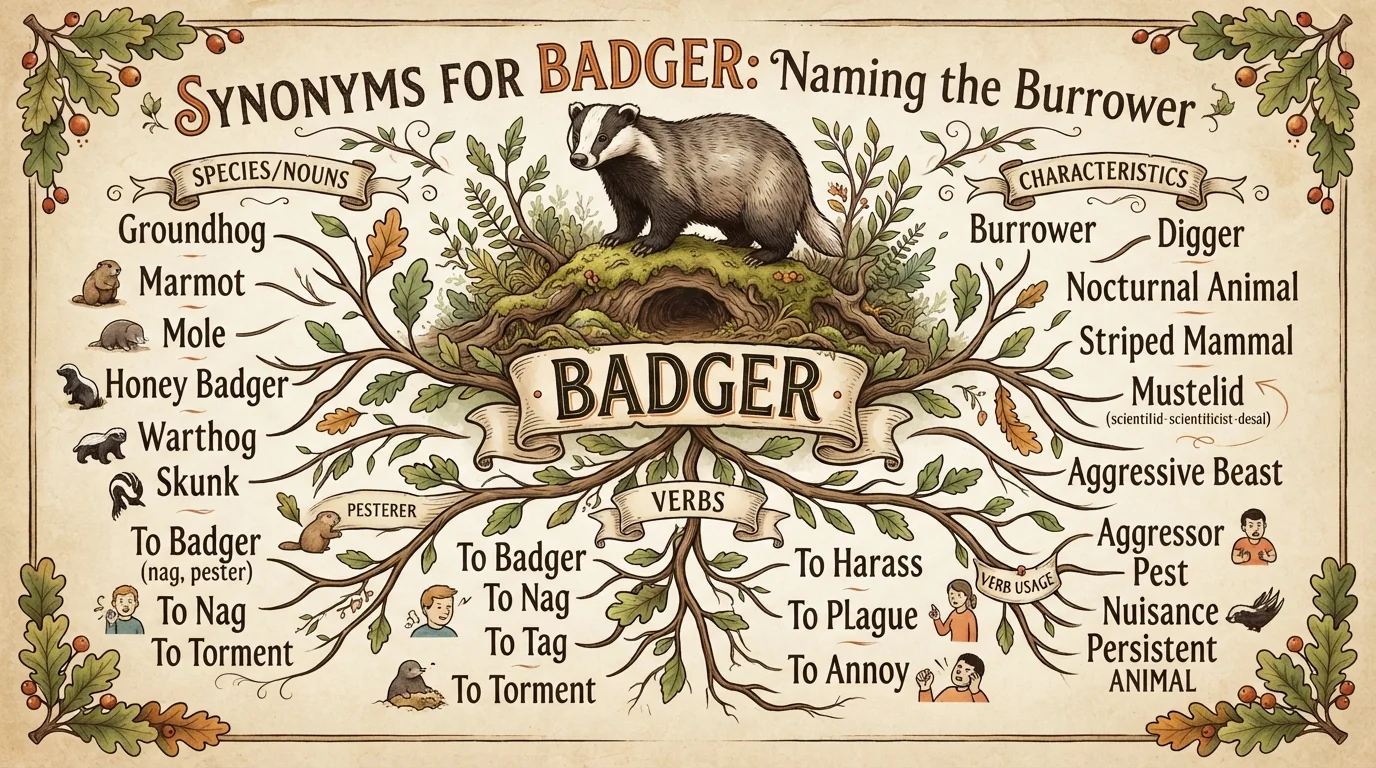
Stronger Alternatives
When you want to emphasize persistent or aggressive behavior, consider:
- hound
- harass
- torment
- plague
- harry
- badger relentlessly
- pressure repeatedly
- pursue persistently
- demand repeatedly
Torment
Means to cause severe mental or emotional suffering.
The memories tormented him.
This is much stronger than badger.
Plague
Can mean to trouble or bother persistently.
The town was plagued by repeated power outages.
It can also describe persistent personal annoyance:
He was plagued by unwanted calls.
Harry
Means to repeatedly harass, attack, or trouble.
The army was harried by repeated attacks.
Tone: formal/literary
It is less common in everyday American English.
Informal Synonyms for “Badger”
For casual conversation, these are often more natural:
Bug
Stop bugging me about it.
Hassle
Don’t hassle her about the decision.
Pester
He keeps pestering me for money.
Hound
They keep hounding me for an answer.
Get on someone’s case
My parents are always getting on my case about cleaning my room.
Keep after someone
She kept after him until he finished the assignment.
Keep pushing
They kept pushing me to make a decision.
These are useful in dialogue and conversational writing but may be too informal for academic or legal prose.
Formal Alternatives for “Badger”
For professional or formal writing, choose a word that describes the exact behavior:
- pressure
- press
- repeatedly question
- persistently request
- urge
- pursue
- insist
- solicit
- importune
- harass
Examples:
The journalist pressed the minister for clarification.
The organization repeatedly requested additional information.
The applicant persistently sought an explanation.
These often sound more neutral than badger.
Badger in Different Contexts
Badger Someone for an Answer
- press someone for an answer
- press for clarification
- demand an answer
- repeatedly question someone
- push for an explanation
- pursue an answer
- insist on an explanation
Best neutral choice: press
The reporter pressed the official for an answer.
Badger Someone to Do Something
- urge
- pressure
- push
- prod
- persuade
- coax
- cajole
- insist
- keep after
The best choice depends on how forceful the behavior is.
Badger Someone With Questions
Possible alternatives:
- question repeatedly
- press with questions
- hound with questions
- bombard with questions
- repeatedly challenge
Bombard with questions is especially useful when there are many questions in rapid succession.
Badger Someone About Something
Possible alternatives:
- pester someone about
- nag someone about
- hassle someone about
- keep asking about
- repeatedly question someone about
- press someone about
- hound someone about
The customer kept badgering the staff about the refund.
The customer kept pressing the staff about the refund.
The second is more neutral and professional.
Comparison Table
| Word | Main Meaning | Tone | Persistence | Strength |
|---|---|---|---|---|
| badger | repeatedly bother or pressure | neutral | high | moderate |
| pester | repeatedly bother | neutral/casual | high | moderate |
| nag | repeatedly remind, complain, or ask | informal | high | moderate |
| bother | annoy or disturb | neutral | low–moderate | mild |
| annoy | irritate someone | neutral | not required | mild–moderate |
| hassle | bother or inconvenience | informal | moderate | moderate |
| hound | pursue persistently | strong | very high | strong |
| harass | repeatedly trouble or intimidate | serious/formal | high | strong |
| press | push for an answer/action | neutral/formal | moderate–high | moderate |
| prod | encourage action | neutral | moderate | mild |
| urge | strongly encourage | neutral/formal | not required | moderate |
| push | pressure or encourage | neutral/informal | moderate | moderate |
| insist | demand firmly | neutral | not required | moderate |
| coax | gently persuade | neutral | variable | mild |
| cajole | persuade through charm/encouragement | formal | variable | mild–moderate |
| importune | ask persistently | formal/literary | very high | strong |
| torment | cause severe distress | strong | not required | very strong |
| plague | trouble persistently | neutral/formal | high | strong |
| harry | repeatedly trouble or attack | formal/literary | high | strong |
Badger vs. Pester
These are among the closest alternatives.
Badger
He badgered me for an explanation.
Pester
He pestered me for an explanation.
Both suggest repeated requests.
Badger can emphasize persistent pressure.
Pester more strongly emphasizes annoyance caused by repetition.
For ordinary conversation, pester is often the simpler choice.
Badger vs. Nag
Nag usually involves repeated criticism, reminders, or requests.
My mother nagged me to clean my room.
Badger is broader.
The reporter badgered the official with questions.
Use nag when the behavior involves repeated reminders or complaints. Use badger when someone persistently pressures or questions another person.
Badger vs. Harass
This distinction matters.
Badger usually describes persistent bothering or pressure.
Harass can describe serious, intimidating, abusive, or unlawful behavior.
He badgered his colleague for a response.
He harassed his colleague.
The second statement is substantially stronger and may carry legal or workplace implications.
Do not use harass simply to make badger sound stronger.
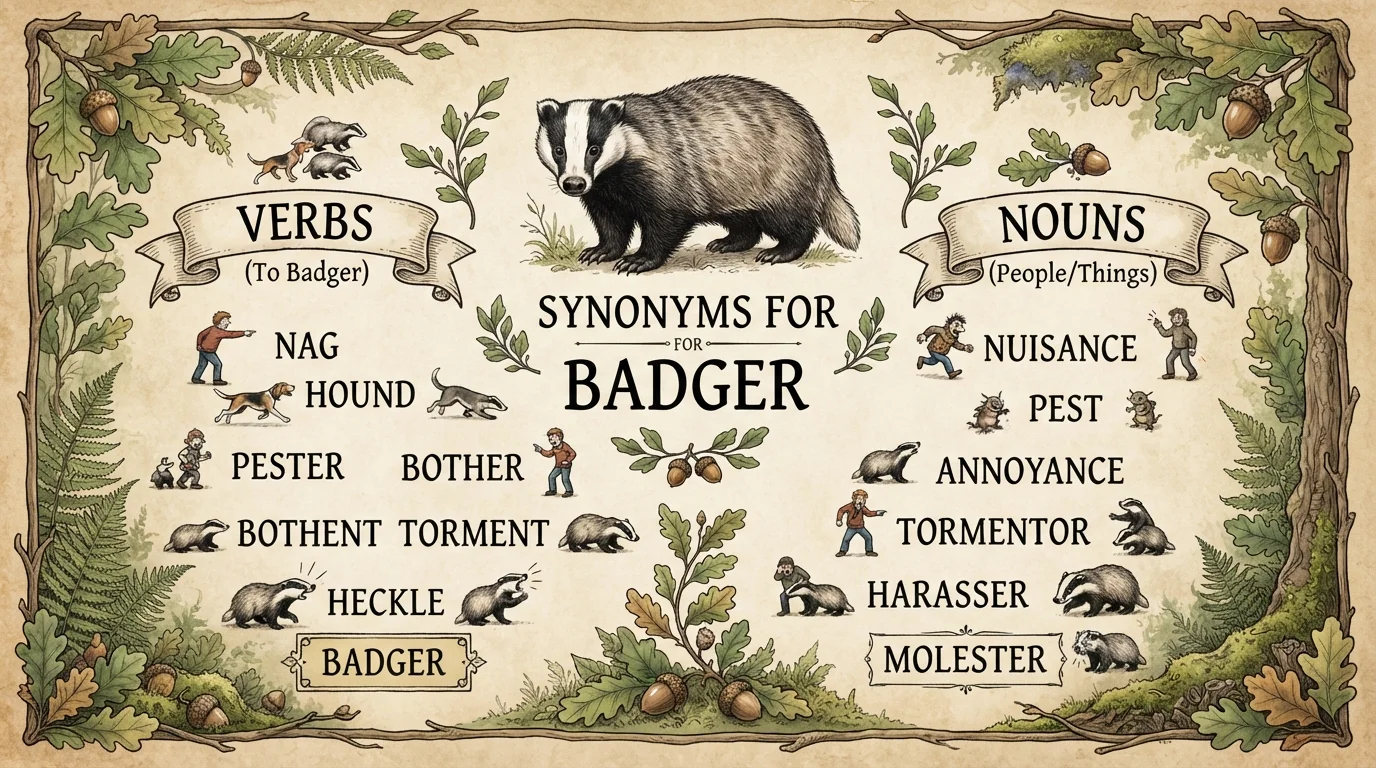
Badger vs. Hound
Both suggest persistence.
Badger:
She kept badgering me about the project.
Hound:
Reporters hounded him for comments.
Hound often creates an image of persistent pursuit.
It is especially common with:
- reporters
- investigators
- creditors
- critics
- opponents
- people seeking answers
Badger vs. Press
Press is often a better choice in professional contexts.
The journalist badgered the official for an answer.
This can sound critical.
The journalist pressed the official for an answer.
This sounds more neutral and professional.
If you want to describe persistence without implying inappropriate behavior, press may be the better choice.
The Noun “Badger”: The Animal
When badger is a noun referring to the animal, the synonym possibilities are much narrower.
Brock
Brock is a traditional name for a badger, especially in British usage and older or literary writing.
A brock emerged from its burrow.
It is not a common everyday replacement for badger in American English.
Species-Specific Names
Depending on the species, you may encounter:
- American badger
- Eurasian badger
- European badger
- honey badger
- hog badger
- Japanese badger
- ferret-badger
These are specific types, not universal synonyms for badger.
For example, a honey badger is not simply another name for every badger.
Sentence Transformations
1. Original
She kept badgering me for an answer.
Alternative: She kept pressing me for an answer.
Why: Press is more neutral and works well in professional contexts.
2. Original
The children badgered their parents for a dog.
Alternative: The children pestered their parents for a dog.
Why: Pester naturally describes repeated requests, especially in everyday situations.
3. Original
He kept badgering me about the deadline.
Alternative: He kept nagging me about the deadline.
Why: Nag fits repeated reminders or complaints.
4. Original
Reporters badgered the actor for a statement.
Alternative: Reporters hounded the actor for a statement.
Why: Hounded emphasizes persistent pursuit.
5. Original
She badgered him into accepting the offer.
Alternative: She pressured him into accepting the offer.
Why: Pressured clearly communicates forceful persuasion.
6. Original
He badgered his friend to come along.
Alternative: He urged his friend to come along.
Why: Urged sounds less negative and focuses on strong encouragement rather than annoyance.
7. Original
The salesperson badgered me into buying the product.
Alternative: The salesperson pressured me into buying the product.
Why: Pressured highlights unwanted persuasion.
8. Original
Stop badgering me with questions.
Alternative: Stop bombarding me with questions.
Why: Bombarding emphasizes a large number of questions arriving rapidly.
9. Original
The committee badgered the applicant for more information.
Alternative: The committee repeatedly requested additional information from the applicant.
Why: This is more neutral and suitable for formal documentation.
10. Original
He kept badgering her until she agreed.
Alternative: He persistently pressured her until she agreed.
Why: This makes the persistence and pressure explicit while avoiding the conversational tone of badger.
Common Collocations With “Badger”
Badger + person
- badger me
- badger him
- badger her
- badger them
- badger someone
Badger + about
- badger someone about something
- badger me about money
- badger him about work
- badger her about the decision
Badger + for
- badger someone for an answer
- badger someone for money
- badger someone for information
- badger someone for details
- badger someone for a response
Badger + into
- badger someone into agreeing
- badger someone into buying
- badger someone into going
- badger someone into accepting
Badger + with
- badger someone with questions
- badger someone with requests
- badger someone with complaints
Common Mistakes
1. Treating “badger” and “annoy” as exact synonyms
They overlap, but badger emphasizes repeated pressure or bothering.
He annoyed me once.
does not mean:
He badgered me once.
2. Using “harass” for ordinary persistence
Harass can imply much more serious conduct.
My friend kept badgering me about the party.
Do not automatically change this to harassing.
3. Using “nag” for every kind of badgering
Nag works especially well for repeated reminders, complaints, or requests.
For persistent questioning, press, hound, or pester may be more precise.
4. Assuming “urge” means “badger”
Urge emphasizes encouragement.
Badger often carries the additional idea of annoyance or unwanted persistence.
5. Confusing “badger” with “bother”
Someone can bother you without repeatedly pressuring you.
Badger is more specific.
6. Using “hound” when there is no pursuit
Hound often suggests persistent pursuit or repeated demands.
It can sound too dramatic for a simple request.
7. Assuming “brock” is common in American English
Brock is a traditional term for a badger, especially in British or literary contexts. It is not normally the everyday word used by American English speakers.
8. Confusing the animal and verb meanings
The dog badgered the child.
Here, badgered is a verb meaning repeatedly bothered or pressured.
We saw a badger in the field.
Here, badger is the animal.
Context determines the meaning.
When Not to Replace “Badger”
Keep badger when:
- you specifically mean repeated pressure
- the person keeps asking after receiving an answer
- you want to emphasize persistent bothering
- the sentence is conversational or narrative
- the slightly negative tone is intentional
For example:
He badgered me until I finally agreed.
The word efficiently communicates both persistence and pressure.
Replacing it with asked would lose much of that meaning:
He asked me until I finally agreed.
This sounds unnatural and does not clearly communicate persistent pressure.
Which Synonym Should You Choose?
| If you mean… | Best choice |
|---|---|
| Repeatedly bother | pester |
| Repeated reminders or complaints | nag |
| General annoyance | bother / annoy |
| Informally bother someone | hassle / bug |
| Pursue persistently | hound |
| Serious repeated mistreatment | harass |
| Push for an answer | press |
| Encourage action | prod |
| Strongly encourage | urge |
| Pressure someone | push / pressure |
| Firmly demand | insist |
| Gently persuade | coax |
| Persuade through charm | cajole |
| Ask persistently | importune |
| Cause severe distress | torment |
| Trouble persistently | plague |
| Repeatedly trouble or attack | harry |
| Animal | badger / brock in traditional usage |
Editor’s Choice
These are editorial recommendations for common contexts rather than an objective ranking.
Pester
Best everyday alternative when repeated bothering is the main idea.
Nag
Best for repeated reminders, criticism, or requests.
Press
Best professional alternative when someone is pushing for an answer or response.
Hound
Best when persistent pursuit is important.
Pressure
Best when the focus is on forcing or strongly influencing someone’s decision.
Coax
Best when the persuasion is gentle rather than irritating.