
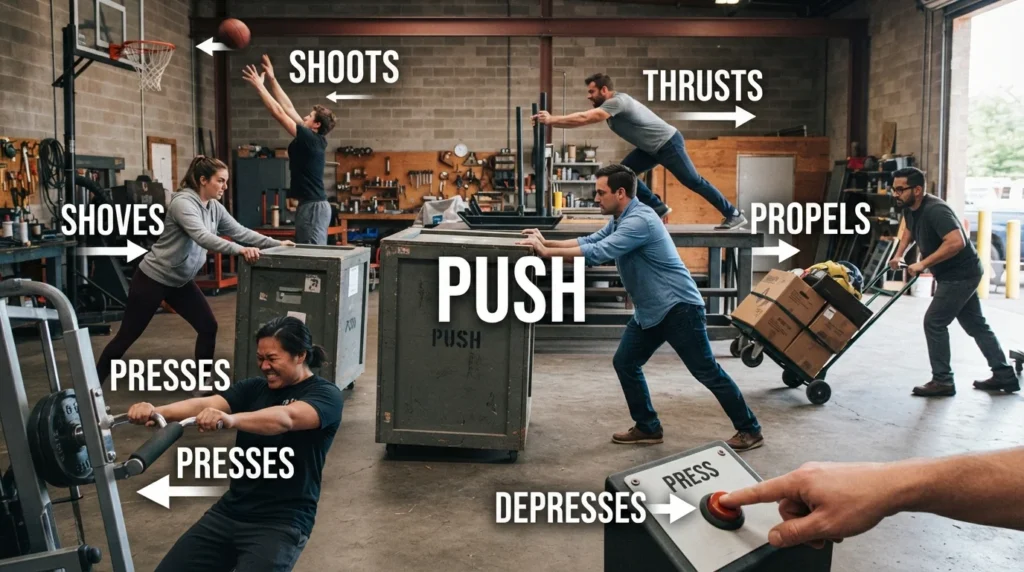
Quick Synonyms for “Push”
When you mean physical force
- press
- shove
- thrust
- propel
- drive
- force
- move
- jolt
- nudge
- propel forward
When you mean encourage or motivate
- encourage
- urge
- prompt
- motivate
- inspire
- stimulate
- spur
- prod
- persuade
- press
When you mean pressure someone
- pressure
- compel
- coerce
- force
- insist
- press
- badger
- hound
- lean on
- push someone into
When you mean promote or support
- promote
- advocate
- champion
- support
- endorse
- advance
- back
- campaign for
- pitch
- market
When you mean move forward or make progress
- advance
- proceed
- move forward
- drive
- pursue
- propel
- accelerate
- progress
When you mean make an effort
- strive
- work
- try
- persevere
- persist
- exert yourself
- apply yourself
What Does “Push” Mean?
Push is a highly flexible word. As a verb, it can describe physical movement, encouragement, pressure, promotion, effort, or progress.
For example:
- She pushed the door open. → applied physical force
- He pushed me to apply for the job. → encouraged or urged
- The manager pushed us to finish early. → pressured or strongly encouraged
- The company is pushing its new product. → promoting
- The team pushed forward despite the setback. → continued moving or progressing
- She pushed herself to finish the race. → made a strong effort
As a noun, push can also mean an effort, campaign, physical force, or period of intensified activity:
- The company launched a marketing push.
- Give the door a gentle push.
- We need one final push to finish the project.
Because these meanings are different, replacing push with a random thesaurus synonym can easily change the sentence.
1. Push = Apply Physical Force
When push means using physical force to move something away from you or change its position, these alternatives work best.
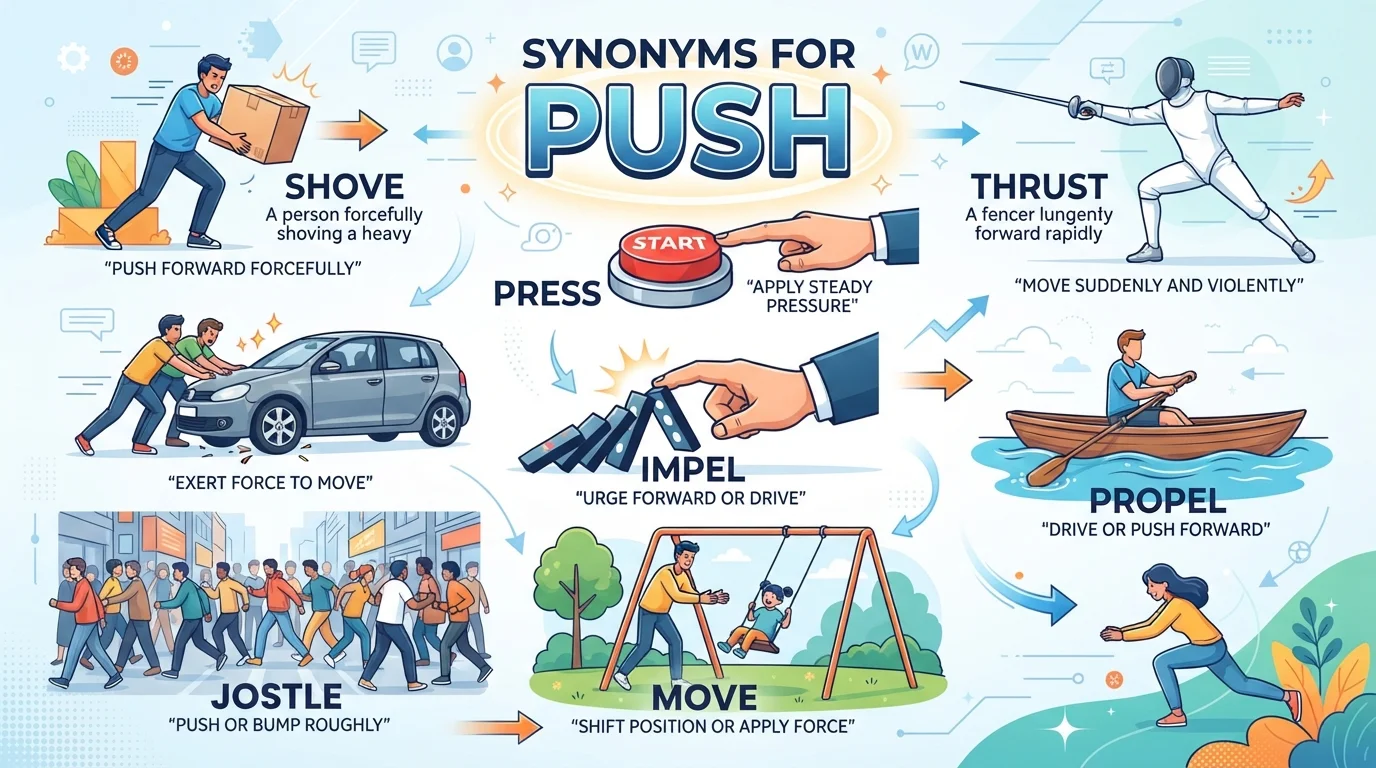
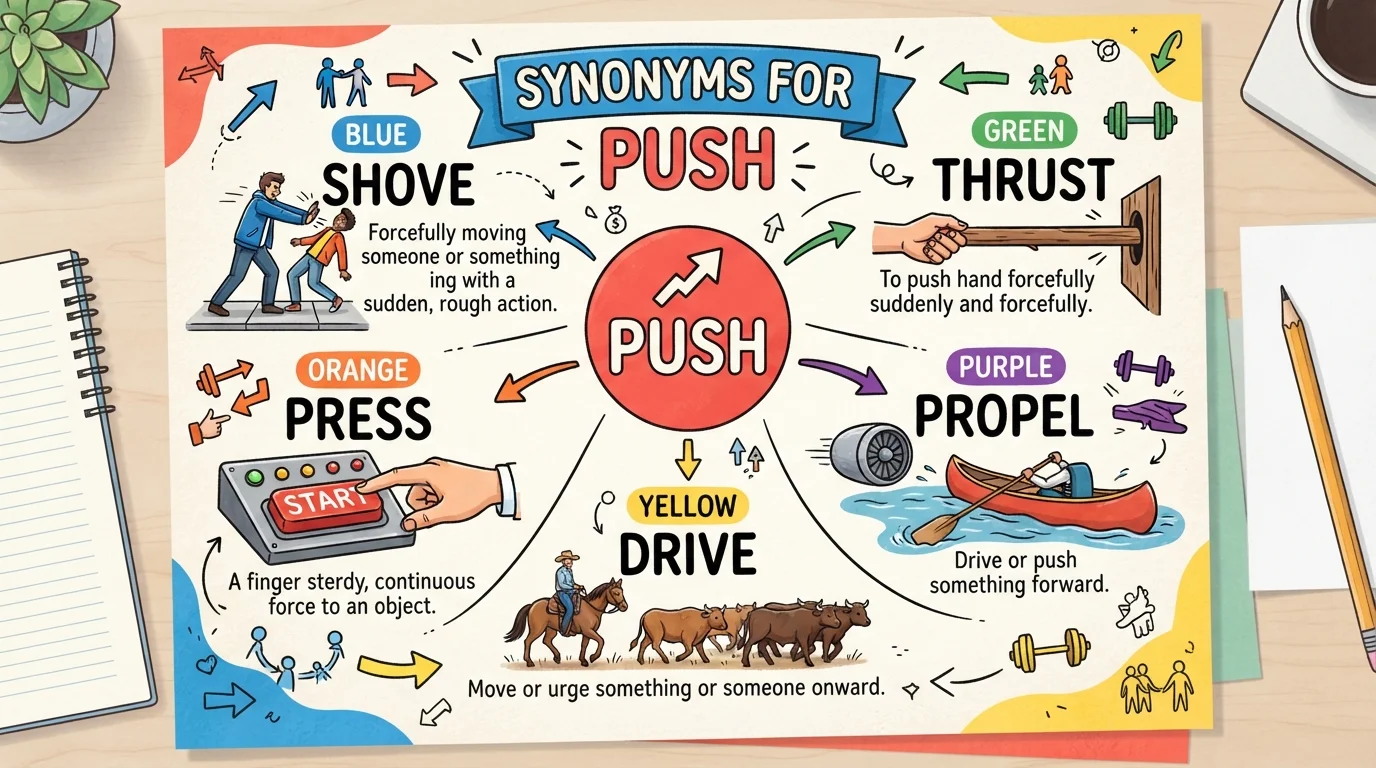
Press
Press means applying force against something, usually with the hand, finger, or another object.
Push the button.
Press the button.
“Press” is often more natural for buttons, switches, controls, and surfaces.
Shove
Shove means pushing suddenly, roughly, or forcefully.
He pushed the box aside.
He shoved the box aside.
Shove is stronger and often suggests impatience or roughness.
Thrust
Thrust means pushing something suddenly and forcefully, often forward.
She pushed the door open.
She thrust the door open.
“Thrust” is more forceful and often more literary or formal.
Propel
Propel means cause something to move forward.
The motor pushed the boat forward.
The motor propelled the boat forward.
It is especially useful for machines, vehicles, forces, and movement.
Drive
Drive can mean force something forward or make it move.
The engine pushes the vehicle forward.
The engine drives the vehicle forward.
“Drive” often suggests a continuing force rather than one simple movement.
Nudge
Nudge means push gently or lightly.
She pushed the door slightly.
She nudged the door open.
It can also mean gently encouraging someone.
2. Push = Encourage or Motivate
Sometimes push means encouraging someone to work harder, act, or reach a goal.
Encourage
The most neutral alternative.
My teacher pushed me to apply.
My teacher encouraged me to apply.
Encourage is generally positive and does not imply excessive pressure.
Urge
Urge means strongly encourage someone to do something.
She pushed him to reconsider.
She urged him to reconsider.
“Urge” is stronger than “encourage” but does not necessarily imply coercion.
Motivate
Motivate means give someone a reason or desire to act.
The coach pushed the team to improve.
The coach motivated the team to improve.
Use “motivate” when the emphasis is on creating willingness or drive.
Prompt
Prompt means cause or encourage someone to take action.
The warning pushed him to act.
The warning prompted him to act.
“Prompt” often focuses on what caused the action rather than emotional encouragement.
Inspire
Inspire means encourage someone through ideas, examples, emotions, or admiration.
Her success pushed me to keep going.
Her success inspired me to keep going.
“Inspire” is generally more positive and uplifting.
Spur
Spur means encourage someone to act, especially more quickly or energetically.
The criticism pushed him to improve.
The criticism spurred him to improve.
“Spur” often suggests that something creates urgency or motivation.
Prod
Prod means encourage someone to act, often because they are slow or reluctant.
I had to push him to finish the application.
I had to prod him to finish the application.
It can sound mildly critical.
3. Push = Pressure Someone
This is a different meaning from simple encouragement.
Pressure
Pressure means trying to influence someone strongly, often making them feel they should act.
They pushed her to accept the offer.
They pressured her to accept the offer.
“Pressure” makes the force behind the influence clearer.
Compel
Compel means make someone do something through strong pressure, circumstances, or necessity.
The evidence pushed him to change his position.
The evidence compelled him to change his position.
“Compel” is stronger and more formal.
Force
Force means make someone do something against their wishes or without genuine choice.
They pushed him into signing the agreement.
They forced him to sign the agreement.
Do not use “force” unless the stronger meaning is intended.
Coerce
Coerce is a strong and formal word meaning to make someone do something through threats, intimidation, or improper pressure.
He was pressured into agreeing.
He was coerced into agreeing.
“Coerce” is much stronger than ordinary “push.”
Insist
Insist means firmly demand that something happen.
She pushed for an immediate response.
She insisted on an immediate response.
It focuses on firmness rather than necessarily applying pressure to another person’s freedom of choice.
Badger
Badger means repeatedly bother or pressure someone.
He kept pushing me for an answer.
He kept badgering me for an answer.
“Badger” emphasizes persistence and annoyance.
Hound
Hound means pursue or pressure someone persistently.
Reporters pushed him for an explanation.
Reporters hounded him for an explanation.
“Hound” is stronger and often suggests relentless pursuit.
4. Push = Promote or Sell
In business and marketing, push often means actively promoting a product, idea, service, or campaign.
Promote
The most general business alternative.
The company is pushing its new product.
The company is promoting its new product.
Market
Market means promote and sell a product or service to customers.
The company is pushing its new app.
The company is marketing its new app.
“Market” is more specific to commercial activity.
Advertise
Advertise means publicly promote a product, service, event, or organization.
They are pushing the new service online.
They are advertising the new service online.
Pitch
Pitch means present or promote an idea, product, proposal, or service persuasively.
She pushed the proposal during the meeting.
She pitched the proposal during the meeting.
“Pitch” is especially natural in business and sales.
Champion
Champion means actively support or promote an idea, cause, policy, or person.
She pushed for better workplace policies.
She championed better workplace policies.
It usually has a positive or strongly supportive tone.
5. Push = Support an Idea or Cause
When push means publicly or actively supporting something, use a more precise alternative.
Advocate
Advocate means publicly support or argue in favor of something.
The organization is pushing for reform.
The organization is advocating for reform.
This is especially useful in professional, academic, legal, and public-policy writing.
Support
Support is broader and more neutral.
The group pushed for the proposal.
The group supported the proposal.
However, “support” does not necessarily suggest active effort.
Back
Back means support someone or something, especially a person, plan, or proposal.
Several investors pushed the project.
Several investors backed the project.
“Back” is more conversational.
Campaign for
Campaign for means actively work to gain support for a cause, policy, or change.
They are pushing for environmental reform.
They are campaigning for environmental reform.
This implies sustained organized effort.
Advance
Advance can mean promote or help develop an idea, cause, interest, or goal.
The organization pushes the cause forward.
The organization advances the cause.
“Advance” is particularly useful in formal writing.
6. Push = Move Forward
Push can describe continuing toward a goal or moving ahead despite obstacles.
Advance
The troops pushed forward.
The troops advanced.
“Advance” is more formal and precise for movement or progress.
Proceed
Proceed means continue or move forward with an action or process.
We decided to push ahead with the project.
We decided to proceed with the project.
Move forward
This is one of the closest general alternatives.
We need to push forward.
We need to move forward.
It works especially well in professional communication.
Drive
Drive can mean actively move something toward a goal.
The team is pushing the project forward.
The team is driving the project forward.
“Drive” emphasizes active leadership or momentum.
Pursue
Pursue means continue trying to achieve or obtain something.
The company is pushing for expansion.
The company is pursuing expansion.
“Pursue” is often more polished in professional writing.
7. Push = Make a Strong Effort
In expressions such as push yourself, the word means to demand greater effort from yourself.
Strive
Strive means make a strong and continued effort to achieve something.
She pushed herself to improve.
She strived to improve.
Apply yourself
This means make a serious effort, especially in study or work.
He needs to push himself harder.
He needs to apply himself more seriously.
Persevere
Persevere means continue making an effort despite difficulty.
They pushed on despite the setbacks.
They persevered despite the setbacks.
Persist
Persist means continue firmly despite difficulty or opposition.
She pushed until she succeeded.
She persisted until she succeeded.
Exert yourself
This means make a physical or mental effort.
You need to push yourself during training.
You need to exert yourself during training.
“Exert yourself” is more formal and less motivational in tone.
Push vs. Press vs. Shove vs. Nudge
These physical alternatives are easy to confuse.
| Word | Meaning | Strength | Typical use |
|---|---|---|---|
| Push | Apply force to move something | Medium | General physical movement |
| Press | Apply steady or directed force | Light–medium | Buttons, surfaces, objects |
| Shove | Push roughly or forcefully | Strong | People or objects |
| Nudge | Push gently | Light | Small movements or subtle encouragement |
| Thrust | Push suddenly and forcefully | Strong | Forward movement |
| Propel | Cause something to move forward | Varies | Vehicles, forces, movement |
| Drive | Force or move forward | Medium–strong | Vehicles, objects, progress |
Example:
- Push the door.
- Press the button.
- Nudge the chair closer.
- Shove the box aside.
- Thrust the door open.
- The engine propelled the vehicle forward.
Push vs. Encourage vs. Urge vs. Pressure
These words describe different levels or types of influence.
| Word | Core meaning | Tone | Strength |
|---|---|---|---|
| Encourage | Give confidence or support | Positive | Moderate |
| Prompt | Cause someone to act | Neutral | Moderate |
| Urge | Strongly recommend action | Firm | Moderate–strong |
| Push | Encourage or pressure | Neutral to forceful | Varies |
| Pressure | Influence strongly | Often negative | Strong |
| Compel | Make action seem necessary | Formal/strong | Very strong |
| Coerce | Force through threats or improper pressure | Negative/formal | Very strong |
Compare:
My parents encouraged me to apply.
This suggests support.
My parents urged me to apply.
This suggests stronger encouragement.
My parents pushed me to apply.
This suggests persistent encouragement or pressure.
My parents pressured me to apply.
This clearly suggests that the influence felt strong or unwanted.
My parents coerced me into applying.
This suggests improper or threatening pressure and is much stronger.
Push vs. Promote vs. Advocate
These words overlap when talking about ideas, products, or causes.
Push
Broad and often conversational.
The company is pushing a new product.
Promote
Actively advertise or encourage acceptance.
The company is promoting a new product.
Advocate
Publicly support an idea, cause, or policy.
The organization is advocating for reform.
Champion
Actively and strongly support something.
She championed the new policy.
Market
Promote something commercially.
The company is marketing the product.
Quick rule: use promote for general promotion, market for commercial promotion, advocate for causes or ideas, and champion for strong active support.
Push in Professional and Academic Writing
“Push” is not always wrong in formal writing, but more precise words often make the sentence clearer.
Instead of:
The researchers pushed for further investigation.
Use:
The researchers advocated further investigation.
Instead of:
The findings pushed the organization to change its policy.
Use:
The findings prompted the organization to change its policy.
Instead of:
The company is pushing a new strategy.
Use:
The company is promoting a new strategy.
Instead of:
The team pushed the project forward.
Use:
The team advanced the project.
The goal is not to eliminate “push.” Choose a replacement only when it communicates the intended meaning more precisely.
10 Sentence Transformations
| Original | Better Alternative | Why |
|---|---|---|
| She pushed the door open. | She shoved the door open. | Stronger physical force |
| Push the button. | Press the button. | “Press” is the natural collocation |
| The coach pushed the players to improve. | The coach motivated the players to improve. | Focuses on motivation |
| They pushed him to agree. | They pressured him to agree. | Makes the pressure explicit |
| The report pushed the government to act. | The report prompted the government to act. | Focuses on cause |
| The company is pushing its new service. | The company is promoting its new service. | More precise for marketing |
| She pushed for reform. | She advocated for reform. | Better for formal support of a cause |
| We need to push ahead. | We need to move forward. | Neutral professional phrasing |
| He pushed himself to finish. | He strived to finish. | Emphasizes sustained effort |
| The engine pushed the vehicle forward. | The engine propelled the vehicle forward. | More precise for mechanical movement |
Common Collocations With “Push”
Some expressions with push are so natural that replacing the word can make the sentence less idiomatic.
Physical
- push the door
- push a button
- push a cart
- push a chair
- push a box
- push someone aside
- push something forward
Influence
- push someone to do something
- push someone into doing something
- push for change
- push for reform
- push someone too far
- push someone harder
- push someone to the limit
Progress
- push ahead
- push forward
- push through
- push onward
- push past a problem
Effort
- push yourself
- push yourself harder
- push the limits
- push your abilities
- push through difficulties
Business
- push a product
- push sales
- push a new service
- push a proposal
- push a campaign
- push for growth
Common Phrases With “Push”
Push for
Means actively seek or support something.
The union is pushing for higher wages.
Possible alternatives:
- advocate for
- campaign for
- call for
- seek
- press for
- demand
Push someone to do something
Means encourage or pressure someone to act.
She pushed me to apply.
Possible alternatives:
- encouraged me to
- urged me to
- persuaded me to
- pressured me to
- motivated me to
- prompted me to
Push someone into something
Means pressure or persuade someone to enter a situation.
They pushed him into accepting the position.
Possible alternatives:
- pressured him into
- persuaded him into
- talked him into
- forced him into
Push through
Can mean successfully complete something despite difficulty.
We pushed through the final stage of the project.
Alternatives:
- complete
- carry through
- persevere through
- work through
- overcome
Push back
Can mean physically move something backward, resist something, or delay something.
The committee pushed back against the proposal.
Possible alternatives:
- resist
- oppose
- challenge
- reject
- object to
Do not automatically replace push back with “oppose”; the exact meaning depends on context.
Common Mistakes With “Push” Synonyms
1. Using “force” when you only mean encourage
❌ My teacher forced me to apply for college.
If the teacher simply encouraged the student strongly:
✓ My teacher pushed me to apply for college.
“Force” suggests the person had little or no choice.
2. Using “pressure” for positive encouragement
❌ My coach pressured me to improve.
This can imply unwanted pressure.
If the meaning is supportive:
✓ My coach encouraged me to improve.
3. Treating “urge” and “encourage” as identical
Both can recommend action, but urge is generally stronger.
She encouraged me to rest.
She urged me to seek medical advice.
The second sentence communicates greater urgency.
4. Using “shove” as a neutral synonym
“Shove” often suggests rough or forceful movement.
She pushed the chair closer.
She shoved the chair closer.
The second sounds more aggressive.
5. Replacing “push” with “promote” in every context
You can push a product, but you cannot normally replace every use of “push” with “promote.”
The wind pushed the boat.
❌ The wind promoted the boat.
Choose synonyms according to meaning, not just dictionary similarity.
6. Confusing “push for” with “push someone”
Push for change = actively seek change.
Push someone to change = encourage or pressure a person to change.
These structures have different meanings.
7. Using “coerce” too casually
Coerce implies serious pressure, threats, or improper influence.
❌ My friend coerced me to try the new restaurant.
Unless there was genuinely coercive behavior, persuaded, encouraged, or urged is more appropriate.
8. Replacing idiomatic expressions unnecessarily
Expressions such as push yourself, push for change, and push through are natural English.
A more formal synonym is not automatically a better choice.
When Should You Keep “Push”?
Keep push when it is the clearest or most natural word.
Use “push” for everyday physical actions
Push the door.
Push the cart.
Push the button.
Keep it in common expressions
Push yourself.
Push for change.
Push forward.
Push through.
Use it for a broad idea of influence
The experience pushed her to reconsider her decision.
This can deliberately leave open whether the influence was encouragement, pressure, or circumstances.
Use it when the tone is conversational
We need to push harder.
This sounds natural and energetic.
A formal replacement such as exert additional effort would usually be less natural.
Which Synonym Should You Choose?
| If you mean… | Best alternatives |
|---|---|
| Physical force | press, shove, thrust |
| Gentle physical movement | nudge |
| Move something forward | propel, drive |
| Encourage | encourage, motivate |
| Strong encouragement | urge, spur |
| Gentle encouragement | nudge, prompt |
| Pressure | pressure, press |
| Force | compel, force |
| Coercion | coerce |
| Repeated pressure | badger, hound |
| Promote a product | promote, market, advertise |
| Promote an idea | advocate, champion |
| Support a proposal | back, support |
| Seek change | push for, advocate for, campaign for |
| Move forward | advance, proceed, move forward |
| Work harder | strive, persevere, apply yourself |
| Make an effort | exert yourself, strive |
| Continue despite difficulty | persist, persevere, push through |
Editor’s Choice: The Most Useful Alternatives
For everyday writing, these alternatives cover most of the important meanings of push:
- Press — for physical force, especially buttons and controls.
- Encourage — for positive motivation.
- Urge — for strong encouragement.
- Pressure — when the influence is forceful or unwanted.
- Promote — for products, services, or ideas.
- Advocate — for causes, policies, and positions.
- Propel — for causing something to move forward.
- Advance — for progress or movement.
- Prompt — when something causes a person to act.
- Shove — for rough or forceful physical movement.
These are not interchangeable. The best choice depends on what push means in your sentence.