

Quick Answer
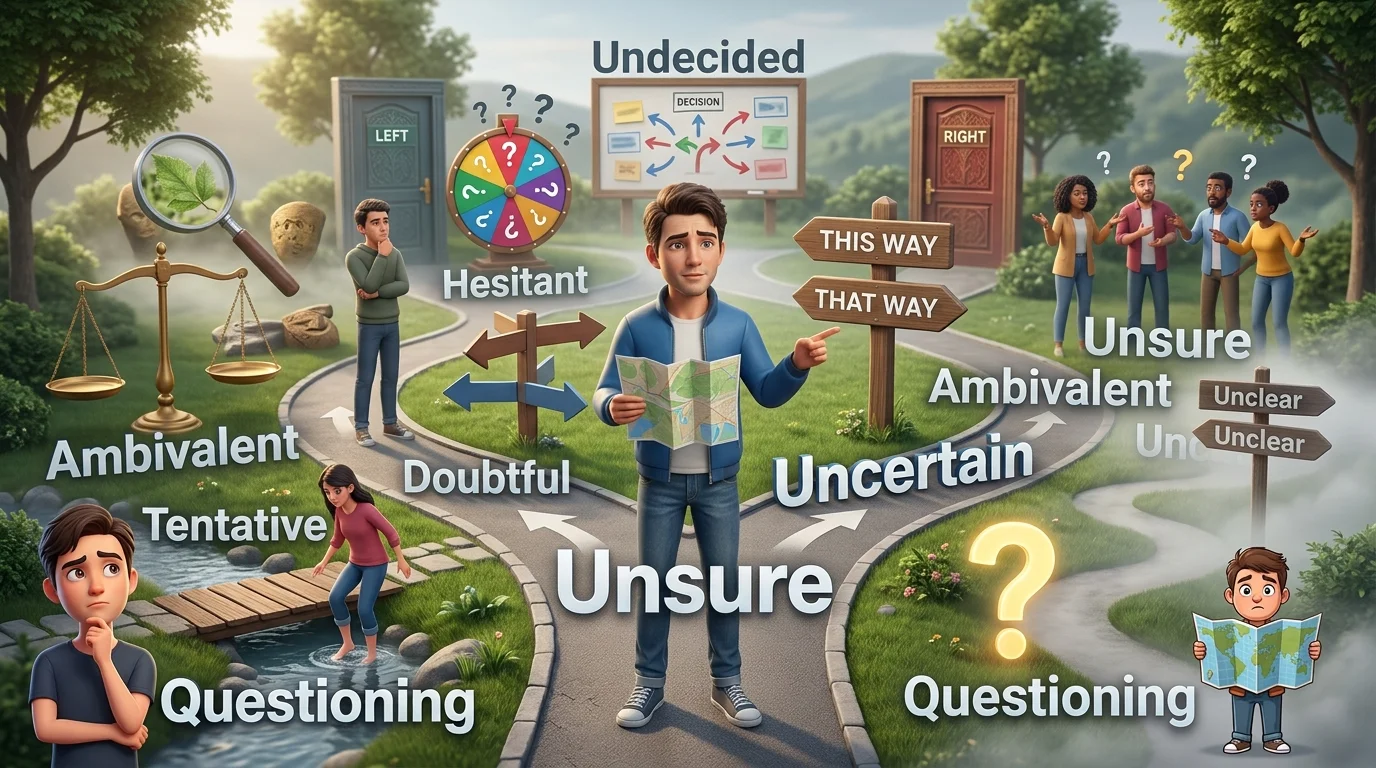
The closest and most useful synonyms for unsure include:
- Uncertain
- Doubtful
- Hesitant
- Undecided
- Unclear
- Uncertain-minded
- Insecure
- Ambivalent
- Tentative
- Questioning
- Skeptical
- Wavering
- Indecisive
- Unresolved
- Dubious
- Suspicious
- Conflicted
- Reluctant
- Hesitating
- Unconvinced
- Unsatisfied
- In doubt
- At a loss
- Perplexed
- Puzzled
The best general synonym is uncertain, while hesitant, doubtful, undecided, and insecure are more specific alternatives.
What Does Unsure Mean?
Unsure is an adjective meaning not certain, confident, or convinced about something.
For example:
I am unsure about the answer.
This means I do not know whether the answer is correct.
She was unsure whether to accept the offer.
This means she had difficulty deciding.
He felt unsure of himself during the interview.
This means he lacked confidence.
The meaning changes slightly depending on what follows unsure.
Quick Synonym List
| Synonym | Main Meaning | Tone |
|---|---|---|
| Uncertain | Not certain or definite | Neutral |
| Doubtful | Having doubts | Neutral |
| Hesitant | Slow or reluctant to decide | Neutral |
| Undecided | Unable to choose | Neutral |
| Unclear | Difficult to understand or determine | Neutral |
| Insecure | Lacking confidence | Personal |
| Ambivalent | Having conflicting feelings | Formal |
| Tentative | Not definite or final | Formal |
| Questioning | Having doubts or seeking answers | Neutral |
| Skeptical | Not easily convinced | Neutral |
| Wavering | Changing between choices | Neutral |
| Indecisive | Struggling to make decisions | Usually Negative |
| Dubious | Feeling doubt about truth or validity | Formal |
| Conflicted | Experiencing opposing feelings | Neutral |
| Unconvinced | Not persuaded | Neutral |
| Perplexed | Confused by something | Formal |
| Puzzled | Confused or uncertain | Everyday |
| Reluctant | Unwilling or hesitant | Neutral |
| Unresolved | Not settled or decided | Formal |
| In doubt | Not certain | Neutral |
Closest Synonyms for Unsure
Uncertain
Uncertain is the closest broad synonym for unsure.
I am unsure about the results.
I am uncertain about the results.
Both sentences express a lack of certainty.
Uncertain is especially useful in formal and professional writing.
Doubtful
Doubtful means having doubts about whether something is true, possible, or likely.
She was doubtful about his explanation.
It often suggests that you have reasons to question something.
Hesitant
Hesitant describes someone who pauses or struggles before taking action or making a decision.
He was hesitant to sign the contract.
The emphasis is on action or decision, not simply lack of knowledge.
Undecided
Undecided means unable to choose between options.
I am still undecided about which car to buy.
This is a particularly good synonym when someone has multiple choices.
Unclear
Unclear describes something that is not easy to understand, determine, or interpret.
The instructions were unclear.
It can sometimes replace unsure, but the grammatical subject changes.
Compare:
I am unsure about the instructions.
The instructions are unclear.
Unsure vs. Uncertain
These words are often interchangeable.
Unsure is common in everyday English.
Uncertain sounds slightly more formal and is widely used in professional, academic, and analytical writing.
Compare:
I am unsure what to do.
I am uncertain what to do.
Both are correct.
For casual conversation, unsure sounds natural. For formal writing, uncertain often fits better.
Unsure vs. Doubtful
These words differ in emphasis.
Unsure means you lack certainty.
Doubtful suggests that you have reasons to question something.
I am unsure whether she will come.
This simply means I do not know.
I am doubtful that she will come.
This suggests I think her coming may be unlikely.
Unsure vs. Hesitant
Unsure focuses on uncertainty.
Hesitant focuses on reluctance or difficulty taking action.
She was unsure whether to speak.
This means she did not know whether speaking was the right choice.
She was hesitant to speak.
This suggests she was reluctant or nervous about doing so.
Unsure vs. Undecided
Undecided specifically concerns a choice.
I am undecided about which university to attend.
You can be unsure about a fact without being undecided.
I am unsure whether the information is accurate.
There is no choice involved here.
Unsure vs. Insecure
Insecure usually concerns confidence, self-belief, safety, or stability.
He felt unsure of himself.
He felt insecure about his abilities.
These can be similar.
But:
I am unsure about the answer.
does not mean:
I am insecure about the answer.
The second sounds unusual because insecure is generally about confidence rather than factual uncertainty.
Unsure vs. Ambivalent
Ambivalent means having conflicting or mixed feelings about something.
She was ambivalent about moving abroad.
She may simultaneously want to move and want to stay.
Unsure is broader and does not necessarily imply conflicting feelings.
Unsure vs. Tentative
Tentative describes something that is not final, definite, or firmly established.
We have a tentative plan for Friday.
This means the plan may change.
I am unsure about the plan.
This means I am not certain about it.
Formal and Professional Synonyms
Uncertain
The safest formal alternative to unsure.
The outcome remains uncertain.
Tentative
Useful when a decision, estimate, proposal, or plan is not final.
The company made a tentative agreement.
Ambivalent
Useful when someone has mixed or conflicting feelings.
The committee remained ambivalent about the proposal.
Dubious
Useful when someone has serious doubts about truth, quality, or validity.
The researcher was dubious about the reliability of the data.
Unresolved
Useful when an issue has not been settled.
Several questions remain unresolved.
Unconvinced
Useful when someone has not accepted an argument or explanation.
The reviewers remained unconvinced by the evidence.
Neutral and Everyday Alternatives
Doubtful
I am doubtful that the plan will work.
Hesitant
She was hesitant to answer.
Undecided
He is still undecided.
Puzzled
I was puzzled by the unexpected result.
Confused
She was confused about what to do next.
Wavering
He was wavering between the two options.
These words are easy to understand and work well in everyday communication.

Synonyms for Different Types of Unsure
Unsure About a Fact
Use:
- Uncertain
- Doubtful
- Unconvinced
- Skeptical
- Dubious
- Questioning
Example:
I am unsure whether the claim is true.
I am skeptical about the claim.
Unsure About a Decision
Use:
- Undecided
- Hesitant
- Indecisive
- Wavering
- Ambivalent
- Conflicted
Example:
She was unsure about accepting the job.
She was undecided about accepting the job.
Unsure Because of Confusion
Use:
- Confused
- Puzzled
- Perplexed
- Bewildered
- Unclear
- At a loss
Example:
I was unsure about the instructions.
I was confused by the instructions.
Unsure Because of Lack of Confidence
Use:
- Insecure
- Self-doubting
- Unconfident
- Hesitant
- Apprehensive
Example:
He felt unsure of himself.
He felt insecure about his abilities.
Comparison Table
| Word | Main Meaning | Best Context | Tone |
|---|---|---|---|
| Unsure | Lacking certainty | General | Neutral |
| Uncertain | Lacking certainty | General/Formal | Neutral |
| Doubtful | Having doubts | Claims/outcomes | Neutral |
| Hesitant | Slow to act | Decisions/actions | Neutral |
| Undecided | Unable to choose | Choices | Neutral |
| Unclear | Not understandable/definite | Information | Neutral |
| Insecure | Lacking confidence | Personal confidence | Personal |
| Ambivalent | Having mixed feelings | Decisions/feelings | Formal |
| Tentative | Not final | Plans/proposals | Formal |
| Skeptical | Not easily convinced | Claims/evidence | Neutral |
| Wavering | Changing between options | Decisions | Neutral |
| Indecisive | Struggling to decide | People/decisions | Negative |
| Dubious | Strongly doubtful | Truth/validity | Formal |
| Conflicted | Experiencing opposing feelings | Personal decisions | Neutral |
| Unconvinced | Not persuaded | Arguments/evidence | Neutral |
| Perplexed | Very confused | Difficult situations | Formal |
| Puzzled | Confused | Everyday | Neutral |
| Reluctant | Unwilling/hesitant | Actions | Neutral |
| Unresolved | Not settled | Issues/questions | Formal |
How to Choose the Right Synonym
Use uncertain for general lack of certainty.
Use doubtful when you question whether something is true or likely.
Use hesitant when you are reluctant to act.
Use undecided when you cannot choose between options.
Use unclear when information, instructions, or meaning is difficult to understand.
Use insecure when the uncertainty comes from a lack of confidence.
Use ambivalent when you have conflicting feelings.
Use tentative when a plan or decision is not final.
Use skeptical when you are not easily convinced.
Use indecisive when someone repeatedly struggles to make decisions.
Use dubious when you have serious doubts about credibility or validity.
Use conflicted when two opposing feelings or priorities compete.
Sentence Transformations
General Uncertainty
Original:
I am unsure about the answer.
Using uncertain:
I am uncertain about the answer.
Doubting a Claim
Original:
She was unsure whether his story was true.
Using doubtful:
She was doubtful that his story was true.
The second version suggests greater suspicion.
Difficulty Making a Decision
Original:
He was unsure about accepting the offer.
Using undecided:
He was undecided about accepting the offer.
Reluctance to Act
Original:
She was unsure about speaking in front of everyone.
Using hesitant:
She was hesitant to speak in front of everyone.
This emphasizes reluctance rather than simply uncertainty.
Lack of Confidence
Original:
He felt unsure of himself.
Using insecure:
He felt insecure about himself.
More naturally:
He felt insecure about his abilities.
Mixed Feelings
Original:
She was unsure about moving to another city.
Using ambivalent:
She was ambivalent about moving to another city.
This suggests she had both positive and negative feelings about the move.
Grammar and Usage
Unsure is an adjective.
Common patterns include:
- unsure about something
- unsure of something
- unsure whether
- unsure if
- unsure what to do
- unsure how to respond
- unsure where to go
- unsure who to trust
- feel unsure
- remain unsure
- seem unsure
Examples:
I am unsure about the decision.
She was unsure of herself.
We are unsure whether the plan will work.
He seemed unsure how to respond.
Unsure About vs. Unsure Of
Both are correct, but they are commonly used in different patterns.
Unsure about often refers to a matter, decision, or situation:
I am unsure about the plan.
Unsure of often refers to knowledge, identity, ability, or confidence:
I am unsure of the answer.
She is unsure of herself.
Common Collocations With Unsure
Natural combinations include:
- feel unsure
- remain unsure
- seem unsure
- look unsure
- sound unsure
- be unsure about
- be unsure of
- be unsure whether
- be unsure how
- be unsure what to do
- be unsure what to say
- be unsure of yourself
- unsure about the future
- unsure about the decision
- unsure about the outcome
- unsure of the answer
- unsure of the result
Common Mistakes
Mistake 1: Using Indecisive for Every Kind of Uncertainty
Indecisive specifically describes difficulty making decisions.
I am unsure whether the information is accurate.
Do not automatically replace this with:
I am indecisive whether the information is accurate.
That sounds unnatural because this is a question of certainty, not decision-making.
Mistake 2: Using Insecure for Factual Uncertainty
Insecure generally relates to confidence.
She was unsure about the answer.
is different from:
She was insecure about her abilities.
Mistake 3: Treating Unclear and Unsure as Identical
Usually, a person is unsure, while information can be unclear.
I am unsure about the instructions.
The instructions are unclear.
Mistake 4: Using Doubtful When You Only Mean Uncertain
Doubtful can imply that you think something is unlikely or questionable.
I am uncertain whether he will come.
is more neutral than:
I am doubtful that he will come.
Mistake 5: Confusing Hesitant With Uncertain
Hesitant suggests difficulty taking action.
She was hesitant to answer.
This does not necessarily mean she did not know the answer.
When Not to Use a Synonym for Unsure
Sometimes unsure is the best choice.
Use unsure when:
- You want simple everyday language.
- You are describing a person’s uncertainty.
- You do not want to imply suspicion.
- You do not want to imply confusion.
- You do not want to imply reluctance.
- The exact source of uncertainty is not important.
For example:
I am unsure what will happen next.
This is natural, clear, and neutral.
Replacing it with a more specialized word could introduce a meaning that was not originally intended.
Writing Tips
For precise writing, first identify why someone is unsure.
If they lack information, use uncertain.
If they question truth or likelihood, use doubtful or skeptical.
If they cannot choose, use undecided.
If they hesitate to act, use hesitant.
If they lack confidence, use insecure.
If they have conflicting feelings, use ambivalent or conflicted.
If the information itself is difficult to understand, use unclear.
If a proposal or plan is not final, use tentative.
This makes your writing more precise and avoids treating every form of uncertainty as the same.
Related Questions
What is a professional word for unsure?
Uncertain is the most versatile professional alternative. Depending on the context, tentative, unresolved, doubtful, ambivalent, or unconvinced may be more precise.
What is a stronger word for unsure?
Depending on the meaning, doubtful, skeptical, dubious, conflicted, perplexed, or ambivalent can express stronger or more specific uncertainty.
What is a synonym for unsure about a decision?
Useful alternatives include undecided, hesitant, indecisive, wavering, conflicted, and ambivalent.
What is a synonym for unsure of yourself?
Useful alternatives include insecure, self-doubting, unconfident, hesitant, and lacking confidence.
What is a synonym for unsure about the future?
Possible alternatives include uncertain about the future, apprehensive about the future, doubtful about the future, or unclear about what lies ahead.
What is the opposite of unsure?
Common opposites include certain, sure, confident, definite, convinced, decisive, and assured, depending on the context.