
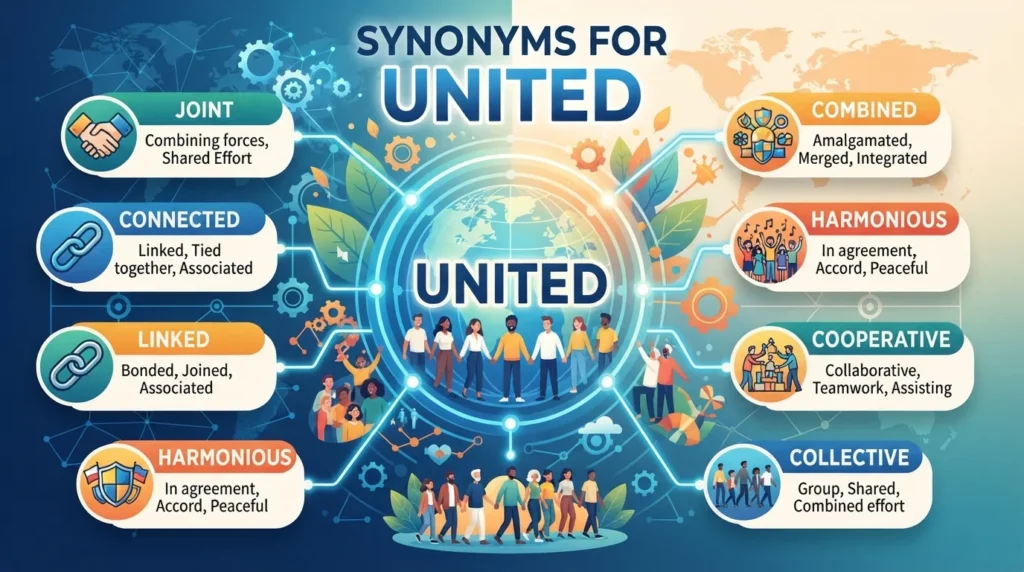
Quick Synonym List
Because united has several related meanings, the best alternative depends on the context.
Closest alternatives
- unified
- joined
- combined
- connected
- integrated
- together
- bonded
- cohesive
- coordinated
- allied
For people working together
- cooperative
- collaborative
- coordinated
- organized
- supportive
- mutually supportive
- team-oriented
- concerted
For agreement
- unanimous
- agreed
- harmonious
- in accord
- of one mind
- like-minded
- consenting
- concordant
For groups becoming one
- unified
- merged
- consolidated
- integrated
- combined
- joined
- amalgamated
- incorporated
For political, military, or strategic alliances
- allied
- coalition-based
- partnered
- affiliated
- associated
- aligned
- coordinated
For emotional or personal bonds
- bonded
- connected
- close-knit
- devoted
- attached
- united in purpose
- bound together
Key distinction: United is a broad word. It can mean joined together physically, working together, sharing a purpose, agreeing with one another, or remaining closely connected. A good synonym should preserve the particular meaning intended.
What Does “United” Mean?
United is an adjective that describes people, groups, organizations, countries, or other entities that are joined together, working together, or acting with a shared purpose.
For example:
The community remained united during the crisis.
This means the members stayed together and supported a common position or purpose.
The word can describe several different kinds of connection.
Physical or structural connection
The two sections are united by a narrow bridge.
Here, united means joined or connected.
Shared purpose
The workers were united in their demand for better conditions.
Here, united means sharing a common goal.
Agreement
The committee was united in its support for the proposal.
Here, the members were in agreement.
Cooperation
The organizations united to provide emergency assistance.
Here, united means came together to cooperate.
Emotional connection
The experience united the two families.
Here, the experience brought them closer together.
Because these meanings differ, words such as joined, unanimous, allied, and bonded cannot always replace one another.
The Best Synonyms for United
1. Unified
Unified is one of the closest general alternatives to united.
- Meaning: Brought or held together as one group or whole
- Tone: Neutral to formal
- Best for: Groups, organizations, movements, communities, and teams
- Interchangeability: Very high in many contexts
Example:
The organization remained unified despite internal disagreements.
United vs. unified:
United often emphasizes people joining together around a common purpose. Unified can emphasize the result of becoming one coordinated or coherent whole.
The team was united behind its captain.
The team was unified behind its captain.
Both are natural.
2. Joined
Joined means brought together or connected.
- Meaning: Connected or brought into association
- Tone: Neutral
- Best for: People, objects, groups, organizations, and physical structures
- Interchangeability: High in some contexts
Example:
The two organizations joined forces to support the project.
Joined can describe a physical connection as well as cooperation.
The two pipes are joined together.
Several groups joined together to organize the event.
Watch out: Joined does not always imply agreement or emotional solidarity.
3. Combined
Combined means brought together so that separate things form a larger whole.
- Meaning: Put together or used together
- Tone: Neutral
- Best for: Resources, efforts, organizations, ideas, and forces
- Interchangeability: Context-dependent
Example:
The two teams combined their resources.
Combined focuses on bringing separate elements together. It does not necessarily imply emotional unity or agreement.
4. Connected
Connected means linked or related to one another.
- Meaning: Linked physically, socially, emotionally, or conceptually
- Tone: Neutral
- Best for: People, systems, places, ideas, and relationships
- Interchangeability: Sometimes
Example:
The experience left the entire community feeling connected.
Watch out: People can be connected without being united. A group may have relationships with one another without sharing a goal or position.
5. Integrated
Integrated means combined into a functioning whole.
- Meaning: Incorporated so that separate parts work together
- Tone: Professional or formal
- Best for: Organizations, systems, communities, technology, and institutions
- Interchangeability: Limited
Example:
The departments became more integrated after the restructuring.
Integrated emphasizes successful incorporation into a larger system.
6. Together
Together is a broad and natural alternative in many everyday situations.
- Meaning: In the same place, group, activity, or relationship
- Tone: Neutral and conversational
- Best for: Everyday speech, relationships, teams, and shared activities
- Interchangeability: Context-dependent
Example:
We must stay together during difficult times.
It is less formal than united and does not always imply agreement.
The students worked together.
This means they cooperated, but it does not necessarily mean they shared every opinion.
7. Bonded
Bonded emphasizes a strong connection between people.
- Meaning: Developed a close emotional or social connection
- Tone: Neutral to warm
- Best for: Families, friends, teammates, and shared experiences
- Interchangeability: Limited
Example:
The difficult experience bonded the members of the team.
Use bonded when emotional closeness is more important than political, strategic, or practical cooperation.
8. Cohesive
Cohesive describes a group whose members remain closely connected and work effectively as a unit.
- Meaning: Closely united and mutually supportive
- Tone: Professional or academic
- Best for: Teams, organizations, communities, groups, and arguments
- Interchangeability: Often
Example:
The company developed a more cohesive leadership team.
Cohesive is especially useful in professional and academic writing.
9. Coordinated
Coordinated means organized so that different people or activities work effectively together.
- Meaning: Carefully organized to operate together
- Tone: Professional
- Best for: Teams, operations, campaigns, emergency responses, and projects
- Interchangeability: Limited
Example:
The agencies launched a coordinated response to the emergency.
A coordinated group does not necessarily agree on everything. The focus is on organized cooperation.
10. Allied
Allied describes people, groups, or countries that cooperate because they share interests or goals.
- Meaning: Joined through an alliance or partnership
- Tone: Formal or neutral
- Best for: Countries, organizations, businesses, and groups
- Interchangeability: Context-dependent
Example:
The allied organizations worked together on the humanitarian project.
Allied emphasizes a relationship based on cooperation or common interests.
11. Cooperative
Cooperative describes people or groups that are willing to work together.
- Meaning: Willing or able to cooperate
- Tone: Neutral to positive
- Best for: Teams, employees, organizations, communities, and relationships
- Interchangeability: Sometimes
Example:
The two departments maintained a cooperative relationship.
Watch out: Cooperative describes willingness to work together, while united often suggests a stronger shared purpose.
12. Collaborative
Collaborative describes people or organizations working together on a task or project.
- Meaning: Produced through joint effort
- Tone: Professional
- Best for: Workplaces, education, research, creative projects, and technology
- Interchangeability: Limited
Example:
The project was a collaborative effort between several universities.
Use collaborative when the emphasis is on joint work.
13. Unanimous
Unanimous means everyone in a particular group agrees.
- Meaning: Complete agreement
- Tone: Neutral to formal
- Best for: Decisions, votes, opinions, and resolutions
- Interchangeability: Limited but precise
Example:
The committee was unanimous in its support for the proposal.
This is one of the most important distinctions.
United does not always mean everyone agrees. A group can be united around a broad goal while disagreeing about details.
14. Harmonious
Harmonious describes people or groups existing or working together without serious conflict.
- Meaning: Peaceful, compatible, and well-balanced
- Tone: Positive
- Best for: Relationships, communities, teams, and social situations
- Interchangeability: Sometimes
Example:
The families maintained a harmonious relationship.
Use harmonious when the emphasis is on peace and compatibility rather than a shared campaign or objective.
15. Aligned
Aligned means having similar goals, positions, interests, or priorities.
- Meaning: In agreement or working toward the same objective
- Tone: Professional
- Best for: Organizations, strategies, policies, teams, and opinions
- Interchangeability: Often in professional contexts
Example:
The departments are aligned on the project’s main objectives.
Aligned is common in business writing because it emphasizes shared direction.
16. Like-Minded
Like-minded describes people who have similar opinions, interests, values, or goals.
- Meaning: Sharing similar ideas or attitudes
- Tone: Neutral
- Best for: Groups, communities, organizations, and social movements
- Interchangeability: Limited
Example:
The conference brought together like-minded professionals.
Being like-minded can help people become united, but the two words are not identical.
17. Consolidated
Consolidated means combined into a stronger or more organized whole.
- Meaning: Brought together and strengthened
- Tone: Formal or professional
- Best for: Businesses, organizations, resources, power, and information
- Interchangeability: Limited
Example:
The company consolidated its regional offices.
This word emphasizes structural combination or strengthening, not emotional unity.
18. Merged
Merged means two or more separate entities became one.
- Meaning: Combined into a single entity
- Tone: Neutral or professional
- Best for: Companies, organizations, departments, databases, and systems
- Interchangeability: Limited
Example:
The two departments merged into a single division.
A merger is more specific than unity because the separate entities may cease to operate independently.
19. Affiliated
Affiliated means officially or informally connected with another organization or group.
- Meaning: Associated or linked
- Tone: Formal or professional
- Best for: Organizations, institutions, businesses, and professional groups
- Interchangeability: Limited
Example:
The local clinics are affiliated with the university hospital.
Affiliation does not necessarily mean the groups are united in purpose or opinion.
20. Close-Knit
Close-knit describes a group whose members have strong personal relationships and support one another.
- Meaning: Closely connected socially or emotionally
- Tone: Warm and positive
- Best for: Families, communities, teams, and small groups
- Interchangeability: Sometimes
Example:
They are a close-knit community that supports one another.
Use this when the relationship itself is the focus.
Synonyms for United by Context
United in Purpose
When people are united because they share a goal, the most useful alternatives are:
- unified
- aligned
- joined
- coordinated
- cooperative
- collaborative
- allied
- like-minded
- concerted
- working together
Example
The workers were united in their efforts to improve safety.
Possible alternatives:
The workers were unified in their efforts to improve safety.
The workers were aligned around the goal of improving safety.
The workers made a concerted effort to improve safety.
The meaning changes slightly with each choice.
United in Agreement
If united means people agree with one another, consider:
- unanimous
- agreed
- in agreement
- in accord
- of one mind
- harmonious
- concordant
- aligned
- like-minded
Example
The committee was united in its decision.
Possible rewrite:
The committee was unanimous in its decision.
This is stronger and more precise if every member supported the decision.
United as a Group
When a group remains together, use:
- unified
- cohesive
- close-knit
- connected
- bonded
- together
- organized
- consolidated
Example
The community remained united despite the difficulties.
Possible rewrite:
The community remained cohesive despite the difficulties.
Here, cohesive emphasizes the group’s ability to stay connected.
United for a Common Cause
When people come together to support a cause, useful expressions include:
- united
- unified
- aligned
- joined together
- rallied together
- acting collectively
- working together
- standing together
- in solidarity
- of one mind
Example
The community united to protect the local park.
Possible alternatives:
The community came together to protect the local park.
The community rallied together to protect the local park.
The community stood together to protect the local park.
These phrases are often more natural than a formal synonym in everyday writing.
United in Marriage or Partnership
In personal or relationship contexts, united can mean joined through marriage or a close relationship.
Possible alternatives include:
- joined
- bonded
- connected
- partnered
- married
- bound together
- brought together
Example
The couple was united in marriage.
Possible rewrite:
The couple was joined in marriage.
Or:
The ceremony brought the two families together.
Married is more specific than united because it identifies the exact relationship.
United Against Something
When people cooperate in opposition to a problem or threat, use:
- joined forces
- allied
- collaborated
- stood together
- rallied
- combined efforts
- acted collectively
- formed a coalition
- worked together
Example
Several organizations united against the proposed policy.
Possible rewrite:
Several organizations joined forces in opposition to the proposal.
Joined forces is especially natural when separate groups cooperate for a specific purpose.
United in the Workplace
For professional writing, the best alternative depends on what you mean.
Shared goals
Use aligned, unified, or coordinated.
The leadership team is aligned on the company’s priorities.
Joint work
Use collaborative, cooperative, or coordinated.
The departments took a collaborative approach.
Strong team relationships
Use cohesive or close-knit.
We have a highly cohesive team.
Complete agreement
Use unanimous.
The board reached a unanimous decision.
Avoid replacing united with unanimous unless everyone actually agrees.
Formal Alternatives to United
For formal or academic writing, consider:
- unified
- cohesive
- aligned
- consolidated
- integrated
- allied
- coordinated
- unanimous
- harmonious
- concordant
- cooperative
- collective
- concerted
Example
Informal:
The organizations were united in their efforts.
More formal:
The organizations were aligned in their efforts.
Or:
The organizations made a concerted effort.
The best choice depends on whether you mean shared goals, cooperation, or coordinated action.
Casual Alternatives to United
For everyday English, natural alternatives include:
- together
- joined together
- came together
- stood together
- worked together
- joined forces
- stuck together
- bonded
- rallied together
Example
We stayed united during the difficult period.
Casual:
We stuck together during the difficult period.
This sounds more conversational and personal.
United vs. Unified
These words are extremely close.
United often emphasizes people or groups coming together around a shared purpose.
The community was united against the proposal.
Unified often emphasizes the result of becoming one coordinated group.
The organization presented a unified position.
Both can work in many contexts.
Simple distinction
United = together around something
Unified = functioning or presenting as one
The distinction is not absolute, but it can help with word choice.
United vs. Unanimous
These words are not interchangeable.
United means joined together or sharing a broad purpose.
Unanimous means everyone agrees.
Compare:
The team was united behind the project.
The members support the project but could disagree about how to complete it.
The team was unanimous in approving the proposal.
Every member agreed with the decision.
Use unanimous only when complete agreement is intended.
United vs. Allied
United is broader.
Allied usually describes separate parties that cooperate because of shared interests or goals.
The countries were united against the threat.
The countries were allied against the threat.
The second sentence emphasizes an alliance between otherwise separate countries.
United vs. Together
Together is more general and conversational.
The family stayed united during the crisis.
The family stayed together during the crisis.
The first emphasizes solidarity.
The second can simply mean that they remained with one another.
United vs. Cohesive
Cohesive focuses on how well the members of a group remain connected.
The team is united behind its leader.
The team is cohesive and works effectively together.
A group can be cohesive without being united around a particular cause.
United vs. Integrated
Integrated emphasizes that separate parts have been incorporated into one functioning system.
The departments became integrated after the merger.
This does not simply mean that the departments agreed with one another.
Use integrated when structural or functional combination matters.
United vs. Connected
Connected is broader and weaker.
The two communities are connected by shared history.
This does not necessarily mean they act together.
The two communities are united around a common goal.
This clearly indicates shared purpose.
United vs. Combined
Combined emphasizes putting separate things together.
The teams combined their resources.
United can suggest a stronger social or purposeful relationship.
The teams united to solve the problem.
The difference is subtle but useful: combined often focuses on the elements being brought together, while united often focuses on their shared action or purpose.
Comparison Table
| Word | Main Meaning | Tone | Strength | Best Use | Interchangeable? |
|---|---|---|---|---|---|
| United | Joined around a purpose or connection | Neutral | Medium | General use | — |
| Unified | Formed or functioning as one | Neutral/formal | Strong | Groups and organizations | Often |
| Joined | Connected or brought together | Neutral | Medium | People, groups, objects | Often |
| Combined | Put together into a whole | Neutral | Medium | Resources and efforts | Sometimes |
| Connected | Linked or related | Neutral | Mild | Relationships and systems | Sometimes |
| Integrated | Incorporated into a functioning whole | Formal | Strong | Organizations and systems | Sometimes |
| Together | In the same group or activity | Conversational | Mild | Everyday use | Sometimes |
| Cohesive | Closely connected as a group | Professional | Strong | Teams and organizations | Often |
| Allied | Cooperating through an alliance | Formal | Strong | Countries and organizations | Sometimes |
| Cooperative | Willing to work together | Neutral | Medium | People and groups | Sometimes |
| Collaborative | Working jointly | Professional | Medium | Projects and work | Sometimes |
| Unanimous | Completely in agreement | Formal | Very strong | Decisions and votes | Only for agreement |
| Harmonious | Peaceful and compatible | Positive | Medium | Relationships | Sometimes |
| Aligned | Sharing goals or direction | Professional | Medium | Strategy and organizations | Often |
| Bonded | Emotionally connected | Warm | Strong | People and relationships | Sometimes |
| Close-knit | Strongly connected socially | Warm | Strong | Families and communities | Sometimes |
| Consolidated | Combined and strengthened | Formal | Strong | Organizations and power | Limited |
| Merged | Separate entities become one | Professional | Very strong | Companies and departments | Limited |
Sentence Transformations
1. Shared purpose
Original:
The community remained united during the crisis.
Alternative:
The community remained unified during the crisis.
Why: Unified emphasizes the group remaining as one.
2. Complete agreement
Original:
The committee was united in its support for the proposal.
Alternative:
The committee was unanimous in its support for the proposal.
Why: Unanimous specifically means every member agreed.
3. Professional strategy
Original:
The departments are united around the company’s goals.
Alternative:
The departments are aligned around the company’s goals.
Why: Aligned is especially natural in professional and strategic contexts.
4. Joint work
Original:
The organizations united to solve the problem.
Alternative:
The organizations joined forces to solve the problem.
Why: Joined forces clearly emphasizes cooperation between separate organizations.
5. Emotional connection
Original:
The experience united the family.
Alternative:
The experience bonded the family.
Why: Bonded emphasizes the emotional relationship created by the experience.
6. Teamwork
Original:
The team was united and productive.
Alternative:
The team was cohesive and productive.
Why: Cohesive highlights the team’s ability to function effectively as a connected group.
7. Organizational combination
Original:
The two departments became united after the restructuring.
Alternative:
The two departments were integrated after the restructuring.
Why: Integrated emphasizes structural incorporation.
8. Peaceful relationship
Original:
The neighboring communities remained united.
Alternative:
The neighboring communities maintained a harmonious relationship.
Why: Harmonious emphasizes peace and compatibility.
9. Casual conversation
Original:
We remained united through the difficult period.
Alternative:
We stuck together through the difficult period.
Why: Stuck together is more natural and conversational.
10. Business collaboration
Original:
Several companies united to develop the technology.
Alternative:
Several companies collaborated to develop the technology.
Why: Collaborated focuses specifically on joint work.
Grammar and Usage
United is primarily an adjective.
Common structures include:
- united in something
- united around a goal
- united behind a person or position
- united against an opponent or problem
- united by a shared experience or belief
- united with another person or group
- united for a common purpose
United in
The members were united in their support.
This emphasizes shared agreement or purpose.
United around
The community united around a common cause.
This emphasizes a central goal or principle.
United behind
The team was united behind its captain.
This emphasizes support for a person, idea, or position.
United against
The organizations united against the threat.
This emphasizes collective opposition.
United by
The students were united by a shared passion for science.
This emphasizes the thing that connects them.
United with
The smaller organization became united with the larger association.
This can describe formal or general combination, although merged with may be more precise for organizational restructuring.
“United” in Common Expressions
United We Stand
United we stand expresses the idea that people are stronger when they remain together.
It is an established expression about solidarity and collective strength.
Example
United we stand, divided we fall.
This expression contrasts cooperation with division.
United Front
A united front is a situation in which people or groups present a common position, especially when facing an external challenge.
The departments presented a united front during the negotiations.
A united front does not necessarily mean that every member agrees privately on every issue. It emphasizes a common public position or coordinated action.
United Against
The community was united against the proposed closure.
This structure emphasizes collective opposition.
United Behind
The employees were united behind the new initiative.
This means they broadly supported the initiative.
United in
The researchers were united in their belief that further testing was necessary.
This structure emphasizes agreement.
Common Mistakes
1. Treating “united” and “unanimous” as identical
A united group can disagree about details.
Unanimous requires complete agreement.
2. Using “allied” for any group working together
An alliance usually involves separate parties cooperating because of shared interests.
3. Using “integrated” for emotional unity
Integrated is primarily about incorporating separate parts into a functioning whole.
4. Using “cohesive” to mean unanimous
A cohesive team can contain different opinions while still working effectively together.
5. Assuming “connected” means united
Connection can be weak or indirect. Unity generally suggests a stronger relationship or common purpose.
6. Using “combined” when agreement is the important idea
Combined emphasizes putting things together. United can emphasize solidarity and shared purpose.
7. Using “bonded” for formal alliances
Bonded usually suggests emotional or interpersonal connection.
8. Using “collaborative” for every form of unity
Collaboration specifically involves working together. A united group may simply share a belief or position.
When “United” Is Better Than a Synonym
Do not replace united simply because it appears more than once in your writing.
United is often the best word when you want to combine the ideas of togetherness, solidarity, and shared purpose without specifying exactly how the connection works.
For example:
The community remained united during the crisis.
This is broader than:
The community remained cooperative during the crisis.
Cooperative suggests willingness to work together, but it does not necessarily capture solidarity.
Likewise:
The team was united behind its leader.
is more natural than:
The team was unanimous behind its leader.
Unanimous is about agreement, while united emphasizes collective support.
Good writing is not about replacing a common word with a more complicated one. The better choice is the word that preserves the intended meaning.
Which Synonym Should You Choose?
If you mean “joined together”
Use joined, unified, or combined.
If you mean “working together”
Use cooperative, collaborative, or coordinated.
If you mean “sharing the same goal”
Use unified, aligned, like-minded, or concerted.
If you mean “everyone agrees”
Use unanimous, in agreement, or of one mind.
If you mean “strongly connected”
Use cohesive, bonded, or close-knit.
If you mean “cooperating as separate parties”
Use allied, partnered, or affiliated, depending on the relationship.
If you mean “combined into one system”
Use integrated, merged, or consolidated.
If you mean “peaceful and compatible”
Use harmonious.
If you mean “in everyday language”
Use together, stuck together, came together, or joined forces.