
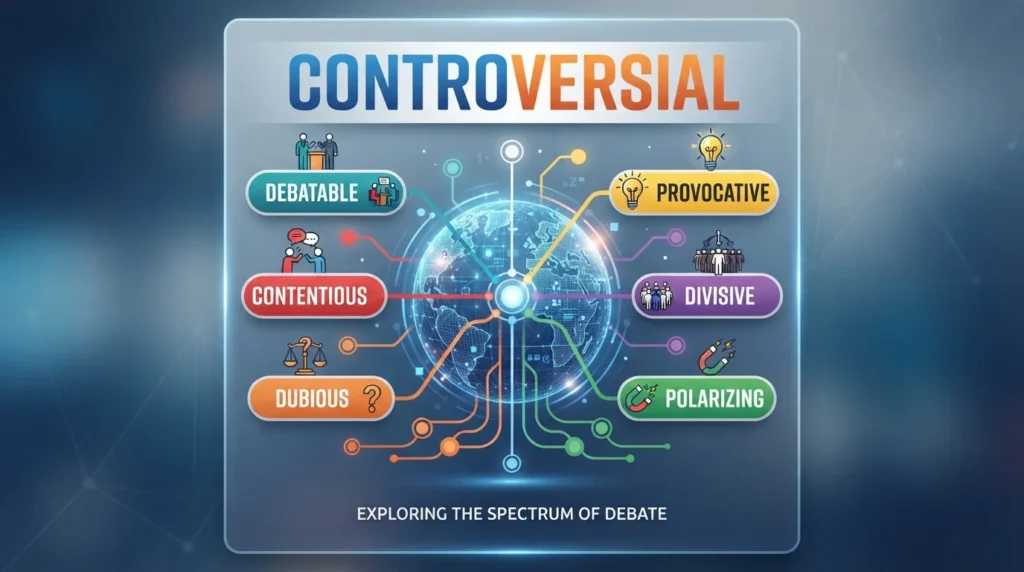
Quick Synonym List
Closest alternatives
- Contentious
- Disputed
- Contested
- Debatable
- Divisive
- Polarizing
- Provocative
- Polemical
- Disagreeable
- Questionable
Formal and academic alternatives
- Contentious
- Disputed
- Contested
- Debatable
- Polemical
- Disputable
- Open to debate
- Subject to dispute
- Under debate
- Heavily debated
When people strongly disagree
- Contentious
- Divisive
- Polarizing
- Disputed
- Contested
- Hotly debated
- Highly debated
- Fiercely contested
- Disagreement-provoking
When something causes a strong reaction
- Provocative
- Provoking
- Inflammatory
- Incendiary
- Sensational
- Confrontational
- Challenging
- Troubling
When something is questionable
- Debatable
- Disputable
- Questionable
- Doubtful
- Unsettled
- Unproven
- Contentious
- Subject to dispute
Informal alternatives
- Divisive
- Polarizing
- Heated
- Touchy
- Sensitive
- Hot-button
- Taboo
- Provocative
What Does “Controversial” Mean?
Controversial describes something that causes substantial disagreement, argument, criticism, or debate.
“The decision was controversial.”
This means people strongly disagreed about the decision or reacted to it in significantly different ways.
The word does not necessarily mean that something is wrong, false, unethical, or unpopular. It simply indicates that the subject has generated meaningful disagreement or strong opposing reactions.
For example:
“The controversial proposal divided the committee.”
Here, controversial tells us that the proposal caused disagreement. It does not tell us which side was correct.
This distinction matters when choosing a synonym.
- Contentious emphasizes disagreement.
- Divisive emphasizes separation between groups.
- Disputed emphasizes disagreement over a claim, fact, or decision.
- Provocative emphasizes the reaction something is designed or likely to produce.
- Questionable suggests doubt about quality, truth, validity, or acceptability.
The Closest Synonyms for Controversial
Contentious
Meaning: Likely to cause disagreement or argument.
Tone: Neutral to formal.
Best for: Issues, subjects, decisions, proposals, legal matters, and debates.
“The proposal remains contentious.”
How it differs: Contentious is one of the closest alternatives to controversial. It strongly emphasizes disagreement or argument.
Disputed
Meaning: Not accepted as true, correct, valid, or settled.
Tone: Neutral to formal.
Best for: Claims, facts, figures, territory, interpretations, and decisions.
The disputed claim has been examined by several researchers.”
How it differs: Disputed usually suggests that people disagree about the truth, validity, ownership, or accuracy of something.
Contested
Meaning: Subject to disagreement, challenge, or opposition.
Tone: Neutral to formal.
Best for: Decisions, elections, interpretations, claims, territory, rights, and positions.
“The results remain contested.”
How it differs: Contested emphasizes active challenge or opposition.
Debatable
Meaning: Open to argument or reasonable disagreement.
Tone: Neutral.
Best for: Claims, conclusions, decisions, interpretations, and opinions.
“Whether the policy was successful is debatable.”
How it differs: Debatable can be milder than controversial. Something may be debatable without being socially or politically divisive.
Divisive
Meaning: Causing people to split into opposing groups.
Tone: Neutral to negative.
Best for: Issues, policies, speeches, leaders, decisions, and public debates.
“The issue became increasingly divisive.”
How it differs: Divisive focuses specifically on the effect on groups of people.
Polarizing
Meaning: Causing people to form strongly opposed sides.
Tone: Neutral to negative.
Best for: Public figures, political issues, cultural debates, opinions, and social questions.
“The proposal has become highly polarizing.”
How it differs: Polarizing suggests a strong division into opposing camps.
Provocative
Meaning: Causing a strong reaction, especially by challenging accepted ideas or deliberately attracting attention.
Tone: Neutral to negative, depending on context.
Best for: Statements, art, questions, arguments, advertising, and behavior.
“The filmmaker made a provocative statement.”
How it differs: Something can be provocative without being controversial. Provocative focuses on the reaction it generates or is intended to generate.
Formal Alternatives
Polemical
Meaning: Strongly argumentative or aggressively critical, especially in writing or public debate.
Tone: Formal, often negative.
“The article takes a highly polemical approach.”
Use polemical when the controversy comes from forceful argument or criticism.
Disputable
Meaning: Open to being questioned or challenged.
“The claim is disputable.”
This is a more formal alternative to debatable or questionable.
Subject to dispute
A formal phrase meaning that something is not universally accepted.
“The interpretation remains subject to dispute.”
This works especially well in academic, legal, and analytical writing.
Open to debate
A neutral phrase that indicates that reasonable disagreement remains possible.
“The long-term effects are still open to debate.”
It is often softer than controversial.
Heavily debated
Useful when the important feature is the amount of discussion surrounding an issue.
“The proposal has been heavily debated.”
This does not necessarily imply hostility or division.
Synonyms for Something That Divides People
Divisive
“The issue became divisive.”
This is one of the strongest choices when the controversy creates opposing groups.
Polarizing
“The candidate’s remarks were polarizing.”
This suggests that people moved toward strongly opposing positions.
Contentious
“The contentious issue dominated the meeting.”
This emphasizes argument rather than group division.
Hot-button
Tone: Informal.
Meaning: An issue that provokes strong public emotion or disagreement.
“Housing costs are a hot-button issue.”
It is especially common in journalism and everyday American English.
Sensitive
A sensitive issue may generate discomfort, disagreement, or strong reactions.
“The committee discussed several sensitive issues.”
However, sensitive is weaker than controversial. Something can be sensitive without being controversial.
Touchy
Tone: Informal.
“It’s a touchy subject.”
This suggests that people may react emotionally or defensively.
It is useful in conversation but generally too informal for academic or official writing.
Synonyms for Something That Provokes Strong Reactions
Provocative
“The artist’s work is deliberately provocative.”
This means something stimulates a strong reaction, often by challenging expectations.
Inflammatory
Meaning: Likely to provoke anger, hostility, or conflict.
“The statement was widely criticized as inflammatory.”
This is considerably stronger and more negative than controversial.
Incendiary
Meaning: Likely to provoke intense anger, conflict, or hostility.
“The speech contained several incendiary remarks.”
Incendiary is a strong word. Do not use it simply because something is controversial.
Confrontational
Meaning: Aggressively challenging or directly opposing someone or something.
“The interview took a confrontational turn.”
This describes behavior or communication more specifically than controversial.
Sensational
Meaning: Designed to attract attention through excitement, shock, or dramatic presentation.
“The newspaper published a sensational headline.”
Something can be sensational without being controversial.
Synonyms for a Questionable or Unsettled Claim
Questionable
Meaning: Open to doubt or criticism.
“The reliability of the evidence is questionable.”
This is stronger than simply saying something is controversial because it introduces doubt about its quality or validity.
Unsettled
Meaning: Not yet resolved or firmly established.
“The scientific question remains unsettled.”
This is useful when experts or evidence have not reached a clear conclusion.
Unproven
Meaning: Not established by sufficient evidence.
“The treatment remains unproven.”
Do not use unproven merely because something is controversial. A controversial claim can be well supported.
Doubtful
Meaning: Unlikely or difficult to believe.
“The explanation seems doubtful.”
This expresses skepticism and therefore should not automatically replace controversial.
Disputable
“The conclusion is disputable.”
This indicates that the conclusion can reasonably be challenged.

Controversial in Academic Writing
Academic writing often benefits from choosing a more precise word than controversial.
Compare:
“This is a controversial theory.”
Possible alternatives:
“This is a contested theory.”
“The theory remains disputed.”
“The theory is subject to debate.”
“The evidence remains inconclusive.”
Each sentence communicates something different.
Use “contested” when:
People actively challenge the interpretation or conclusion.
Use “disputed” when:
The truth, accuracy, or validity of a claim is in question.
Use “debatable” when:
Reasonable disagreement exists.
Use “unsettled” when:
The issue has not been resolved.
Use “inconclusive” when:
Available evidence does not establish a clear conclusion.
This last word is particularly important: inconclusive describes the evidence or result, not necessarily the social controversy surrounding the issue.
Controversial in Business and Professional Writing
In professional writing, precision is usually better than simply calling something controversial.
For example:
“The decision was controversial.”
Depending on the facts, you might instead write:
- “The decision was widely disputed.”
- “The decision generated significant disagreement.”
- “The proposal was contentious.”
- “The change prompted strong opposition.”
- “The policy divided stakeholders.”
- “The issue remains under debate.”
Each alternative identifies a different feature.
For disagreement
Use contentious.
For opposition
Use opposed or met with resistance.
For uncertainty
Use debatable or unsettled.
For division
Use divisive or polarizing.
For strong reactions
Use provocative.
Controversial in Journalism
News writing often uses controversial, but more specific wording can provide greater information.
Instead of:
“The controversial decision sparked discussion.”
Consider:
“The disputed decision prompted criticism from several groups.”
or:
“The decision divided members of the committee.”
The second versions identify what made the decision controversial.
That is usually more informative than simply attaching the adjective controversial.
Controversial in Everyday Conversation
For casual speech, people often use:
- Divisive
- Touchy
- Sensitive
- Heated
- Polarizing
- Hot-button
- Provocative
- Debatable
Examples:
“That’s a pretty divisive issue.”
“It’s a sensitive topic.”
“That’s a touchy subject.”
“It’s definitely a hot-button issue.”
These expressions are conversational and should be matched to the situation.
Controversial vs. Contentious
These words are very close.
Controversial means something generates substantial disagreement, argument, or strong reactions.
Contentious emphasizes conflict or disagreement.
Compare:
“The controversial proposal attracted national attention.”
“The contentious proposal led to a lengthy argument.”
The first emphasizes public controversy. The second emphasizes disagreement.
Controversial vs. Divisive
The distinction is important.
Controversial means people disagree about something.
Divisive means the disagreement separates people into opposing groups.
“The decision was controversial.”
does not necessarily mean that society or an organization split into two camps.
“The decision was divisive.”
does.
Therefore, divisive is more specific.
Controversial vs. Polarizing
Polarizing is similar to divisive but often suggests a particularly strong division between opposing positions.
“The issue is controversial.”
is broad.
“The issue is polarizing.”
suggests that people tend to cluster into strongly opposed sides.
Controversial vs. Debatable
Debatable often sounds milder.
“The conclusion is debatable.”
This means the conclusion can reasonably be questioned.
“The conclusion is controversial.”
suggests that it has generated significant disagreement or attention.
A claim can be debatable without being controversial.
Controversial vs. Disputed
Disputed usually points to a specific disagreement about truth, validity, ownership, interpretation, or accuracy.
“The disputed figures were removed from the report.”
This tells the reader what is being challenged.
Controversial is broader:
“The figures were controversial.”
This tells us that they caused disagreement but not exactly what the disagreement concerned.
Controversial vs. Provocative
Provocative describes something that causes or deliberately seeks a reaction.
“The artist made a provocative statement.”
Controversial describes the disagreement or controversy surrounding the statement.
A provocative statement may be controversial, but the two words are not interchangeable.
Controversial vs. Questionable
These words can communicate very different judgments.
“The claim is controversial.”
means people disagree about it.
“The claim is questionable.”
suggests that there are reasons to doubt it.
Calling something questionable therefore introduces a more skeptical evaluation.
True Synonyms vs. Related Alternatives
| Alternative | Relationship | Can Replace “Controversial”? | Tone | Best Context |
|---|---|---|---|---|
| Contentious | Very close synonym | Yes | Neutral/formal | Disagreement |
| Disputed | Close/meaning-specific | Often | Neutral/formal | Claims, facts, decisions |
| Contested | Close/meaning-specific | Often | Neutral/formal | Active challenge |
| Debatable | Near synonym | Often | Neutral | Opinions, conclusions |
| Divisive | Near synonym | Sometimes | Negative/neutral | Group division |
| Polarizing | Near synonym | Sometimes | Neutral/negative | Strong opposing camps |
| Provocative | Contextual alternative | Sometimes | Neutral/negative | Strong reactions |
| Polemical | Related alternative | Sometimes | Formal/negative | Argumentative writing |
| Questionable | Related alternative | Sometimes | Negative | Doubt or criticism |
| Unsettled | Contextual alternative | Sometimes | Neutral | Unresolved issues |
| Inflammatory | Stronger related term | No | Negative | Anger or hostility |
| Incendiary | Stronger related term | No | Strongly negative | Conflict-provoking remarks |
| Sensitive | Broader/contextual | Sometimes | Neutral | Delicate subjects |
| Touchy | Contextual alternative | Sometimes | Informal | Casual conversation |
| Hot-button | Contextual alternative | Sometimes | Informal | Public issues |
| Inconclusive | Different meaning | No | Neutral | Evidence/results |
Comparison Table: Which Word Should You Choose?
| Word/Phrase | Main Meaning | Tone | Strength | Best Use | Interchangeable? |
|---|---|---|---|---|---|
| Controversial | Causes significant disagreement | Neutral | Moderate | General use | — |
| Contentious | Causes argument or disagreement | Neutral/formal | Moderate | Issues, decisions | Often |
| Disputed | Challenged as true or valid | Neutral/formal | Moderate | Claims, facts | Often |
| Contested | Actively challenged | Neutral/formal | Moderate | Decisions, claims | Often |
| Debatable | Open to reasonable argument | Neutral | Mild/moderate | Conclusions, opinions | Sometimes |
| Divisive | Splits people into opposing groups | Neutral/negative | Strong | Social issues | Sometimes |
| Polarizing | Creates strongly opposed sides | Neutral/negative | Strong | Public debates | Sometimes |
| Provocative | Causes a strong reaction | Neutral/negative | Variable | Statements, art | Sometimes |
| Questionable | Deserving of doubt | Negative | Moderate/strong | Claims, conduct | No |
| Unsettled | Not resolved | Neutral | Mild | Research, questions | No |
| Inflammatory | Likely to provoke anger | Negative | Strong | Language, statements | No |
| Incendiary | Likely to provoke severe conflict | Strongly negative | Very strong | Remarks, rhetoric | No |
| Sensitive | Requiring careful treatment | Neutral | Mild | Topics, issues | No |
| Hot-button | Likely to generate strong public reactions | Informal | Strong | Public issues | Sometimes |
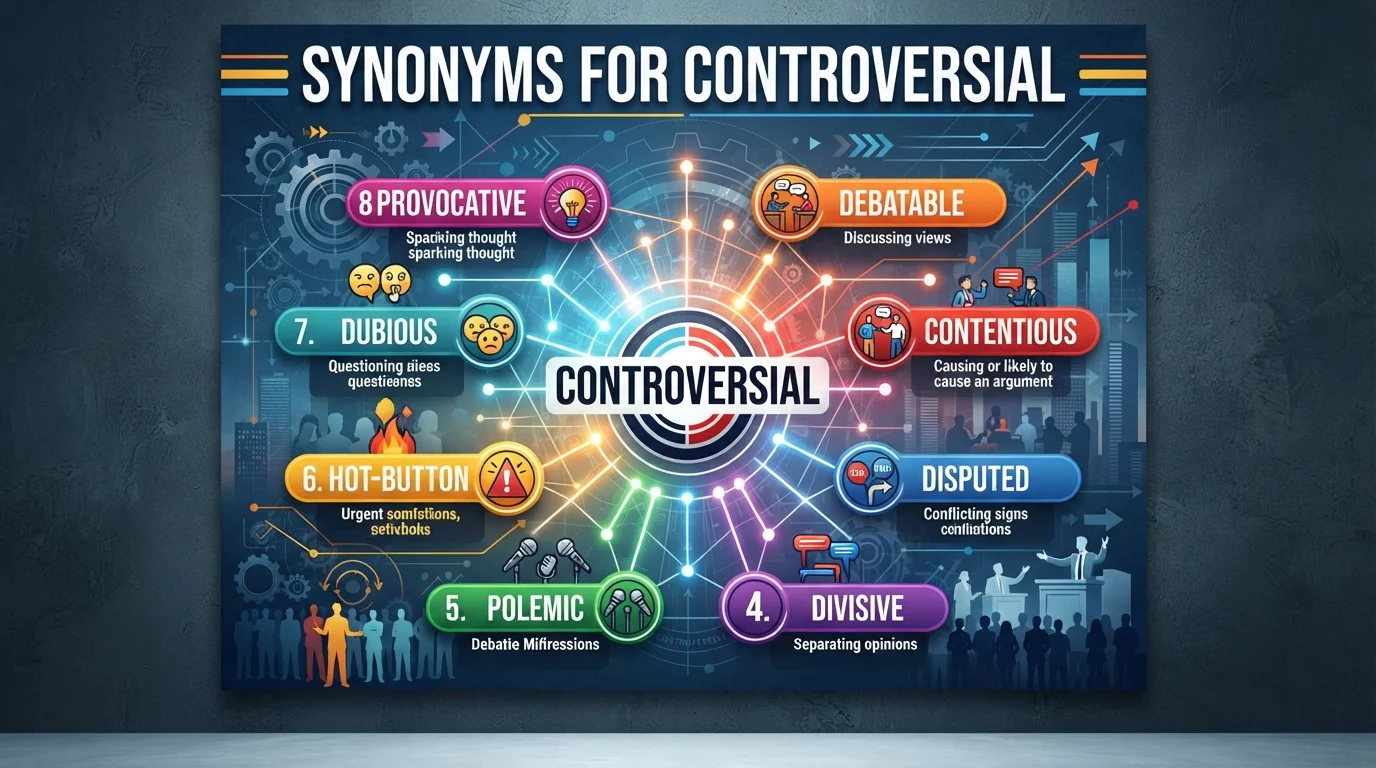
Sentence Transformations
1. General disagreement
Original:
“The proposal is controversial.”
Alternative:
“The proposal is contentious.”
Why:
Contentious emphasizes the disagreement surrounding the proposal.
2. Disputed claim
Original:
“The controversial claim has been criticized.”
Alternative:
“The disputed claim has been criticized.”
Why:
Disputed makes it clearer that the claim itself is being challenged.
3. Group division
Original:
“The issue is controversial.”
Alternative:
“The issue is divisive.”
Why:
Divisive specifically indicates that the issue separates people into opposing groups.
4. Strong polarization
Original:
“The public debate is controversial.”
Alternative:
“The public debate is polarizing.”
Why:
Polarizing emphasizes the formation of strongly opposed positions.
5. Academic uncertainty
Original:
“The interpretation is controversial.”
Alternative:
“The interpretation remains debatable.”
Why:
Debatable is useful when the focus is whether the interpretation can reasonably be challenged.
6. Strong reaction
Original:
“The artist created a controversial work.”
Alternative:
“The artist created a provocative work.”
Why:
Provocative emphasizes the work’s ability to generate a strong reaction.
7. Formal writing
Original:
“The issue is controversial among researchers.”
Alternative:
“The issue remains subject to dispute among researchers.”
Why:
The alternative gives the sentence a more formal academic tone.
8. Unresolved question
Original:
“The cause remains controversial.”
Alternative:
“The cause remains unsettled.”
Why:
Unsettled emphasizes that researchers have not reached a firm conclusion.
9. Doubt about validity
Original:
“The study’s conclusion is controversial.”
Alternative:
“The study’s conclusion is questionable.”
Why:
This changes the meaning. Questionable suggests there are reasons to doubt the conclusion, so use it only when that implication is intended.
10. Casual conversation
Original:
“The topic is controversial.”
Alternative:
“It’s a pretty touchy subject.”
Why:
Touchy subject is informal and suggests that people may react sensitively or emotionally.
Common Collocations With Controversial
Common phrases include:
- controversial issue
- controversial topic
- controversial decision
- controversial proposal
- controversial policy
- controversial law
- controversial statement
- controversial figure
- controversial claim
- controversial theory
- controversial book
- controversial film
- controversial article
- controversial opinion
- controversial debate
- controversial subject
- controversial ruling
- controversial practice
- controversial measure
- controversial remarks
Examples:
“The court’s decision remains controversial.”
“She made a controversial statement during the interview.”
“The theory remains controversial among researchers.”
Grammar and Usage
Controversial is an adjective.
It commonly appears:
Before a noun
“a controversial proposal”
“a controversial decision”
“a controversial figure”
After a linking verb
“The proposal is controversial.”
“The decision became controversial.”
“The issue remains controversial.”
With adverbs of degree
“highly controversial”
“deeply controversial”
“widely controversial”
“extremely controversial”
“potentially controversial”
Be careful with widely controversial. It is understandable, but phrases such as widely disputed, widely debated, or widely criticized are often more precise because they identify what is widespread.
Common Mistakes
Mistake 1: Treating “controversial” as meaning “wrong”
Something can be controversial without being false or wrong.
Controversial describes disagreement, not necessarily correctness.
Mistake 2: Using “divisive” for every controversial subject
A subject can be controversial without actually splitting people into opposing groups.
Use divisive when group division is an important part of the meaning.
Mistake 3: Using “provocative” as an exact synonym
Provocative emphasizes a strong reaction. It does not necessarily mean that people disagree about something.
Mistake 4: Using “questionable” when you only mean disputed
“The claim is disputed.”
is neutral about the truth of the claim.
“The claim is questionable.”
suggests that the writer has doubts about it.
Mistake 5: Using “inflammatory” too casually
Inflammatory suggests language or behavior that is likely to provoke anger or hostility. It is considerably stronger than controversial.
Mistake 6: Confusing “debated” with “controversial”
Something can be extensively debated without being socially controversial.
A technical question may receive years of academic debate without generating broad public conflict.
Mistake 7: Calling something “polarizing” without evidence of strong division
Polarizing implies that people are being pushed toward opposing positions. If you only know that disagreement exists, controversial or contentious may be more accurate.
Mistake 8: Using “hot-button” in formal writing
Hot-button is informal. In an academic or official document, use contentious issue, divisive issue, or another precise expression.
When Not to Replace “Controversial”
Sometimes controversial is the most accurate word.
Use it when you know that an issue has generated significant disagreement but do not need to specify exactly what kind of disagreement is involved.
“The proposal remains controversial.”
This is concise and neutral.
Do not replace it with a stronger word simply to make the writing sound more sophisticated.
For example:
“The proposal is inflammatory.”
does not mean the same thing as:
“The proposal is controversial.”
The first suggests that the proposal provokes anger or hostility. The second only tells us that it has generated disagreement.
Likewise:
“The proposal is questionable.”
suggests doubt about its validity or acceptability.
Precision matters more than variety.
How to Choose the Right Alternative
If people disagree about an issue
Use contentious or disputed.
If a claim is challenged
Use disputed or contested.
If an issue divides groups
Use divisive.
If people form strongly opposing sides
Use polarizing.
If something deliberately or strongly provokes reactions
Use provocative.
If a conclusion can reasonably be challenged
Use debatable.
If something has not been resolved
Use unsettled.
If you have reason to doubt its validity
Use questionable.
If language is likely to provoke anger
Use inflammatory.
If you are writing informally
Use touchy, hot-button, or divisive, depending on the meaning.
If you need a neutral general term
Keep controversial.
Editor’s Choice
The most useful alternatives are those that make the reason for the controversy clearer.
Contentious
Best when the central idea is disagreement or argument.
Disputed
Best when a claim, fact, interpretation, or decision is being challenged.
Divisive
Best when the issue separates people into opposing groups.
Debatable
Best when something remains open to reasonable argument.
Provocative
Best when the emphasis is on generating a strong reaction.
These are not a ranking of which word is “better.” Each describes a different aspect of controversy.