
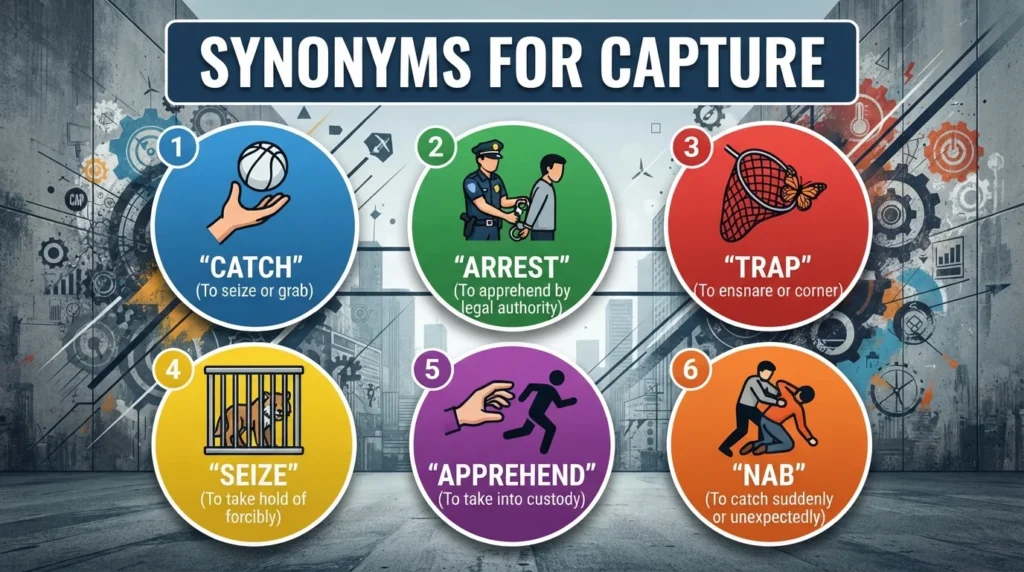
Quick Synonym Reference
Capture = catch or take control
- catch
- seize
- apprehend
- arrest
- detain
- take
- take prisoner
- overtake
- trap
- ensnare
- intercept
- secure
Capture = photograph or record
- photograph
- film
- record
- document
- shoot
- videotape
- videotape
- preserve
- reproduce
- reproduce visually
- snapshot
Capture = preserve an event or moment
- record
- document
- preserve
- chronicle
- archive
- memorialize
- save
- retain
- register
Capture = express or represent
- convey
- express
- communicate
- reflect
- represent
- depict
- portray
- illustrate
- embody
- encapsulate
- crystallize
Capture = attract attention or interest
- attract
- engage
- hold
- command
- draw
- grab
- seize
- captivate
- fascinate
- enthrall
Capture = obtain or secure
- obtain
- acquire
- secure
- gain
- win
- claim
- collect
- obtain control of
Important: These are not interchangeable in every sentence. Capture a photograph can mean take a photograph, while capture someone’s attention means attract or hold attention. Capture a city means seize control, not simply catch it.
What Does “Capture” Mean?
Capture is a versatile verb with several major meanings.
It can mean:
- To catch or take someone or something by force
- To take a photograph, video, or recording
- To preserve or document an event, moment, or information
- To express or represent an idea, feeling, quality, or appearance
- To attract and hold attention or interest
- To obtain, secure, or gain something
- To take control of a place, territory, or system
- To reproduce or store information digitally
For example:
The police captured the suspect.
She captured the sunset in a photograph.
The article captures the mood of the city.
The advertisement captured the audience’s attention.
The company captured a larger share of the market.
Because these meanings are quite different, there is no single synonym that works everywhere.
Synonyms for “Capture” Meaning Catch or Take
When capture means physically catching someone or something, these alternatives are useful.
1. Catch
Meaning: Stop, grasp, or take hold of something or someone.
Tone: Neutral
Best for: Everyday English, physical movement, animals, people
Example:
The police caught the suspect.
Difference: Catch is more general and often less forceful than capture.
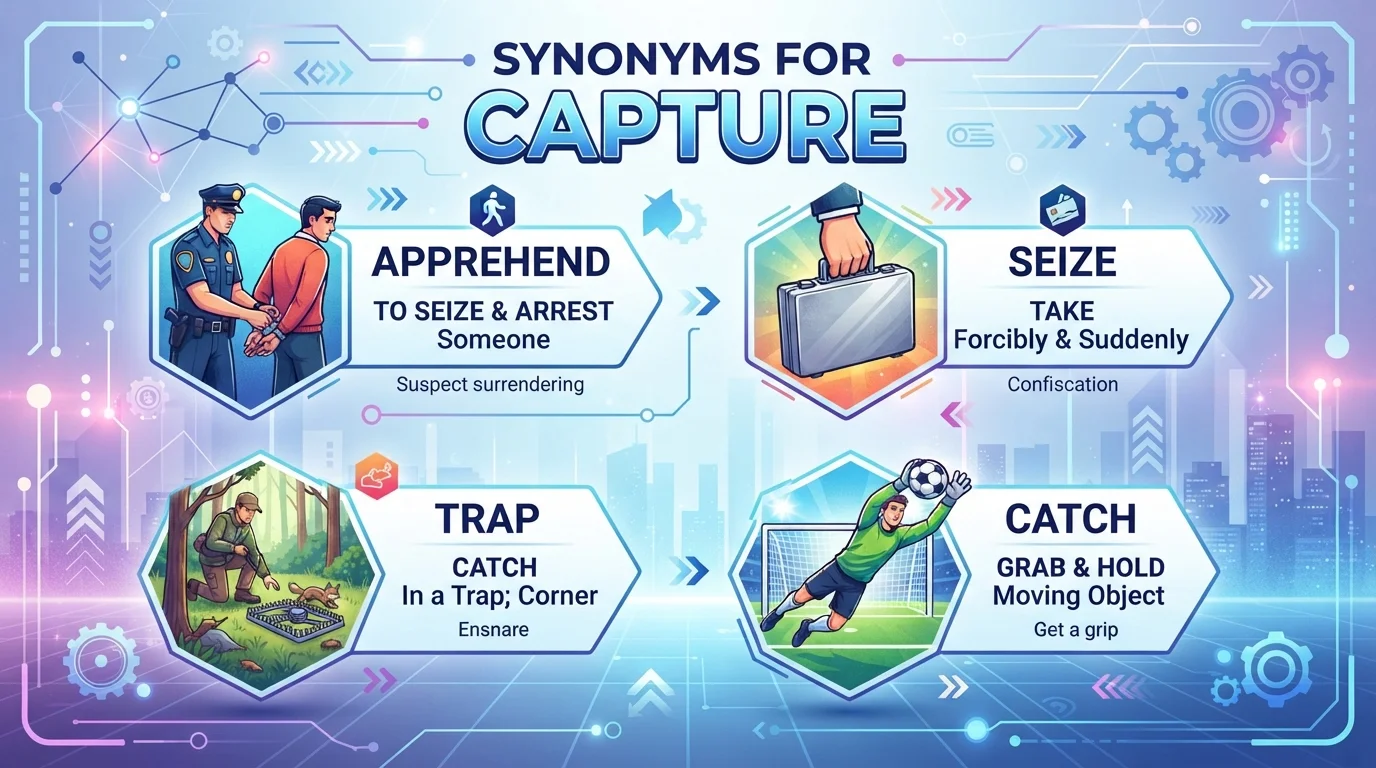
2. Seize
Meaning: Take something suddenly or forcefully.
Tone: Neutral to formal
Best for: Property, opportunities, control, military or legal contexts
Example:
The soldiers seized control of the building.
Difference: Seize emphasizes force, suddenness, or taking possession.
3. Apprehend
Meaning: Catch and arrest someone suspected of a crime.
Tone: Formal/legal
Example:
Officers apprehended the suspect shortly after the incident.
Difference: More specific than capture because it commonly implies law enforcement.
4. Arrest
Meaning: Legally take someone into custody.
Tone: Neutral/formal
Example:
Police arrested the suspect.
Difference: Arrest is a legal action. A person can be captured without being formally arrested.
5. Detain
Meaning: Keep someone in custody or prevent them from leaving.
Tone: Formal/legal
Example:
Officers detained the individual for questioning.
Difference: Detention does not necessarily mean the person was captured after being pursued.
6. Trap
Meaning: Prevent someone or something from escaping.
Tone: Neutral
Example:
The firefighters trapped the animal safely.
Difference: Trap focuses on preventing escape.
7. Ensnare
Meaning: Catch or trap someone or something.
Tone: Formal/literary
Example:
The animal was ensnared in the net.
It can also be metaphorical:
He was ensnared in a complicated legal dispute.
8. Intercept
Meaning: Stop, seize, or catch something before it reaches its destination.
Best for: Messages, vehicles, passes, people, communications
Example:
The defense intercepted the pass.
Difference: The idea of stopping something while it is moving toward a destination is central.
9. Take
Meaning: Gain control or possession of someone or something.
Example:
The army took the city.
Difference: Very broad. Take is often more natural than capture when the context is already clear.
10. Take Prisoner
Meaning: Capture someone during a conflict and hold them in custody.
Tone: Formal/historical
Example:
The soldiers took several enemy fighters prisoner.
Synonyms for “Capture” Meaning Photograph or Film
This is one of the most common modern meanings of capture.
11. Photograph
Meaning: Create a photograph of someone or something.
Example:
The photographer captured the sunset.
More directly:
The photographer photographed the sunset.
Difference: Photograph is precise when you literally mean taking a still image.
12. Shoot
Meaning: Take photographs or record video.
Tone: Neutral/professional
Example:
We shot several photos during the event.
Watch out: Shoot has many meanings, so the context must make the photographic meaning clear.
13. Film
Meaning: Record moving images.
Example:
The crew captured the performance on film.
Or:
The crew filmed the performance.
Difference: Film is specifically associated with moving images.
14. Record
Meaning: Store audio, video, images, or other information.
Example:
The camera recorded the entire performance.
Difference: Record emphasizes preserving the material rather than the artistic act of photographing it.
15. Document
Meaning: Create a record of something through photographs, video, writing, or other evidence.
Example:
The photographer documented life in the village.
Difference: Document emphasizes creating a useful or evidentiary record.
16. Snapshot
As a noun, snapshot means a quick or informal photograph.
She took a snapshot of the children playing.
It is related to capture, but it is not a direct verb synonym.
Synonyms for “Capture” Meaning Preserve a Moment
In photography, journalism, writing, and storytelling, capture often means preserve something so that it can be experienced or remembered later.
17. Preserve
Meaning: Keep something from being lost or changed.
The photograph preserved a special moment.
Difference: Broader than capture and not necessarily connected to recording.
18. Chronicle
Meaning: Record events in detail and usually in sequence.
The book chronicles the history of the community.
Tone: Formal
Difference: Better for extended records than a single moment.
19. Archive
Meaning: Store material for future reference.
The museum archived thousands of photographs.
Difference: Focuses on storage and preservation.
20. Memorialize
Meaning: Preserve the memory of a person or event.
The monument memorializes those who lost their lives.
Tone: Formal
21. Register
Meaning: Record or make something officially known or noticeable.
The sensor registered a sudden change in temperature.
Best for: Technical, scientific, official contexts.
Synonyms for “Capture” Meaning Express or Represent
This meaning is extremely common in writing about photography, art, film, literature, and communication.
22. Convey
Meaning: Communicate an idea, feeling, quality, or impression.
The painting captures a sense of loneliness.
Alternative:
The painting conveys a sense of loneliness.
Difference: Convey focuses on communicating meaning.
23. Express
Meaning: Communicate a thought, feeling, or quality.
The poem captures her grief.
The poem expresses her grief.
Difference: Express emphasizes putting an internal feeling or idea into a communicable form.
24. Reflect
Meaning: Show or represent a quality, condition, or attitude.
The design captures the company’s modern identity.
The design reflects the company’s modern identity.
Difference: Reflect suggests that something reveals or mirrors an existing quality.
25. Represent
Meaning: Show, stand for, or depict something.
The image captures the spirit of the festival.
The image represents the spirit of the festival.
Difference: Represent is broader and can be literal, symbolic, or conceptual.
26. Depict
Meaning: Show or represent someone or something, especially visually.
The painting captures a peaceful rural scene.
The painting depicts a peaceful rural scene.
Difference: Depict is especially useful for visual representation.
27. Portray
Meaning: Represent someone or something in a particular way.
The film captures the challenges of modern life.
The film portrays the challenges of modern life.
Difference: Portray often suggests how something or someone is presented or characterized.
28. Illustrate
Meaning: Show or explain something through an image, example, or other representation.
The example captures the problem clearly.
The example illustrates the problem clearly.
Difference: Illustrate often explains or clarifies rather than simply records.
29. Embody
Meaning: Represent or express an idea or quality in a particularly strong way.
She captures the spirit of the organization.
She embodies the spirit of the organization.
Difference: Embody is stronger. It suggests that the person or thing represents the quality itself.
30. Encapsulate
Meaning: Express the essential features of something in a concise or concentrated form.
The photograph captures the mood of the era.
The photograph encapsulates the mood of the era.
Tone: Formal
Difference: Encapsulate emphasizes containing the essential elements of something.
31. Crystallize
Meaning: Make an idea, feeling, or situation clear and distinct.
The speech captured the public’s concerns.
The speech crystallized the public’s concerns.
Difference: Crystallize suggests making something previously unclear more defined.

Synonyms for “Capture” Meaning Attract Attention
When something captures attention, capture means to attract and hold someone’s focus or interest.
32. Attract
The headline captured my attention.
The headline attracted my attention.
The simplest direct alternative.
33. Draw
The display captured everyone’s attention.
The display drew everyone’s attention.
Natural and widely used.
34. Grab
Tone: Informal
The opening sentence grabbed my attention.
Stronger and more energetic than attract.
35. Command
Meaning: Attract and hold strongly.
The speaker commanded the audience’s attention.
Tone: Formal
36. Engage
Meaning: Hold someone’s attention or interest.
The presentation captured the audience’s attention.
The presentation engaged the audience.
Difference: Engage often suggests sustained involvement rather than merely attracting attention.
37. Captivate
Meaning: Attract and hold someone’s attention or interest strongly.
The performance captivated the audience.
Strength: Strong
38. Fascinate
Meaning: Hold someone’s attention because something is extremely interesting.
The documentary captured her interest.
The documentary fascinated her.
39. Enthrall
Meaning: Hold someone’s attention completely through intense interest or fascination.
The storyteller enthralled the audience.
Tone: Literary/formal
Synonyms for “Capture” Meaning Obtain or Secure
In business, marketing, technology, and general writing, capture can mean obtain, gain, or secure something.
40. Obtain
The company captured new customer data.
The company obtained new customer data.
Difference: Obtain simply means get something.
41. Acquire
The company captured a larger share of the market.
The company acquired a larger share of the market.
Difference: Acquire emphasizes gaining possession or control.
42. Secure
The team captured the contract.
The team secured the contract.
Difference: Secure emphasizes successfully obtaining something desirable.
43. Gain
The brand captured significant market share.
The brand gained significant market share.
Difference: Gain is broader and often natural in business writing.
44. Win
The company captured the account.
The company won the account.
Difference: Win is particularly natural when competing against others for business, a prize, or an opportunity.
45. Claim
The team captured the championship.
The team claimed the championship.
Difference: Claim emphasizes successfully taking or earning a title, prize, or position.
Synonyms for “Capture” in Business and Marketing
Capture is common in business phrases such as:
- capture market share
- capture customer attention
- capture leads
- capture demand
- capture value
- capture an audience
- capture a market
- capture revenue
- capture opportunities
The best replacement changes according to the noun.
| Phrase | Natural alternatives |
|---|---|
| capture market share | gain, secure, win |
| capture customers | attract, acquire, win |
| capture leads | generate, collect, acquire |
| capture attention | attract, draw, grab, command |
| capture an audience | engage, attract, captivate |
| capture value | realize, obtain, secure |
| capture demand | meet, attract, serve |
| capture an opportunity | seize, exploit, take advantage of |
| capture revenue | generate, earn, secure |
| capture data | collect, record, obtain |
Example
The campaign captured customer attention.
Could become:
The campaign grabbed customer attention.
More formal:
The campaign attracted customer attention.
More focused on sustained involvement:
The campaign engaged customers.
Capture vs. Its Closest Alternatives
Capture vs. Catch
Catch is more general and often more conversational.
I caught the ball.
The police caught the suspect.
Capture often suggests deliberately taking control or holding something.
The soldiers captured the town.
Capture vs. Seize
Seize emphasizes taking something suddenly or forcefully.
The authorities seized the property.
Capture emphasizes taking control or preventing escape.
The army captured the city.
They overlap in military contexts, but the emphasis differs.
Capture vs. Photograph
Photograph specifically means producing a photograph.
She photographed the building.
Capture can describe the photograph’s result or what it preserves:
She captured the beauty of the building.
The second sentence can refer to more than simply taking a picture.
Capture vs. Record
Record emphasizes preserving information.
The camera recorded the entire speech.
Capture can emphasize obtaining or preserving a moment, image, sound, or quality.
The photograph captured the speaker’s expression.
Capture vs. Document
Document implies creating a record that provides evidence, information, or a historical account.
The journalist documented the protests.
Capture can sound more artistic or moment-focused.
The photographer captured the atmosphere of the protest.
Capture vs. Convey
Convey means communicate or express.
The photograph conveys a feeling of calm.
Capture often suggests successfully representing or preserving the essential quality.
The photograph captures the feeling of calm.
They can overlap, but capture often sounds more vivid.
Capture vs. Portray
Portray means represent someone or something in a particular way.
The film portrays the character as ambitious.
Capture is broader and can mean recording or successfully conveying an aspect.
Capture vs. Attract
When talking about attention:
The headline attracted readers’ attention.
The headline captured readers’ attention.
Both work. Capture can suggest that the attention was successfully secured and held.
Capture vs. Captivate
Captivate means strongly attract and hold attention.
The performance captivated the audience.
It is stronger and more emotional than the ordinary use of capture.
Comparison Table
| Word | Main Meaning | Tone | Strength | Interchangeable with “capture”? |
|---|---|---|---|---|
| catch | take hold of | Neutral | Medium | Often, physical sense |
| seize | take forcefully | Formal/neutral | Strong | Sometimes |
| apprehend | arrest/catch | Formal/legal | Strong | Contextually |
| arrest | take into legal custody | Formal/legal | Strong | No |
| detain | hold in custody | Formal | Medium/strong | Contextually |
| trap | prevent escape | Neutral | Strong | Sometimes |
| photograph | take a photo | Neutral | — | In photo contexts |
| film | record moving images | Neutral | — | In video contexts |
| record | preserve information | Neutral | — | Often |
| document | create a record | Formal/neutral | — | Often |
| preserve | keep for future | Neutral/formal | — | Contextually |
| chronicle | record events over time | Formal | — | Sometimes |
| convey | communicate an idea/feeling | Neutral/formal | Medium | In expressive contexts |
| express | communicate a feeling/idea | Neutral | Medium | Contextually |
| reflect | show or mirror | Neutral/formal | Medium | Often |
| represent | show or stand for | Neutral/formal | Medium | Often |
| depict | visually represent | Formal/neutral | Medium | In visual contexts |
| portray | represent in a particular way | Neutral/formal | Medium | Often |
| embody | strongly represent | Formal | Strong | Sometimes |
| encapsulate | express the essentials | Formal | Strong | Sometimes |
| attract | draw attention | Neutral | Medium | In attention contexts |
| draw | attract | Neutral | Medium | Often |
| grab | attract strongly | Informal | Strong | Contextually |
| command | strongly attract | Formal | Strong | Contextually |
| engage | hold attention/involvement | Neutral | Strong | Often |
| captivate | fascinate and hold | Neutral/formal | Very strong | Contextually |
| obtain | get | Neutral/formal | — | In acquisition contexts |
| acquire | gain possession | Formal | — | Often |
| secure | successfully obtain | Formal/neutral | — | Often |
| gain | obtain/increase | Neutral | — | Often |
| win | successfully obtain through competition | Neutral | — | Contextually |
| claim | take or earn | Neutral/formal | — | Contextually |
“Capture” in Different Contexts
Photography
Use:
- photograph
- shoot
- snap
- take a picture
- record
- document
The photographer captured the moment perfectly.
This can mean more than simply taking the photograph. It can imply that the image successfully conveys the feeling, action, or significance of the moment.
Video and Film
Use:
- film
- record
- videotape
- shoot
- document
The camera captured the entire performance.
More direct:
The camera recorded the entire performance.
Writing and Storytelling
Use:
- convey
- portray
- describe
- express
- represent
- depict
- encapsulate
- evoke
- reflect
The novel captures the uncertainty of adolescence.
Possible alternatives:
The novel portrays the uncertainty of adolescence.
The novel conveys the uncertainty of adolescence.
The novel reflects the uncertainty of adolescence.
Emotions and Feelings
Use:
- express
- convey
- reflect
- evoke
- communicate
- embody
- portray
Her expression captured her disappointment.
More precise:
Her expression reflected her disappointment.
Her expression conveyed her disappointment.
Attention
Use:
- attract
- draw
- grab
- command
- engage
- captivate
- hold
The headline captured my attention.
More informal:
The headline grabbed my attention.
More formal:
The headline commanded my attention.
Military or Law Enforcement
Use:
- seize
- apprehend
- arrest
- detain
- take prisoner
- overtake
- intercept
- trap
The soldiers captured the city.
The soldiers seized the city.
Police captured the suspect.
Police apprehended the suspect.
The precise word depends on whether the focus is military control, arrest, interception, or physical containment.
Business and Marketing
Use:
- attract
- acquire
- gain
- secure
- win
- generate
- collect
- obtain
- engage
The company captured a larger share of the market.
Possible alternatives:
The company gained a larger share of the market.
The company secured a larger share of the market.
The company won a larger share of the market.
Sentence Transformations
| Original | Better Alternative | Why |
|---|---|---|
| The photographer captured the sunset. | The photographer photographed the sunset. | Directly identifies the act of taking a photograph. |
| The image captured the mood of the city. | The image conveyed the mood of the city. | Emphasizes communication of the mood. |
| Police captured the suspect. | Police apprehended the suspect. | More precise legal/law-enforcement wording. |
| The army captured the city. | The army seized the city. | Emphasizes taking control. |
| The headline captured my attention. | The headline grabbed my attention. | More energetic and conversational. |
| The documentary captured the reality of rural life. | The documentary portrayed the reality of rural life. | Emphasizes representation. |
| The camera captured the entire event. | The camera recorded the entire event. | Emphasizes preserving the recording. |
| The speech captured the audience’s interest. | The speech engaged the audience. | Emphasizes sustained involvement. |
| The company captured new customers. | The company acquired new customers. | More precise business terminology. |
| The painting captures her sadness. | The painting expresses her sadness. | Emphasizes expression of emotion. |
Useful Collocations with “Capture”
Physical control
- capture a suspect
- capture an enemy
- capture a prisoner
- capture a fugitive
- capture a city
- capture a territory
- capture a fortress
- capture a position
Photography and media
- capture a photograph
- capture an image
- capture a moment
- capture a scene
- capture footage
- capture video
- capture audio
- capture a recording
- capture an event
Ideas and emotions
- capture an idea
- capture a feeling
- capture an emotion
- capture a mood
- capture a moment
- capture the atmosphere
- capture the essence
- capture the spirit
- capture the imagination
- capture the character of a place
Attention and interest
- capture attention
- capture interest
- capture the audience
- capture someone’s imagination
- capture someone’s curiosity
Business
- capture market share
- capture customers
- capture leads
- capture demand
- capture value
- capture revenue
- capture an opportunity
- capture a market
Technology
- capture data
- capture information
- capture a screen
- capture a screenshot
- capture input
- capture signals
- capture system activity
Common Expressions with “Capture”
Capture the Moment
Means to preserve or represent a particular moment, especially through photography, video, or writing.
The photographer captured the moment perfectly.
Capture the Essence
Means successfully represent the most important or characteristic qualities of something.
The painting captures the essence of the countryside.
This is often used in art, photography, writing, branding, and design.
Capture the Spirit
Means represent the characteristic feeling, energy, or attitude of something.
The documentary captures the spirit of the community.
Capture the Imagination
Means strongly interest or inspire someone’s imagination.
The story captured the imagination of young readers.
Capture Attention
Means attract and hold someone’s attention.
The opening sentence captured the reader’s attention.
Capture the Market
Means obtain a significant position or share of a market.
The company hopes to capture a larger share of the market.
Common Mistakes with “Capture”
1. Treating “capture” and “photograph” as exact synonyms
Capture can mean taking a photograph, but it often adds the idea of successfully preserving a moment, feeling, or quality.
She photographed the sunset.
is about taking the photo.
She captured the beauty of the sunset.
is about successfully representing its beauty.
2. Using “arrest” for every use of capture
Arrest is a legal action.
Police arrested the suspect.
A person can be captured without the situation involving a formal arrest.
3. Confusing “capture” with “seize”
They overlap, but seize emphasizes taking something forcefully or suddenly, while capture often emphasizes taking control or preventing escape.
4. Using “document” when the goal is artistic expression
The photographer documented the sunset.
This sounds factual or record-oriented.
The photographer captured the beauty of the sunset.
This emphasizes artistic representation.
5. Treating “capture attention” as identical to “captivate”
Captivate is stronger.
The presentation captured my attention.
means it attracted my attention.
The presentation captivated me.
suggests much stronger fascination.
6. Using “grab” in formal writing
Grab attention is natural and energetic, but attract, draw, or command may be more appropriate in formal writing.
7. Assuming “capture” always implies physical possession
In phrases such as:
- capture an idea
- capture a feeling
- capture a mood
- capture attention
the word is metaphorical.
It means successfully represent, obtain, or hold, not physically seize.
8. Using “obtain” for every business use of capture
The company obtained customer data.
works when the meaning is simply getting the data.
But:
The company captured market share.
requires a different idea. Gain, secure, or win may be more natural.
When “Capture” Is Better Than a Synonym
Do not replace capture just to avoid repetition.
It is especially useful when you want one word to suggest both recording something and successfully preserving its important qualities.
Compare:
The photograph shows the city at night.
with:
The photograph captures the city at night.
The second can suggest that the image conveys the atmosphere, mood, or character of the city—not merely that the city appears in the photograph.
Likewise:
The article captures the public mood.
is often more expressive than:
The article describes the public mood.
Use the synonym that communicates the specific relationship you mean.
Choosing the Right Alternative
Use catch when:
You mean physically stopping or taking hold of someone or something.
Use seize when:
You mean taking something forcefully or suddenly.
Use apprehend when:
You mean catching someone in a law-enforcement context.
Use arrest when:
You mean legally taking someone into custody.
Use photograph when:
You mean taking a still photograph.
Use film when:
You mean recording moving images.
Use record when:
You mean preserving audio, video, data, or information.
Use document when:
You mean creating a factual or evidentiary record.
Use convey when:
You mean communicating an idea, feeling, or quality.
Use portray when:
You mean representing someone or something in a particular way.
Use depict when:
You mean visually representing something.
Use reflect when:
You mean showing or mirroring a quality or condition.
Use embody when:
Something strongly represents a particular quality or idea.
Use encapsulate when:
You mean expressing the essential features of something concisely.
Use attract when:
You mean drawing attention or interest.
Use engage when:
You mean attracting and holding someone’s attention or involvement.
Use captivate when:
You mean strongly fascinating and holding someone’s attention.
Use secure when:
You mean successfully obtaining something.
Use acquire when:
You mean gaining possession, customers, assets, or resources.
Use gain when:
You mean obtaining or increasing something, especially in business.
A Simple Decision Guide
| If you mean… | Best choices |
|---|---|
| catch someone/something | catch, capture |
| take control by force | seize, capture |
| catch a criminal | apprehend, arrest |
| hold someone in custody | detain |
| prevent escape | trap, ensnare |
| take a photograph | photograph, shoot |
| record video | film, record |
| preserve information | record, document, archive |
| record an event historically | document, chronicle |
| represent a feeling | convey, express, reflect |
| represent a person/scene | portray, depict |
| represent an important quality | embody, reflect |
| summarize the essential qualities | encapsulate |
| attract attention | attract, draw, grab |
| hold attention | engage, command |
| strongly fascinate | captivate, enthrall |
| obtain something | obtain, acquire |
| successfully obtain something | secure, gain, win |
| obtain a market position | gain, secure, win |
| take a title or prize | claim, win |
| collect data | collect, record, obtain |
Editor’s Choice: The Most Useful Alternatives
For general writing, these alternatives are especially valuable because they cover the major meanings of capture without creating unnecessary complexity:
1. Record — best for preserving information, audio, video, or events.
2. Convey — best for expressing an idea, feeling, mood, or quality.
3. Photograph — best when you literally mean taking a photograph.
4. Seize — best when capture means taking control forcefully.
5. Attract — best when capture means gaining attention or interest.
The key is to identify the sense of capture before choosing a replacement. A photograph can be captured, a suspect can be apprehended, an emotion can be conveyed, and attention can be attracted—but those verbs describe different actions.