
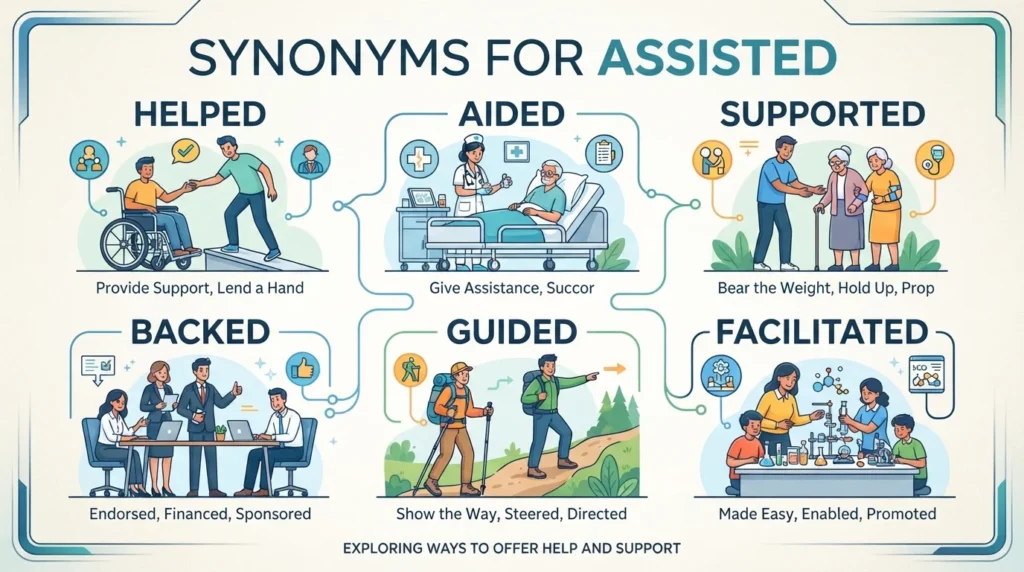
Quick List: Synonyms for Assisted
General help
- helped
- aided
- supported
- assisted
- backed
- served
- aided
- cooperated with
- contributed to
- lent a hand
Formal or professional
- aided
- supported
- facilitated
- enabled
- contributed to
- collaborated with
- advised
- counseled
- provided assistance to
- rendered assistance to
Practical or direct help
- helped
- aided
- supported
- guided
- served
- attended to
- handled
- took care of
- worked with
- pitched in
Helping someone complete a task
- helped
- guided
- assisted
- facilitated
- enabled
- supported
- coached
- advised
- instructed
- collaborated
Financial or organizational support
- funded
- sponsored
- financed
- backed
- supported
- subsidized
- contributed to
Medical or care contexts
- cared for
- attended to
- treated
- supported
- aided
- helped
- tended to
What Does “Assisted” Mean?
Assisted is the past tense and past participle of assist. It generally means helped someone do something or helped make something possible.
The technician assisted the customer.
This means the technician helped the customer.
The word can also describe different kinds of support:
- helped someone complete a task
- supported a person, team, or project
- aided someone in a formal context
- facilitated a process
- guided someone toward a result
- attended to someone’s needs
- contributed to an effort or outcome
- enabled something to happen
The right alternative depends on who received the assistance, what kind of help was provided, and how formal the writing needs to be.
1. Assisted Meaning “Helped”
Helped
Meaning: Gave someone support or made something easier.
Tone: Neutral and natural
Best for: Everyday English, general writing, conversations, emails
Example:
The teacher assisted the student with the assignment.
→ The teacher helped the student with the assignment.
Difference: Helped is the simplest and most natural alternative. Assisted often sounds more formal or professional.
Aided
Meaning: Helped or supported someone or something.
Tone: Formal
Best for: Academic, professional, historical, and formal writing
Example:
The new system aided researchers in analyzing the data.
Difference: Aided is close to assisted but sounds more formal and is less common in everyday conversation.
Supported
Meaning: Gave assistance, encouragement, resources, or practical help.
Tone: Neutral to professional
Example:
→ The organization supported local businesses.
Difference: Supported can imply ongoing or broader assistance, while assisted may refer to a specific act of help.
Backed
Meaning: Supported someone or something, often with resources, money, or approval.
Tone: Neutral to informal
Example:
Several investors assisted the project.
→ Several investors backed the project.
Difference: Backed often suggests financial, institutional, or strategic support.
2. Assisted Meaning “Made Something Easier”
Facilitated
Meaning: Made an action, process, or outcome easier.
Tone: Professional/formal
Best for: Business, education, management, research, and organizational writing
Example:
The software assisted communication between teams.
→ The software facilitated communication between teams.
Difference: Facilitated focuses on making something possible or easier, rather than directly helping a person.
Enabled
Meaning: Made something possible.
Tone: Neutral to formal
Example:
The new technology assisted remote collaboration.
→ The new technology enabled remote collaboration.
Difference: Enabled emphasizes the fact that something became possible. It does not necessarily mean direct personal assistance.
Contributed to
Meaning: Helped produce or achieve a result as one part of a larger effort.
Tone: Neutral/professional
Example:
The program assisted in reducing waste.
→ The program contributed to reducing waste.
Difference: Contributed to does not necessarily mean direct assistance. It emphasizes a role in an outcome.
3. Assisted Meaning “Guided”
Guided
Meaning: Helped someone by giving direction, advice, or instruction.
Tone: Neutral/professional
Example:
The counselor assisted the student in choosing a career.
→ The counselor guided the student in choosing a career.
Difference: Use guided when the help involves direction or decision-making.
Advised
Meaning: Gave someone recommendations or information to help them make a decision.
Tone: Neutral to formal
Example:
The consultant assisted the company with its expansion plans.
→ The consultant advised the company on its expansion plans.
Difference: Advised specifically involves giving advice. It does not cover every kind of practical assistance.
Counseled
Meaning: Gave advice, guidance, or support, often in a professional setting.
Tone: Formal/professional
Example:
The advisor assisted students with their career choices.
→ The advisor counseled students about their career choices.
Difference: Counseled is more specific than assisted and is commonly associated with professional guidance.
Coached
Meaning: Helped someone improve a skill or performance through instruction and practice.
Tone: Neutral/professional
Example:
The trainer assisted the new employees.
→ The trainer coached the new employees.
Difference: Coached implies teaching, practice, and improvement rather than general help.
4. Assisted Meaning “Worked With”
Collaborated With
Meaning: Worked together with someone to achieve a shared goal.
Tone: Professional
Example:
She assisted the research team.
→ She collaborated with the research team.
Difference: Collaborated with suggests shared participation, whereas assisted usually suggests that one person helped another.
This distinction matters.
The assistant assisted the manager.
means the assistant provided help.
The assistant collaborated with the manager.
suggests both people worked together as collaborators.
Cooperated With
Meaning: Worked with someone or complied with a request to achieve a result.
Tone: Neutral
Example:
The department assisted the investigation.
→ The department cooperated with the investigation.
Difference: Cooperated emphasizes willingness to work together rather than direct practical assistance.
Contributed
Meaning: Gave something—such as effort, knowledge, money, or resources—to a larger effort.
Tone: Neutral/professional
Example:
Several experts assisted the project.
→ Several experts contributed to the project.
Difference: Contributed emphasizes adding something valuable rather than simply helping.
5. Assisted Meaning “Attended to Someone”
This sense is especially common in customer service, healthcare, hospitality, and personal care.
Attended To
Meaning: Gave attention or practical care to a person or matter.
Tone: Neutral to formal
Example:
The nurse assisted the patient.
→ The nurse attended to the patient.
Difference: Attended to emphasizes taking care of someone’s needs.
Cared For
Meaning: Looked after someone and provided the support they needed.
Tone: Neutral
Example:
The staff assisted elderly residents.
→ The staff cared for elderly residents.
Difference: Cared for suggests ongoing personal or medical support.
Tended To
Meaning: Looked after someone or dealt with a particular need or task.
Tone: Neutral
Example:
The nurse assisted the injured patient.
→ The nurse tended to the injured patient.
Difference: Tended to often emphasizes immediate care or attention.
Served
Meaning: Provided assistance, service, or practical support.
Tone: Neutral/professional
Example:
The customer-service representative assisted the client.
→ The representative served the client.
Difference: Served is appropriate when assistance is part of a service role. It is not a universal replacement for assisted.
6. Assisted Meaning “Provided Resources or Money”
Sometimes assisted refers to financial or material support.
Funded
Meaning: Provided money for a project, activity, or organization.
Example:
The foundation assisted the research project.
→ The foundation funded the research project.
Difference: Funded specifically means provided financial resources.
Sponsored
Meaning: Supported someone or something financially or institutionally.
Example:
The company assisted the event.
→ The company sponsored the event.
Difference: Sponsored usually implies formal financial or organizational support.
Financed
Meaning: Provided or arranged money needed for something.
Example:
The bank assisted the business with its expansion.
→ The bank financed the business’s expansion.
Difference: Financed is specifically about money.
Subsidized
Meaning: Helped pay for something, often through financial support that reduces its cost.
Tone: Formal
Example:
The government assisted farmers with production costs.
→ The government subsidized farmers’ production costs.
Difference: This is much more specific than assisted.
Assisted in vs. Assisted With
A useful grammar distinction is that assist commonly appears with in and with.
Assist in + -ing
The program assisted in reducing costs.
This means the program helped make cost reduction possible.
Assist someone with + noun
The technician assisted the customer with the installation.
Assist someone in + -ing
The technician assisted the customer in installing the software.
Both constructions are grammatical, but the choice depends on what follows.
“Assisted by” in Passive Sentences
Assisted by is common in formal and professional writing.
The surgeon was assisted by two nurses.
The surgeon was supported by two nurses.
The surgeon worked with two nurses.
Two nurses helped the surgeon.
The best choice depends on whether you want to emphasize formal assistance, teamwork, or simple help.
Assisted in Different Contexts
Workplace
Use:
- helped
- supported
- aided
- assisted
- facilitated
- collaborated with
- contributed to
The analyst assisted the manager with the report.
More conversational:
The analyst helped the manager with the report.
More collaborative:
The analyst worked with the manager on the report.
Academic Writing
Useful choices include:
- aided
- supported
- facilitated
- contributed to
- enabled
- informed
The findings supported the researchers’ conclusion.
The software facilitated data analysis.
Academic writing benefits from specifying how something provided assistance rather than repeatedly using assisted.
Customer Service
Natural options include:
- helped
- assisted
- served
- supported
- guided
- attended to
Our representative helped the customer resolve the issue.
More formal:
Our representative assisted the customer in resolving the issue.
Healthcare
Depending on the meaning:
- cared for
- attended to
- treated
- supported
- aided
- helped
- tended to
The nurse assisted the patient.
If the focus is care:
The nurse cared for the patient.
If the focus is immediate attention:
The nurse attended to the patient.
If the focus is medical intervention:
The doctor treated the patient.
These are not interchangeable.
Technology
Use:
- facilitated
- enabled
- supported
- helped
- aided
- automated
- streamlined
The software assisted the team in analyzing data.
→ The software facilitated data analysis.
If the software made the task possible:
The software enabled the team to analyze the data.
If it made the process faster or simpler:
The software streamlined data analysis.
Assisted vs. Similar Words
| Word | Main Meaning | Tone | Type of Help | Direct Replacement? |
|---|---|---|---|---|
| assisted | Helped | Neutral/formal | General | — |
| helped | Gave support | Neutral | General | Usually |
| aided | Helped or supported | Formal | General | Often |
| supported | Provided ongoing help/resources | Neutral/professional | Broad | Often |
| facilitated | Made something easier | Professional | Process-based | Sometimes |
| enabled | Made something possible | Neutral/formal | Outcome-based | Sometimes |
| guided | Gave direction | Neutral | Advice/instruction | Sometimes |
| advised | Gave recommendations | Professional | Decision-making | Sometimes |
| collaborated | Worked together | Professional | Shared effort | No |
| contributed | Added effort/resources | Neutral | Partial participation | Sometimes |
| attended to | Took care of | Neutral/formal | Personal/practical | Sometimes |
| cared for | Looked after | Neutral | Ongoing care | Sometimes |
| funded | Provided money | Formal | Financial | Only financially |
| sponsored | Provided financial/institutional support | Professional | Financial/institutional | Only in specific contexts |
Sentence Transformations
1. General help
Original:
The assistant assisted the manager with the report.
Alternative:
The assistant helped the manager with the report.
Why:
Helped is simpler and more natural in everyday or general writing.
2. Formal writing
Original:
The program assisted local communities.
Alternative:
The program aided local communities.
Why:
Aided provides a more formal tone.
3. Ongoing support
Original:
The organization assisted small businesses.
Alternative:
The organization supported small businesses.
Why:
Supported can better suggest continuing or broader assistance.
4. Process
Original:
The software assisted researchers in analyzing the data.
Alternative:
The software facilitated data analysis.
Why:
Facilitated clearly emphasizes making the process easier.
5. Making something possible
Original:
The new technology assisted remote communication.
Alternative:
The new technology enabled remote communication.
Why:
Enabled emphasizes that the technology made the activity possible.
6. Direction
Original:
The counselor assisted the student in choosing a career.
Alternative:
The counselor guided the student in choosing a career.
Why:
Guided specifies that the assistance involved direction and advice.
7. Teamwork
Original:
She assisted the research team.
Alternative:
She collaborated with the research team.
Why:
Use this when she participated as a working partner rather than simply providing assistance.
8. Care
Original:
The nurse assisted the patient.
Alternative:
The nurse attended to the patient.
Why:
Attended to emphasizes direct attention to the patient’s needs.
9. Financial support
Original:
The foundation assisted the project.
Alternative:
The foundation funded the project.
Why:
Funded is more precise if the assistance consisted of providing money.
10. Immediate care
Original:
The paramedic assisted the injured person.
Alternative:
The paramedic tended to the injured person.
Why:
Tended to emphasizes immediate care and attention.
Common Collocations with “Assisted”
Assisted with
- assisted with the project
- assisted with the work
- assisted with the research
- assisted with the installation
- assisted with the process
- assisted with the preparation
- assisted with the task
Assisted in
- assisted in developing
- assisted in creating
- assisted in preparing
- assisted in improving
- assisted in reducing
- assisted in completing
- assisted in solving
Assisted by
- assisted by a team
- assisted by staff
- assisted by experts
- assisted by researchers
- assisted by volunteers
- assisted by technology
- assisted by an advisor
Professional phrases
- assisted customers
- assisted clients
- assisted patients
- assisted employees
- assisted researchers
- assisted the team
- assisted the manager
- assisted with operations
Common Mistakes
1. Treating “assisted” and “collaborated” as identical
They are not.
Assisted = one person or group helps another.
Collaborated = two or more parties work together.
The assistant assisted the director.
The assistant provided help.
The assistant collaborated with the director.
The two worked together.
2. Using “enabled” when you mean direct help
The nurse assisted the patient.
This does not normally mean:
The nurse enabled the patient.
Enabled focuses on making something possible, not necessarily providing personal assistance.
3. Using “facilitated” for every use of “assisted”
Facilitated is especially useful for processes, communication, meetings, and activities.
The mediator facilitated the discussion.
But:
The nurse assisted the patient.
Here, assisted is more natural.
4. Using “funded” for nonfinancial assistance
Funding is only one form of assistance.
The charity assisted the community.
does not necessarily mean:
The charity funded the community.
It might have provided food, staff, equipment, or other services.
5. Assuming “aided” always sounds better
Aided is more formal, but formal does not automatically mean better.
The neighbor helped me move.
is usually more natural than:
The neighbor aided me in relocating.
Use the level of formality that the context needs.
6. Confusing “attended” with “assisted”
Attended can mean participated in an event:
She attended the meeting.
Attended to means gave attention or care:
She attended to the customer’s needs.
Dropping to can completely change the meaning.
7. Replacing “assisted” with a vague synonym
If you know exactly how someone helped, a more specific verb is often stronger.
Instead of:
The consultant assisted the company.
Consider:
The consultant advised the company.
or:
The consultant trained the staff.
or:
The consultant funded the project.
Precision is more useful than simply choosing a different synonym.
When Not to Replace “Assisted”
Keep assisted when:
- you want a neutral professional tone;
- the exact type of help is not important;
- you are describing formal assistance;
- the word is part of a natural phrase such as assisted by;
- a more specific synonym would add a meaning you do not intend.
For example:
The technician assisted the customer.
If you do not know whether the technician guided, instructed, repaired, or simply helped the customer, assisted is a useful neutral choice.
Do not replace it with guided, advised, treated, funded, collaborated, or enabled unless that more specific meaning is actually intended.
Decision Guide: Which Word Should You Choose?
General help?
→ helped
Formal help?
→ aided
Ongoing or broad support?
→ supported
Made a process easier?
→ facilitated
Made something possible?
→ enabled
Gave direction or instruction?
→ guided
Gave professional advice?
→ advised / counseled
Worked together as a partner?
→ collaborated
Added effort or resources?
→ contributed
Took care of someone?
→ attended to / cared for
Provided immediate care?
→ tended to
Provided money?
→ funded / financed
Provided institutional support?
→ sponsored / backed
Editor’s Choice: Most Useful Alternatives
These are editorial recommendations based on precision and natural usage, not an objective ranking.
Helped
The best everyday replacement.
She helped the customer complete the form.
Supported
Best when the assistance is broad or ongoing.
The organization supported local businesses.
Aided
A good formal alternative.
The program aided researchers in their work.
Facilitated
Best for processes and activities.
The mediator facilitated the discussion.
Guided
Best when assistance involves direction.
The advisor guided the student through the application process.