

Quick Synonym List
The word ensuring has several closely related meanings. These alternatives are grouped by purpose rather than treated as interchangeable.
Meaning | |
|---|---|
Closest alternatives | Making sure, guaranteeing, securing, seeing to it |
Checking or confirming | Verifying, confirming, checking, validating, double-checking |
Making something happen | Securing, establishing, bringing about, arranging |
Protecting something | Safeguarding, protecting, preserving, maintaining |
Meeting requirements | Enforcing, implementing, monitoring, overseeing |
Providing confidence | Assuring, reassuring, giving assurance |
Reducing uncertainty | Checking, testing, reviewing, inspecting, auditing |
Formal and professional | Guaranteeing, verifying, establishing, safeguarding, securing |
Everyday conversation | Making sure, checking, seeing to it, double-checking |
Important distinction
Ensuring means taking steps to make a result certain or to make sure a requirement is satisfied. Checking and verifying establish whether something is true; they do not necessarily make it true. Similarly, protecting reduces exposure to harm but does not always guarantee safety.
What Does “Ensuring” Mean?
Ensuring is the present participle of the verb ensure. It means making certain that something happens, exists, or meets a particular requirement.
For example:
The manager is ensuring that all employees receive the necessary training.
This means the manager is taking steps to make the training happen.
Other examples include:
Ensuring safety: Taking steps to prevent harm.
Ensuring accuracy: Making sure information or results are correct.
Ensuring compliance: Making sure rules and requirements are followed.
Ensuring success: Taking steps intended to secure a successful outcome.
Ensuring quality: Establishing and maintaining required quality standards.
Ensuring access: Making sure people can obtain or use something.
Although these expressions share a general meaning, they often require different alternatives. Safeguarding works naturally with safety, while verifying is particularly useful for accuracy.
The Best Synonyms for Ensuring
1. Making Sure
Meaning: Taking steps to confirm or bring about a desired result.
Tone: Neutral or conversational.
Best for: Everyday communication, workplace instructions, emails, and informal writing.
Example: The supervisor is making sure that everyone understands the new procedure.
How it differs: Making sure is one of the closest everyday alternatives to ensuring. It sounds less formal and is usually easier to understand.
Watch out: Like ensuring, the phrase can describe either checking a condition or taking action to achieve it. Context determines the exact meaning.
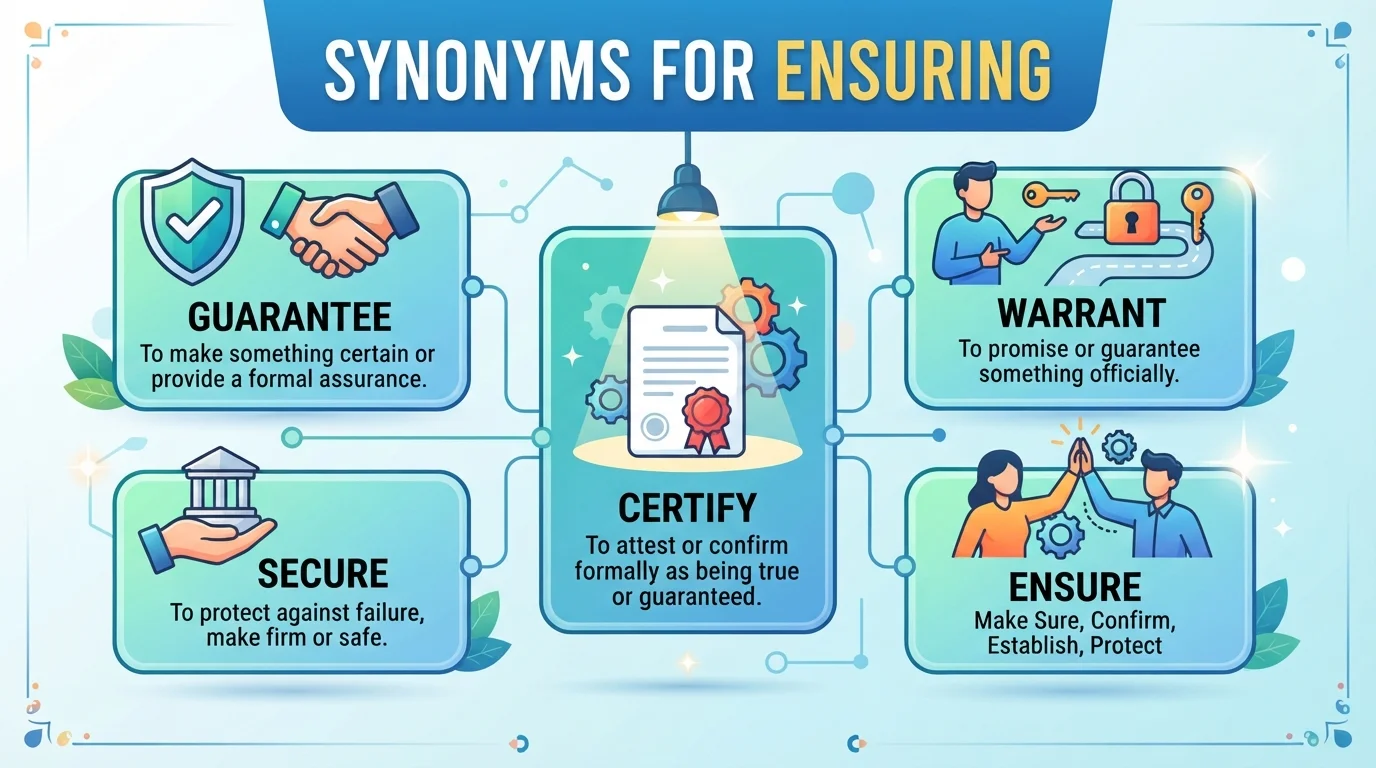
2. Guaranteeing
Meaning: Promising or making certain that a particular result will occur.
Tone: Strong, formal, or professional.
Best for: Warranties, contractual promises, commitments, and situations involving a high degree of certainty.
Example: The warranty guarantees replacement of defective parts under the stated conditions.
How it differs: Guaranteeing expresses a stronger commitment than ensuring in many contexts.
Watch out: Avoid promising guaranteed results when uncertainty remains. For example, training may improve performance without guaranteeing success.
3. Securing
Meaning: Successfully obtaining, establishing, or protecting something.
Tone: Neutral to professional.
Best for: Funding, agreements, access, resources, opportunities, and favorable outcomes.
Example: The organization is securing additional funding for the project.
How it differs: Securing emphasizes obtaining or establishing something rather than merely checking that it exists.
Watch out: It is not a natural substitute in every sentence. “Securing that the data is correct” is less natural than “ensuring that the data is correct.”
4. Confirming
Meaning: Establishing that information, an arrangement, or a condition is correct.
Tone: Neutral or professional.
Best for: Appointments, schedules, reservations, details, requirements, and communications.
Example: The administrator is confirming that all participants have received the invitation.
How it differs: Confirming emphasizes establishing that something is true or has happened.
Watch out: Confirming an arrangement does not necessarily guarantee that it will proceed as planned.
5. Verifying
Meaning: Checking that something is accurate, authentic, or meets specified requirements.
Tone: Professional, academic, or technical.
Best for: Research, data analysis, documentation, quality control, security, and technical procedures.
Example: The analyst is verifying the figures before publishing the report.
How it differs: Verifying emphasizes evidence-based checking rather than bringing about an outcome.
Watch out: Verification can reveal an error. It does not automatically correct that error.
6. Checking
Meaning: Examining something to determine whether it is correct, complete, safe, or satisfactory.
Tone: Neutral.
Best for: Everyday tasks, instructions, workplace procedures, and routine inspections.
Example: She is checking that every application contains the required documents.
How it differs: Checking is usually less formal than verifying and does not necessarily imply a rigorous validation process.
7. Safeguarding
Meaning: Protecting something valuable from harm, loss, misuse, or damage.
Tone: Professional or formal.
Best for: Safety, privacy, confidential information, assets, rights, and public welfare.
Example: The organization introduced additional measures for safeguarding customer information.
How it differs: Safeguarding emphasizes protection against risk rather than certainty about an outcome.
Watch out: Safeguarding information does not necessarily eliminate every possible security threat.
8. Protecting
Meaning: Keeping someone or something safe from harm, damage, or danger.
Tone: Neutral.
Best for: People, property, data, the environment, and physical safety.
Example: The new procedures are designed to protect employees from workplace hazards.
How it differs: Protecting is more directly concerned with preventing harm, while ensuring can refer to any desired result.
9. Establishing
Meaning: Creating, proving, or putting something on a firm basis.
Tone: Professional or formal.
Best for: Procedures, standards, systems, facts, policies, and organizational arrangements.
Example: The company is establishing clear guidelines for handling customer complaints.
How it differs: Establishing often describes creating the conditions necessary for a result rather than continuously ensuring that it occurs.
10. Maintaining
Meaning: Keeping something at a required level or in a desired condition.
Tone: Neutral or professional.
Best for: Quality, safety, consistency, standards, equipment, and performance.
Example: Regular inspections help maintain high safety standards.
How it differs: Maintaining focuses on preserving an existing condition. Ensuring can refer to creating that condition in the first place.
11. Validating
Meaning: Establishing that something meets defined criteria or is appropriate for its intended use.
Tone: Technical or professional.
Best for: Software, research methods, processes, models, and technical systems.
Example: The development team is validating the software against the project requirements.
How it differs: Validating generally involves evaluating something against established criteria.
Watch out: Validation and verification have distinct technical meanings in some fields. Use the terminology appropriate to the relevant standard.
12. Monitoring
Meaning: Observing or checking something over time to detect changes, problems, or deviations.
Tone: Professional or technical.
Best for: Performance, compliance, security, quality, health, and ongoing operations.
Example: The team is monitoring equipment performance throughout the testing period.
How it differs: Monitoring provides ongoing information. Additional action may be necessary to ensure the desired outcome.
13. Enforcing
Meaning: Making sure that rules, laws, standards, or requirements are followed through the exercise of authority.
Tone: Formal or professional.
Best for: Policies, regulations, contracts, and organizational rules.
Example: Management is responsible for enforcing workplace safety procedures.
How it differs: Enforcing specifically involves requiring compliance. It is not appropriate for every kind of assurance.
14. Overseeing
Meaning: Supervising an activity or process to make sure it is carried out appropriately.
Tone: Professional.
Best for: Projects, operations, employees, procedures, and organizational responsibilities.
Example: The project manager is overseeing the installation of the new equipment.
How it differs: Overseeing describes supervision. A supervisor may oversee a process without being able to guarantee its outcome.
15. Seeing to It
Meaning: Taking responsibility for making sure something happens.
Tone: Conversational or neutral.
Best for: Everyday instructions, personal responsibilities, and workplace communication.
Example: I’ll see to it that the documents reach the office before Friday.
How it differs: Seeing to it emphasizes personal responsibility and follow-through.
Watch out: The natural construction is usually see to it that, followed by a clause.
Synonyms for Ensuring by Context
The most useful alternative often depends on what you are trying to ensure. Choosing a word that identifies the actual action makes instructions and professional writing more precise.
Ensuring Safety
For safety-related writing, consider safeguarding, protecting, maintaining, monitoring, enforcing, and securing.
Alternative | When to use it | Example |
|---|---|---|
Safeguarding | Preventing harm or reducing risk | Safeguarding employees is a central responsibility. |
Protecting | Keeping people or property safe | The barriers protect workers from falling objects. |
Maintaining | Preserving existing safety standards | Regular inspections help maintain safety. |
Monitoring | Watching for potential hazards | Sensors monitor equipment temperatures. |
Enforcing | Requiring adherence to safety rules | Supervisors enforce safety procedures. |
For example, “The company is ensuring employee safety” can become “The company is implementing measures to protect employees.”
The revised sentence identifies a concrete action without implying that all risks have been eliminated.
Ensuring Accuracy
Useful alternatives include verifying, checking, validating, reviewing, double-checking, and cross-checking.
Verifying works when evidence or reliable sources are used to establish accuracy. Double-checking means checking something again, while cross-checking involves comparing information against another source.
For example:
The editor is ensuring the accuracy of the article.
A more specific version is:
The editor is verifying the article’s factual claims against reliable sources.
The second sentence tells readers exactly what the editor is doing.
Ensuring Quality
For quality-related writing, use maintaining, monitoring, inspecting, testing, reviewing, or upholding, depending on the process.
For example, a manufacturer may inspect finished products, test their performance, monitor production, and maintain quality standards. Each activity contributes to quality assurance, but none necessarily guarantees that every product is free from defects.
Ensuring Compliance
For regulatory and organizational contexts, alternatives include enforcing, monitoring, verifying, auditing, implementing, and overseeing.
These words describe distinct responsibilities. Implementing a policy puts it into operation, monitoring tracks whether requirements are followed, and auditing involves a more structured examination of records or practices.
For example:
The department is ensuring compliance with internal policies.
Can become:
The department is monitoring compliance with internal policies.
Use enforcing instead when the department has the authority to require adherence and take corrective action.
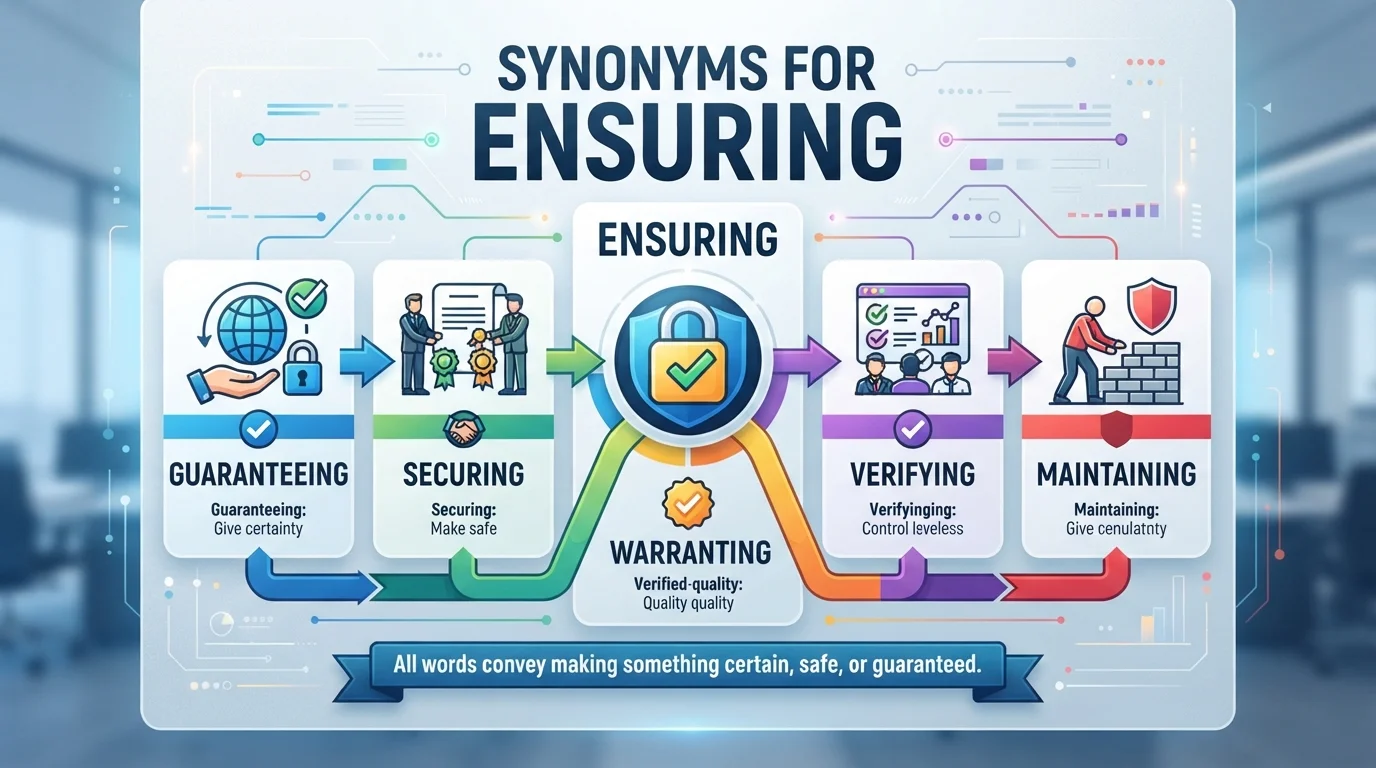
Ensuring Success
Alternatives such as securing, promoting, facilitating, supporting, enabling, and contributing to can be useful.
However, success is rarely guaranteed by a single action. In many situations, a phrase that expresses support rather than certainty is more accurate.
Instead of “The training program ensures career success,” write “The training program helps participants develop skills that support career advancement.”
Ensuring Access
When describing access to services, resources, or information, use providing, securing, facilitating, maintaining, or guaranteeing, depending on the commitment involved.
For example, “The program ensures access to educational materials” can become “The program provides participants with access to educational materials.”
The second sentence is direct and identifies what the program actually delivers.
Ensuring vs. Assuring vs. Insuring
These three words are often confused because they look and sound similar.
Make certain that something happens
The coordinator checked the schedule to ensure that every session had a speaker.
Give someone confidence or reassurance
The coordinator assured the speakers that the equipment would be ready.
Provide or obtain insurance coverage
The organizers insured the equipment against accidental damage.
In American English, insure is generally preferred for insurance-related contexts. Assure typically takes a person as its object, while ensure commonly takes a clause or describes a result.
True Synonyms vs. Related Alternatives
Alternative | Relationship | Can replace ensuring? | Best context |
|---|---|---|---|
Making sure | Close synonym | Often | General communication |
Guaranteeing | Stronger alternative | When certainty is warranted | Promises |
Securing | Contextual synonym | Sometimes | Resources and outcomes |
Confirming | Related action | When establishing a fact | Arrangements |
Verifying | Related action | When checking accuracy | Data and evidence |
Checking | Related action | Sometimes | Routine procedures |
Safeguarding | Contextual alternative | For protection | Safety and privacy |
Establishing | Related action | For creating conditions | Systems and standards |
Maintaining | Related action | For preserving conditions | Quality and performance |
Monitoring | Supporting activity | Not directly | Ongoing observation |
Enforcing | Specific action | For requiring compliance | Rules and policies |
Overseeing | Supporting activity | Not directly | Supervision |
Seeing to it | Close synonym | Often | Personal responsibility |
The difference between an outcome and the action intended to produce it is especially important. Monitoring a process may help ensure quality, but monitoring and ensuring are not the same activity.
Comparison Table
Word or phrase | Main meaning | Tone | Strength | Best use |
|---|---|---|---|---|
Ensuring | Making a result certain | Neutral | Strong | General outcomes |
Making sure | Checking or securing a result | Conversational | Moderate–strong | Everyday writing |
Guaranteeing | Promising a result | Formal | Very strong | Explicit commitments |
Securing | Obtaining or protecting | Professional | Strong | Resources |
Confirming | Establishing that something is true | Neutral | Moderate | Arrangements |
Verifying | Checking against evidence | Technical | Precise | Accuracy |
Safeguarding | Protecting against harm | Formal | Preventive | Safety |
Maintaining | Preserving a condition | Neutral | Ongoing | Standards |
Monitoring | Observing over time | Professional | Observational | Performance |
Enforcing | Requiring compliance | Formal | Authoritative | Rules |
How to Choose the Right Alternative
What do you want to express?
Suitable alternative
Making sure
We’re making sure every participant receives the materials.
10 Sentence Transformations
These examples show how replacing ensuring can improve precision, change the tone, or describe a specific action.
Original | Better alternative | Why |
|---|---|---|
We’re ensuring everyone understands the instructions. | We’re making sure everyone understands the instructions. | More conversational. |
The team is ensuring data accuracy. | The team is verifying the data. | Identifies the checking process. |
The company is ensuring employee safety. | The company is implementing measures to protect employees. | Describes concrete preventive action. |
The manager is ensuring quality. | The manager is maintaining quality standards. | Emphasizes ongoing consistency. |
The department is ensuring compliance. | The department is enforcing the requirements. | Emphasizes authority and adherence. |
The organization is ensuring additional resources. | The organization is securing additional resources. | More natural for obtaining resources. |
She’s ensuring the appointment is scheduled. | She’s confirming the appointment. | Identifies the specific task. |
The supervisor is ensuring the work is completed. | The supervisor is overseeing the work. | Emphasizes supervision rather than a guaranteed outcome. |
The system is ensuring continuous performance. | The system is monitoring performance continuously. | Describes observation without overstating certainty. |
We’re ensuring the documents arrive tomorrow. | We’re arranging for the documents to arrive tomorrow. | Emphasizes the arrangements being made. |
Grammar and Natural Usage
Ensuring is the present participle and gerund form of ensure.
As a present participle, it appears in continuous verb constructions:
The team is ensuring that all requirements are met.
As a gerund, it functions as a noun:
Ensuring accurate records requires careful attention.
The most common grammatical patterns are ensure that + clause and ensure + noun phrase.
For example:
Please ensure that the doors are locked.
The new procedures help ensure compliance.
A frequent error is using ensure to when the intended meaning is make sure to. Instead of “Ensure to submit your application,” write “Make sure to submit your application” or “Ensure that your application is submitted.”
Common Mistakes
Treating verifying and ensuring as identical. Verification checks whether something meets requirements; ensuring involves making certain that the requirements are met.
Using guaranteeing when certainty is impossible. Avoid absolute promises when results depend on factors outside your control.
Confusing ensuring and assuring. You ensure an outcome but typically assure a person.
Using insuring outside insurance contexts. In American English, use insure for obtaining or providing insurance coverage.
Replacing ensuring with monitoring without considering the difference. Monitoring identifies conditions or changes but does not necessarily correct problems.
Using securing with an unnatural grammatical structure. Write “securing funding,” not “securing that funding is available.”
Assuming protection eliminates every risk. Safeguarding and protecting generally describe preventive actions, not absolute guarantees.
Making professional writing unnecessarily formal. Making sure is often clearer than a complicated alternative.
When “Ensuring” Is the Better Word
Ensuring is useful when the intended meaning is genuinely broader than checking, supervising, protecting, or maintaining.
For example:
The project manager is responsible for ensuring that the work is completed on time.
This sentence describes responsibility for the final result. Replacing ensuring with monitoring would narrow the responsibility to observation, while overseeing would emphasize supervision.
Keep ensuring when it accurately captures responsibility for achieving a required outcome.