
Quick Synonym List
Meaning | Alternatives |
|---|---|
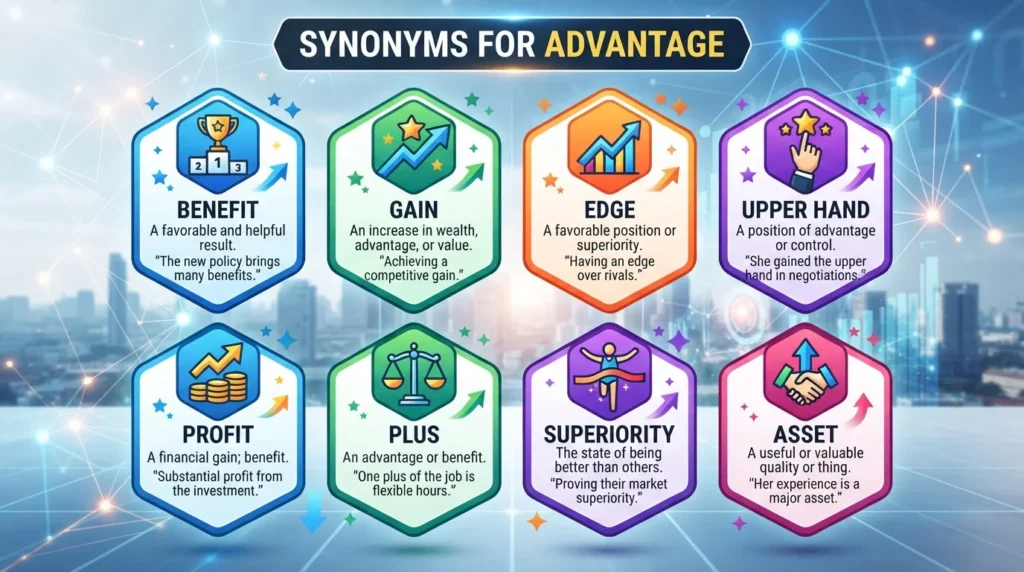
General benefit | Benefit, gain, positive, plus, upside |
Competitive advantage | Edge, upper hand, lead, head start, superiority |
Useful quality or resource | Strength, asset, strong point, selling point |
Opportunity | Opportunity, opening, favorable position |
Influence or power | Leverage, bargaining power, influence |
Special advantage | Privilege, preferential treatment, special access |
Business advantage | Competitive edge, market advantage, strategic advantage |
Personal advantage | Strength, talent, skill, favorable position |
Not all these words are direct synonyms. For example, an opportunity is a chance to gain an advantage, while a privilege is a special benefit or right that not everyone has.
What Does “Advantage” Mean?
Advantage is a noun that refers to a favorable condition, useful quality, benefit, or circumstance that helps someone succeed or puts them in a better position.
It has three especially common meanings:
Benefit: “One advantage of working remotely is flexibility.”
Competitive edge: “Their experience gave them an advantage over other applicants.”
Useful quality or resource: “Her communication skills are a major advantage.”
The best alternative depends on whether you are describing a positive outcome, a competitive position, or something useful.
The Best Synonyms for Advantage
1. Benefit
Meaning: A positive result or useful effect.
Tone: Neutral or professional.
Best for: Products, services, decisions, employment, health, and everyday situations.
Example: One benefit of online learning is the ability to study from home.
Watch out: Benefit emphasizes what you gain, while advantage can also mean being in a stronger position than someone else.
2. Edge
Meaning: A small but meaningful advantage over someone or something.
Tone: Neutral to conversational.
Best for: Sports, business, competition, education, and job applications.
Example: Her previous experience gave her an edge over other candidates.
Watch out: Edge usually suggests comparison or competition. It is not a natural replacement for every general benefit.
3. Upper Hand
Meaning: A stronger or more favorable position in a competition, disagreement, or negotiation.
Tone: Conversational.
Best for: Negotiations, conflicts, games, and competitive situations.
Example: The company gained the upper hand during negotiations.
Watch out: This expression suggests relative power or control rather than a simple benefit.
4. Strength
Meaning: A quality or ability that makes someone or something effective.
Tone: Neutral or professional.
Best for: Personal abilities, business capabilities, products, and performance evaluations.
Example: Clear communication is one of her greatest strengths.
Watch out: A strength is an existing positive quality. It does not necessarily provide a competitive advantage.
5. Asset
Meaning: Something valuable or useful that contributes to success.
Tone: Professional.
Best for: Business, employment, teamwork, and personal development.
Example: His technical knowledge is a valuable asset to the team.
Watch out: An asset is a resource or quality, while an advantage is the favorable position or benefit it may create.
6. Gain
Meaning: Something positive obtained through an action, decision, or experience.
Tone: Neutral or professional.
Best for: Finance, personal development, productivity, and measurable improvements.
Example: The new system delivered significant efficiency gains.
Watch out: Gain emphasizes an improvement or something acquired, rather than an existing favorable condition.
7. Opportunity
Meaning: A favorable situation that makes it possible to achieve something.
Tone: Neutral or positive.
Best for: Careers, education, business, and personal development.
Example: The internship provided an opportunity to develop practical skills.
Watch out: An opportunity is a chance to obtain a benefit, not necessarily a benefit already received.
8. Leverage
Meaning: Influence or power that can be used to obtain a favorable result.
Tone: Professional.
Best for: Business, finance, negotiations, and strategy.
Example: The supplier’s exclusive technology gave it considerable leverage in negotiations.
Watch out: Leverage emphasizes influence and the ability to use an advantage, not every kind of positive outcome.
9. Head Start
Meaning: An advantage gained by beginning earlier or having more preparation than others.
Tone: Neutral or conversational.
Best for: Education, careers, projects, and competition.
Example: Learning to code in high school gave her a head start in college.
Watch out: Use this expression when the advantage involves time, early preparation, or an earlier starting position.
10. Privilege
Meaning: A special right, benefit, or opportunity available to a particular person or group.
Tone: Neutral or formal, depending on context.
Best for: Education, employment, social circumstances, and special access.
Example: Employees receive the privilege of accessing the facility outside regular hours.
Watch out: Privilege suggests special access or entitlement. It is not interchangeable with every advantage.

11. Superiority
Meaning: The condition of being better or more effective in a particular respect.
Tone: Formal.
Best for: Technical comparisons, competitive performance, and measurable differences.
Example: The material demonstrated superior durability in laboratory testing.
Watch out: Superiority is a stronger claim than advantage. Use it only when the comparison supports it.
12. Upside
Meaning: A positive aspect or potential benefit of a situation.
Tone: Conversational or business-oriented.
Best for: Evaluating decisions, opportunities, investments, and trade-offs.
Example: The biggest upside of the new schedule is greater flexibility.
Watch out: Upside often suggests a benefit considered alongside possible disadvantages or risks.
Synonyms for Advantage by Context
In business
Business writing often requires more precise language than simply saying that something provides an advantage.
Alternative | Best use | Example |
|---|---|---|
Competitive edge | Being better positioned than competitors | The software gives the company a competitive edge. |
Strategic advantage | A favorable position that supports long-term goals | The location offers a strategic advantage. |
Market advantage | A favorable position within a market | Lower costs provide a market advantage. |
Leverage | Influence in negotiations or decisions | The company has considerable bargaining leverage. |
Asset | A valuable resource or capability | The experienced workforce is an important asset. |
Selling point | A feature that attracts customers | Battery life is the product’s main selling point. |
In academic and formal writing
Benefit, favorable condition, positive outcome, gain, strength, and strategic advantage are useful, depending on the sentence.
For example, instead of “The main advantage of the approach is accuracy,” you could write “The primary benefit of the approach is improved accuracy.”
Avoid replacing advantage with superiority unless the evidence establishes a meaningful comparison.
In everyday conversation
Plus, upside, benefit, edge, head start, and upper hand sound natural in the right situations.
For example, “One advantage of living nearby is the short commute” can become “One big plus of living nearby is the short commute.”
In sports and competition
Use edge for a competitive benefit, lead for being ahead in score or position, head start for an early advantage, and upper hand for having greater control.
A team can have a tactical advantage without being in the lead. These terms should not be treated as interchangeable.
True Synonyms vs. Related Alternatives
Alternative | Relationship | Can replace advantage? | Tone | Best context |
|---|---|---|---|---|
Benefit | Often | Neutral | Positive outcomes | |
Edge | Near synonym | In competition | Neutral | Competitive situations |
Upper hand | Contextual synonym | Sometimes | Conversational | Negotiations |
Strength | Related alternative | Sometimes | Neutral | Positive qualities |
Asset | Related alternative | Sometimes | Professional | Useful resources |
Gain | Near synonym | Sometimes | Neutral | Improvements |
Opportunity | Related concept | Rarely directly | Positive | Future possibilities |
Leverage | Contextual synonym | Sometimes | Professional | Influence |
Head start | Specific advantage | Sometimes | Neutral | Early preparation |
Privilege | Specific benefit | Sometimes | Formal | Special access |
Superiority | Stronger alternative | Only with evidence | Formal | Direct comparisons |
Upside | Near synonym | Often for benefits | Conversational | Trade-offs |
The distinction matters because a word can be related to advantage without preserving its meaning in every sentence.
Advantage vs. Benefit vs. Edge vs. Asset
What positive result do you receive?
A flexible schedule is a benefit of remote work.
What puts you ahead of others?
Specialized training gives applicants an edge.
What useful quality or resource do you possess?
Specialized training is a valuable asset.
What creates a favorable result or position?
Specialized training can be an advantage in the job market.
How to Choose the Right Alternative
What do you want to express?
Suggested word
Benefit
One benefit of the program is lower costs.
10 Sentence Transformations
Original | Alternative | Why |
|---|---|---|
This plan has several advantages. | This plan offers several benefits. | Emphasizes positive results. |
Her experience gives her an advantage. | Her experience gives her an edge. | Highlights competition. |
We have an advantage in negotiations. | We have the upper hand in negotiations. | Emphasizes a stronger position. |
His creativity is a major advantage. | His creativity is a major strength. | Identifies a personal quality. |
The new software is an advantage to our team. | The new software is a valuable asset to our team. | Identifies a useful resource. |
Starting early gave us an advantage. | Starting early gave us a head start. | Emphasizes timing. |
The agreement gives us an advantage. | The agreement gives us leverage. | Highlights influence. |
One advantage is lower costs. | One upside is lower costs. | Sounds more conversational. |
The training offers several advantages. | The training provides several benefits. | Fits professional writing. |
The company has an advantage over competitors. | The company has a competitive edge. | Makes the comparison explicit. |
Grammar and Usage
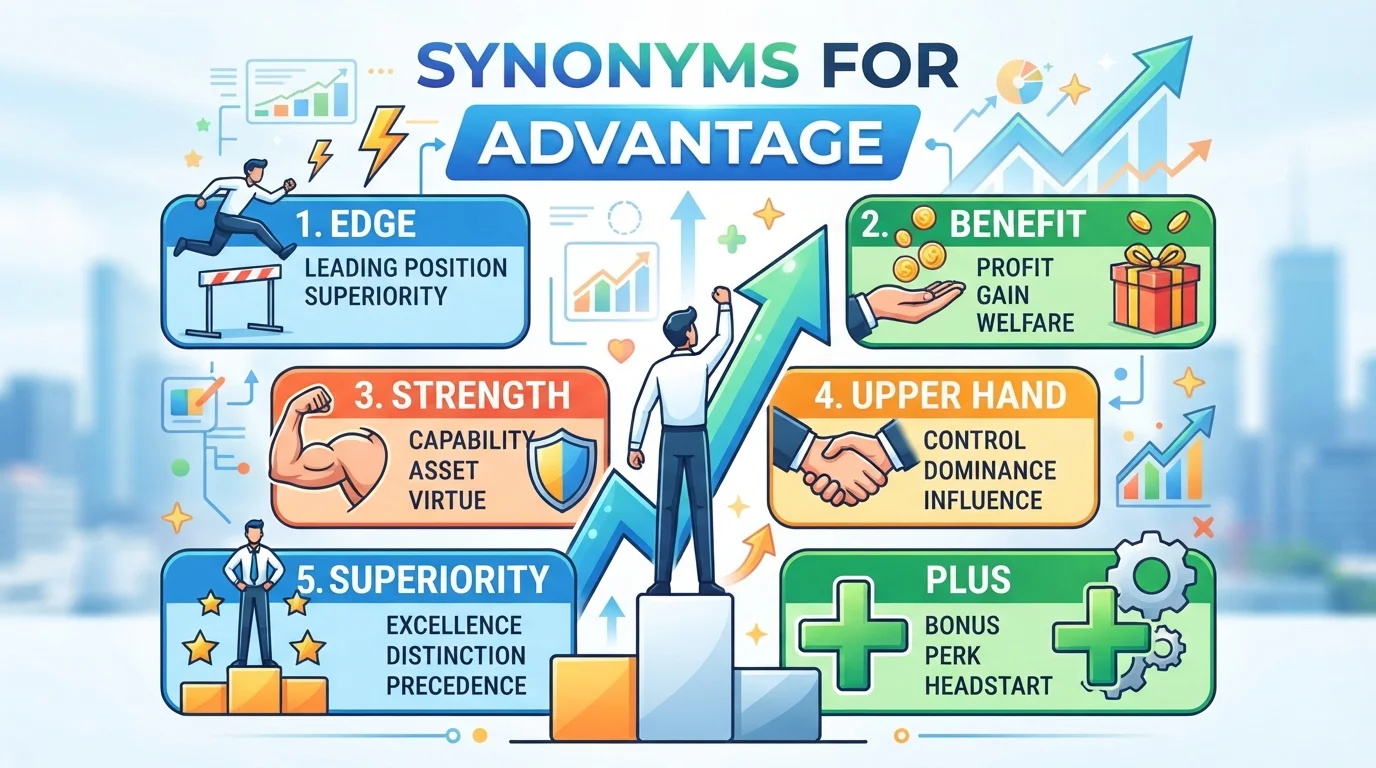
Advantage is a countable noun: an advantage, several advantages, a major advantage.
Common patterns include:
Advantage of: One advantage of the system is its simplicity.
Advantage over: She has an advantage over less experienced applicants.
Advantage in: The team has an advantage in speed.
Advantage to: The arrangement is an advantage to both parties.
Take advantage of: You should take advantage of the available resources.
The expression take advantage of has two meanings. It can mean making good use of an opportunity, but it can also mean exploiting someone unfairly. The context determines which meaning is intended.
Common Mistakes
Using benefit for every competitive advantage. Edge or upper hand may communicate the comparison more clearly.
Confusing an asset with its advantage. A skill is an asset; the favorable position it creates is an advantage.
Treating opportunity as an achieved benefit. An opportunity offers potential rather than a guaranteed result.
Using superiority without evidence. Having one advantage does not establish overall superiority.
Confusing a lead with an advantage. A team may lead on the scoreboard while its opponent has a tactical advantage.
Using leverage for ordinary positive outcomes. Leverage generally involves influence or power.
Replacing every instance of advantage. Repetition is sometimes clearer than an inaccurate alternative.
Ignoring the meaning of take advantage of. It may refer to either using an opportunity or unfair exploitation.
When “Advantage” Is the Better Word
Advantage is already clear, professional, and flexible. It works well when you want to describe a favorable circumstance without narrowing the meaning to a financial gain, a competitive edge, a personal strength, or an opportunity.
For example, “The new location offers several advantages” is natural. Replacing it with “The new location offers several superiorities” would be awkward and potentially inaccurate.