
Quick Answer
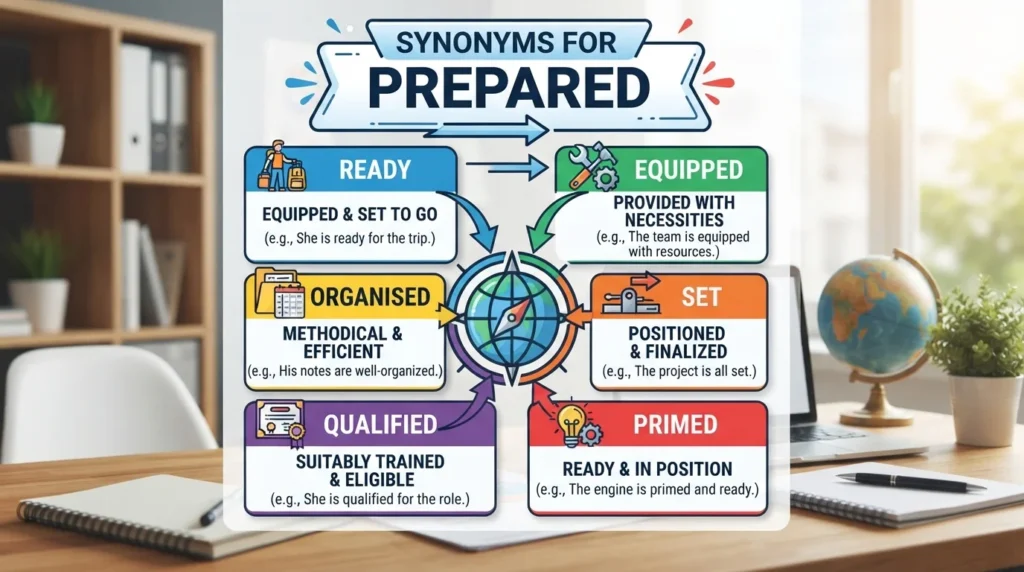
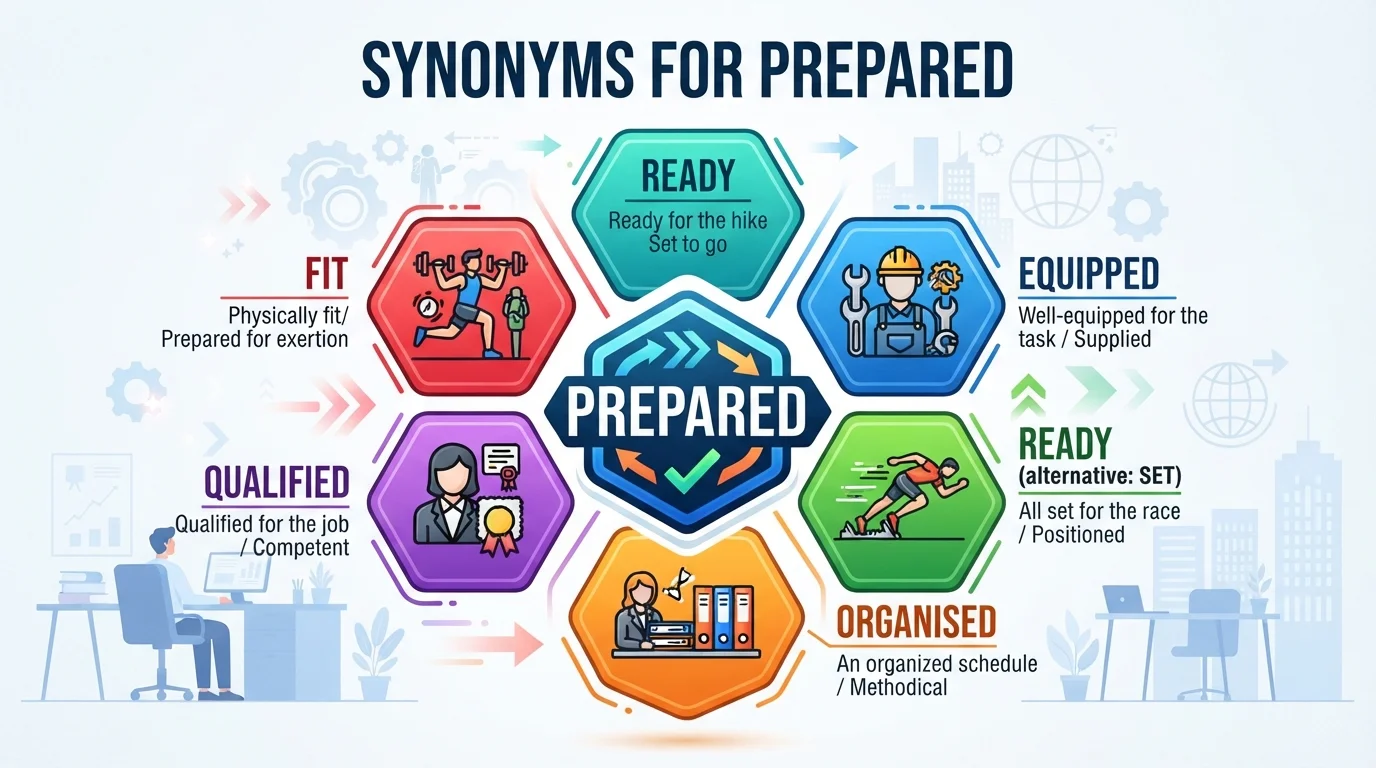
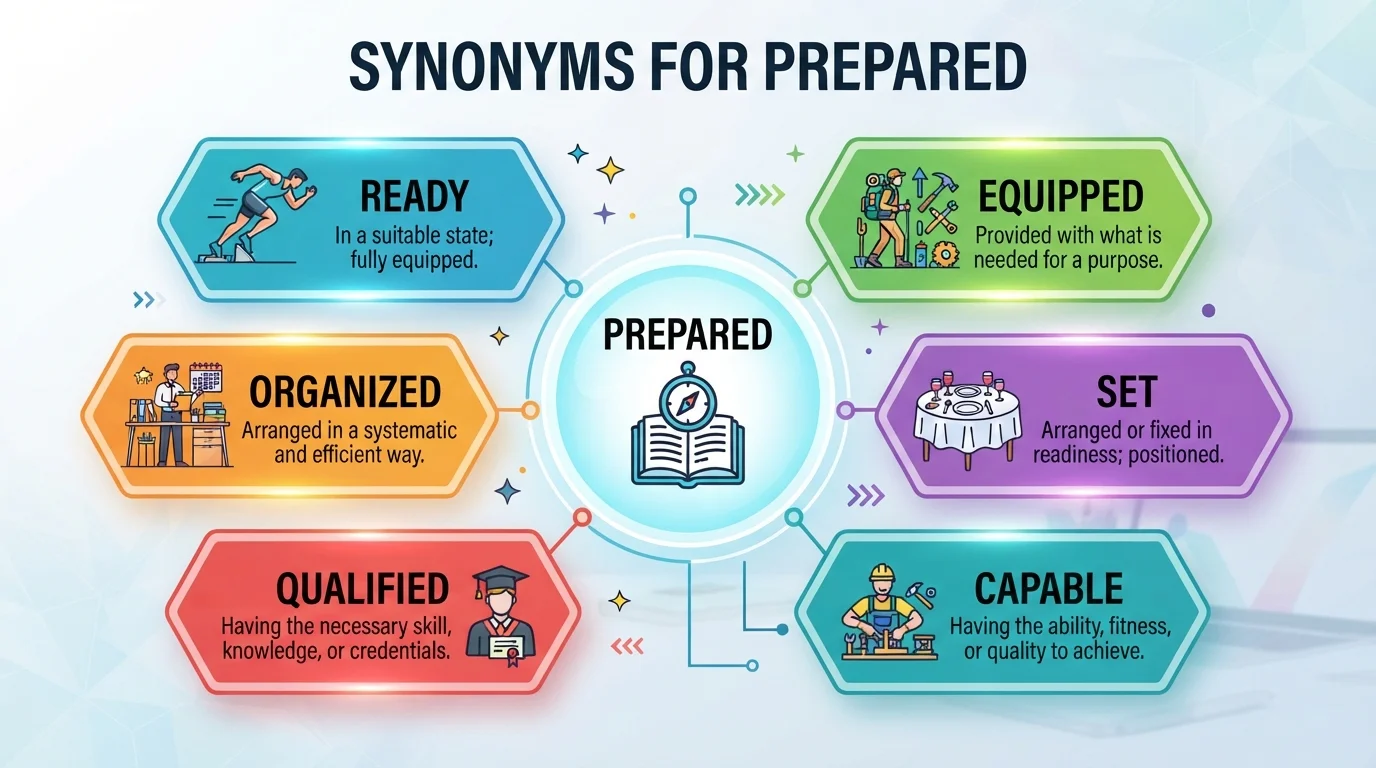
Common synonyms for prepared include ready, equipped, organized, trained, qualified, rehearsed, primed, arranged, planned, and well-prepared. Use ready for general readiness, equipped for having necessary resources, trained for developed skills, and rehearsed for practiced performances. When describing something made in advance, prepared may mean assembled, cooked, or completed.
Quick Synonym List
The following alternatives are grouped by meaning. Some are close synonyms, while others apply only to particular situations.
Meaning | |
|---|---|
Ready for something | Ready, all set, set, primed, poised |
Properly equipped | Equipped, well-equipped, supplied, provisioned, outfitted |
Mentally prepared | Mentally ready, psychologically ready, composed, confident, focused |
Trained or qualified | Trained, qualified, skilled, competent, practiced, experienced |
Practiced in advance | Rehearsed, practiced, well-rehearsed, polished |
Organized beforehand | Organized, planned, arranged, coordinated, scheduled |
Made in advance | Prearranged, preplanned, assembled, completed, finished |
Prepared food | Cooked, made, assembled, ready-made, precooked |
Ready for difficulties | Forearmed, equipped, ready, braced, on standby |
Equipped, primed, provisioned, qualified, poised |
Words such as confident, composed, and focused describe qualities that can accompany preparation. They are not direct replacements for prepared.
What Does Prepared Mean?
Prepared is the past tense and past participle of the verb prepare. It also functions as an adjective.
As an adjective, it usually means ready for something because the necessary steps have already been taken.
“She was fully prepared for the interview.”
As a verb form, it can describe something that has been made, organized, or arranged.
“The chef prepared dinner.”
“The manager prepared the documents before the meeting.”
These uses are different. Someone who is prepared for an interview is ready to participate, while prepared documents have been created or organized.
The following sections separate these meanings to help you choose the appropriate alternative.
Closest Synonyms for Prepared
1. Ready
Meaning: In a suitable condition to begin an activity or deal with a situation.
Tone: Neutral.
Best for: Everyday conversation, work, school, travel, and general readiness.
Example: “The students were ready for their final examination.”
How it differs: Ready is the closest general alternative to prepared. However, it does not always imply advance planning or practice.
A student might feel ready for an exam without having studied extensively. Prepared more strongly suggests that some preparation has taken place.
2. Equipped
Meaning: Having the necessary tools, resources, knowledge, or abilities for a particular purpose.
Tone: Neutral to professional.
Example: “The rescue team was equipped to handle emergencies.”
Equipped emphasizes having what is needed rather than simply being ready.
It works both literally and figuratively:
“The laboratory is equipped with modern instruments.”
“The training equipped employees with essential skills.”
The usual patterns are equipped with something and equipped to do something.
3. Organized
Meaning: Having arranged things systematically so that an activity can proceed efficiently.
Tone: Neutral.
Example: “She was organized and had all her documents ready.
Organized is useful when preparation involves planning, arranging materials, or managing time.
However, someone can be organized without being prepared for a particular challenge.
4. Primed
Meaning: Made ready for a particular action, event, or result.
Tone: Neutral to formal.
Example: “The team was primed for the upcoming competition.”
Primed often suggests a high degree of readiness or favorable conditions for something to happen.
It is common in sports, business, science, and journalism.
Be careful with the context: “primed for failure” means conditions have made failure more likely, not that someone has deliberately prepared to fail.
5. Poised
Meaning: Ready and positioned to take action or experience a particular development.
Tone: Professional or formal.
Example: “The company is poised to expand into new markets.”
Poised often suggests that an event is likely to happen soon or that someone is in a favorable position to act.
It does not necessarily mean that every practical preparation has been completed.
6. All Set
Meaning: Completely ready to begin or proceed.
Tone: Conversational.
Example: “We’re all set for tomorrow’s trip.”
All set is a natural alternative in American English. It is especially useful in friendly conversations, informal emails, and customer service.
It can also mean that someone does not need anything else:
“Would you like another coffee?” “No, thanks. I’m all set.”
In this expression, it does not necessarily mean prepared.
7. Well-Prepared
Meaning: Having made thorough or effective preparations.
Tone: Neutral to professional.
Example: “The candidate was well-prepared for the interview.”
Well-prepared is a stronger form of prepared, not a separate meaning.
It is useful when the quality or completeness of someone’s preparation matters.
Synonyms for Prepared When Describing Skills
Sometimes prepared means having the knowledge, training, or experience needed for a task.
8. Trained
Meaning: Having received instruction or practice for a particular activity.
Example: “Only trained personnel should operate the equipment.”
Trained is appropriate when readiness comes from instruction or practice. It does not guarantee that someone is ready for every situation.
9. Qualified
Meaning: Having the necessary education, experience, skills, or credentials.
Example: “The organization hired a qualified instructor.”
Qualified is particularly useful in employment, education, and professional communication.
A qualified person may still need additional preparation for a specific task.
10. Skilled
Meaning: Having developed the ability to perform something effectively.
Example: “The company needs skilled technicians for the project.”
Skilled emphasizes ability rather than immediate readiness.
A skilled musician, for example, may still be unprepared for a particular performance.
11. Competent
Meaning: Having sufficient ability or knowledge to perform a task satisfactorily.
Example: “The team included competent professionals with relevant experience.”
Competent is appropriate for professional assessments. It describes ability rather than the amount of preparation someone has completed.
12. Practiced
Meaning: Having developed skill through repeated performance.
Example: “She was practiced in handling difficult customer inquiries.”
Practiced emphasizes experience gained through repetition.
It is particularly useful for procedures, performances, and activities requiring developed skills.
13. Experienced
Meaning: Having gained knowledge or ability through previous involvement.
Example: “An experienced guide accompanied the hikers.”
Experienced is not a direct synonym for prepared. Previous experience can contribute to readiness, but someone experienced may still be unprepared for a new situation.
Synonyms for Prepared When Something Has Been Practiced
Rehearsed vs. prepared
A speaker can be prepared by researching a topic and organizing notes. A rehearsed speaker has specifically practiced delivering the speech.
Both activities contribute to readiness, but they are not identical.
14. Rehearsed
Meaning: Practiced in advance of a performance or presentation.
Example: “The actors were thoroughly rehearsed before opening night.”
Rehearsed is particularly appropriate for speeches, presentations, plays, musical performances, and planned responses.
It can sometimes suggest that something sounds unnatural or overly practiced.
“His apology sounded rehearsed.”
Here, rehearsed has a potentially negative implication that prepared does not.
15. Polished
Meaning: Refined through practice, revision, or careful preparation.
Example: “She delivered a polished presentation.”
Polished describes the quality of the finished performance or work.
It does not simply mean ready. A polished presentation is usually well-organized and professionally delivered.
16. Well-Rehearsed
Meaning: Practiced thoroughly in advance.
Example: “The dancers gave a well-rehearsed performance.”
This expression emphasizes extensive practice. It is more specific than prepared and should be reserved for activities that can actually be rehearsed.
Synonyms for Prepared When Something Is Planned or Arranged
A prepared schedule, document, or event may be described with words that identify the type of preparation involved.
Alternative | Specific meaning | Example |
|---|---|---|
Planned | Decided or designed in advance | “The team planned the event carefully.” |
Arranged | Put into the required order or organization | “The seating was arranged before the ceremony.” |
Coordinated | Organized different activities or participants to work together | “The volunteers coordinated the deliveries.” |
Scheduled | Assigned a particular date or time | “The interviews were scheduled for Monday.” |
Prearranged | Arranged before an event | “They met at a prearranged location.” |
Preplanned | Planned beforehand | “The group followed a preplanned route.” |
Assembled | Put together from separate parts | “The materials were assembled before the workshop.” |
Completed | Finished in full | “The report was completed on Friday.” |
These alternatives are often more precise than prepared, but they cannot always replace it directly.
For example, a prepared document might mean a drafted document, a completed document, or one that has been organized for a meeting. The correct alternative depends on what was actually done.
Synonyms for Prepared Food
When describing food, prepared often means made or made ready for eating. The alternatives depend on the method.
Cooked means food has been prepared using heat.
“The vegetables were freshly cooked.”
Precooked means food was cooked before the time it will be served or used.
“The recipe uses precooked chicken.”
Ready-made describes food or other products made in advance and available for immediate use or consumption, sometimes after heating.
“We bought a ready-made meal for dinner.”
Assembled is useful when ingredients have been put together without necessarily being cooked.
“The sandwiches were assembled before the guests arrived.”
Homemade means made at home rather than commercially produced. It describes where or how food was made, not whether it is ready.
A prepared meal may be cooked, assembled, or packaged, so no single alternative works in every situation.
Formal and Professional Alternatives for Prepared
Professional writing benefits from identifying the type of readiness rather than automatically choosing a more formal word.
Situation | Recommended alternative | Example |
|---|---|---|
Employees have necessary training | Trained | “All staff members are trained in emergency procedures.” |
A team has the required resources | Equipped | “The department is equipped to manage the workload.” |
A candidate meets job requirements | Qualified | “She is qualified for the position.” |
A company is positioned for expansion | Poised | “The business is poised for growth.” |
An event has been organized | Arranged | “The arrangements have been finalized.” |
A project plan is ready for use | Completed | “The project plan has been completed.” |
A response has been practiced | Rehearsed | “The spokesperson rehearsed the presentation.” |
For business emails, ready is often more natural than an elaborate alternative.
“The documents are ready for your review.”
This is clear and professional. “The documents are primed for your review” would sound unnatural.
True Synonyms vs. Related Alternatives
The following table separates close alternatives from words that describe particular aspects of preparation.
Alternative | Relationship | Can replace prepared? | Tone | Best context |
|---|---|---|---|---|
Ready | Close synonym | Usually, for readiness | Neutral | General situations |
All set | Informal equivalent | Often | Conversational | Everyday communication |
Well-prepared | Intensified form | Usually | Neutral | Thorough preparation |
Equipped | Contextual alternative | When resources or abilities matter | Professional | Tools and capabilities |
Primed | Near synonym | In selected contexts | Neutral to formal | Readiness for action |
Poised | Near synonym | In selected contexts | Professional | Imminent action |
Trained | Related alternative | When training is involved | Neutral | Skills and procedures |
Qualified | Related alternative | When requirements are met | Professional | Employment and expertise |
Rehearsed | Narrower alternative | When practice is involved | Neutral | Performances |
Organized | Related alternative | When arrangements matter | Neutral | Planning |
Completed | Contextual alternative | When preparation is finished | Neutral | Documents and tasks |
Cooked | Narrower alternative | Only for food prepared with heat | Neutral | Meals |
Comparing the Strongest Alternatives
Word or phrase | Meaning | Tone | Strength | Best use | Interchangeable? |
|---|---|---|---|---|---|
Ready | Able to begin or respond | Neutral | General | Everyday readiness | Usually |
All set | Fully ready | Casual | Strong | Informal conversation | Often |
Well-prepared | Thoroughly prepared | Neutral | Strong | Exams and interviews | Usually |
Equipped | Supplied with what is needed | Professional | Specific | Resources and abilities | Sometimes |
Primed | Made ready for action | Expressive | Strong | Performance or action | Sometimes |
Poised | Positioned to act | Professional | Strong | Upcoming developments | Sometimes |
Rehearsed | Practiced beforehand | Neutral | Specific | Presentations | Sometimes |
Organized | Systematically arranged | Neutral | Specific | Events and work | Sometimes |
How to Choose the Right Alternative
What kind of preparation do you mean?
Ready · All set · Well-prepared
“We’re all set for the meeting.”
Ready works in nearly every general context. All set is friendlier and more informal.
Sentence Transformations
These examples show how a more specific alternative can improve clarity without changing the intended meaning.
1. Job interview
Original: “She was prepared for the job interview.”
Better alternative: “She was well-prepared for the job interview.”
Why: Well-prepared emphasizes that she had completed thorough preparation.
2. Emergency response
Original: “The team was prepared for emergencies.”
Better alternative: “The team was equipped and trained to respond to emergencies.”
Why: The revised sentence identifies the resources and skills that support readiness.
3. Business presentation
Original: “He gave a prepared presentation.”
Better alternative: “He gave a carefully rehearsed presentation.”
Why: Rehearsed emphasizes practice before delivery.
4. Everyday conversation
Original: “We’re prepared to leave.”
Better alternative: “We’re all set to leave.”
Why: All set sounds natural and friendly in informal conversation.
5. Professional development
Original: “The employees were prepared for their new responsibilities.”
Better alternative: “The employees were trained for their new responsibilities.”
Why: The alternative specifies that preparation involved training.
6. Project planning
Original: “The manager prepared the project schedule.”
Better alternative: “The manager finalized the project schedule.”
Why: Finalized is appropriate if the manager completed the last details and approved the schedule.
7. Food
Original: “The chef prepared the vegetables.”
Better alternative: “The chef chopped and arranged the vegetables.”
Why: The revised sentence identifies the actual preparation activities.
8. Business growth
Original: “The company is prepared to enter new markets.”
Better alternative: “The company is poised to enter new markets.”
Why: Poised emphasizes a favorable position for an upcoming development.
9. Event organization
Original: “The organizers prepared everything before the conference.”
Better alternative: “The organizers arranged everything before the conference.”
Why: Arranged emphasizes organizing the necessary details.
10. Difficult situations
Original: “She was prepared for a difficult conversation.”
Better alternative: “She was mentally ready for a difficult conversation.”
Why: The alternative emphasizes psychological readiness rather than practical arrangements.
Grammar and Natural Usage
Prepared for vs. Prepared to
The two most common adjective patterns are prepared for + noun and prepared to + verb.
“The students were prepared for the examination.”
“The students were prepared to answer difficult questions.”
Prepared for identifies the event or situation. Prepared to identifies the action someone is ready or willing to take.
The expression prepared to can also mean willing to do something:
“The company is prepared to negotiate.”
In this example, willing may be a more accurate alternative than ready.
Prepared by vs. Prepared with
When prepared is a passive verb, by identifies the person or organization that did the preparation.
“The report was prepared by the research team.”
With may identify an ingredient, tool, or method.
“The meal was prepared with fresh vegetables.”
These prepositions are not interchangeable.
Preparedness vs. Preparation
Preparation refers to the process of getting ready.
Preparedness refers to the state of being ready, particularly for potential difficulties or emergencies.
“Preparation for the examination took several weeks.”
“The organization reviewed its emergency preparedness.”
The distinction is useful in academic, professional, and emergency-management writing.
Common Mistakes
1. Treating ready and prepared as identical
Ready describes a current state. Prepared often implies that someone has taken steps in advance.
For example, a person may be ready to leave simply because they have decided to go, while being prepared for a trip suggests that they have completed the necessary arrangements.
2. Confusing trained with prepared
Training can contribute to preparation, but a trained person is not automatically prepared for every specific situation.
Use trained when instruction or developed skills are central to the meaning.
3. Using qualified for ordinary readiness
Qualified describes meeting particular requirements or possessing relevant credentials and abilities.
“She is qualified for the job” does not necessarily mean that she is prepared for tomorrow’s interview.
4. Using poised when no upcoming action is implied
Poised usually suggests being positioned for an imminent action or development.
“The documents are poised on the desk” does not naturally mean that the documents have been prepared.
5. Confusing organized with prepared
Someone may be organized but lack the knowledge or resources needed for a particular task.
Similarly, a prepared person may have the necessary knowledge without being especially organized in general.
6. Assuming rehearsed always expresses praise
A rehearsed performance may be polished and effective. However, a rehearsed response can sound artificial or insincere.
Consider the tone before using the word.
7. Using precooked for all prepared food
Precooked specifically means cooked in advance. A prepared salad may contain raw ingredients and therefore is not necessarily precooked.
8. Confusing prepared to with prepared for
Use prepared to before a verb and prepared for before a noun or noun phrase.
Correct: “They are prepared to respond.”
Correct: “They are prepared for emergencies.”
When Prepared Is the Better Word
Prepared is often the most accurate choice when you want to emphasize readiness resulting from advance action without specifying exactly what was done.
For example:
“The students were prepared for the examination.”
This may include studying, practicing, reviewing notes, and organizing materials. Replacing prepared with trained or rehearsed would narrow the meaning.
Similarly:
“The organization is prepared for unexpected disruptions.”
This broad statement may include resources, procedures, training, and contingency plans. Prepared captures all these elements without requiring a separate description of each one.
Avoid replacing it simply to make writing sound more sophisticated