
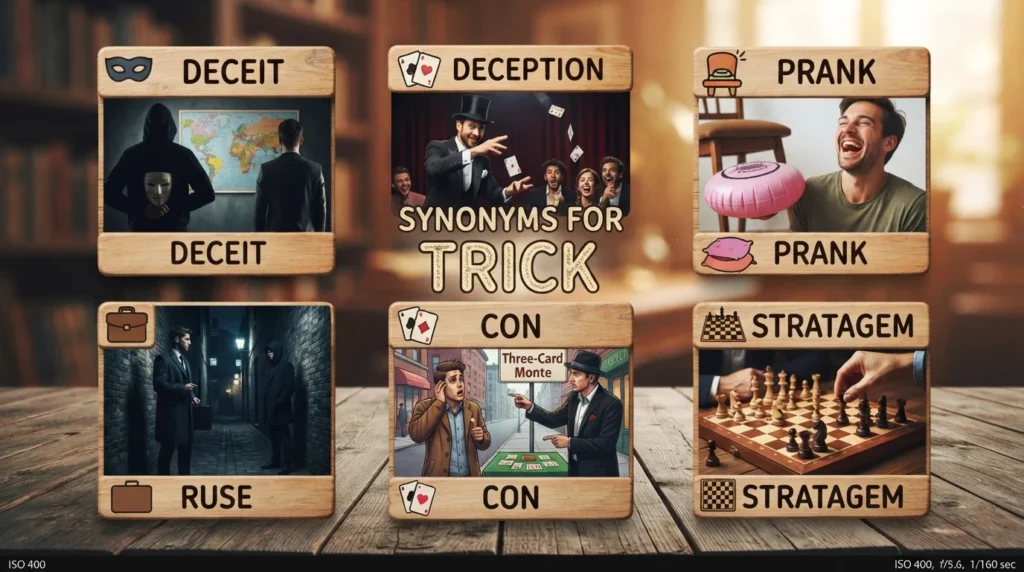
Quick List: Synonyms for Trick by Meaning
When “trick” means deception
- deception
- ruse
- ploy
- stratagem
- scheme
- maneuver
- artifice
- subterfuge
- deception
- swindle
- scam
- con
- hoax
- fraud
When “trick” means a technique or method
- technique
- method
- tactic
- approach
- strategy
- procedure
- maneuver
- device
- skill
- technique
When “trick” means a useful tip or shortcut
- tip
- hack
- shortcut
- pointer
- suggestion
- technique
- workaround
- solution
- insight
- advice
When “trick” means a stunt or impressive skill
- stunt
- feat
- maneuver
- move
- performance
- act
- flourish
- skill
- display
- sleight
When “trick” means a joke or prank
- joke
- prank
- gag
- ruse
- tease
- practical joke
- stunt
- prankish act
What Does “Trick” Mean?
Trick is a flexible word with several distinct meanings. That makes it difficult to replace with one synonym in every sentence.
As a noun, trick can refer to:
- A deceptive action designed to mislead someone.
- The salesman used a trick to get the customer to sign.
- A clever method or technique that produces a result.
- This trick makes it easier to remember new words.
- A practical tip or shortcut.
- She taught me a trick for removing stains.
- A skillful or difficult movement, especially in sports, entertainment, or performance.
- The skateboarder performed an impressive trick.
- A joke or prank.
- The children played a trick on their teacher.
As a verb, trick usually means to deceive, mislead, fool, or manipulate someone.
- He tricked me into paying twice.
- Don’t let the advertisement trick you.
Because these meanings are different, deception is not always a suitable replacement for trick. In “Here’s a trick for remembering names,” the word means a useful technique, not dishonesty.
1. Trick Meaning “Deception”
When someone uses a trick to make another person believe something false or act against their interests, these alternatives may fit.
Deception
Meaning: The act of deliberately misleading someone.
Tone: Neutral to formal
Best for: General writing, professional writing, journalism, academic contexts
Example:
The investigation uncovered a deliberate deception.
Difference: Deception is broader and more formal than trick. A trick can be harmless or playful; deception usually emphasizes misleading behavior.
Ruse
Meaning: A clever plan used to deceive someone.
Tone: Formal or literary
Best for: Narratives, journalism, historical writing, strategic contexts
Example:
The suspect used a ruse to distract the guards.
Difference: A ruse normally involves a deliberate plan. It is closer to a deceptive strategy than a simple prank.
Ploy
Meaning: A clever action or tactic used to gain an advantage.
Tone: Neutral
Best for: Business, negotiations, politics, strategy, everyday discussion
Example:
Offering a discount was a ploy to attract new customers.
Difference: A ploy is usually purposeful and strategic. It does not necessarily involve outright lying.
Stratagem
Meaning: A carefully planned tactic designed to achieve an advantage, often through deception.
Tone: Formal
Best for: Military, strategic, historical, literary, and analytical writing
Example:
The commander devised a clever stratagem.
Difference: Stratagem sounds more deliberate and sophisticated than trick.
Scheme
Meaning: A planned action or arrangement, often intended to deceive or gain an advantage.
Tone: Neutral to negative
Best for: Dishonest plans, conspiracies, business or financial misconduct
Example:
They were involved in a scheme to defraud investors.
Watch out: Scheme does not always mean deception. It can simply mean a plan.
Artifice
Meaning: A clever or deceptive device or technique.
Tone: Formal or literary
Example:
The magician relied on artifice to create the illusion.
Difference: This word is less common in everyday English than trick.
Subterfuge
Meaning: A secret or deceptive method used to avoid a problem or achieve a goal.
Tone: Formal
Example:
The company obtained the information through subterfuge.
Difference: Subterfuge strongly suggests concealment or deception.
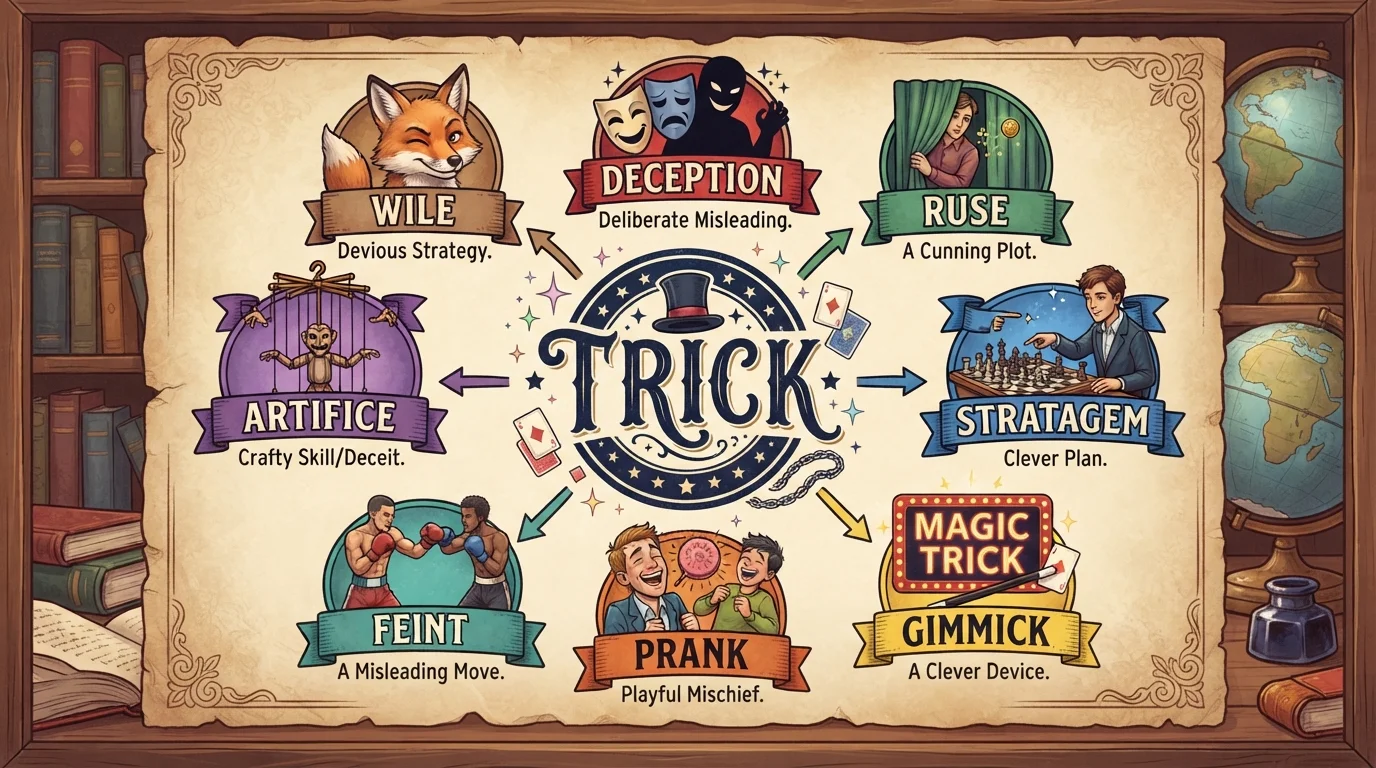
2. Trick Meaning “Method or Technique”
In sentences such as “Here’s a trick for learning vocabulary,” the word is positive or neutral.
Technique
Meaning: A particular way of doing something skillfully or effectively.
Tone: Neutral to professional
Example:
This technique can help you remember difficult words.
Difference: Technique is usually more precise than trick when describing a repeatable skill or procedure.
Method
Meaning: A particular way of doing or achieving something.
Tone: Neutral, formal, or academic
Example:
She developed a simple method for organizing her notes.
Difference: Method is broader and more systematic. A trick can be a small clever shortcut.
Tactic
Meaning: A specific action used to achieve an objective.
Tone: Neutral to professional
Example:
The company used a new marketing tactic to reach younger customers.
Difference: Tactic emphasizes achieving a particular goal, often in a competitive situation.
Approach
Meaning: A way of dealing with a problem or situation.
Tone: Neutral to professional
Example:
We need a different approach to the problem.
Difference: An approach is usually broader than a trick.
Strategy
Meaning: A planned approach for achieving a larger or longer-term goal.
Tone: Professional, academic
Example:
The team developed a strategy for increasing customer retention.
Watch out: Don’t replace every use of trick with strategy. A trick may be a single small technique; a strategy can involve many coordinated actions.
Maneuver
Meaning: A skillful action or move, especially one intended to achieve an advantage.
Tone: Neutral to formal
Example:
The driver performed a difficult maneuver.
Difference: Maneuver can describe physical movement or strategic action.
3. Trick Meaning “Useful Tip or Shortcut”
This is one of the most common positive uses of trick.
Tip
Meaning: A small piece of useful advice or practical information.
Tone: Neutral, conversational
Example:
Here’s a useful tip for writing clearer sentences.
Difference: Tip is often the most natural replacement when trick means helpful advice.
Hack
Meaning: A simple, clever way to solve a problem or make something easier.
Tone: Informal, conversational
Example:
This keyboard shortcut is a useful productivity hack.
Watch out: Hack is informal and can have other meanings, including unauthorized access to computer systems.
Shortcut
Meaning: A faster or easier way of accomplishing something.
Tone: Neutral
Example:
The shortcut saves several minutes every morning.
Difference: A shortcut specifically suggests efficiency or avoiding unnecessary steps.
Workaround
Meaning: A way of dealing with a problem when the normal solution is unavailable.
Tone: Professional, technical
Example:
We found a workaround for the software problem.
Difference: A workaround solves or bypasses a specific obstacle. It is not a general synonym for trick.
Pointer
Meaning: A useful piece of advice or guidance.
Tone: Informal to neutral
Example:
The instructor gave us a few useful pointers.
Difference: Pointer usually refers to advice that helps someone perform better.
4. Trick Meaning “Stunt, Feat, or Skillful Move”
In sports, magic, entertainment, and performance, trick can describe something difficult or impressive.
Stunt
Meaning: A difficult or unusual action performed for entertainment or demonstration.
Example:
The actor performed the stunt without a double.
Difference: A stunt often involves physical risk or spectacle.
Feat
Meaning: An impressive achievement or display of skill.
Tone: Neutral to formal
Example:
Completing the climb in one day was an impressive feat.
Difference: A feat emphasizes achievement or difficulty rather than deception.
Move
Meaning: A particular action or maneuver, especially in sports or games.
Example:
That was an impressive move.
Difference: Move is broader and often more natural in sports or games.
Maneuver
The gymnast performed a difficult maneuver.
This works well when the action involves controlled physical movement or strategic skill.
Sleight
Meaning: Skillful or deceptive movement, especially with the hands.
Common expression: sleight of hand
Example:
The magician’s performance depended on sleight of hand.
Difference: This is especially associated with magic and skillful manipulation.
5. Trick Meaning “Joke or Prank”
When trick describes playful deception, the alternatives change.
Joke
Meaning: Something done or said to make people laugh.
Example:
It was only a joke.
Difference: A joke is primarily intended to amuse. It does not necessarily involve deception.
Prank
Meaning: A playful act intended to surprise, annoy, or amuse someone.
Tone: Informal
Example:
The students played a harmless prank on their friend.
Difference: A prank is usually an action directed at another person.
Gag
Meaning: A joke, especially a practical joke or humorous action.
Tone: Informal
Example:
The fake announcement was just a gag.
Difference: Gag is casual and can also refer to a recurring joke in entertainment.
Tease
Meaning: To make fun of someone playfully or provoke them for amusement.
Example:
His friends were only teasing him.
Difference: Tease describes the interaction rather than necessarily a planned deceptive act.
Trick as a Verb: Better Alternatives
When trick is used as a verb, it usually means to deceive someone.
Trick → Deceive
The advertisement tricked customers.
→ The advertisement deceived customers.
Deceive is more formal and directly emphasizes misleading someone.
Trick → Fool
She tricked him into believing the story.
→ She fooled him into believing the story.
Fool is common and conversational.
Trick → Mislead
The headline tricked readers into expecting something else.
→ The headline misled readers.
Mislead is useful when something causes an incorrect understanding.
Trick → Dupe
He was tricked into paying for a fake product.
→ He was duped into paying for a fake product.
Dupe is more informal and strongly suggests that someone was successfully deceived.
Trick → Con
They tricked him into giving them money.
→ They conned him into giving them money.
Con suggests deliberate deception for personal gain.
Trick → Manipulate
They tricked her into changing her decision.
→ They manipulated her into changing her decision.
Manipulate emphasizes controlling someone’s actions or choices, often unfairly.
Trick → Mislead
The report tricked people about the actual results.
→ The report misled people about the actual results.
This is often preferable in formal writing.
Trick vs. Its Closest Alternatives
| Word | Main Meaning | Tone | Deception Required? | Direct Replacement? |
|---|---|---|---|---|
| trick | Deception, technique, prank, or skill | Neutral | Sometimes | — |
| deception | Deliberately misleading someone | Formal/neutral | Yes | Sometimes |
| ruse | Planned deception | Formal/literary | Yes | Often |
| ploy | Strategic action for advantage | Neutral | Sometimes | Sometimes |
| scheme | Planned action, often dishonest | Neutral/negative | Often | Sometimes |
| technique | Skillful method | Neutral | No | Only in method sense |
| method | Way of doing something | Neutral/formal | No | Only in method sense |
| tip | Useful advice | Conversational | No | Only in advice sense |
| hack | Clever shortcut | Informal | No | Only in shortcut sense |
| stunt | Difficult or spectacular action | Neutral | No | Only in performance sense |
| prank | Playful practical joke | Informal | Usually | Only in joke sense |
| feat | Impressive achievement | Neutral/formal | No | Only in skill/performance sense |
Which Synonym Should You Choose?
Use deception when:
You mean deliberate misleading.
The company was accused of deception.
Use ruse when:
You mean a clever, planned deceptive tactic.
The disguise was a ruse.
Use ploy when:
You mean a tactic designed to gain an advantage.
The offer was a clever ploy.
Use technique when:
You mean a skillful method.
This technique improves concentration.
Use tip when:
You mean useful advice.
Here’s a tip for remembering irregular verbs.
Use hack when:
You mean an informal shortcut.
Try this productivity hack.
Use stunt when:
You mean a spectacular physical action.
The movie featured a dangerous stunt.
Use prank when:
You mean a playful practical joke.
They planned a harmless prank.
Use ruse or ploy when:
You want to emphasize strategy rather than simply saying trick.
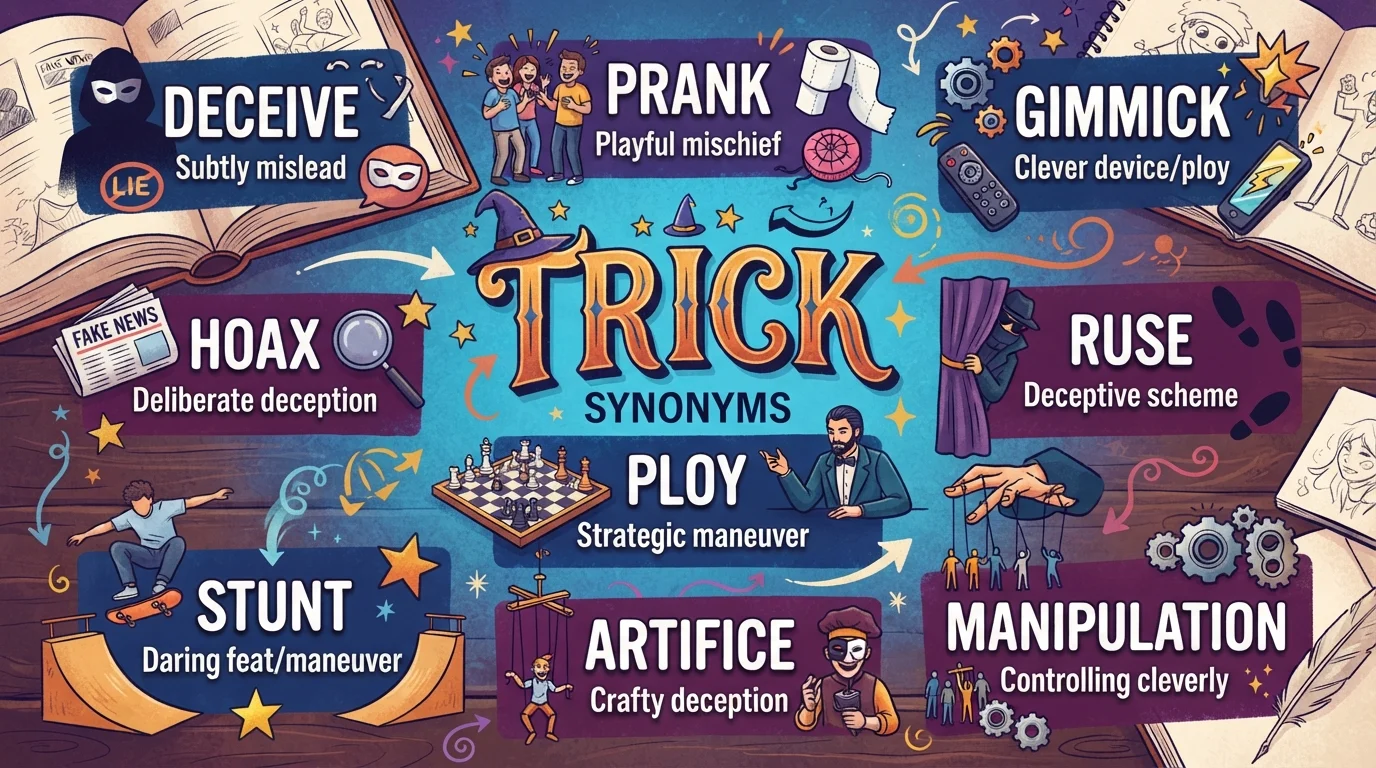
Stronger and More Precise Alternatives
| Word/Phrase | Meaning | Tone | Strength | Best Use | Interchangeable with “trick”? |
|---|---|---|---|---|---|
| deception | Deliberate misleading | Formal | Strong | Formal writing | Sometimes |
| ruse | Planned deceptive device | Formal/literary | Strong | Stories, strategy | Often |
| ploy | Tactic for advantage | Neutral | Medium | Business, strategy | Sometimes |
| stratagem | Carefully planned tactic | Formal | Strong | Strategy, history | Sometimes |
| technique | Skilled method | Neutral | Neutral | Learning, work | In method sense |
| method | Way of doing something | Neutral/formal | Neutral | Academic/professional | In method sense |
| tip | Useful advice | Conversational | Neutral | Everyday help | In advice sense |
| hack | Clever shortcut | Informal | Neutral | Technology, productivity | In shortcut sense |
| stunt | Spectacular action | Neutral | Strong | Sports, film | In performance sense |
| prank | Playful practical joke | Informal | Medium | Social situations | In joke sense |
Sentence Transformations
1. Deception
Original:
The salesman used a trick to persuade the customer.
Alternative:
The salesman used deception to persuade the customer.
Why:
Deception is more formal and clearly signals misleading behavior.
2. Ruse
Original:
The soldier used a trick to distract the enemy.
Alternative:
The soldier used a ruse to distract the enemy.
Why:
Ruse suggests a deliberate plan designed to deceive.
3. Ploy
Original:
The discount was just a trick to attract customers.
Alternative:
The discount was just a ploy to attract customers.
Why:
Ploy emphasizes the tactic’s strategic purpose.
4. Technique
Original:
She taught me a trick for remembering names.
Alternative:
She taught me a technique for remembering names.
Why:
Technique is clearer when the “trick” is a repeatable method.
5. Tip
Original:
Here’s a useful trick for writing better introductions.
Alternative:
Here’s a useful tip for writing better introductions.
Why:
Tip sounds natural when you are giving practical advice.
6. Hack
Original:
I learned a trick for organizing my email.
Alternative:
I learned an email-organization hack.
Why:
Hack works well in informal writing for a clever shortcut.
7. Stunt
Original:
The actor performed an impressive trick.
Alternative:
The actor performed an impressive stunt.
Why:
Stunt is more precise if the action is physically difficult or spectacular.
8. Prank
Original:
The students played a trick on their teacher.
Alternative:
The students played a prank on their teacher.
Why:
Prank specifically identifies a playful practical joke.
9. Mislead
Original:
The headline tricked readers.
Alternative:
The headline misled readers.
Why:
Mislead is concise and appropriate for formal or analytical writing.
10. Fool
Original:
He tricked me into believing the story.
Alternative:
He fooled me into believing the story.
Why:
Fool is a natural conversational alternative to the verb trick.
Common Collocations with “Trick”
Some combinations with trick are so natural that replacing the word can make the sentence less idiomatic.
Deception
- a clever trick
- a dirty trick
- a deceptive trick
- a cruel trick
- a dishonest trick
- a trick to deceive someone
- trick someone into doing something
- trick someone out of money
Useful method
- a useful trick
- a simple trick
- a clever trick
- a handy trick
- a little trick
- a trick for remembering something
- a trick for saving time
- a trick of the trade
Performance
- a magic trick
- a card trick
- a circus trick
- a skateboard trick
- a party trick
- a difficult trick
- a new trick
- perform a trick
Playful deception
- play a trick on someone
- pull a trick
- play a practical joke
- a harmless trick
- a funny trick
“Trick of the Trade”
Trick of the trade means a useful technique or piece of practical knowledge that people learn through experience in a particular job or activity.
The chef showed me a few tricks of the trade.
Here, trick does not mean dishonest deception.
Possible alternatives include:
- professional technique
- practical tip
- expert method
- useful technique
- insider tip
- practical know-how
However, trick of the trade is an established expression, so replacing trick is often unnecessary.
Common Mistakes with “Trick” Synonyms
1. Using “deception” for a harmless technique
❌ This deception helps you memorize vocabulary.
That suggests someone is being misled.
✅ This technique helps you memorize vocabulary.
2. Using “strategy” for every clever trick
A strategy is usually broader and more deliberate than a trick.
A strategy for entering a new market is not the same as a trick for remembering a password.
3. Using “hack” in formal writing
Hack is useful and common in casual digital language, but method, technique, or approach may fit better in academic or professional writing.
4. Confusing a “trick” with a “prank”
A prank is a specific kind of playful act directed at someone.
A trick can be a prank, but it can also be a technique, deception, or performance.
5. Using “scam” for every deceptive trick
A scam usually involves deliberate deception for money or some other gain.
The website was a scam.
That is much stronger and more specific than:
The magician performed a trick.
6. Using “fraud” for a small deception
Fraud generally refers to deliberate deception involving unlawful or dishonest gain.
It is not a general synonym for every trick.
7. Replacing “magic trick” with “deception”
A magic trick may create an illusion, but calling every magic trick a deception changes the tone and focus.
The magician performed a magic trick.
is much more natural than:
The magician performed a deception.
8. Replacing every instance of “trick”
Sometimes trick is the clearest and most natural word.
Here’s a trick for remembering the formula.
There is no need to replace it simply to avoid repetition.
When Should You Keep the Word “Trick”?
Keep trick when:
- the meaning is intentionally broad;
- the context is casual;
- you are describing magic or entertainment;
- you mean a clever little technique;
- you are using a familiar expression;
- the exact distinction does not matter;
- replacing it would make the sentence unnecessarily formal.
For example:
Here’s a simple trick for remembering the rule.
This is often more natural than:
Here’s a simple methodological technique for remembering the rule.
The second sentence is technically understandable but unnecessarily heavy.
Good writing is not about choosing the most sophisticated synonym. It is about choosing the most accurate and natural word.
Decision Guide: What Should You Use Instead of “Trick”?
| If you mean… | Best alternatives |
|---|---|
| Deliberate misleading | deception, deceit |
| Clever deceptive plan | ruse, ploy |
| Strategic tactic | maneuver, stratagem, tactic |
| Dishonest plan | scheme |
| Illegal financial deception | fraud, scam |
| Useful method | technique, method |
| Practical advice | tip, pointer |
| Informal shortcut | hack, shortcut |
| Technical workaround | workaround |
| Difficult performance | stunt, feat |
| Physical movement | maneuver, move |
| Magic performance | magic trick, sleight of hand |
| Playful practical joke | prank, gag |
| Make someone believe something false | deceive, fool, mislead |
| Deceive for personal gain | con, dupe, swindle |
Editor’s Choice: The Most Useful Alternatives
These are editorial recommendations based on precision and natural usage, not an objective ranking.
1. Technique
Best general replacement when trick means a useful method.
Try this technique for memorizing vocabulary.
2. Deception
Best formal replacement when trick means deliberate misleading.
The investigation revealed deliberate deception.
3. Ruse
Best when the deception is a clever, planned device.
The invitation was a ruse.
4. Tip
Best for practical everyday advice.
Here’s a useful tip for improving your writing.
5. Ploy
Best when the action is a tactic designed to gain an advantage.
The offer was a clever ploy.