
Quick Answer
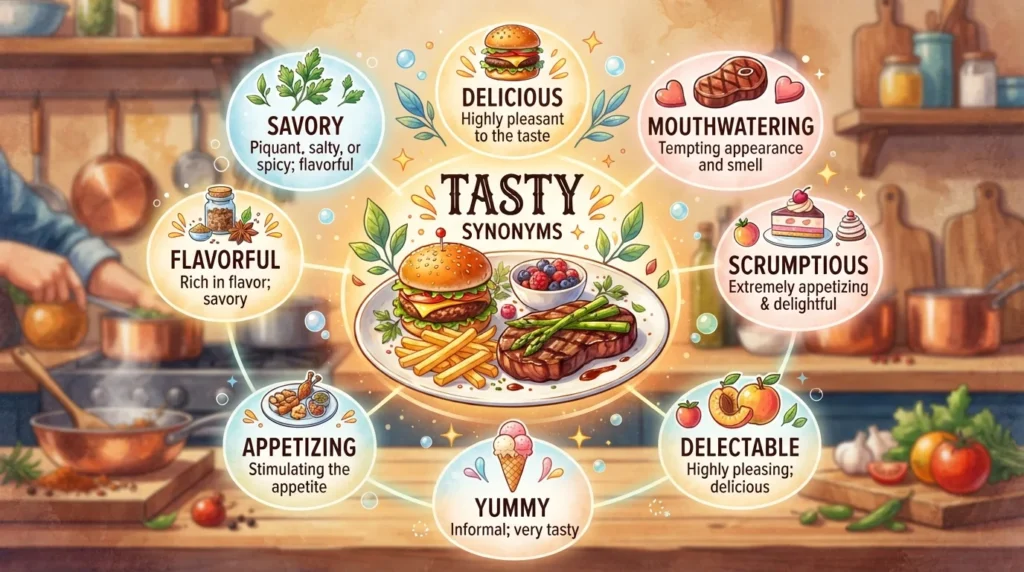
The closest everyday synonyms for tasty are delicious, flavorful, appetizing, savory, delectable, mouthwatering, yummy, scrumptious, and delightful. Use delicious for general praise, flavorful when emphasizing strong or well-developed flavor, savory for non-sweet foods, and mouthwatering when describing food that looks or smells especially tempting.
Quick Synonym Reference
| Alternative | Main meaning | Register | Can replace “tasty”? |
|---|---|---|---|
| delicious | very pleasant to eat | Neutral | Yes |
| flavorful | full of noticeable flavor | Neutral | Yes, often |
| appetizing | makes you want to eat | Neutral | Sometimes |
| savory | pleasantly salty/spicy, non-sweet | Neutral | Only for certain foods |
| delectable | extremely enjoyable to eat | Formal/literary | Yes |
| mouthwatering | extremely tempting or delicious-looking | Neutral | Often |
| yummy | pleasantly delicious | Informal | Yes |
| scrumptious | extremely delicious | Informal/playful | Yes |
| delightful | highly pleasing | Neutral | Sometimes |
| palatable | pleasant or acceptable to eat | Formal | Sometimes |
| succulent | juicy and tender | Neutral | No, narrower |
| savory | rich, salty, non-sweet flavor | Neutral | No, narrower |
| rich | strong, full flavor | Neutral | Sometimes |
| zesty | lively, fresh, tangy flavor | Neutral | No, narrower |
| tangy | pleasantly sharp or acidic | Neutral | No, narrower |
| sweet | sugary flavor | Neutral | No, narrower |
| spicy | hot or strongly seasoned | Neutral | No, narrower |
| flavorful | strong or distinctive flavor | Neutral | Often |
| well-seasoned | balanced seasoning | Neutral | Sometimes |
| toothsome | pleasing to eat | Formal/literary | Yes |
| luscious | rich, juicy, appealing | Literary | Sometimes |
| ambrosial | exceptionally delicious | Literary | Yes |
| sumptuous | luxurious and rich | Formal | Sometimes |
| appetizing | visually/sensorily tempting | Neutral | Sometimes |
| tempting | attractive enough to want to eat | Neutral | Sometimes |
| inviting | appealing and tempting | Neutral | Sometimes |
| scrumptious | extremely tasty | Informal | Yes |
| yummy | tasty and enjoyable | Informal | Yes |
| lip-smacking | very tasty, informal | Informal | Yes |
| finger-licking good | extremely tasty | Informal/idiomatic | Yes |
| mouthwatering | highly tempting | Neutral | Often |
| heavenly | exceptionally pleasurable | Informal/literary | Sometimes |
| divine | exceptionally delicious | Informal/literary | Sometimes |
| delish | delicious | Informal | Yes |
What Does “Tasty” Mean?
Tasty is an adjective meaning pleasant or enjoyable to eat because of its flavor.
This soup is tasty.
The restaurant serves tasty food.
The word is positive but relatively general. It tells the reader that something tastes good without explaining exactly why.
That is why a more precise word can sometimes improve your writing.
For example:
- tasty → general positive flavor
- flavorful → strong or well-developed flavor
- savory → salty, spicy, or non-sweet flavor
- sweet → sugary flavor
- tangy → sharp, acidic flavor
- spicy → hot or strongly seasoned
- succulent → juicy and tender
- mouthwatering → extremely tempting
1. Delicious
Delicious is the closest and most useful general synonym for tasty.
This pasta is tasty.
This pasta is delicious.
Tasty sounds slightly more casual and restrained. Delicious expresses stronger praise.
Best for:
- everyday speech
- restaurant reviews
- food writing
- recipes
- recommendations
- general descriptions
If you simply mean “this food tastes very good,” delicious is usually the safest choice.
2. Flavorful
Flavorful means having a strong, noticeable, or well-developed flavor.
The chicken was tasty.
The chicken was flavorful.
This does not necessarily mean the food was delicious. A food can have a strong flavor without everyone liking it.
Flavorful is especially useful when discussing:
- spices
- sauces
- herbs
- meat
- vegetables
- soups
- international cuisine
The curry was rich and flavorful.
3. Appetizing
Appetizing means attractive or appealing enough to make you want to eat something.
The meal looked tasty.
The meal looked appetizing.
This distinction matters: appetizing can describe the appearance, smell, or general appeal of food before you taste it.
The freshly baked bread looked appetizing.
You can therefore use appetizing when the food looks or smells inviting, not necessarily when you already know it tastes good.
4. Savory
Savory describes food with a pleasant non-sweet flavor, often involving salt, herbs, spices, meat, cheese, or umami-rich ingredients.
We ordered a tasty breakfast.
We ordered a savory breakfast.
But these sentences are not identical.
Tasty says the food tastes good.
Savory identifies the type of flavor.
Examples:
- savory pie
- savory sauce
- savory pastry
- savory filling
- savory snack
- savory breakfast
Do not use savory as a universal synonym for tasty. Sweet foods can be tasty, but they are not normally described as savory.
5. Delectable
Delectable means extremely pleasant to eat.
The dessert was tasty.
The dessert was delectable.
It sounds more polished and expressive than tasty.
Best for:
- food reviews
- menus
- restaurant descriptions
- creative writing
- descriptive prose
The bakery is known for its delectable pastries.
6. Mouthwatering
Mouthwatering describes food that looks, smells, or sounds extremely appealing.
The steak looked tasty.
The steak looked mouthwatering.
It is especially effective in food marketing and descriptive writing.
The restaurant serves mouthwatering grilled seafood.
It does not necessarily prove that someone has tasted the food. It focuses on temptation and anticipation.
7. Yummy
Yummy is an informal, friendly word for delicious or tasty.
These cookies are tasty.
These cookies are yummy.
It is common in casual conversation and is especially associated with friendly or playful language.
Best for:
- casual conversation
- children
- social media
- informal food reviews
Avoid it in formal academic or professional writing.
8. Scrumptious
Scrumptious means extremely tasty or delicious.
The cake was scrumptious.
It is expressive, enthusiastic, and somewhat playful.
Use it when you deliberately want a lively tone rather than a neutral description.
9. Palatable
Palatable means pleasant or acceptable to eat or drink.
The soup was tasty.
The soup was palatable.
These are not always equal in strength.
Palatable can mean merely acceptable, while tasty is clearly positive.
The medication had a more palatable flavor after sweetening.
So palatable is useful in technical, medical, nutritional, and formal contexts, but it is not usually the best word for enthusiastic praise.
10. Toothsome
Toothsome means pleasing or delicious to eat.
It is a genuine word, but it is much less common than delicious or tasty.
The restaurant offered a toothsome selection of desserts.
It has a literary or old-fashioned flavor and is best used deliberately.
11. Succulent
Succulent describes food that is juicy, tender, and rich in moisture.
The steak was tasty.
The steak was succulent.
The second sentence gives much more specific information.
You can have a succulent steak that is not necessarily your favorite flavor.
Common collocations include:
- succulent steak
- succulent chicken
- succulent roast
- succulent meat
- succulent fruit
12. Rich
Rich can describe food with a strong, full, heavy, or luxurious flavor.
The chocolate cake was tasty.
The chocolate cake was rich.
It is especially common with:
- chocolate
- cream
- butter
- sauces
- desserts
- cheese
Rich does not simply mean “tasty.” It describes a particular sensory quality.
13. Zesty
Zesty means lively, fresh, and pleasantly sharp in flavor.
The salad was tasty.
The salad was zesty.
It works particularly well with:
- lemon
- lime
- citrus
- herbs
- dressings
- sauces
The chicken had a zesty lemon sauce.
14. Tangy
Tangy describes a pleasantly sharp, sour, or acidic flavor.
The sauce was tasty.
The sauce was tangy.
Common examples include:
- tangy yogurt
- tangy cheese
- tangy barbecue sauce
- tangy dressing
- tangy citrus flavor
Again, tangy is more specific than tasty.
15. Well-Seasoned
Well-seasoned means prepared with an appropriate or effective amount of herbs, spices, salt, or other seasonings.
The soup was tasty.
The soup was well-seasoned.
This is useful when you want to explain why the food tastes good.
The vegetables were fresh and well-seasoned.
16. Luscious
Luscious describes something rich, juicy, or highly pleasurable, especially fruit, desserts, sauces, or other indulgent foods.
The peaches were tasty.
The peaches were luscious.
It is more expressive and literary than tasty.
17. Heavenly
Heavenly is an enthusiastic, informal-to-literary way to say something is exceptionally pleasurable.
The cheesecake was tasty.
The cheesecake was heavenly.
It is common in food writing and enthusiastic personal reviews.
18. Divine
Divine is another expressive way to say that food tastes exceptionally good.
The dessert was divine.
This is not a literal statement about religion. In food writing, it is an exaggerated expression of pleasure.
19. Delish
Delish is a shortened informal form of delicious.
These tacos are delish!
It is suitable for:
- texts
- social media
- casual reviews
- informal conversation
It is not appropriate for most formal writing.
20. Lip-Smacking
Lip-smacking is an informal expression for very tasty or appetizing food.
They served a lip-smacking barbecue dinner.
It is vivid and promotional, so it can work well in casual food content but may sound exaggerated in formal writing.
True Synonyms vs. Related Alternatives
Not every word associated with good food is a true synonym for tasty.
| Alternative | Relationship | Can replace “tasty”? | What it adds |
|---|---|---|---|
| delicious | Close synonym | Yes | Stronger praise |
| flavorful | Near synonym | Usually | Strong flavor |
| delectable | Close synonym | Yes | Strong, polished praise |
| yummy | Informal synonym | Yes | Casual friendliness |
| scrumptious | Informal synonym | Yes | Enthusiastic praise |
| appetizing | Related alternative | Sometimes | Desire to eat |
| mouthwatering | Related alternative | Often | Temptation |
| savory | Narrower term | No | Non-sweet flavor |
| sweet | Narrower term | No | Sugary flavor |
| spicy | Narrower term | No | Heat/seasoning |
| tangy | Narrower term | No | Sharp/acidic flavor |
| succulent | Narrower term | No | Juicy/tender texture |
| rich | Related sensory term | Sometimes | Full/heavy flavor |
| fresh | Related term | No | Recently prepared/quality |
| crispy | Texture term | No | Crisp texture |
Tasty vs. Delicious
These are the two most interchangeable words.
Tasty
Usually means:
pleasantly flavored or good to eat
Delicious
Usually means:
highly enjoyable to eat
Compare:
The sandwich was tasty.
This is positive but fairly restrained.
The sandwich was delicious.
This expresses stronger enthusiasm.
For neutral food descriptions, tasty can be enough. For stronger praise, delicious is usually more natural.
Tasty vs. Flavorful
This distinction is especially useful.
Tasty = good to eat.
Flavorful = full of noticeable flavor.
The rice was tasty.
The rice was flavorful.
The first gives an overall judgment. The second describes its flavor intensity or complexity.
Tasty vs. Appetizing
Tasty usually refers to the experience of eating something.
Appetizing can refer to how something looks or smells before you eat it.
The soup was tasty.
The soup looked appetizing.
A bowl of soup can look appetizing but turn out not to be tasty.
Tasty vs. Savory
Tasty is broad.
Savory describes a particular category of flavor.
The meal was tasty.
The meal was savory.
The second does not necessarily mean the meal was excellent. It primarily tells you that the food had a non-sweet, often salty or umami-rich flavor.
Tasty vs. Palatable
These words differ in strength.
Tasty = pleasantly good.
Palatable = pleasant or acceptable enough to eat.
The meal was tasty.
sounds more enthusiastic than:
The meal was palatable.
Palatable is often useful when discussing whether something is acceptable rather than especially delicious.
Context-Specific Synonyms for Tasty
For Restaurant Reviews
Best choices:
- delicious
- flavorful
- delectable
- mouthwatering
- exquisite
- savory
- well-seasoned
- succulent
- rich
Example:
The restaurant serves flavorful dishes made with fresh ingredients.
For Recipes
Useful choices include:
- delicious
- flavorful
- savory
- rich
- zesty
- spicy
- sweet
- creamy
- well-seasoned
- mouthwatering
Recipe writing benefits from specific sensory language rather than repeating tasty.
Instead of:
Add a tasty sauce.
Try:
Add a rich, creamy sauce with a hint of garlic.
The second version tells the reader much more.
For Food Advertising
Useful expressions include:
- delicious
- mouthwatering
- irresistible
- delectable
- indulgent
- luscious
- scrumptious
- heavenly
- tempting
- flavorful
Advertising often uses stronger language because its purpose is to create desire.
For Formal or Professional Writing
Use more precise words such as:
- flavorful
- palatable
- well-seasoned
- savory
- rich
- pleasantly flavored
- highly palatable
Avoid overly playful terms such as yummy, delish, or scrumptious when the tone needs to remain formal.
For Casual Conversation
Natural choices include:
- tasty
- delicious
- yummy
- yummy-looking
- delish
- scrumptious
- really good
- so good
- mouthwatering
- amazing
This pizza is so good!
In everyday speech, this can sound more natural than an elaborate synonym.
10 Sentence Transformations
1. General praise
Original:
The pasta was tasty.
Alternative:
The pasta was delicious.
Why: Delicious gives stronger positive praise.
2. Strong flavor
Original:
The soup was tasty.
Alternative:
The soup was flavorful.
Why: Flavorful emphasizes the strength and quality of the flavor.
3. Before eating
Original:
The meal looked tasty.
Alternative:
The meal looked appetizing.
Why: Appetizing focuses on visual appeal and the desire to eat.
4. Non-sweet food
Original:
They served a tasty pastry.
Alternative:
They served a savory pastry.
Why: Savory identifies the type of flavor rather than simply praising it.
5. Casual tone
Original:
These cookies are tasty.
Alternative:
These cookies are yummy.
Why: Yummy is more informal and playful.
6. Professional food writing
Original:
The dish was tasty.
Alternative:
The dish was well-seasoned and flavorful.
Why: The alternative gives specific information instead of general praise.
7. Juicy meat
Original:
The chicken was tasty.
Alternative:
The chicken was succulent.
Why: Succulent emphasizes juiciness and tenderness.
8. Sharp flavor
Original:
The dressing was tasty.
Alternative:
The dressing was zesty and refreshing.
Why: The alternative identifies the character of the flavor.
9. Strong enthusiasm
Original:
The dessert was tasty.
Alternative:
The dessert was absolutely heavenly.
Why: This creates a much more enthusiastic and expressive tone.
10. Formal context
Original:
The meal was tasty and easy to eat.
Alternative:
The meal was flavorful and highly palatable.
Why: The alternative has a more formal, descriptive tone.
Common Collocations with “Tasty”
Natural combinations include:
- tasty food
- tasty meal
- tasty dish
- tasty snack
- tasty recipe
- tasty treat
- tasty dessert
- tasty breakfast
- tasty lunch
- tasty dinner
- tasty sauce
- tasty soup
- tasty sandwich
- tasty vegetables
- tasty chicken
- tasty seafood
- tasty meal idea
- tasty homemade food
You can also use tasty before a noun:
a tasty snack
a tasty recipe
a tasty meal
Common Mistakes
1. Treating “savory” as a direct synonym for “delicious”
Savory describes a type of flavor. It does not automatically mean delicious.
2. Using “appetizing” after tasting something
You can, but it changes the focus. Appetizing is about appeal and desire to eat, not necessarily the actual taste.
3. Assuming “flavorful” means delicious
Something can be extremely flavorful but not appealing to a particular person.
4. Using “palatable” as enthusiastic praise
Palatable can mean merely acceptable. It is not as enthusiastic as delicious.
5. Overusing “mouthwatering”
Mouthwatering is vivid and expressive. Repeating it throughout an article can make food writing sound promotional.
6. Using informal words in formal writing
Words such as yummy, delish, scrumptious, and lip-smacking are usually casual or playful.
7. Confusing taste with texture
Words such as crispy, crunchy, tender, and juicy describe texture or physical qualities, not simply taste.
8. Replacing every use of “tasty”
Sometimes tasty is the clearest and most natural word. A precise alternative is better than a more complicated one.
When Not to Replace “Tasty”
You do not need to replace tasty simply to make your writing sound sophisticated.
This is a tasty snack.
is perfectly natural.
If you are writing for general readers, tasty can be clearer than an uncommon word such as toothsome or ambrosial.
Use a different word when it adds useful information:
- delicious → stronger praise
- flavorful → strong or complex flavor
- savory → non-sweet flavor
- succulent → juicy and tender
- tangy → sharp/acidic
- zesty → lively citrus-like flavor
- appetizing → visually or sensorially tempting
- palatable → acceptable or pleasant enough
A Simple Decision Guide
| If you mean… | Choose… |
|---|---|
| Generally tastes good | tasty |
| Very good to eat | delicious |
| Full of flavor | flavorful |
| Makes you want to eat it | appetizing |
| Extremely tempting | mouthwatering |
| Non-sweet, salty/umami flavor | savory |
| Juicy and tender | succulent |
| Rich or full flavor | rich |
| Sharp, acidic flavor | tangy |
| Fresh, lively flavor | zesty |
| Sugary flavor | sweet |
| Hot/strong seasoning | spicy |
| Pleasantly seasoned | well-seasoned |
| Acceptable to eat | palatable |
| Very delicious, formal/literary | delectable |
| Casual and playful | yummy |
| Very enthusiastic/casual | scrumptious |
| Informal version of delicious | delish |
Editor’s Choice: The Most Useful Alternatives
For most readers, these five cover the biggest practical needs:
- Delicious — the best general stronger alternative.
- Flavorful — best when flavor itself is the focus.
- Appetizing — best for appearance, aroma, or temptation.
- Mouthwatering — best for vivid food descriptions.
- Savory — best when you specifically mean a non-sweet flavor.
The strongest choice depends less on how impressive the synonym sounds and more on what quality of the food you actually want to describe.