
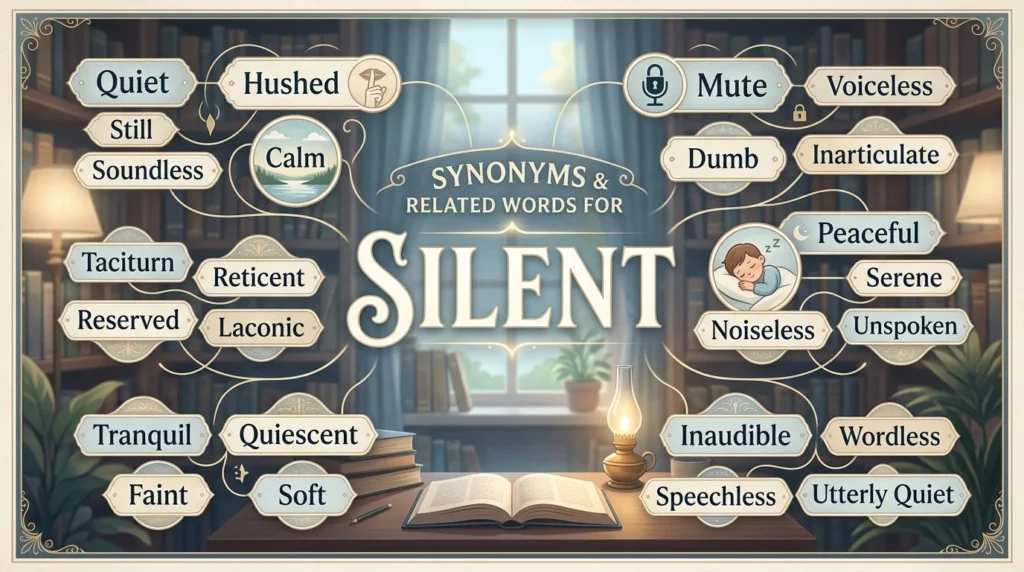
Quick Synonym List
When silent means “not speaking”
- quiet
- mute
- speechless
- wordless
- taciturn
- uncommunicative
- reticent
- reserved
- tight-lipped
- nonverbal
- voiceless
- inarticulate
- tongue-tied
When silent means “without noise”
- quiet
- soundless
- noiseless
- still
- hushed
- peaceful
- tranquil
- calm
- serene
- noiseless
- inaudible
When silent means “without being expressed”
- unspoken
- unstated
- unexpressed
- implicit
- tacit
- unacknowledged
- undisclosed
- concealed
- hidden
- suppressed
- withheld
When silent means “not communicating”
- unresponsive
- uncommunicative
- withdrawn
- reticent
- reserved
- taciturn
- nonresponsive
- disengaged
Important: These words are not all interchangeable. Silent has several distinct meanings, so the right alternative depends on whether you are describing speech, sound, communication, expression, secrecy, or stillness.
What Does “Silent” Mean?
Silent is an adjective that generally means not making a sound, not speaking, or not expressing something.
It can describe very different situations:
The room was silent.
Here, silent means there was little or no sound.
She remained silent during the meeting.
Here, it means she did not speak.
He gave a silent nod.
Here, it means the communication occurred without words.
There was silent opposition to the proposal.
Here, silent has a figurative meaning: the opposition was not openly expressed.
Because these meanings differ, replacing silent with the wrong synonym can subtly change the sentence.

Best Synonyms for Silent
1. Quiet
Meaning: Making little or no noise; not talking.
Tone: Neutral, everyday
Best for: People, rooms, places, conversations, environments
The library was quiet.
She was quiet during the meeting.
Interchangeability: Usually the closest everyday alternative.
Difference: Quiet can mean low noise rather than complete absence of sound. Silent often suggests no sound or no speech at all.
2. Soundless
Meaning: Producing or containing no sound.
Tone: Neutral, descriptive
Best for: Movements, environments, machines, actions
The cat moved soundlessly across the floor.
The room was completely soundless.
Interchangeability: Good for physical sound, but not for every meaning of silent.
You cannot normally replace:
He remained silent.
with:
He remained soundless.
if you mean he chose not to speak.
3. Noiseless
Meaning: Producing no noise.
Tone: Neutral, descriptive
Best for: Machines, movement, environments, actions
The elevator doors closed with a noiseless motion.
Interchangeability: Mainly applies to physical noise.
4. Hushed
Meaning: Very quiet or characterized by subdued sound.
Tone: Descriptive, literary
Best for: Rooms, crowds, voices, conversations, atmospheres
The audience grew hushed as the speaker approached the stage.
Difference: Hushed often suggests a deliberate or sudden reduction in noise.
5. Still
Meaning: Quiet and without movement or disturbance.
Tone: Literary, descriptive
Best for: Nature, places, nights, water, environments
The lake was perfectly still.
The forest was still at dawn.
Interchangeability: Context-dependent.
Still emphasizes lack of movement as well as quietness.
6. Mute
Meaning: Not speaking or unable to speak.
Tone: Neutral to formal
Best for: People, sounds, devices, figurative descriptions
He remained mute throughout the discussion.
Interchangeability: Sometimes.
Watch out: Mute can imply an inability or refusal to speak, depending on context. It can also be a verb:
Please mute your microphone.
7. Speechless
Meaning: Unable or unwilling to speak, often because of strong emotion, surprise, shock, or amazement.
Tone: Emotional
Best for: Reactions to surprising or emotional events
She was speechless with surprise.
Interchangeability: Not a general synonym.
A silent person may simply choose not to speak. A speechless person is unable to find words or is overwhelmed.
8. Wordless
Meaning: Without words.
Tone: Literary, expressive
Best for: Gestures, communication, reactions, moments
They exchanged a wordless glance.
Interchangeability: Useful when communication happens without speech.
9. Taciturn
Meaning: Habitually saying very little.
Tone: Formal, literary
Best for: Describing personality
His taciturn nature made him difficult to get to know.
Interchangeability: No.
Taciturn describes a person’s tendency to speak little, not a temporary period of silence.
10. Reticent
Meaning: Unwilling to speak openly about something.
Tone: Formal, professional
Best for: People, opinions, personal information, sensitive subjects
She was reticent about discussing her past.
Interchangeability: Context-dependent.
Reticent usually implies reluctance to communicate, not simply the absence of speech.
11. Reserved
Meaning: Not openly expressing thoughts or feelings.
Tone: Neutral, often positive
Best for: Personality, behavior, social interaction
He is naturally reserved around strangers.
Interchangeability: Related rather than exact.
A reserved person may speak normally but avoid revealing much about themselves.
12. Uncommunicative
Meaning: Unwilling or unlikely to communicate.
Tone: Neutral to negative
Best for: People, relationships, workplaces
He became increasingly uncommunicative after the disagreement.
Interchangeability: Good when silence involves a lack of communication.
13. Unspoken
Meaning: Not expressed in words.
Tone: Neutral, literary
Best for: Feelings, agreements, rules, tensions, assumptions
There was an unspoken understanding between them.
Interchangeability: Excellent for figurative uses, but not for physical silence.
14. Unstated
Meaning: Not directly expressed or formally declared.
Tone: Formal, professional
Best for: Assumptions, opinions, conditions, rules
The report was based on several unstated assumptions.
Interchangeability: Useful when something has not been explicitly said.
15. Tacit
Meaning: Understood or accepted without being directly expressed.
Tone: Formal, academic
Best for: Agreements, assumptions, approval, knowledge
They reached a tacit agreement.
Interchangeability: Not a general synonym for silent.
Tactit refers to something understood without being explicitly stated.
Synonyms for a Silent Person
If someone is silent because they are not speaking, consider:
- quiet
- mute
- speechless
- wordless
- taciturn
- reticent
- reserved
- uncommunicative
- tight-lipped
- withdrawn
- nonverbal
- tongue-tied
Choose based on the reason
Simply not talking → quiet
Habitually speaks little → taciturn
Reluctant to discuss something → reticent
Not openly expressing thoughts or feelings → reserved
Refusing or unable to speak → mute
Overwhelmed by emotion or surprise → speechless
Refusing to reveal information → tight-lipped
Avoiding communication generally → uncommunicative
Synonyms for a Silent Room or Place
When a location has little or no noise, use:
- quiet
- still
- soundless
- noiseless
- hushed
- peaceful
- tranquil
- serene
- calm
- undisturbed
- deserted
Examples
The house was silent.
Could become:
The house was quiet.
The house was hushed.
The house was still.
The house was completely soundless.
Each creates a slightly different image.
Quiet is the most natural everyday choice.
Hushed creates a stronger atmosphere.
Still suggests both quietness and lack of movement.
Soundless emphasizes the complete absence of sound.
Silent vs. Quiet
These are often treated as synonyms, but there is a useful distinction.
Quiet usually means little noise.
Silent can suggest no sound at all.
Compare:
The room was quiet.
There may still be a clock ticking or people whispering.
The room was silent.
This suggests an absence of noticeable sound.
For people:
He was quiet.
This may mean he simply did not talk much.
He was silent.
This can sound more deliberate or noticeable.
Silent vs. Mute
Mute specifically relates to speech or the production of sound.
He remained silent during the interview.
This says he did not speak.
He remained mute during the interview.
This can sound stronger and may suggest refusal, inability, or complete absence of speech.
For technology:
Mute your microphone.
Here, mute is a verb meaning to turn off the microphone’s audio.
Silent vs. Speechless
These words describe different situations.
Silent = not speaking.
Speechless = unable to speak, usually because of strong emotion or surprise.
She remained silent after the question.
She chose or simply continued not to speak.
She was speechless after hearing the news.
The news left her unable to find words.
Silent vs. Taciturn
Silent can describe a temporary state.
He was silent during lunch.
Taciturn describes a habitual personality trait.
He was a taciturn man.
Someone may be silent today without being taciturn.
Silent vs. Reticent
Reticent suggests reluctance to reveal information, opinions, or feelings.
She was silent during the discussion.
This only tells us that she did not speak.
She was reticent about discussing her finances.
This tells us that she was reluctant to discuss a particular subject.

Silent vs. Reserved
Reserved describes someone’s general social behavior.
She is reserved around new people.
This does not necessarily mean she is silent. She may speak politely but reveal little about herself.
Silent vs. Unspoken
These belong to different grammatical and semantic categories.
a silent audience
The audience makes little or no sound.
an unspoken agreement
The agreement exists but has not been expressed in words.
Use unspoken when the thing itself is an idea, feeling, rule, agreement, or understanding that has not been stated.
Synonyms for “Silent” in Different Contexts
| Context | Best alternatives |
|---|---|
| A quiet person | quiet, reserved |
| Someone who refuses to talk | mute, tight-lipped, uncommunicative |
| Someone who normally speaks little | taciturn |
| Someone reluctant to reveal information | reticent |
| Someone overwhelmed by emotion | speechless |
| A quiet room | quiet, hushed, soundless |
| A peaceful landscape | still, tranquil, serene |
| No physical sound | soundless, noiseless |
| An unstated feeling | unspoken, unexpressed |
| An unstated assumption | implicit, unspoken |
| An agreement not directly expressed | tacit, unspoken |
| Hidden information | undisclosed, concealed |
| Suppressed expression | suppressed, withheld |
| No communication | uncommunicative, unresponsive |
Formal and Academic Alternatives
For formal writing, choose according to the specific meaning:
- reticent
- tacit
- unspoken
- unstated
- implicit
- unexpressed
- unacknowledged
- undisclosed
- suppressed
- withheld
- nonverbal
- uncommunicative
- inaudible
- soundless
Example
Instead of:
The researcher remained silent about the limitations of the study.
Consider:
The researcher did not disclose the limitations of the study.
This is better if you mean the information was deliberately withheld.
Or:
The report contained several unstated assumptions.
This is more precise if the assumptions were present but not explicitly expressed.
Literary Alternatives
If you’re writing fiction, poetry, or descriptive prose, these words can create stronger atmosphere:
- hushed
- still
- soundless
- noiseless
- tranquil
- serene
- mute
- wordless
- speechless
- breathless
- noiseless
- deathly quiet
- eerily quiet
- subdued
- calm
Example
The village was silent at midnight.
Possible literary rewrites:
The village was hushed at midnight.
The village lay still beneath the moonlight.
The village was eerily quiet at midnight.
The original may still be better if you want simple, direct description.
Casual Alternatives
For everyday conversation:
- quiet
- not talking
- keeping quiet
- keeping to oneself
- saying nothing
- not saying a word
- keeping mum
- tight-lipped
Examples
He stayed silent.
→ He stayed quiet.
→ He didn’t say a word.
→ He kept to himself.
→ He kept quiet.
Be careful with keep to himself: it means avoiding social interaction or maintaining privacy, not simply remaining silent.
Stronger Expressions for “Completely Silent”
If you need emphasis:
- completely silent
- absolutely silent
- perfectly silent
- utterly silent
- dead silent
- deathly silent
- eerily silent
- completely soundless
- noiseless
- still as death
Tone matters
Dead silent → informal
Deathly silent → dramatic or literary
Eerily silent → suggests something feels strange or unsettling
Perfectly silent → emphasizes complete absence of sound
Sentence Transformations
1. Silent room
Original:
The room was silent.
Alternative:
The room was completely quiet.
Why: Quiet is the most natural everyday replacement when referring to a lack of noise.
2. Silent person
Original:
He remained silent during the meeting.
Alternative:
He said nothing during the meeting.
Why: This is more direct and clearly describes the person’s behavior.
3. Silent character
Original:
The character is silent and mysterious.
Alternative:
The character is quiet and enigmatic.
Why: Enigmatic preserves the sense of mystery, while quiet handles the speech-related meaning.
4. Silent opposition
Original:
There was silent opposition to the plan.
Alternative:
There was unspoken opposition to the plan.
Why: Unspoken makes the figurative meaning clear.
5. Silent agreement
Original:
They reached a silent agreement.
Alternative:
They reached an unspoken agreement.
Why: Unspoken agreement is the more natural collocation.
6. Silent treatment
Original:
He gave her the silent treatment.
Alternative:
He deliberately refused to speak to her.
Why: This explains the intentional behavior rather than merely replacing one phrase with another.
7. Silent machine
Original:
The machine operated silently.
Alternative:
The machine operated without making a sound.
Why: This clearly describes the absence of mechanical noise.
8. Silent reaction
Original:
She gave a silent reaction to the news.
Alternative:
She responded without saying a word.
Why: This is more natural because silent reaction can sound vague.
Grammar and Usage
Silent is an adjective.
Common structures
silent + noun
a silent room
a silent response
a silent protest
a silent agreement
a silent observer
remain/stay + silent
He remained silent.
She stayed silent throughout the interview.
be silent about + topic
They were silent about the incident.
This structure often suggests that someone did not discuss or disclose something.
silent on + subject
The report is silent on the issue.
This means the report does not address or mention the issue.
silently + verb
The adverb is silently:
She walked silently into the room.
“Silent” vs. “Silently”
Silent is an adjective:
The room was silent.
Silently is an adverb:
She entered silently.
A common mistake is using the adjective where an adverb is required.
He walked silent. ✗
He walked silently. ✓
However, some constructions can use silent after linking verbs:
He remained silent. ✓
Common Collocations With “Silent”
Natural combinations include:
- remain silent
- stay silent
- keep silent
- fall silent
- grow silent
- sit in silence
- silent room
- silent night
- silent response
- silent protest
- silent agreement
- silent treatment
- silent observer
- silent majority
- silent partner
- silent witness
- silent communication
- silent prayer
- silent movie
- silent mode
- silent alarm
- silent operation
Common Mistakes
1. Using “speechless” for ordinary silence
He was speechless during the meeting.
This suggests surprise, shock, emotion, or inability to find words.
If he simply chose not to talk:
He remained silent.
2. Using “taciturn” for temporary silence
Tactiturn describes a person’s habitual tendency to speak very little.
3. Using “unspoken” for physical noise
The room was unspoken. ✗
The room was silent. ✓
Unspoken normally describes something that has not been expressed in words.
4. Assuming “quiet” always means completely silent
A quiet room can still contain small sounds.
5. Using “mute” when “quiet” is more natural
Mute can sound stronger or suggest an inability/refusal to speak.
6. Confusing “silent” with “secret”
Something can be silent without being secret.
a silent protest
does not mean:
a secret protest
A silent protest is usually visible but involves little or no speech.
7. Confusing “silent” with “unresponsive”
Someone can remain silent while still communicating through gestures or facial expressions.
“Silent” in Common Expressions
Silent treatment
Meaning: Deliberately refusing to communicate with someone.
He gave me the silent treatment.
Possible alternatives:
- refused to speak to me
- ignored me
- stopped communicating with me
Watch out: Ignoring can be broader than giving someone the silent treatment.
Silent protest
A form of protest involving little or no spoken communication.
Possible alternatives:
- nonverbal protest
- quiet protest
- wordless protest
But silent protest is often the clearest phrase.
Silent majority
A phrase describing a large group believed not to express its views publicly.
This is a fixed expression, so replacing silent with quiet can change its familiar meaning.
Silent partner
A business partner who invests or has an ownership interest but does not take an active role in management.
This is an established business term, not simply a description of a quiet partner.
Silent witness
Someone or something that observes an event without speaking or intervening.
The old building was a silent witness to decades of change.
Here, silent contributes a figurative, literary meaning.
Which Synonym Should You Choose?
Use this quick guide:
- No or very little noise → quiet
- Absolutely no sound → soundless
- No noise from an object or movement → noiseless
- A subdued atmosphere → hushed
- Quiet and motionless → still
- A person who doesn’t speak → quiet
- Habitually speaks very little → taciturn
- Reluctant to discuss something → reticent
- Doesn’t openly express thoughts or feelings → reserved
- Refuses or cannot speak → mute
- Unable to speak because of emotion or surprise → speechless
- Without words → wordless
- Not expressed → unspoken
- Not explicitly stated → unstated
- Understood without being expressed → tacit
- Not communicating → uncommunicative
- Deliberately not revealing information → withheld or undisclosed
- Not producing an audible sound → inaudible
When “Silent” Is Better Than a Synonym
Sometimes silent is the most precise word.
Consider:
The audience fell silent.
This is concise, natural, and idiomatic. Replacing it with:
The audience became soundless.
would sound unnatural.
Likewise:
She remained silent.
is often better than:
She remained uncommunicative.
The latter suggests a broader failure or refusal to communicate.
And:
There was an unspoken agreement.
is better than:
There was a silent agreement.
because unspoken clearly expresses the figurative meaning.
The goal is not to eliminate repetition at all costs. Keep “silent” when it is the clearest and most natural word.
Editor’s Choice: The 5 Best Alternatives
1. Quiet
The best general-purpose synonym for everyday situations involving little or no noise or speech.
2. Hushed
Best for creating a subdued, atmospheric sense of quiet.
3. Soundless
Best when you specifically mean that something produces no sound.
4. Reticent
Best for someone who is reluctant to discuss a subject.
5. Unspoken
Best for figurative uses involving feelings, agreements, assumptions, or tensions that have not been expressed.