
What Does “Moon” Mean?
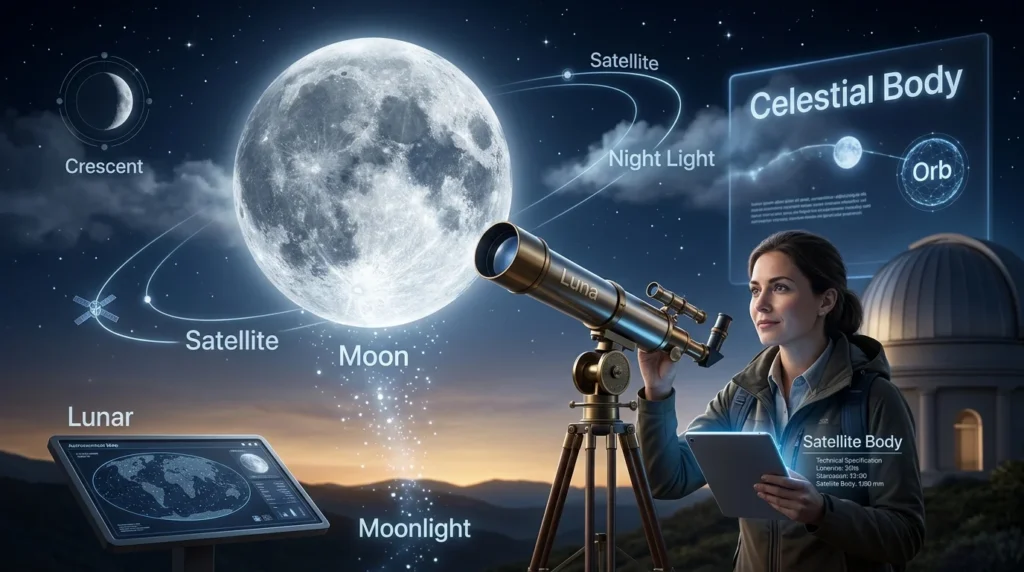
The word moon usually refers to Earth’s natural satellite, the celestial body that orbits Earth and reflects sunlight.
For example:
- The moon was bright tonight.
- We watched the moon rise over the mountains.
- The moon was visible through the clouds.
In astronomy, the word can also refer generally to a natural satellite orbiting another planet or celestial object.
For example:
- Jupiter has many moons.
- Europa is one of Jupiter’s moons.
The exact synonym depends on whether you mean Earth’s Moon, a natural satellite generally, a particular lunar phase, or a poetic representation of the Moon.
Synonyms for Moon at a Glance
| Synonym or Related TermBest Used For | |
|---|---|
| Natural Satellite | Scientific description |
| Satellite | General astronomical term |
| Celestial Body | Formal or scientific writing |
| Lunar Body | Scientific or descriptive writing |
| Orb | Poetic or literary description |
| Celestial Orb | Poetic description |
| Night Orb | Literary description |
| Silver Orb | Poetic description |
| Lunar Sphere | Descriptive or scientific writing |
| Heavenly Body | Literary or general description |
| Celestial Companion | Poetic description |
| Night Companion | Literary description |
| Luna | Latin-derived poetic or proper name |
| Selene | Greek mythological name |
| Diana | Roman mythological association |
| Crescent | Crescent phase |
| Crescent Moon | Specific lunar phase |
| Half-Moon | First- or third-quarter appearance |
| Gibbous Moon | Specific lunar phase |
| Full Moon | Full lunar phase |
| New Moon | Specific lunar phase |
| Harvest Moon | Traditional name for a full moon |
| Supermoon | Full or new moon near perigee |
| Blood Moon | Common term for a total lunar eclipse |
| Lunar | Adjective relating to the Moon |
| Moonlight | Light reflected from the Moon |
| Moonbeam | A visible ray or shaft of moonlight |
| Moonshine | Light from the Moon; also has other meanings |
| Moonlit Orb | Poetic expression |
| Night Lantern | Poetic metaphor |
| Night Light | Figurative description |
| Silver Light | Poetic description |
| Sky Lantern | Figurative description |
| Night Watcher | Literary metaphor |
| Sky Orb | Poetic description |
| Night Sphere | Literary description |
| Earth’s Companion | Descriptive phrase |
| Earth’s Satellite | Scientific description |
| Earth’s Natural Satellite | Precise scientific phrase |
| Lunar Companion | Poetic or descriptive phrase |
| Heavenly Orb | Literary description |
| Silver Disc | Poetic visual description |
1. Natural Satellite
Natural satellite is one of the most precise scientific alternatives to “moon” when referring to an object that naturally orbits a planet or another celestial body.
Examples:
- The Moon is Earth’s natural satellite.
- Scientists study natural satellites throughout the solar system.
- Jupiter has numerous natural satellites.
This term is especially appropriate in astronomy and science writing.
2. Satellite
Satellite is a broader term for an object that orbits another object.
A satellite can be natural or artificial, so “natural satellite” is more precise when discussing the Moon.
Examples:
- The Moon is Earth’s satellite.
- The planet has several satellites.
Because “satellite” can also refer to human-made spacecraft, context is important.
3. Celestial Body
Celestial body is a broad scientific term for a naturally occurring object in space.
Examples:
- The Moon is a prominent celestial body in Earth’s night sky.
- Astronomers observe distant celestial bodies.
It is not an exact synonym for “moon” because stars, planets, asteroids, and other objects can also be celestial bodies.
4. Lunar Body
Lunar body can be used as a descriptive term referring to the Moon or something associated with lunar matter or form.
Examples:
- The spacecraft studied the lunar body from orbit.
- The lunar body has a heavily cratered surface.
This expression is more specialized than the everyday word “moon.”
5. Orb
Orb is a literary word for a rounded or spherical object. Writers sometimes use it to describe the Moon.
Examples:
- The pale orb rose above the horizon.
- A glowing orb appeared in the night sky.
It creates a more poetic tone than “moon.”
6. Celestial Orb
Celestial orb is a poetic expression for a rounded object in the sky, particularly the Moon.
Examples:
- The celestial orb illuminated the quiet landscape.
- The silver celestial orb appeared between the clouds.
It is best suited to creative and literary writing.
7. Night Orb
Night orb is a descriptive phrase that emphasizes the Moon’s presence in the nighttime sky.
Examples:
- The bright night orb hung above the forest.
- The night orb reflected across the water.
This is primarily a poetic expression rather than a scientific term.
8. Silver Orb
Silver orb describes the Moon by referring to its familiar pale or silvery appearance.
Examples:
- The silver orb rose over the hills.
- A silver orb illuminated the dark sky.
This phrase is particularly effective in poetry and descriptive prose.
9. Lunar Sphere
Lunar sphere emphasizes the Moon’s roughly spherical shape.
Examples:
- The lunar sphere appeared against the dark sky.
- The spacecraft photographed the lunar sphere.
It can work in descriptive or scientific writing, although “Moon” remains more natural in most contexts.
10. Heavenly Body
Heavenly body is a traditional expression for an object seen in the sky.
Examples:
- The Moon is one of the most familiar heavenly bodies.
- Ancient cultures observed heavenly bodies carefully.
It is broader than “moon” and can refer to stars, planets, and other celestial objects.
11. Celestial Companion
Celestial companion is a poetic expression emphasizing the Moon’s relationship with Earth.
Examples:
- Earth’s celestial companion brightened the evening sky.
- The celestial companion followed the travelers through the night.
It works best in literary and descriptive writing.
12. Night Companion
Night companion is a poetic expression that presents the Moon as a companion during nighttime.
Examples:
- The Moon served as a quiet night companion.
- The night companion shone above the village.
This phrase is figurative rather than scientific.
13. Luna
Luna is the Latin word for “moon” and is also used as a poetic or proper name for Earth’s Moon.
Examples:
- Luna appeared above the horizon.
- The spacecraft entered lunar orbit around Luna.
It is especially common in literary, artistic, and astronomical contexts.
14. Selene
Selene is the name of the Greek goddess associated with the Moon.
It can be used in literary or mythological writing as a personification of the Moon.
Examples:
- Selene illuminated the ancient landscape.
- The poet invoked Selene in the night sky.
This is not a direct everyday synonym but is useful for mythological writing.
15. Diana
Diana is the Roman goddess traditionally associated with the Moon, hunting, and nature.
Examples:
- The poet connected Diana with the moonlit forest.
- Diana was invoked in the mythological scene.
Use this term specifically in mythological or literary contexts.
16. Crescent
A crescent is a curved shape resembling a thin section of the Moon.
It can refer to the Moon when it is in a crescent phase.
Examples:
- A crescent appeared in the evening sky.
- The thin crescent was visible after sunset.
“Crescent” does not refer to the Moon during every phase.
17. Crescent Moon
Crescent moon specifically describes the Moon when less than half of its visible disk is illuminated.
Examples:
- A crescent moon appeared above the rooftops.
- The crescent moon was visible shortly after sunset.
This is more precise than simply saying “moon.”
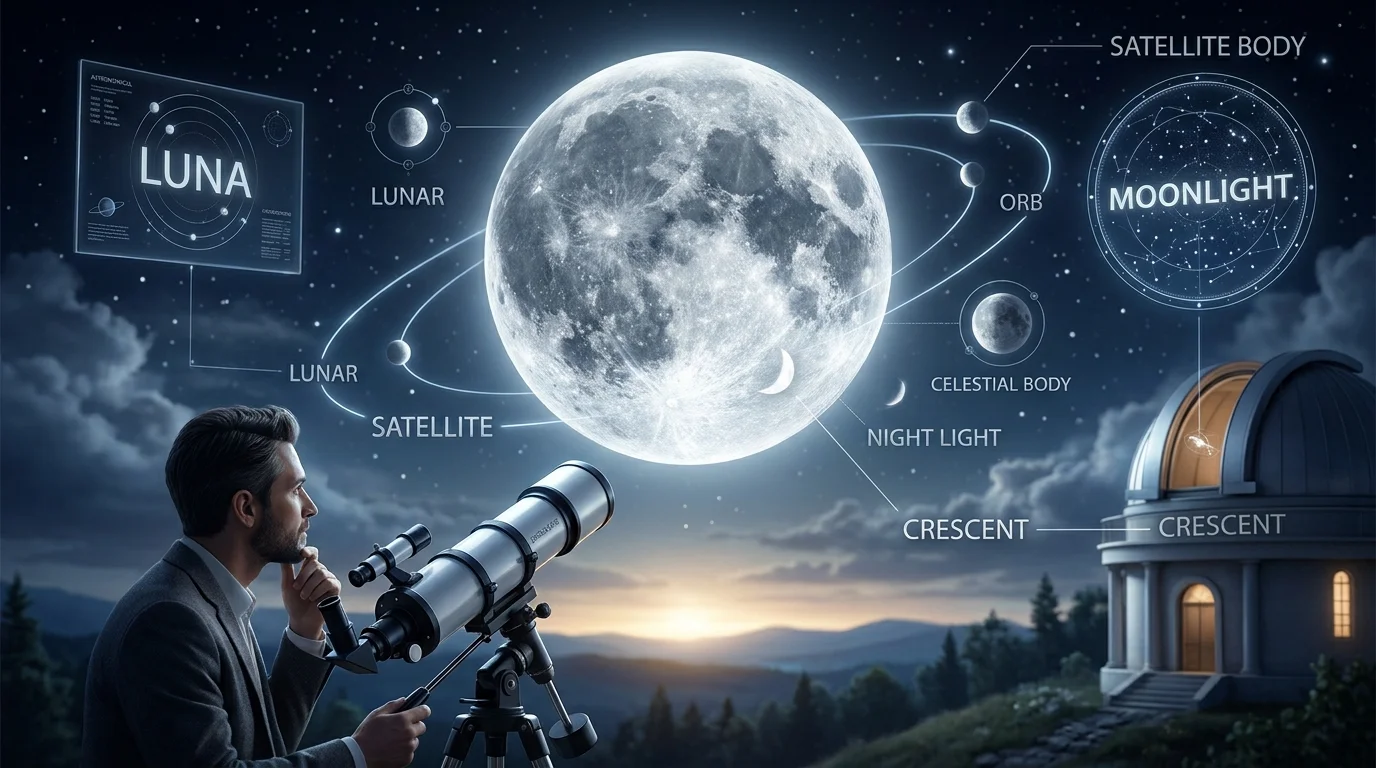
18. Half-Moon
Half-moon is a common descriptive term for a Moon that appears approximately half illuminated.
Examples:
- A half-moon appeared in the evening sky.
- The half-moon cast a faint glow over the landscape.
In astronomy, the terms first quarter and third quarter are more precise for the two half-illuminated phases.
19. Gibbous Moon
A gibbous moon is more than half illuminated but less than fully illuminated.
Examples:
- The gibbous moon rose before midnight.
- The bright gibbous moon was visible through the clouds.
This is a useful scientific and descriptive term.
20. Full Moon
A full moon occurs when the Moon’s Earth-facing side appears fully illuminated.
Examples:
- The full moon brightened the landscape.
- We walked beneath the full moon.
It describes a specific lunar phase rather than the Moon in general.
21. New Moon
A new moon is the lunar phase when the Moon is positioned so that its illuminated side is generally facing away from Earth.
Examples:
- The new moon marked the beginning of the lunar cycle.
- The sky was particularly dark during the new moon.
Again, this is a phase rather than a general synonym for “moon.”
22. Harvest Moon
Harvest Moon is the traditional name commonly given to the full moon closest to the autumnal equinox.
Examples:
- The harvest moon rose over the fields.
- Farmers traditionally associated the harvest moon with the autumn harvest.
It is a specific traditional lunar name.
23. Supermoon
A supermoon is a popular term for a full or new moon occurring near the Moon’s closest approach to Earth in its elliptical orbit.
Examples:
- The supermoon appeared unusually large and bright.
- Many people photographed the supermoon.
It should not be used as a general synonym for every full moon.
24. Blood Moon
Blood moon is a popular term commonly used for a total lunar eclipse, when the Moon can take on a reddish appearance.
Examples:
- People gathered to watch the blood moon.
- The blood moon appeared red above the horizon.
This is a specific astronomical event, not a general synonym for the Moon.
25. Lunar
Lunar is an adjective meaning related to the Moon.
It cannot always replace the noun “moon,” but it is one of the most useful related terms.
Examples:
- lunar surface
- lunar eclipse
- lunar landscape
- lunar mission
- lunar cycle
Instead of:
The moon landscape was fascinating.
write:
The lunar landscape was fascinating.
26. Moonlight
Moonlight refers to the light that reaches Earth after being reflected from the Moon.
Examples:
- The moonlight illuminated the path.
- We walked beneath the moonlight.
“Moonlight” is not a synonym for the Moon itself, but it is closely related.
27. Moonbeam
A moonbeam is a poetic expression for a ray or shaft of moonlight.
Examples:
- A moonbeam entered through the window.
- The garden was illuminated by a pale moonbeam.
It is particularly useful in poetic and descriptive writing.
28. Moonshine
Moonshine can mean light from the Moon, although in modern English it also has other meanings, including illegally produced alcohol and nonsense.
Examples:
- The path glowed in the moonshine.
Because of its other meanings, “moonlight” is usually clearer.
29. Moonlit Orb
Moonlit orb is a poetic phrase describing the Moon as a glowing, rounded object.
Example:
- The moonlit orb hovered above the quiet ocean.
It is best suited to creative writing.
30. Night Lantern
Night lantern is a metaphor that compares the Moon to a lantern illuminating the darkness.
Examples:
- The night lantern guided their journey.
- The moon hung like a night lantern above the valley.
This is figurative rather than scientific.
31. Night Light
Night light can be used poetically to describe the Moon’s illumination.
Example:
- The night light shone over the sleeping town.
However, “night-light” also commonly means a small electric lamp used at night, so context is important.
32. Silver Light
Silver light is a poetic expression often associated with moonlight.
Examples:
- Silver light covered the lake.
- The mountains glowed beneath the silver light.
It describes the Moon’s illumination rather than the Moon itself.
33. Sky Lantern
Sky lantern can be used metaphorically for the Moon because of its bright, lantern-like appearance.
Example:
- The sky lantern floated above the sleeping village.
It is a creative expression rather than a standard synonym.
34. Night Watcher
Night watcher is a literary metaphor presenting the Moon as an observer in the nighttime sky.
Examples:
- The night watcher remained above the silent town.
- The ancient night watcher appeared through the clouds.
It is appropriate for poetry and imaginative prose.
35. Sky Orb
Sky orb is a poetic description of the Moon as a rounded object in the sky.
Examples:
- The sky orb appeared above the trees.
- The glowing sky orb dominated the horizon.
36. Night Sphere
Night sphere describes the Moon in terms of its spherical appearance and nighttime presence.
Examples:
- The night sphere illuminated the landscape.
- The pale night sphere rose slowly.
This is primarily a creative-writing expression.
37. Earth’s Companion
Earth’s companion is a descriptive phrase emphasizing the Moon’s relationship with Earth.
Examples:
- Earth’s companion has fascinated observers for centuries.
- The planet’s companion appeared above the horizon.
It can work well in educational and literary writing.
38. Earth’s Satellite
Earth’s satellite is a precise descriptive term for the Moon.
Examples:
- Earth’s satellite completes an orbit around the planet.
- Scientists continue to study Earth’s satellite.
This is useful when scientific precision is more important than poetic style.
39. Earth’s Natural Satellite
Earth’s natural satellite is one of the clearest scientific descriptions of the Moon.
Examples:
- The Moon is Earth’s natural satellite.
- Earth’s natural satellite has a heavily cratered surface.
It is more precise than simply saying “satellite.”
40. Lunar Companion
Lunar companion is a poetic or descriptive expression that emphasizes the Moon’s connection to Earth.
Examples:
- The lunar companion appeared above the horizon.
- Earth’s lunar companion has influenced calendars throughout history.
41. Heavenly Orb
Heavenly orb is a literary expression for a rounded object in the sky.
Examples:
- The heavenly orb shone through the clouds.
- The poet described the Moon as a heavenly orb.
It can also describe other celestial objects, so it is not specific to the Moon.
42. Silver Disc
Silver disc describes the Moon’s familiar round, pale appearance.
Examples:
- The silver disc rose above the mountains.
- A silver disc appeared in the cloudless sky.
It is especially effective in poetry and descriptive prose.
Scientific Terms Related to the Moon
When writing scientifically, the following terms are more appropriate than poetic expressions:
- Natural satellite
- Earth’s natural satellite
- Earth’s satellite
- Lunar body
- Lunar
- Celestial body
- Lunar surface
- Lunar sphere
- Lunar phase
- Lunar companion
For example:
The Moon is Earth’s natural satellite.
is more scientifically precise than:
The Moon is Earth’s companion.
Poetic Synonyms for Moon
If you are writing poetry, fiction, or descriptive prose, consider:
- Orb
- Silver orb
- Celestial orb
- Night orb
- Silver disc
- Heavenly orb
- Night lantern
- Sky orb
- Night sphere
- Night watcher
- Earth’s companion
- Lunar companion
These expressions create imagery rather than providing strict scientific definitions.
Synonyms for Moon by Lunar Phase
Different phases of the Moon have different names.
Crescent Moon
A thin curved portion of the Moon is visible.
Half-Moon
Approximately half of the visible lunar disk is illuminated.
Gibbous Moon
More than half but less than all of the visible disk is illuminated.
Full Moon
The visible lunar disk appears fully illuminated.
New Moon
The Moon is generally not visible from Earth because the illuminated side faces away from us.
Using the phase-specific term is more precise than simply using “moon” when the phase matters.
Moon vs. Lunar
The words moon and lunar are closely related but serve different grammatical functions.
Moon is a noun:
The moon is bright tonight.
Lunar is an adjective:
The lunar surface is covered with craters.
You generally cannot replace “moon” with “lunar” by itself.
Moon vs. Satellite
A moon is a natural satellite, but satellite is a broader term.
For example, Earth has one natural satellite, the Moon, while artificial satellites are human-made objects placed into orbit.
Therefore, “satellite” is more general than “moon.”
Moon vs. Orb
Orb is a poetic or descriptive term for a rounded object.
For example:
The silver orb rose above the trees.
This can clearly refer to the Moon in context, but “orb” does not specifically mean “Moon.”
Moon vs. Crescent
A crescent is not a complete synonym for “moon.” It describes the Moon during a particular phase or its characteristic curved shape.
For example:
The crescent appeared in the western sky.
The word is appropriate when only a curved portion of the Moon is visible.
Moon vs. Moonlight
The Moon is the celestial body.
Moonlight is the light reflected from that body.
Compare:
The moon appeared above the trees.
and:
Moonlight covered the trees.
These words are related but cannot be used interchangeably.
Formal Alternatives to Moon
For scientific, academic, or formal writing, consider:
- Natural satellite
- Earth’s natural satellite
- Earth’s satellite
- Celestial body
- Lunar body
- Lunar sphere
- Lunar object
Choose the term based on the level of scientific precision required.
Poetic Alternatives to Moon
For creative writing, poetry, and storytelling, consider:
- Silver orb
- Celestial orb
- Night orb
- Heavenly orb
- Silver disc
- Night lantern
- Sky orb
- Night watcher
- Earth’s companion
- Lunar companion
These alternatives can make descriptions more vivid and atmospheric.
Common Mistakes When Choosing Synonyms for Moon
Using “lunar” as a noun
“Lunar” is normally an adjective, not a direct noun replacement for “moon.”
Incorrect:
The lunar was bright tonight.
Better:
The moon was bright tonight.
Or:
The lunar surface was brightly illuminated.
Calling every phase a crescent
A crescent is only one particular lunar appearance. A full moon should not be called a crescent.
Using “moonlight” to mean the Moon
Moonlight refers to illumination produced by reflected sunlight, not the celestial body itself.
Using “satellite” without considering context
“Satellite” can refer to artificial spacecraft as well as natural satellites. “Natural satellite” is more precise when discussing the Moon.
Treating poetic expressions as scientific terms
Expressions such as “silver orb” and “night lantern” are creative descriptions rather than astronomical terminology.
How to Choose the Right Synonym for Moon
The best alternative depends on the purpose of your writing.
If you need scientific precision, use natural satellite, Earth’s natural satellite, or Earth’s satellite.
If you need a general descriptive term, consider celestial body, lunar body, or orb.
If you are describing a specific phase, use crescent, half-moon, gibbous moon, full moon, or new moon.
If you are writing poetry or fiction, consider silver orb, celestial orb, night lantern, heavenly orb, or Earth’s companion.
If you mean something related to the Moon, use lunar, moonlight, or moonbeam.
The right choice should communicate both the meaning and the tone you want.
Examples of Synonyms for Moon in Sentences
- The natural satellite orbits Earth.
- The celestial body appeared above the horizon.
- A bright orb illuminated the night.
- The silver orb rose above the mountains.
- The crescent moon appeared after sunset.
- The gibbous moon was visible through the clouds.
- The full moon brightened the landscape.
- The new moon marked a new lunar cycle.
- The lunar surface contains countless craters.
- Moonlight covered the quiet garden.
- A moonbeam entered through the window.
- The celestial companion followed Earth through space.
- The silver disc appeared against the dark sky.
- The night lantern seemed to float above the village.
- The heavenly orb shone through the clouds.
- Earth’s satellite has been studied for centuries.
- The lunar companion appeared over the ocean.
- The sky orb seemed unusually bright.
- The night watcher remained visible until dawn.
- The silver light reflected across the water.
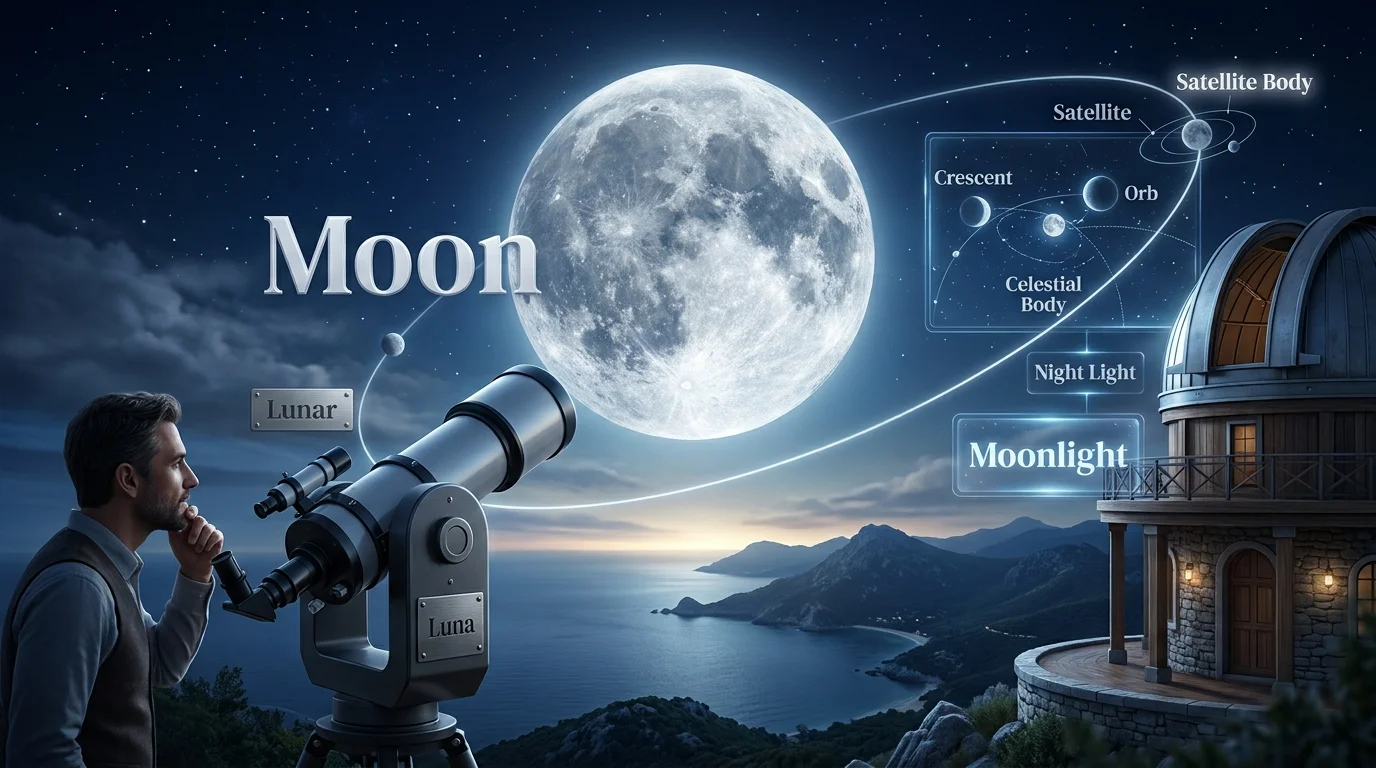
Best Alternatives to Moon by Context
| Context | Best Alternatives |
|---|---|
| Astronomy | Natural satellite, Earth’s satellite |
| Scientific writing | Lunar body, celestial body |
| General description | Orb, celestial body |
| Poetry | Silver orb, heavenly orb, night orb |
| Fiction | Night lantern, sky orb, night watcher |
| Moon phases | Crescent, gibbous moon, full moon |
| Moon’s light | Moonlight, moonbeam, silver light |
| Mythology | Selene, Luna, Diana |
| Descriptive writing | Silver disc, celestial companion |
| Educational writing | Earth’s natural satellite |