

Quick Synonym List
Closest alternatives
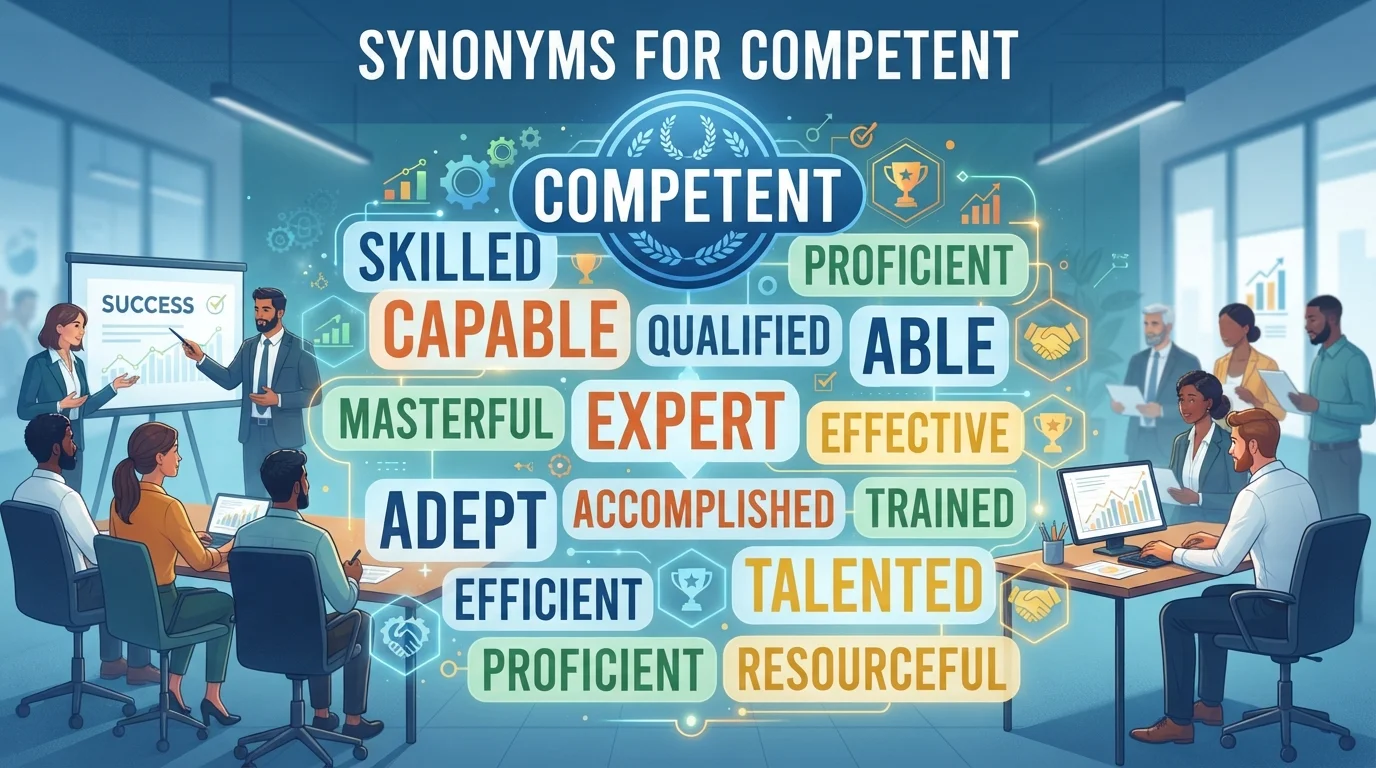
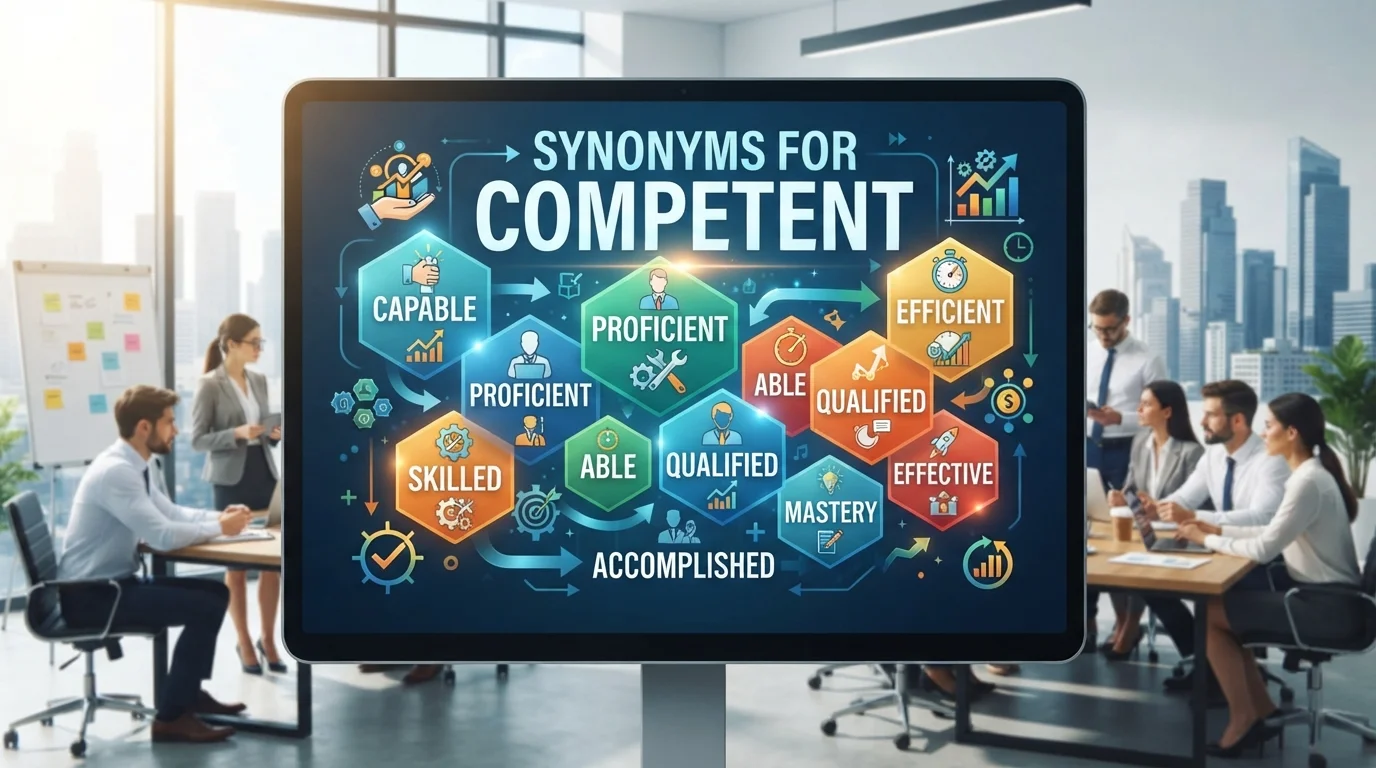
- Capable
- Able
- Skilled
- Proficient
- Qualified
- Effective
- Adept
- Accomplished
- Experienced
- Knowledgeable
Professional and workplace alternatives
- Qualified
- Capable
- Skilled
- Proficient
- Effective
- Efficient
- Reliable
- Well-trained
- Experienced
- Dependable
- Productive
- Capable of handling
Stronger alternatives
- Highly skilled
- Expert
- Accomplished
- Masterful
- Talented
- Gifted
- Seasoned
- Outstanding
- Exceptional
- Versatile
Academic and technical alternatives
- Proficient
- Knowledgeable
- Qualified
- Well-trained
- Technically skilled
- Practiced
- Accomplished
- Adept
- Capable
- Versed
Positive but measured alternatives
- Capable
- Competent
- Reliable
- Dependable
- Effective
- Proficient
- Skilled
- Well-prepared
- Well-qualified
- Experienced
What Does “Competent” Mean?
Competent means having enough skill, knowledge, ability, or training to perform a task or role successfully.
“She is a competent manager.”
This usually means she can perform her responsibilities effectively and to an acceptable professional standard.
The word can also mean adequately qualified or legally authorized in certain contexts.
“Only competent personnel should operate the equipment.”
A useful point about competent is that it is often a measured compliment. It says someone can do the job properly, but it does not necessarily mean they are outstanding, exceptional, or the best.
Compare:
“He is competent at his job.”
This means he can do it successfully.
“He is highly skilled at his job.”
This suggests a higher level of ability.
“He is an expert in his field.”
This suggests extensive knowledge and advanced skill.
That difference in strength is important when choosing a synonym.
The Closest Synonyms for Competent
Capable
Meaning: Having the ability to do something successfully.
Tone: Neutral to positive.
Best for: People, employees, managers, professionals, and general abilities.
“She is a capable project manager.”
Why choose it: Capable is probably the safest general alternative to competent.
Difference: Capable emphasizes ability or potential. Competent more strongly suggests that the person actually meets the required standard.
Compare:
“He is capable of doing the job.”
This focuses on ability.
“He is competent at the job.”
This suggests demonstrated ability at an acceptable standard.
Able
Meaning: Having the ability to do something.
Tone: Neutral and common.
“She is an able administrator.”
Able can mean capable or competent, although it often sounds slightly broader and less specific.
It is also frequently used in the construction:
“He is able to manage the team.”
rather than:
“He is able at managing the team.”
Skilled
Meaning: Having developed ability through training, practice, or experience.
Tone: Positive.
Best for: Practical, technical, professional, creative, or specialized abilities.
“She is a skilled technician.”
Difference: Skilled often suggests more than basic competence.
A competent worker can perform the job properly. A skilled worker may perform it with a high level of ability.
Proficient
Meaning: Competent or skilled at performing a particular activity.
Tone: Professional/formal.
Best for: Languages, software, technical tasks, academic skills, and professional abilities.
“He is proficient in Excel.”
“She is proficient in Spanish.”
Difference: Proficient is usually more specific than competent. It commonly describes ability in a particular skill.
Qualified
Meaning: Having the required training, education, certification, experience, or credentials.
Tone: Professional/formal.
“She is a qualified engineer.”
Important difference: Someone can be qualified without being highly skilled, and someone can be skilled without holding a particular formal qualification.
So qualified is not always a direct synonym for competent.
Effective
Meaning: Able to produce the desired result.
Tone: Professional and positive.
“He is an effective team leader.”
Difference: Effective focuses on results, while competent focuses more broadly on ability and performance.
Someone can be competent without being particularly effective in every situation.
Adept
Meaning: Very skilled or proficient at something.
Tone: Formal/positive.
“She is adept at solving complex problems.”
Adept generally suggests a stronger level of skill than competent.
It is especially useful with:
- adept at negotiation
- adept at problem-solving
- adept at communication
- adept at using technology
Accomplished
Meaning: Highly skilled or successful because of extensive ability, experience, or achievement.
Tone: Strongly positive/formal.
“She is an accomplished researcher.”
This is stronger than competent.
Use it when there is evidence of a high level of achievement or ability.
Experienced
Meaning: Having substantial practical experience in a particular activity or field.
“He is an experienced supervisor.”
Experience often contributes to competence, but the two words are not identical.
Someone can be experienced but ineffective. Someone can also be competent despite having relatively little experience.
Knowledgeable
Meaning: Having a lot of knowledge about a subject.
“She is knowledgeable about environmental policy.”
Difference: Knowledgeable emphasizes what someone knows, while competent includes the ability to perform.
A person may know a great deal about a task without being good at carrying it out.
Stronger Alternatives to Competent
Sometimes competent is too weak because you want to praise someone for exceptional ability.
Expert
Meaning: A person with extensive knowledge and advanced skill in a particular area.
“She is an expert in cybersecurity.”
This is much stronger than competent.
Highly Skilled
“He is highly skilled in data analysis.”
This directly communicates a high level of practical ability.
Masterful
Meaning: Extremely skillful or showing exceptional control.
“Her masterful presentation impressed the audience.”
This is strongly positive and should not replace competent when you only mean adequate ability.
Talented
Meaning: Naturally or notably gifted at something.
“She is a talented designer.”
Talented emphasizes natural ability or exceptional aptitude rather than professional competence alone.
Gifted
Meaning: Having exceptional natural ability.
“He is a gifted musician.”
This is much stronger and more specific than competent.
Seasoned
Meaning: Highly experienced, especially in a professional role.
“She is a seasoned executive.”
Seasoned emphasizes accumulated experience rather than technical skill alone.
Professional and Workplace Synonyms
In workplace writing, these alternatives are especially useful:
Qualified
“We need a qualified candidate.”
Use this when formal credentials or requirements matter.
Proficient
“The candidate is proficient in Microsoft Excel.”
Use this for specific skills.
Skilled
“We are looking for a skilled technician.”
Use this when practical ability matters.
Experienced
“We hired an experienced project manager.”
Use this when practical experience is important.
Effective
“She is an effective leader.”
Use this when performance and results matter.
Reliable
“He is a reliable employee.”
Use this when consistency and dependability matter.
Dependable
“She is a dependable member of the team.”
Use this when people can rely on the person’s performance or behavior.
Well-trained
“The staff are well-trained and prepared.”
Use this when training is the reason for their ability.
Competent vs. Capable
These words are very close.
Capable focuses on ability.
“She is capable of managing the project.”
Competent suggests that the person has sufficient skill and knowledge to perform the task successfully.
“She is a competent project manager.”
A simple distinction:
- Capable = has the ability.
- Competent = has sufficient ability and performs to an acceptable standard.
Competent vs. Skilled
Skilled is generally stronger.
“He is competent at repairing computers.”
This means he can do the work properly.
“He is skilled at repairing computers.”
This suggests a higher level of practical ability.
Use skilled when you want a stronger compliment.
Competent vs. Proficient
These overlap heavily, but proficient is often used for a specific skill.
“She is competent in several areas of administration.”
“She is proficient in Excel and data analysis.”
A useful pattern is:
- competent at/in a role or area
- proficient in a particular skill, language, or tool
- proficient at a specific activity, though proficient in is especially common
Competent vs. Qualified
This is an important distinction.
Qualified means someone has the required credentials, training, or formal eligibility.
Competent means someone has the ability to perform effectively.
“He is a qualified electrician.”
This tells us about his credentials.
“He is a competent electrician.”
This tells us about his ability and performance.
A qualified person is not automatically highly competent, and competence does not always require a formal qualification.
Competent vs. Effective
Competent focuses on ability and acceptable performance.
Effective focuses on achieving the intended result.
“She is a competent administrator.”
“She is an effective administrator.”
The first says she can perform the job properly.
The second emphasizes that her work produces good results.
Competent vs. Efficient
Efficient means achieving a result with relatively little wasted time, effort, money, or resources.
“He is a competent employee.”
“He is an efficient employee.”
A competent employee can do the job correctly without necessarily being especially fast or resource-efficient.
Competent vs. Expert
These words differ significantly in strength.
| Word | General Strength | Main Focus |
|---|---|---|
| Capable | Moderate | Ability |
| Competent | Moderate | Adequate skill and performance |
| Skilled | Strong | Developed ability |
| Proficient | Strong | Specific skill |
| Adept | Strong | High skill |
| Accomplished | Very strong | Skill and achievement |
| Expert | Very strong | Advanced knowledge and skill |
| Masterful | Very strong | Exceptional skill |
A useful scale is:
capable → competent → skilled/proficient → adept/accomplished → expert
This is a rough semantic scale, not a universal ranking. Context can change the strength of each word.
True Synonyms vs. Related Alternatives
| Alternative | Relationship | Can Replace “Competent”? | Tone | Best Context |
|---|---|---|---|---|
| Capable | Very close synonym | Yes | Neutral/positive | General ability |
| Able | Close synonym | Often | Neutral | General ability |
| Skilled | Near synonym | Often | Positive | Practical ability |
| Proficient | Near synonym | Often | Professional | Specific skills |
| Qualified | Related alternative | Sometimes | Formal | Credentials |
| Effective | Related alternative | Sometimes | Positive | Results |
| Adept | Stronger synonym | Sometimes | Positive/formal | High skill |
| Accomplished | Stronger alternative | Sometimes | Formal/positive | Achievement |
| Experienced | Related alternative | Sometimes | Neutral/positive | Practical experience |
| Knowledgeable | Related alternative | Sometimes | Positive | Knowledge |
| Efficient | Related alternative | Sometimes | Professional | Resource/time management |
| Reliable | Related alternative | Sometimes | Positive | Dependability |
| Expert | Stronger alternative | Sometimes | Strong/positive | Advanced expertise |
| Talented | Related alternative | Sometimes | Positive | Natural ability |
| Well-trained | Related alternative | Sometimes | Professional | Training |
| Seasoned | Related alternative | Sometimes | Professional | Extensive experience |
Competent by Context
Competent Employee
Natural alternatives include:
- Capable employee
- Skilled employee
- Proficient employee
- Effective employee
- Reliable employee
- Dependable employee
- Well-trained employee
- Experienced employee
The best choice depends on what you want to praise.
“She is a competent employee.”
Neutral.
“She is a highly skilled employee.”
Stronger praise.
“She is a reliable employee.”
Focuses on dependability.
“She is an effective employee.”
Focuses on results.
Competent Professional
For professionals, consider:
- Qualified
- Skilled
- Proficient
- Experienced
- Capable
- Accomplished
- Seasoned
- Expert
Example:
“He is a competent financial adviser.”
Possible alternatives:
“He is an experienced financial adviser.”
“He is a highly qualified financial adviser.”
“He is a skilled financial adviser.”
Each sentence emphasizes something different.
Competent Manager
Useful alternatives include:
- Capable manager
- Effective manager
- Skilled manager
- Experienced manager
- Proficient manager
- Reliable manager
- Accomplished manager
- Strong manager
Strong manager is common in workplace English but is somewhat broad and evaluative.
Competent Candidate
When discussing a job candidate, qualified, capable, skilled, and experienced can be useful.
“She is a competent candidate.”
“She is a well-qualified candidate.”
“She is an experienced candidate.”
Be careful: qualified refers to meeting requirements, while experienced refers to prior experience.
Competent at a Skill
When describing a particular skill, these are useful:
- Proficient
- Skilled
- Adept
- Capable
- Practiced
- Experienced
- Well-versed
Examples:
“She is proficient in Spanish.”
“He is skilled at negotiation.”
“They are adept at solving technical problems.”
“She is well-versed in the relevant regulations.”
Competent in Academic Writing
Academic writing often benefits from more precise terms.
Instead of:
“The researcher is competent.”
you may want:
“The researcher is proficient in statistical analysis.”
or:
“The researcher is well-trained in experimental methods.”
or:
“The researcher has extensive expertise in the field.”
The more specific version tells the reader what the person can actually do.
Competent in a Resume
Competent is grammatically correct on a resume, but it can sound modest or vague.
Instead of:
“Competent in data analysis.”
a more specific phrase may be stronger:
“Proficient in data analysis.”
Or:
“Skilled in data analysis.”
Or, when accurate:
“Advanced proficiency in data analysis.”
The best resume language describes the actual skill rather than relying on a broad adjective.
Competent in Performance Reviews
In performance reviews, competent can be useful because it is measured and professional.
“The employee consistently demonstrates competent performance.”
Possible alternatives:
- Meets expectations
- Performs effectively
- Demonstrates proficiency
- Performs reliably
- Demonstrates strong technical skills
- Consistently performs assigned duties
These phrases can communicate performance more precisely than simply saying someone is “good.”
Sentence Transformations
1. General ability
Original:
“She is a competent employee.”
Alternative:
“She is a capable employee.”
Why:
Capable is a natural general alternative that emphasizes ability.
2. Stronger praise
Original:
“He is a competent technician.”
Alternative:
“He is a highly skilled technician.”
Why:
Highly skilled communicates a higher level of ability than ordinary competence.
3. Specific skill
Original:
“She is competent in data analysis.”
Alternative:
“She is proficient in data analysis.”
Why:
Proficient works especially well when describing a specific skill.
4. Credentials
Original:
“He is competent to perform the procedure.”
Alternative:
“He is qualified to perform the procedure.”
Why:
Qualified emphasizes formal eligibility, training, or credentials rather than general ability.
5. Results
Original:
“She is a competent manager.”
Alternative:
“She is an effective manager.”
Why:
Effective shifts the emphasis from general ability to producing good results.
6. Experience
Original:
“He is a competent project manager.”
Alternative:
“He is an experienced project manager.”
Why:
The alternative emphasizes practical experience rather than general competence.
7. Advanced skill
Original:
“She is a competent negotiator.”
Alternative:
“She is an adept negotiator.”
Why:
Adept suggests a higher degree of skill.
8. Dependability
Original:
“He is a competent member of the team.”
Alternative:
“He is a dependable member of the team.”
Why:
Dependable shifts the focus toward reliability and consistency.
9. Knowledge
Original:
“She is competent in environmental law.”
Alternative:
“She is knowledgeable about environmental law.”
Why:
Knowledgeable emphasizes subject knowledge rather than practical performance.
10. Expertise
Original:
“He is a competent software engineer.”
Alternative:
“He is an expert software engineer.”
Why:
Expert is much stronger and should be used only when the person’s level of knowledge and skill supports that description.
Common Collocations With Competent
Natural expressions include:
- competent employee
- competent worker
- competent professional
- competent manager
- competent leader
- competent teacher
- competent engineer
- competent lawyer
- competent administrator
- competent candidate
- competent practitioner
- competent staff
- competent team
- competent performance
- competent service
- competent handling
- competent management
- competent decision-making
- competent at the job
- competent in the field
Common patterns:
Competent at
“She is competent at managing complex projects.”
Competent in
“He is competent in several areas of engineering.”
Competent to
In formal contexts, competent to can mean having the necessary ability or authority to do something.
“The employee is competent to operate the equipment.”
Common Mistakes
Mistake 1: Assuming “competent” means excellent
It does not necessarily mean exceptional.
Competent generally indicates that someone can perform adequately or effectively.
If you mean outstanding ability, consider:
- Highly skilled
- Accomplished
- Expert
- Exceptional
- Masterful
Mistake 2: Treating “qualified” as an exact synonym
A qualified person meets particular requirements or possesses credentials.
A competent person can actually perform the task successfully.
The concepts overlap but are not identical.
Mistake 3: Using “experienced” when you mean skilled
Experience means someone has spent time doing something.
It does not automatically prove high skill.
Mistake 4: Using “knowledgeable” when practical ability matters
Someone can be knowledgeable about a subject without being able to perform the associated task.
Mistake 5: Using “efficient” when you mean generally capable
Efficiency concerns time, resources, and effort.
Competence is broader.
Mistake 6: Calling someone an “expert” when you only mean competent
Expert is a strong claim.
Use it when the person has advanced knowledge or recognized expertise.
Mistake 7: Using “talented” as a direct replacement
Talent usually suggests natural ability or exceptional aptitude.
Competence does not necessarily imply natural talent.
When Not to Replace “Competent”
Sometimes competent is exactly the right word.
For example:
“The employee is competent and reliable.”
This communicates a balanced, professional assessment without exaggerating the person’s abilities.
Replacing it with:
“The employee is exceptional and masterful.”
would make a much stronger claim.
Likewise, replacing:
“The technician is competent to operate the equipment.”
with:
“The technician is an expert at operating the equipment.”
would change the meaning substantially.
Use a stronger synonym only when the evidence supports the stronger claim.
A Simple Decision Guide
| If you mean… | Use… |
|---|---|
| Has enough ability to do the job | Competent |
| Has general ability | Capable |
| Can do something | Able |
| Has developed practical skill | Skilled |
| Has a specific skill | Proficient |
| Has required credentials | Qualified |
| Produces the desired result | Effective |
| Works with little waste | Efficient |
| Has extensive practical experience | Experienced |
| Knows a subject well | Knowledgeable |
| Has high-level skill | Adept |
| Has strong achievements | Accomplished |
| Has advanced expertise | Expert |
| Has natural ability | Talented |
| Has extensive experience | Seasoned |
| Can be relied upon | Reliable / Dependable |
| Has received relevant training | Well-trained |
Editor’s Choice
Capable
The safest general alternative when you mean someone has the ability to do something successfully.
Skilled
Best when you want to emphasize developed practical ability.
Proficient
Best for a specific skill, language, software tool, or professional task.
Qualified
Best when formal training, credentials, or eligibility matter.
Effective
Best when the person’s ability is demonstrated through successful results.
These choices are contextual rather than a ranking. Competent itself remains the better word when you want to communicate solid, adequate ability without exaggerating.