
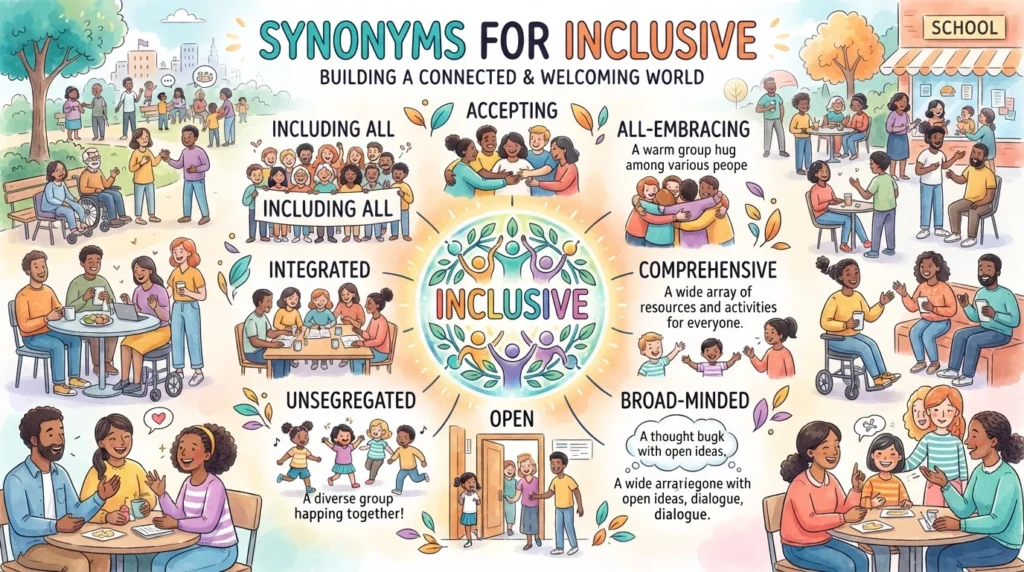
Quick Synonym List
The word inclusive has several meanings. These alternatives are grouped by meaning rather than treated as interchangeable synonyms.
Meaning of inclusive | |
|---|---|
Welcoming to different people | Welcoming, open, accepting, embracing, accommodating |
Providing fair participation | Equitable, accessible, barrier-free, participatory |
Representing different groups | Diverse, representative, multicultural, pluralistic |
Covering everything relevant | Comprehensive, all-encompassing, exhaustive, extensive, wide-ranging |
Including different categories | Broad, encompassing, wide, far-reaching |
Including all specified costs | All-inclusive, bundled, comprehensive, fully covered |
Involving everyone | Participatory, collaborative, collective, open to all |
Counting both endpoints | Including, with both endpoints included, from … through |
Important: Inclusive can describe a welcoming environment, a comprehensive list, a price that includes additional services, or a numerical range that includes both endpoints. A synonym that works in one situation may be inaccurate in another.
What Does “Inclusive” Mean?
Inclusive is an adjective with four important uses.
Welcoming or involving different people: An inclusive workplace gives people from different backgrounds meaningful opportunities to participate.
Broad or comprehensive: An inclusive review considers all the relevant subjects within its scope.
Including specified costs: An inclusive price may cover accommodation, meals, or other listed services.
Including the limits of a range: The dates September 1–10, inclusive, include both September 1 and September 10.
These meanings overlap through the idea of including rather than excluding, but they require different vocabulary.
For example, a welcoming workplace and a comprehensive report can both be described as inclusive. However, welcoming report and comprehensive workplace do not communicate the same meanings.
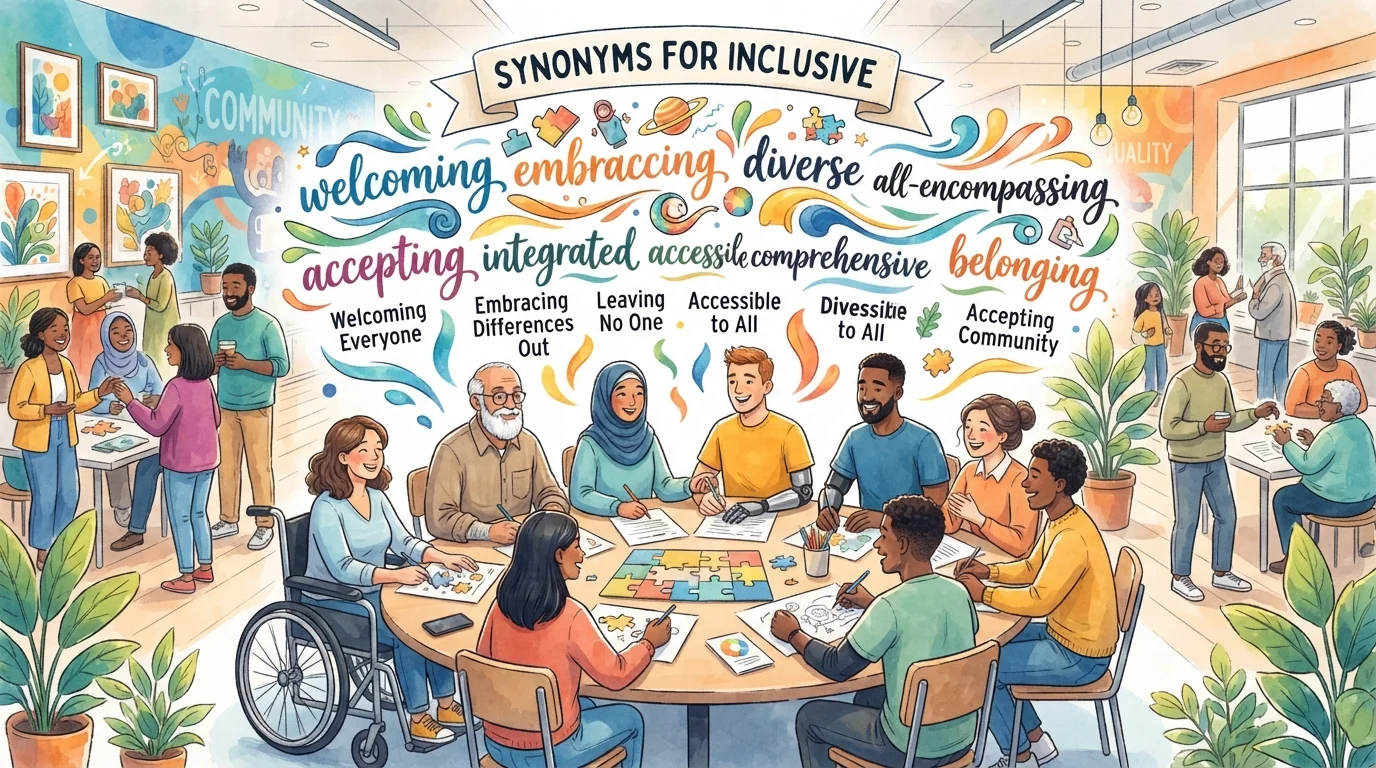
The Best Synonyms for Inclusive
1. Welcoming
Meaning: Making people feel comfortable, accepted, and invited to participate.
Tone: Warm and positive.
Best for: Workplaces, schools, communities, organizations, and social events.
Example: The school aims to create a welcoming environment for students from different backgrounds.
How it differs: Welcoming emphasizes how people are treated and how they feel. Inclusive can also refer to practical access, fair procedures, and meaningful participation.
Watch out: A place can feel welcoming while still having barriers that prevent some people from participating.
2. Open
Meaning: Willing to accept different people, ideas, experiences, or approaches.
Tone: Neutral to positive.
Best for: Organizations, discussions, communities, and attitudes.
Example: The committee encourages open discussions in which participants can share different perspectives.
How it differs: Open emphasizes receptiveness. It does not necessarily indicate that every person can participate equally.
3. Accepting
Meaning: Willing to recognize and respect people or circumstances that differ from one’s own.
Tone: Warm and positive.
Best for: Social environments, relationships, schools, and communities.
Example: The club promotes an accepting atmosphere where members can express themselves.
How it differs: Accepting focuses on attitudes toward differences. Inclusive may also involve actively removing barriers.
4. Accessible
Meaning: Easy to reach, enter, use, understand, or participate in.
Tone: Neutral or professional.
Best for: Buildings, websites, education, public services, information, and events.
Example: The organization provides accessible learning materials in several formats.
How it differs: Accessible focuses on whether people can use or participate in something. It is an important part of inclusion but does not cover every aspect of it.
Watch out: Accessibility requirements vary by context. Physical access, digital accessibility, affordability, and understandable language address different barriers.
5. Accommodating
Meaning: Willing or able to adjust arrangements to meet different needs.
Tone: Positive or professional.
Best for: Workplaces, education, customer service, and event planning.
Example: The organizers were accommodating when participants requested alternative seating arrangements.
How it differs: Accommodating emphasizes flexibility and adjustments rather than broad participation.
6. Equitable
Meaning: Fair in a way that takes relevant differences in circumstances or needs into account.
Tone: Formal or professional.
Best for: Education, employment, public services, resource allocation, and organizational policies.
Example: The program aims to provide equitable access to educational resources.
How it differs: Equitable emphasizes fairness, while inclusive emphasizes participation and avoiding exclusion. The two concepts are related but not identical.
7. Representative
Meaning: Reflecting the characteristics, experiences, or views of a wider group.
Tone: Professional or academic.
Best for: Committees, surveys, organizations, media, and research.
Example: The advisory panel includes representatives from different parts of the community.
How it differs: Representative focuses on how accurately a group reflects a larger population. An inclusive process may aim for representation, but the terms are not interchangeable.
8. Diverse
Meaning: Containing people, ideas, or elements with different characteristics or backgrounds.
Tone: Neutral or positive.
Best for: Teams, communities, workplaces, educational settings, and collections.
Example: The company employs a diverse team with a variety of professional experiences.
Watch out: Diversity describes variety. Inclusion concerns how people are welcomed, supported, and involved. A diverse organization is not automatically inclusive.
9. Participatory
Meaning: Allowing or encouraging people to take an active part in an activity or decision.
Tone: Professional or academic.
Best for: Education, community planning, workshops, organizational decisions, and research.
Example: The council adopted a participatory approach to neighborhood planning.
How it differs: Participatory emphasizes active involvement. It does not necessarily establish that participation is accessible to everyone.
10. All-Encompassing
Meaning: Including everything relevant within a particular scope.
Tone: Neutral to formal.
Best for: Plans, reviews, explanations, discussions, and descriptions.
Example: The guide offers an all-encompassing overview of the application process.
How it differs: All-encompassing is useful when inclusive means broad coverage rather than social participation.
11. Comprehensive
Meaning: Covering all or nearly all the important elements of a subject.
Tone: Professional or academic.
Best for: Reports, plans, reviews, research, training, and services.
Example: The researchers conducted a comprehensive review of the available evidence.
How it differs: Comprehensive emphasizes thorough coverage. It is not normally a substitute for inclusive when describing a welcoming community.
12. Wide-Ranging
Meaning: Covering many subjects, categories, activities, or areas.
Tone: Neutral or professional.
Best for: Discussions, policies, research, programs, and investigations.
Example: The conference featured wide-ranging discussions about education and technology.
How it differs: Wide-ranging emphasizes variety and breadth rather than necessarily including everything.
13. Broad
Meaning: Extending across a large range of people, subjects, or categories.
Tone: Neutral.
Best for: Definitions, policies, programs, discussions, and classifications.
Example: The initiative uses a broad definition of community participation.
How it differs: Broad describes scope. A broad policy may still exclude some groups or issues.
14. Exhaustive
Meaning: Including every relevant item or detail within a defined scope.
Tone: Formal or academic.
Best for: Lists, inventories, investigations, reviews, and technical documentation.
Example: The appendix contains an exhaustive list of the identified errors.
Watch out: Exhaustive makes a stronger claim than comprehensive. Use it only when the coverage is genuinely complete.
15. All-Inclusive
Meaning: Including all specified items, costs, services, or features in a single arrangement.
Tone: Neutral or commercial.
Best for: Travel packages, hotel stays, memberships, subscriptions, and service agreements.
Example: The resort offers an all-inclusive package covering accommodation, meals, and selected activities.
Watch out: All-inclusive does not guarantee that absolutely everything is included. Always check the stated package terms.
Inclusive Synonyms by Context
Inclusive Workplace
An inclusive workplace is one in which employees have meaningful opportunities to participate, contribute, and develop, regardless of relevant differences in their backgrounds or circumstances.
Useful alternatives include welcoming, accessible, equitable, accommodating, supportive, and participatory.
Each emphasizes a different quality. A welcoming workplace fosters acceptance, an accessible workplace reduces barriers, and an equitable workplace considers differences in employees’ needs and circumstances.
For example:
The company is committed to building an inclusive workplace.
A more specific version might be:
The company is committed to creating an accessible workplace with equitable opportunities for professional development.
The revised sentence identifies the particular aspects of inclusion being discussed.
Inclusive Education
In education, inclusion concerns students’ opportunities to access learning, participate in classroom activities, and receive appropriate support.
Useful expressions include accessible education, equitable learning, supportive classrooms, accommodating instruction, and participatory learning.
For example:
Teachers should use inclusive teaching methods.
Depending on the intended meaning:
Teachers should use accessible teaching materials.
Teachers should provide equitable opportunities for classroom participation.
Teachers should adopt flexible teaching methods that accommodate different learning needs.
These statements describe different aspects of inclusive education rather than serving as identical replacements.
Inclusive Language
Inclusive language aims to communicate respectfully and avoid unnecessarily excluding or overlooking people.
Related expressions include respectful language, gender-neutral language, accessible language, non-exclusionary language, and person-centered language.
These terms are not interchangeable. Gender-neutral language addresses gender-specific wording, while accessible language emphasizes ease of understanding.
For example:
The organization revised its documents to use inclusive language.
A more specific alternative might be:
The organization revised its documents to use gender-neutral terminology and accessible language.
Use a more specific expression when the particular communication objective matters.
Inclusive Community
A community may be described as welcoming, accepting, open, accessible, supportive, or embracing.
Choosing words for social inclusion
Word | What it emphasizes |
| Welcoming | Making newcomers feel accepted |
| Accessible | Removing barriers to participation |
| Equitable | Fair treatment and opportunities |
| Diverse | Variety among community members |
| Participatory | Opportunities for active involvement |
Inclusive Pricing and Packages
When a price includes specified services or expenses, consider all-inclusive, bundled, comprehensive, inclusive of fees, or fully covered.
For example:
The inclusive price covers accommodation and breakfast.
A natural rewrite is:
The package price includes accommodation and breakfast.
This is often clearer than replacing inclusive with another adjective because it explicitly identifies what is covered.
Inclusive Dates and Numerical Ranges
In mathematics, administration, and scheduling, inclusive indicates that the stated endpoints are counted.
For example:
The offer is available from June 1 to June 7, inclusive.
This means both June 1 and June 7 are included.
Alternatives include including both dates, with both endpoints included, or simply through June 7 when the context makes the intended range clear.
Avoid replacing this meaning with comprehensive, welcoming, or all-encompassing.
Inclusive vs. Diverse vs. Equitable vs. Accessible
These four words are frequently used together, but each describes something different.
Who can participate and feel included?
An inclusive meeting provides meaningful opportunities for different participants to contribute.
What differences are represented?
A diverse team brings together people with different backgrounds and experiences.
Are opportunities and resources distributed fairly?
An equitable program considers participants’ different needs.
Can people access and use something?
An accessible website supports people using different devices and assistive technologies.
A workplace can be diverse without offering all employees equal opportunities to contribute. Similarly, an accessible event may remove particular barriers without addressing every aspect of social inclusion.
True Synonyms vs. Related Alternatives
Alternative | Relationship | Can replace inclusive? | Best context |
|---|---|---|---|
Welcoming | Near synonym | Often | Social environments |
Open | Contextual alternative | Sometimes | Groups and attitudes |
Accepting | Near synonym | Sometimes | Communities |
Accessible | Related concept | Sometimes | Services and participation |
Accommodating | Related concept | Sometimes | Individual needs |
Equitable | Related concept | Sometimes | Fair opportunities |
Diverse | Related concept | Rarely directly | Group composition |
Representative | Related concept | Sometimes | Committees and surveys |
Participatory | Contextual alternative | Sometimes | Decision-making |
Comprehensive | Close synonym for broad coverage | Often | Reports and plans |
All-encompassing | Close synonym for broad coverage | Often | Scope and coverage |
Wide-ranging | Near synonym | Sometimes | Discussions and programs |
Exhaustive | Stronger alternative | Only for complete coverage | Lists and reviews |
All-inclusive | Close synonym for packages | Often | Pricing and travel |
Practical Word-Choice Guide
What meaning of inclusive do you want to express?
Suggested alternative
Welcoming
The library provides a welcoming environment for all visitors.
10 Sentence Transformations
Original | Alternative | Why |
|---|---|---|
The school has an inclusive atmosphere. | The school has a welcoming atmosphere. | Emphasizes acceptance. |
We need an inclusive website. | We need an accessible website. | Focuses on reducing usability barriers. |
The company supports inclusive hiring. | The company supports equitable hiring practices. | Emphasizes fairness. |
The team is inclusive. | The team welcomes different perspectives. | Identifies a specific behavior. |
The organization wants an inclusive committee. | The organization wants a representative committee. | Emphasizes representation. |
We need an inclusive review. | We need a comprehensive review. | Emphasizes thorough coverage. |
The project requires inclusive discussions. | The project requires participatory discussions. | Emphasizes active involvement. |
The hotel offers inclusive pricing. | The hotel offers all-inclusive packages. | Identifies a pricing arrangement. |
The inclusive fee covers meals. | The fee includes meals. | Uses simpler, clearer wording. |
The dates are inclusive. | Both the starting and ending dates are included. | Removes possible ambiguity. |
Grammar and Natural Usage
Inclusive is an adjective. Its related forms include include (verb), inclusion (noun), inclusively (adverb), and inclusivity (noun).
Common combinations include inclusive workplace, inclusive education, inclusive language, inclusive environment, inclusive policy, inclusive society, inclusive design, and inclusive pricing.
Two important grammatical patterns are:
Inclusive of: “The quoted price is inclusive of taxes.”
Inclusive from … to: “The reporting period runs from January 1 to January 31, inclusive.”
In American English, taxes included is often clearer than inclusive of taxes in everyday customer-facing communication.
Inclusive also has the comparative and superlative forms more inclusive and most inclusive. For example, “The revised policy is more inclusive because it removes additional participation barriers.”
Common Mistakes
1. Treating diverse and inclusive as identical
A diverse group contains people with different characteristics. An inclusive group creates opportunities for those people to participate and contribute.
2. Assuming welcoming means fully accessible
A friendly environment may still contain physical, digital, financial, or communication barriers.
3. Using equitable when you simply mean equal
Equal emphasizes sameness in treatment or quantity. Equitable emphasizes fairness while considering relevant differences in circumstances.
4. Using comprehensive for social inclusion
A comprehensive report covers a subject thoroughly. It does not necessarily demonstrate that different groups were involved in producing it.
5. Claiming exhaustive coverage without evidence
An exhaustive list includes every relevant item within its defined scope. A comprehensive list may cover the subject thoroughly without claiming absolute completeness.
6. Assuming all-inclusive means everything is free
An all-inclusive package includes specified services within the price. Optional activities, premium services, or other expenses may cost extra.
7. Confusing inclusive with exclusive
Inclusive generally emphasizes inclusion. Exclusive can mean excluding others, limited access, or availability only to a particular group.
8. Replacing inclusive without considering its context
An inclusive date range, an inclusive classroom, and an inclusive vacation package require different alternatives.
When “Inclusive” Is the Better Word
Sometimes inclusive is more useful than any individual alternative because it communicates several related qualities together.
For example, an inclusive classroom may be welcoming, accessible, accommodating, and supportive. Replacing inclusive with just one of those words can narrow the intended meaning.
Similarly, inclusive design is an established expression for an approach that considers a broad range of human needs and experiences. Replacing it with welcoming design would not preserve its meaning.
Use inclusive when the broader concept matters. Choose a more specific alternative when you want to identify a particular practice, quality, or outcome.