
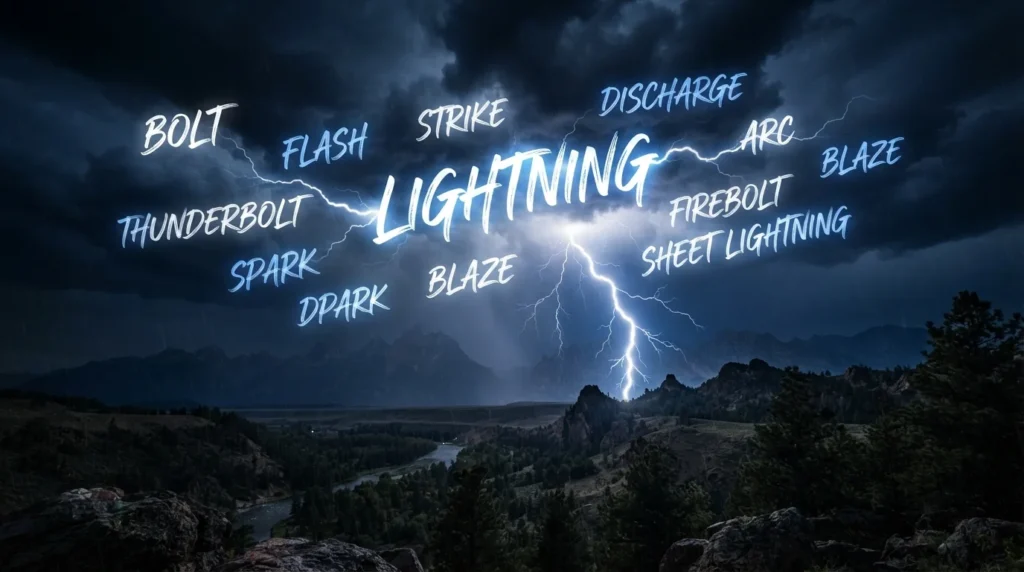
Quick Synonym List
Closest and scientific alternatives
- Electrical discharge
- Atmospheric electrical discharge
- Electrical flash
- Lightning bolt
- Lightning stroke
- Atmospheric discharge
- Electric discharge
- Electric flash
- Cloud-to-ground discharge
- Intra-cloud discharge
Common and descriptive alternatives
- Bolt
- Flash
- Lightning flash
- Lightning strike
- Electric bolt
- Thunderbolt
- Forked lightning
- Sheet lightning
- Chain lightning
Literary and dramatic alternatives
- Thunderbolt
- Bolt from the sky
- Celestial bolt
- Electric flash
- Blazing bolt
- Fiery bolt
- Heavenly bolt
- Sudden flash
Figurative alternatives for speed
- Instantaneous
- Blindingly fast
- Extremely fast
- Rapid
- Swift
- Fleeting
- Lightning-fast
- At lightning speed
- In a flash
- In an instant
Note: Many words above are related terms or specific types of lightning, not exact synonyms. In precise writing, electrical discharge is the closest scientific description, while bolt and flash describe particular aspects of the phenomenon.
What Does “Lightning” Mean?
Lightning is a powerful natural electrical discharge that occurs in the atmosphere, usually during thunderstorms. It produces a bright flash of light and can be accompanied by thunder.
For example:
“Lightning struck near the house.”
The word can refer broadly to the phenomenon or to an individual visible discharge.
Lightning can also be used figuratively to describe extreme speed:
“She has lightning-fast reflexes.”
“The car accelerated at lightning speed.”
Because the word has both a literal and figurative use, the best synonym depends on the sentence.
The Closest Alternatives to Lightning
Electrical Discharge
Meaning: A release or movement of electrical energy, especially through the atmosphere.
Tone: Scientific and technical.
Best for: Physics, meteorology, science writing, and technical explanations.
Example:
“Lightning is a powerful atmospheric electrical discharge.”
How it differs: Electrical discharge is broader than lightning. Electrical discharges can occur in many settings, while lightning specifically refers to a large atmospheric discharge.
Lightning Bolt
Meaning: A single visible stroke or channel of lightning.
Tone: Neutral and descriptive.
Best for: Everyday writing, weather descriptions, literature, and visual descriptions.
Example:
“A lightning bolt lit up the sky.”
How it differs: Lightning bolt usually refers to an individual stroke rather than the phenomenon as a whole.
Bolt
Meaning: A single sudden stroke of lightning.
Tone: Neutral to literary.
Best for: Descriptive writing and dramatic weather descriptions.
Example:
“A bolt struck the tree.”
How it differs: Bolt is shorter and more literary. Without context, it can also mean a metal fastener or a sudden movement, so lightning bolt is clearer in technical writing.
Flash
Meaning: A sudden burst of bright light.
Tone: Neutral.
Best for: Describing the visual appearance of lightning.
Example:
“A bright flash appeared over the horizon.”
How it differs: Flash describes the visible burst of light, not necessarily the electrical discharge itself.
Lightning Flash
Meaning: The visible flash produced by a lightning discharge.
Tone: Neutral to technical.
Best for: Weather descriptions and scientific writing.
Example:
“The lightning flash was visible from several miles away.”
This is more precise than simply using flash when the source of the light needs to be clear.
Lightning Stroke
Meaning: A single discharge or path of lightning.
Tone: Technical.
Best for: Meteorology and scientific descriptions.
Example:
“The storm produced several powerful lightning strokes.”
How it differs: Stroke emphasizes the individual discharge rather than lightning as a general phenomenon.
Thunderbolt
Meaning: A bolt of lightning, especially in literary, mythological, or dramatic language.
Tone: Literary, dramatic, or archaic.
Best for: Fiction, poetry, mythology, and dramatic descriptions.
Example:
“A thunderbolt split the dark sky.”
How it differs: Thunderbolt is associated with dramatic or literary descriptions and can also have mythological meanings.
Scientific Terms Related to Lightning
Scientific writing often requires more precise terminology than everyday speech.
Atmospheric Discharge
A broad technical phrase describing an electrical discharge in the atmosphere.
“The storm produced several atmospheric electrical discharges.”
This can describe lightning but is broader than ordinary lightning.
Electric Discharge
A general term for the movement or release of electrical charge.
“The visible event resulted from a large electric discharge.”
It is technically broader than lightning.
Electrical Flash
A brief visible emission of light associated with an electrical discharge.
“The electrical flash illuminated the surrounding clouds.”
This emphasizes the visual phenomenon.
Cloud-to-Ground Lightning
Lightning that travels between a cloud and the ground.
“The storm produced frequent cloud-to-ground lightning.”
This is a specific type of lightning, not a general synonym.
Intra-Cloud Lightning
Lightning that occurs within a cloud.
“Most lightning activity in the storm was intra-cloud.”
Again, this is a specific category rather than a direct synonym.
Types of Lightning That Are Sometimes Mistaken for Synonyms
Some expressions are related to lightning but actually identify particular forms or patterns.
Forked Lightning
Forked lightning describes lightning that branches into multiple visible paths.
“Forked lightning appeared across the sky.”
It is a descriptive type of lightning, not a general replacement for the word.
Sheet Lightning
Sheet lightning is the diffuse illumination of clouds caused by distant lightning, often when the actual channel is obscured.
“Sheet lightning flickered behind the clouds.”
It should not automatically replace lightning.
Chain Lightning
Chain lightning is a dramatic term associated with branching or successive lightning appearances.
“The novel described the storm as filled with chain lightning.”
The term is often used descriptively and is not a universal technical synonym for lightning.
Ball Lightning
Ball lightning refers to a reported unusual luminous phenomenon appearing as a glowing sphere, associated with thunderstorms.
“The article discussed reports of ball lightning.”
It is a specific phenomenon, not a synonym for ordinary lightning.
Lightning vs. Thunder
One of the most common mistakes is confusing lightning with thunder.
Lightning is the electrical discharge.
Thunder is the sound produced by the rapid heating and expansion of air associated with lightning.
Compare:
“We saw lightning.”
The sentence refers to the flash.
“We heard thunder.”
The sentence refers to the sound.
A storm can therefore produce both lightning and thunder, but they are not synonyms.
Lightning vs. Lightning Bolt
These terms overlap but are not identical.
Lightning is the broader phenomenon.
Lightning bolt usually refers to an individual visible stroke.
Compare:
“The storm produced a lot of lightning.”
This describes the general electrical activity.
“A lightning bolt struck the field.”
This describes one particular discharge.
For general scientific writing, lightning is usually the more natural term.
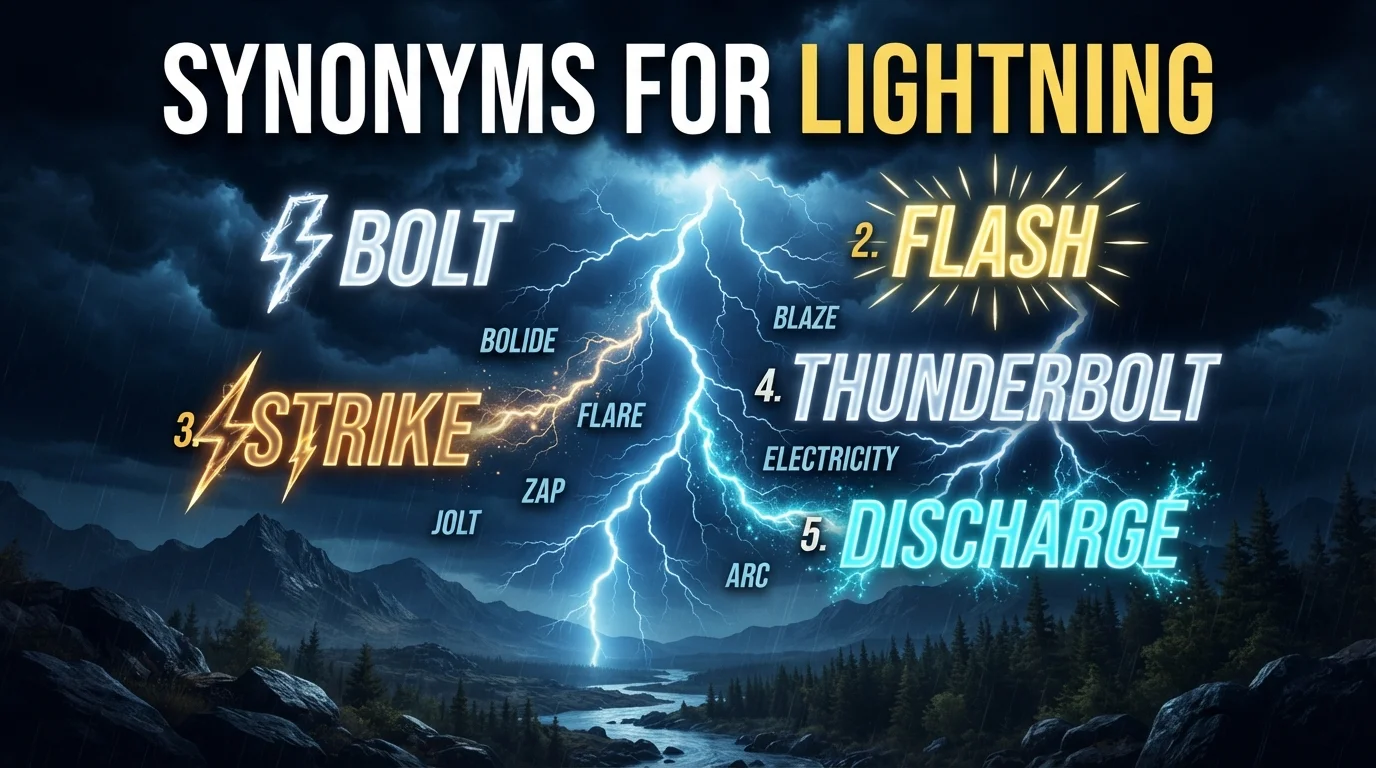
Lightning vs. Flash
A flash emphasizes light.
Lightning identifies the atmospheric electrical phenomenon producing the flash.
Compare:
“We saw lightning in the distance.”
“A bright flash illuminated the horizon.”
The second sentence does not necessarily tell us what caused the flash.
This distinction matters in descriptive writing.
Lightning vs. Electrical Discharge
An electrical discharge is a broader scientific concept.
Lightning is one major example of an atmospheric electrical discharge, but electrical discharges can also occur in other environments.
Therefore:
“Lightning is an electrical discharge.”
is accurate in a broad scientific sense.
But:
“Every electrical discharge is lightning.”
is not accurate.
Lightning vs. Thunderbolt
Thunderbolt can mean lightning in literary or dramatic language.
“A thunderbolt struck the tower.”
It can also refer to a sudden, devastating event metaphorically:
“The news came like a thunderbolt.”
Because of this figurative and literary association, thunderbolt is not always the best choice for scientific writing.
Figurative Synonyms for “Lightning” Meaning Very Fast
Lightning is frequently used as a metaphor for speed.
“He has lightning-fast reflexes.”
“She completed the task at lightning speed.”
In this meaning, alternatives include:
- Extremely fast
- Very fast
- Rapid
- Swift
- Blindingly fast
- Supersonic
- Instantaneous
- Immediate
- Fleeting
- Incredibly quick
- At high speed
- At remarkable speed
- In a flash
- In an instant
- In no time
- Rapid-fire
These are not synonyms for the weather phenomenon. They are alternatives to the figurative expression involving lightning.
Alternatives to “Lightning-Fast”
Extremely Fast
A clear and neutral alternative.
“The processor is extremely fast.”
Best for general writing.
Rapid
A concise formal alternative.
“The company experienced rapid growth.”
It works particularly well in professional and academic writing.
Swift
Means moving or happening quickly.
“The team took swift action.”
It can sound more polished than very fast.
Blindingly Fast
Emphasizes exceptional speed.
“The athlete moved at a blindingly fast pace.”
This is expressive rather than technical.
Instantaneous
Means occurring almost immediately, with little or no noticeable delay.
“The response was nearly instantaneous.”
It is stronger and more precise than simply fast.
In a Flash
An idiomatic expression meaning very quickly.
“She finished the assignment in a flash.”
This is informal and conversational.
In an Instant
Means almost immediately.
“The lights went out in an instant.”
It emphasizes suddenness rather than sustained speed.
Lightning Synonyms by Context
| Context | Best Alternative | Why |
|---|---|---|
| Scientific writing | Electrical discharge | Technical description |
| General weather | Lightning | Clearest general term |
| One visible stroke | Lightning bolt | Refers to an individual discharge |
| Dramatic description | Bolt | Short, vivid expression |
| Visual effect | Flash | Emphasizes light |
| Technical meteorology | Lightning stroke | Describes an individual discharge |
| Literary writing | Thunderbolt | Dramatic/literary |
| Branching pattern | Forked lightning | Describes appearance |
| Diffuse distant glow | Sheet lightning | Specific phenomenon |
| Speed metaphor | Extremely fast | Clear and direct |
| Fast action | Rapid | Concise/formal |
| Sudden speed | Swift | Emphasizes quickness |
| Very immediate | Instantaneous | Emphasizes almost no delay |
| Informal speed | In a flash | Idiomatic |
True Synonyms vs. Related Alternatives
Not every lightning-related word can replace lightning directly.
| Alternative | Relationship | Can Replace “Lightning”? | Tone | Best Context |
|---|---|---|---|---|
| Electrical discharge | Broad scientific equivalent | Sometimes | Technical | Science |
| Lightning bolt | Narrower term | Often | Neutral | Individual stroke |
| Bolt | Contextual synonym | Often | Literary/neutral | Descriptions |
| Flash | Related term | Sometimes | Neutral | Visible light |
| Lightning flash | Close descriptive equivalent | Often | Neutral | Weather |
| Lightning stroke | Narrower technical term | Sometimes | Technical | Meteorology |
| Thunderbolt | Literary synonym | Sometimes | Dramatic | Literature |
| Electric flash | Related technical term | Sometimes | Technical | Science |
| Atmospheric discharge | Broad technical term | Sometimes | Technical | Science |
| Forked lightning | Specific type | No | Descriptive | Branching lightning |
| Sheet lightning | Specific phenomenon | No | Descriptive | Distant storms |
| Chain lightning | Specific/descriptive term | No | Literary/descriptive | Dramatic weather |
| Thunder | Different phenomenon | No | Neutral | Sound |
| Spark | Related electrical phenomenon | No | General | Small electrical discharge |
| Static electricity | Different phenomenon | No | Technical | Electricity |
| Flash of light | Broader description | Sometimes | Neutral | Visual description |
Lightning Synonyms by Meaning
If you mean the natural weather phenomenon
Use:
- Lightning
- Electrical discharge
- Atmospheric discharge
- Lightning bolt
- Lightning flash
- Lightning stroke
- Electric flash
If you mean one individual strike
Use:
- Lightning bolt
- Bolt
- Lightning stroke
- Electrical discharge
- Lightning flash
If you mean the visible burst of light
Use:
- Flash
- Lightning flash
- Electrical flash
- Burst of light
- Sudden flash
If you mean a dramatic literary lightning strike
Use:
- Thunderbolt
- Bolt
- Fiery bolt
- Blazing bolt
- Celestial bolt
If you mean extreme speed
Use:
- Rapid
- Swift
- Extremely fast
- Blindingly fast
- Instantaneous
- In a flash
- In an instant
- At high speed
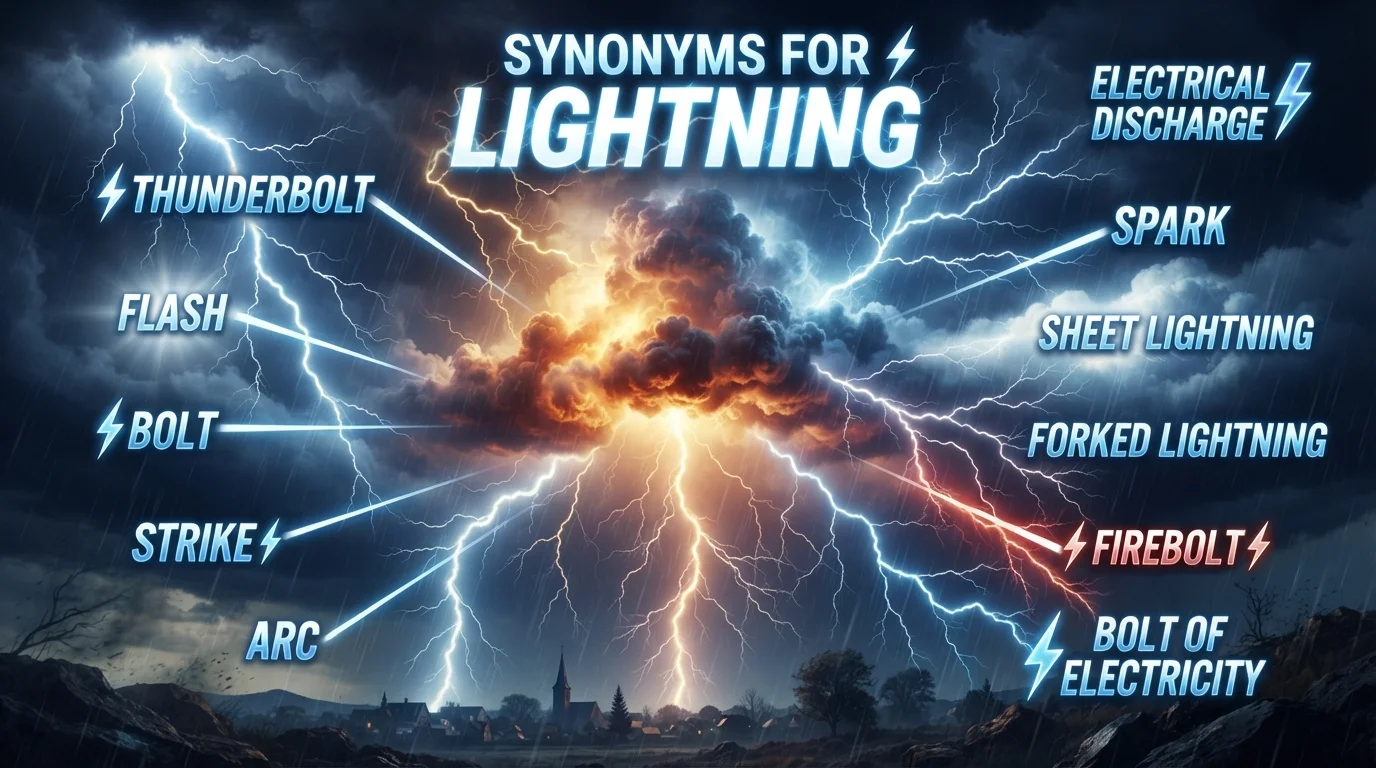
Sentence Transformations
1. General weather
Original:
“Lightning filled the sky.”
Alternative:
“Lightning flashes filled the sky.”
Why:
Lightning flashes emphasizes the repeated visible bursts.
2. Individual discharge
Original:
“Lightning struck the tree.”
Alternative:
“A lightning bolt struck the tree.”
Why:
Lightning bolt makes the individual discharge more vivid.
3. Literary description
Original:
“Lightning appeared above the mountain.”
Alternative:
“A thunderbolt flashed above the mountain.”
Why:
Thunderbolt creates a more dramatic and literary effect.
4. Scientific writing
Original:
“Lightning is a powerful natural event.”
Alternative:
“Lightning is a powerful atmospheric electrical discharge.”
Why:
The alternative adds scientific precision.
5. Visual description
Original:
“Lightning appeared in the distance.”
Alternative:
“A bright flash appeared in the distance.”
Why:
Flash emphasizes what the observer sees rather than the electrical process.
6. Describing speed
Original:
“He ran with lightning speed.”
Alternative:
“He ran at extraordinary speed.”
Why:
This removes the metaphor while preserving the meaning.
7. Formal writing
Original:
“The response was lightning-fast.”
Alternative:
“The response was almost instantaneous.”
Why:
Almost instantaneous is more precise and suitable for formal or technical writing.
8. Casual writing
Original:
“She finished the task at lightning speed.”
Alternative:
“She finished the task in a flash.”
Why:
In a flash is an informal idiom that emphasizes how quickly something happened.
9. Branching lightning
Original:
“The sky showed dramatic lightning.”
Alternative:
“The sky was illuminated by forked lightning.”
Why:
Forked lightning adds a specific visual detail about the branching shape.
10. Distant storm
Original:
“We could see lightning behind the clouds.”
Alternative:
“We could see sheet lightning behind the clouds.”
Why:
Sheet lightning can be appropriate when the clouds are illuminated by distant or obscured lightning.
Common Collocations With Lightning
Some expressions are so established that replacing lightning is unnecessary.
Weather
- lightning strike
- lightning bolt
- lightning flash
- lightning storm
- lightning strike
- lightning activity
- lightning discharge
- lightning channel
- lightning strike victim
- lightning protection
- lightning detection
- lightning warning
- lightning damage
Descriptive
- bright lightning
- sudden lightning
- powerful lightning
- intense lightning
- frequent lightning
- distant lightning
- forked lightning
- sheet lightning
- spectacular lightning
- flashes of lightning
Figurative
- lightning speed
- lightning-fast
- lightning quick
- lightning reflexes
- lightning reaction
- lightning pace
- lightning strike
Be careful with lightning strike: it can refer either to an actual lightning event affecting something or, figuratively, to a sudden action.
Lightning as a Verb or Noun?
Unlike some related words, lightning is primarily used as a noun.
Examples:
“Lightning struck the building.”
“We watched the lightning.”
The verb lightning is not normally used to mean “to strike with lightning.” Instead, English uses strike:
“Lightning struck the tower.”
Related verbs include:
- Strike
- Hit
- Flash
- Illuminate
- Electrify
But these are not direct synonyms for lightning.
Common Mistakes
Mistake 1: Confusing lightning with thunder
Lightning is the electrical discharge and visible flash.
Thunder is the sound associated with the discharge.
“I saw thunder.”
is incorrect if you mean the visual event.
Say:
“I saw lightning.”
Mistake 2: Treating “bolt” as completely interchangeable
A bolt often means one individual stroke of lightning.
“The storm produced lightning.”
is broader than:
“A bolt struck the building.”
Mistake 3: Using “flash” as an exact scientific synonym
A flash describes the visible light. It does not necessarily identify the electrical discharge.
“We saw a flash.”
could describe lightning, a camera, an explosion, or another source of light.
Mistake 4: Using “thunderbolt” in technical writing
Thunderbolt is often literary or dramatic.
For scientific writing, lightning or electrical discharge is generally more precise.
Mistake 5: Confusing lightning with electricity
Lightning is a particular atmospheric electrical phenomenon.
Electricity is the broader concept.
Not all electricity is lightning.
Mistake 6: Assuming “spark” means lightning
A spark is a small electrical discharge. Lightning is vastly larger and occurs in the atmosphere.
“A spark jumped from the wire.”
does not mean the same thing as:
“Lightning struck the ground.”
Mistake 7: Overusing “lightning-fast”
The phrase is vivid, but it can become repetitive in formal writing.
Instead of:
“The system provides lightning-fast processing.”
you may sometimes write:
“The system processes requests with minimal delay.”
The second version is more precise.
Mistake 8: Using “strike” as a complete synonym for lightning
Strike is a verb describing what lightning does or a noun referring to an occurrence of lightning hitting something.
“Lightning struck the roof.”
“The lightning strike damaged the roof.”
Strike itself does not simply mean lightning.
When “Lightning” Is the Better Word
Do not replace lightning simply to avoid repetition.
It is usually the clearest word when discussing the actual weather phenomenon:
“Lightning is common during severe thunderstorms.”
Replacing it with:
“Atmospheric electrical discharge is common during severe thunderstorms.”
may sound unnecessarily technical.
Likewise, lightning bolt is not automatically better:
“The storm produced frequent lightning.”
is a natural general statement.
“The storm produced frequent lightning bolts.”
sounds more focused on individual visible strokes.
Choose the alternative only when it adds useful information.
How to Choose the Right Alternative
Use lightning when:
You mean the general atmospheric electrical phenomenon.
Use electrical discharge when:
You need scientific or technical language.
Use lightning bolt when:
You mean an individual visible stroke.
Use bolt when:
You want a shorter, vivid, or literary description and the context is clear.
Use flash when:
You want to emphasize the visible burst of light.
Use lightning stroke when:
You are writing technically about an individual discharge.
Use thunderbolt when:
You want a dramatic, literary, or mythological tone.
Use forked lightning when:
You want to describe branching lightning.
Use sheet lightning when:
You mean the diffuse illumination associated with distant or obscured lightning.
Use rapid or swift when:
“Lightning” is being used figuratively to describe speed.
Use instantaneous when:
You want to emphasize an almost immediate response or event.
Use in a flash when:
You want a casual idiom meaning very quickly.
Editor’s Choice
For most writing, these alternatives cover the most useful distinctions:
1. Lightning bolt
Best everyday alternative when referring to an individual visible stroke.
2. Electrical discharge
Best scientific description, although broader than lightning.
3. Flash
Best when the visual burst of light is the focus.
4. Bolt
A concise, vivid alternative in descriptive or literary writing.
5. Thunderbolt
Best for dramatic or literary language rather than technical writing.
The original lightning remains the best general-purpose word. The alternatives are useful when you need to emphasize the individual stroke, the visual flash, the scientific process, or the dramatic effect.