
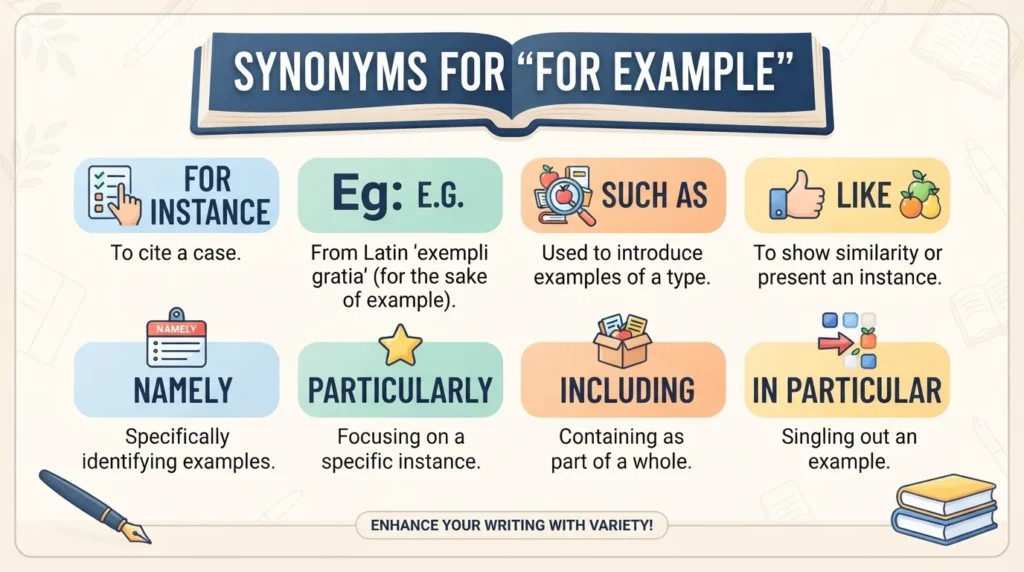
Quick Synonym Reference
| Alternative | Best use | Register | Direct replacement? |
|---|---|---|---|
| for instance | introducing an example | Neutral | Yes |
| such as | listing examples | Neutral | Sometimes |
| to illustrate | explaining with an example | Neutral/formal | Sometimes |
| as an example | introducing an example | Neutral | Yes |
| by way of example | giving an example | Formal | Yes |
| as an illustration | explaining through an example | Formal | Sometimes |
| for one thing | giving one supporting point | Neutral | No |
| including | naming examples within a group | Neutral | Sometimes |
| namely | specifying exactly what is meant | Formal | No |
| specifically | giving precise details | Neutral/formal | No |
| in particular | highlighting a specific case | Neutral | Sometimes |
| as an illustration of this | explaining an idea | Formal | Sometimes |
| to give an example | introducing an example | Neutral | Yes |
| to give you an example | conversational explanation | Conversational | Yes |
| consider | asking reader to think about a case | Neutral | Sometimes |
| take … as an example | using a specific case | Neutral | Sometimes |
| by way of illustration | formal explanatory example | Formal | Yes |
| as a case in point | especially relevant example | Formal | Sometimes |
| a case in point is | introducing a representative case | Formal | Sometimes |
| one example is | straightforward example | Neutral | Yes |
| one instance is | specific case | Formal | Sometimes |
| this includes | examples within a category | Neutral | Sometimes |
| among them | identifying examples from a group | Neutral | Sometimes |
| e.g. | written abbreviation | Formal/academic | Yes |
| viz. | namely/specifically | Very formal | No |
| like | casual examples | Informal | Sometimes |
| say | hypothetical example | Conversational | Sometimes |
| suppose | hypothetical case | Conversational | No |
| imagine | hypothetical illustration | Conversational | No |
| take … for example | introducing a particular case | Neutral | Yes |
| to demonstrate | showing how something works | Formal | Sometimes |
What Does “For Example” Mean?
For example is a phrase used to introduce a particular person, thing, situation, fact, or case that helps explain a broader statement.
Many fruits are rich in vitamins. For example, oranges contain vitamin C.
The first sentence makes a general statement. The second gives a specific example.
The phrase can appear at different points in a sentence:
For example, you could use a dictionary.
You could, for example, use a dictionary.
You could use a dictionary, for example.
The most natural position depends on the sentence and the emphasis you want.
1. For Instance
For instance is the closest direct synonym for for example.
Many animals are nocturnal. For instance, owls are active at night.
Many animals are nocturnal. For example, owls are active at night.
In most situations, you can replace one with the other without changing the meaning.
Best for:
- everyday writing
- academic writing
- professional writing
- explanations
- essays
- articles
For instance can sometimes sound slightly more formal than for example, but the difference is small.
2. Such As
Such as introduces examples that belong to a broader category.
You can eat fruits such as apples, oranges, and bananas.
Unlike for example, such as usually appears directly before the examples rather than functioning as a sentence-opening transition.
Compare:
Many fruits contain vitamin C. For example, oranges do.
Fruits such as oranges contain vitamin C.
This makes such as a related alternative rather than a universal replacement.
Important grammar point
Do not write:
❌ Fruits such as oranges, for example, contain vitamin C.
This can be grammatically possible in some contexts, but using both expressions together is often redundant.
3. To Illustrate
To illustrate means to explain or make an idea clearer by giving an example.
To illustrate, consider a company that suddenly loses its largest customer.
It is especially useful in:
- academic writing
- professional writing
- explanations
- presentations
- analytical articles
It sounds more purposeful than for example because it emphasizes clarifying an idea.
4. As an Example
As an example is a straightforward alternative.
As an example, consider a small business with ten employees.
It can also appear later in a sentence:
A small business, as an example, may have limited resources.
The first construction is generally more natural.
5. By Way of Example
By way of example is a more formal expression meaning “as an example.
By way of example, consider the following situation.
It is suitable for:
- formal writing
- legal writing
- academic prose
- speeches
- professional explanations
It can sound unnecessarily formal in casual conversation.
6. As an Illustration
As an illustration introduces a case used to make an idea clearer.
As an illustration, imagine a student preparing for an important examination.
It is more formal than for example and works particularly well in explanatory writing.
7. To Give an Example
To give an example is direct and natural.
To give an example, imagine that you receive two job offers.
It is useful when you want to signal clearly that an example is coming.
8. To Give You an Example
To give you an example is more conversational.
To give you an example, imagine trying to learn a new language without practicing.
It works well in:
- teaching
- presentations
- conversation
- informal explanations
The phrase directly addresses the reader or listener.
9. Including
Including can introduce examples within a larger category.
Several countries, including Canada and Mexico, use this system.
It is not always a direct substitute for for example.
Compare:
Several countries use this system. For example, Canada and Mexico do.
Several countries, including Canada and Mexico, use this system.
Including integrates the examples into the sentence rather than presenting them as a separate illustration.
10. Namely
Namely means “specifically” or “that is to say.”
Several factors contributed to the problem, namely, poor planning and inadequate funding.
It is useful when you are identifying the exact things you have just referred to.
This is an important distinction:
- for example = one or more examples
- namely = the specific things being referred to
Therefore, namely is not always a true synonym.
11. Specifically
Specifically introduces precise information.
Some countries have strict regulations. Specifically, Canada and Australia have detailed requirements in this area.
It can introduce examples, but its primary function is to make a statement more precise.
12. In Particular
In particular highlights one specific person, thing, or case.
Several products performed well, in particular the newest model.
It is useful when one example deserves special attention.
It is not always interchangeable with for example because it often means especially rather than simply as an example.
13. Take … for Example
Take … for example is a natural phrase for drawing attention to a particular case.
Take renewable energy for example. Solar power has become more accessible.
Or:
Take solar power, for example. Costs have fallen in many markets.
This works well in:
- explanations
- essays
- presentations
- persuasive writing
- conversation
14. Consider
Consider can introduce an example without explicitly saying “for example.”
Consider a student who studies for only ten minutes a day.
The reader is being asked to imagine or examine a particular case.
It is especially useful in analytical and explanatory writing.
15. As a Case in Point
As a case in point introduces an example that strongly supports the point being discussed.
Many businesses struggle with employee retention. As a case in point, the company lost a quarter of its staff last year.
This is stronger than simply for example because the example is presented as particularly relevant or illustrative.
16. A Case in Point Is
This construction is similar.
A case in point is the company’s response to the crisis.
It works well when one particular situation provides a clear example of the broader statement.
17. One Example Is
Sometimes the clearest alternative is simply:
One example is the growing use of renewable energy.
This is especially useful when the writer intends to give one example and then perhaps discuss others.
18. One Instance Is
One instance is means one particular occurrence or case.
One instance is the failure of the original system.
It is more formal and less common than one example is.
19. By Way of Illustration
By way of illustration is a formal phrase meaning that something is being provided to clarify an idea.
By way of illustration, consider the following example.
It is appropriate in formal explanatory writing but usually unnecessary in casual communication.
20. As an Illustration of This
This phrase explicitly connects the example to the preceding point.
The policy has created unexpected costs. As an illustration of this, several departments have had to reduce staff.
It is useful when the relationship between the claim and the example needs to be made explicit.
21. For One Thing
For one thing can introduce one supporting reason or example.
The plan is difficult to implement. For one thing, it requires expensive equipment.
However, it usually introduces a reason or supporting point, not merely an example.
It often suggests that another point will follow:
For one thing… For another…
22. Like
In informal English, like can introduce examples.
You can use citrus fruits like lemons and oranges.
This is common in conversation, but such as is often preferable in formal writing.
Formal:
Fruits such as apples and oranges…
Casual:
Fruits like apples and oranges…
23. Say
Say can introduce a hypothetical example in conversation.
Say you have $500 to invest. What would you do with it?
Here, say means something like suppose or imagine.
It is not a direct replacement for for example in every sentence.
24. Suppose
Suppose introduces a hypothetical situation.
Suppose, for example, that the company loses its largest customer.
Or:
Suppose the company loses its largest customer.
It is useful when the example is imaginary rather than an actual case.
25. Imagine
Imagine works similarly.
Imagine a student preparing for an exam without a study plan.
It creates a hypothetical example and is particularly natural in teaching and explanatory writing.
“For Example” vs. “For Instance”
These are the closest alternatives.
| For example | For instance |
|---|---|
| Very common | Very common |
| Neutral | Neutral to slightly formal |
| Introduces examples | Introduces examples |
| Works in academic writing | Works in academic writing |
| Works in conversation | Works in conversation |
In most sentences, they are interchangeable.
Many animals migrate. For example, birds travel long distances.
Many animals migrate. For instance, birds travel long distances.
Both are correct.
“For Example” vs. “Such As”
This is one of the most common points of confusion.
For example usually introduces a complete example or sentence.
Many fruits are rich in nutrients. For example, oranges contain vitamin C.
Such as normally introduces examples within a sentence.
Fruits such as oranges contain vitamin C.
A simple rule:
For example = sentence-level example
Such as = examples inside a noun phrase
“For Example” vs. “To Illustrate”
Both can introduce an example, but the emphasis differs.
For example simply gives a case.
To illustrate emphasizes that the case helps explain an idea.
Some habits improve concentration. For example, taking regular breaks can help.
Some habits improve concentration. To illustrate, consider a student who takes regular breaks while studying.
The second sounds more explanatory.
“For Example” vs. “Namely”
These are not interchangeable.
Several cities have introduced the program, for example, Boston and Seattle.
This presents Boston and Seattle as examples.
Several cities have introduced the program, namely, Boston and Seattle.
This can imply that Boston and Seattle are the specific cities being referred to.
Use namely when identifying exactly what you mean, not merely when giving representative examples.
“For Example” vs. “Specifically”
Specifically adds precision.
Several companies have adopted the system. For example, Company A and Company B use it.
Several companies have adopted the system. Specifically, Company A and Company B use it.
The second can imply that these are the precise companies under discussion, rather than simply two examples.
True Synonyms vs. Related Alternatives
| Word/Phrase | Relationship | Can replace “for example”? | Main difference |
|---|---|---|---|
| for instance | True synonym | Yes | Nearly identical |
| such as | Related construction | Sometimes | Usually placed before examples |
| to illustrate | Close alternative | Often | Emphasizes explanation |
| as an example | Close alternative | Yes | Directly introduces an example |
| by way of example | Formal equivalent | Yes | More formal |
| as an illustration | Close alternative | Often | Emphasizes clarification |
| to give an example | Phrase-level equivalent | Yes | Direct and explicit |
| including | Related construction | Sometimes | Integrates examples into a sentence |
| namely | Related term | Rarely | Identifies specifics |
| specifically | Related term | Sometimes | Adds precision |
| in particular | Related term | Sometimes | Highlights one case |
| consider | Explanatory alternative | Sometimes | Asks reader to examine a case |
| case in point | Related expression | Sometimes | Especially relevant example |
| like | Informal alternative | Sometimes | Casual examples |
| say | Conversational alternative | Sometimes | Hypothetical example |
| suppose | Related expression | No | Hypothetical situation |
| imagine | Related expression | No | Hypothetical illustration |
Formal Alternatives for “For Example”
For academic, professional, and formal writing, consider:
- for instance
- to illustrate
- as an example
- by way of example
- as an illustration
- by way of illustration
- to give an example
- as a case in point
- a case in point is
- specifically
- in particular
- namely
Example
Basic:
Many factors influence productivity. For example, sleep affects concentration.
More formal:
Many factors influence productivity. For instance, sleep affects concentration.
More explanatory:
Many factors influence productivity. To illustrate, consider the effect of sleep on concentration.
Alternatives for Academic Writing
Academic writing often benefits from varied but precise expressions:
- for instance
- such as
- to illustrate
- as an example
- for example
- specifically
- in particular
- consider
- a case in point
- by way of illustration
Example
Several variables can affect the results. For instance, sample size can influence statistical reliability.
Or:
Several variables can affect the results, such as sample size and measurement error.
Alternatives for Business Writing
Useful professional choices include:
- for instance
- such as
- including
- to illustrate
- for example
- specifically
- consider
- a case in point
- one example is
Example
Several costs have increased, including transportation and raw materials.
This is often cleaner than:
Several costs have increased. For example, transportation and raw materials have increased.
Alternatives for Casual Conversation
Natural conversational options include:
- for example
- for instance
- like
- say
- take…
- imagine
- suppose
- to give you an example
Example
You could try a different hobby, like photography.
Or:
Say you have an hour free. What would you do with it?
10 Sentence Transformations
1. Direct replacement
Original:
Many animals are nocturnal. For example, owls hunt at night.
Alternative:
Many animals are nocturnal. For instance, owls hunt at night.
Why: For instance is the closest direct synonym.
2. Examples within a sentence
Original:
You can use fruits for breakfast. For example, apples and bananas work well.
Alternative:
You can use fruits such as apples and bananas for breakfast.
Why: Such as integrates the examples directly into the sentence.
3. Explanatory writing
Original:
The policy can create unexpected problems. For example, small businesses may face higher costs.
Alternative:
The policy can create unexpected problems. To illustrate, small businesses may face higher costs.
Why: To illustrate emphasizes the explanatory role of the example.
4. Formal writing
Original:
Several factors affect performance. For example, sleep and nutrition matter.
Alternative:
Several factors affect performance. By way of example, sleep and nutrition matter.
Why: The alternative is more formal, though it is also more wordy.
5. Professional writing
Original:
Several expenses increased. For example, shipping costs rose sharply.
Alternative:
Several expenses increased, including shipping costs.
Why: Including creates a more concise professional sentence.
6. Highlighting one case
Original:
Several products performed well. For example, the new model exceeded expectations.
Alternative:
Several products performed well. In particular, the new model exceeded expectations.
Why: In particular highlights the new model rather than presenting it merely as one example.
7. Precise identification
Original:
Several cities participated. For example, Boston and Seattle participated.
Alternative:
Several cities participated, namely Boston and Seattle.
Why: Namely suggests that Boston and Seattle are the specific cities being identified.
8. Hypothetical example
Original:
For example, imagine a company losing its largest customer.
Alternative:
Suppose a company loses its largest customer.
Why: Suppose directly introduces a hypothetical case.
9. Conversational explanation
Original:
For example, you could start with a small project.
Alternative:
Say you start with a small project.
Why: Say creates a more conversational hypothetical example.
10. Analytical writing
Original:
For example, consider a student with only one hour to study.
Alternative:
Consider a student with only one hour to study.
Why: Consider can introduce the example without an explicit example marker.
Punctuation with “For Example”
Correct punctuation depends on where the phrase appears.
At the beginning
For example, many students use flashcards.
A comma normally follows the introductory phrase.
In the middle
Many students, for example, use flashcards.
The phrase is parenthetical, so commas are used around it.
At the end
Many students use flashcards, for example.
This is grammatically possible but less common and often less natural than placing the phrase earlier.
Before a specific example
Several fruits are rich in vitamin C, for example, oranges.
This construction can be used, although rewriting with such as may be smoother:
Several fruits, such as oranges, are rich in vitamin C.
Common Mistakes
1. Treating “such as” and “for example” as identical in grammar
They have different typical sentence structures.
2. Using “namely” for any example
Namely is more specific than for example. It identifies what you mean rather than simply giving a representative case.
3. Using “like” in formal writing without considering tone
Like is natural in casual English, but such as is usually better for formal writing.
4. Overusing “for example”
Repeating the same phrase in every paragraph can make writing feel mechanical.
Vary it naturally with:
- for instance
- such as
- to illustrate
- including
- consider
- in particular
5. Adding too many examples
An example should clarify the point. A long list can distract from the main idea.
6. Using “e.g.” in every context
e.g. is useful in writing, but it is not normally spoken as “e-g.” In ordinary prose, spelling out for example is often clearer.
7. Confusing “for example” with “namely”
Examples are representative. Namely can identify the exact items being discussed.
8. Using formal phrases unnecessarily
By way of example and by way of illustration are correct but may sound overly formal in everyday writing.
When Not to Replace “For Example”
For example is already clear, concise, and natural. You do not need to replace it simply to avoid repetition.
Many skills can improve through practice. For example, writing becomes easier with regular use.
This is perfectly good writing.
If the examples are embedded in a noun phrase, such as may be more efficient:
Many skills, such as writing and public speaking, improve with practice.
If you are explaining a concept through a hypothetical case, consider or suppose may be more precise.
The goal is not to avoid for example. The goal is to choose the construction that fits the sentence.
A Simple Decision Guide
| If you want to… | Use… |
|---|---|
| Give a normal example | for example |
| Give a direct alternative | for instance |
| List examples inside a sentence | such as |
| Explain an idea with a case | to illustrate |
| Introduce one example directly | as an example |
| Write formally | by way of example |
| Integrate examples concisely | including |
| Identify exact items | namely |
| Add precision | specifically |
| Highlight one example | in particular |
| Ask readers to examine a case | consider |
| Introduce a strong supporting example | as a case in point |
| Give a hypothetical case | suppose / imagine |
| Speak casually | like / say |
Editor’s Choice: The Most Useful Alternatives
For most writers, these five are enough to cover nearly every practical need:
- For instance — the closest direct synonym.
- Such as — best for examples embedded in a sentence.
- To illustrate — best for explanatory or analytical writing.
- Including — best for concise lists of examples.
- In particular — best when one example deserves special attention.
Use for example itself when it is the clearest option. Vocabulary variety is useful, but forced variation can make writing less natural.
Quick Synonym Reference
| Alternative | Best use | Register | Direct replacement? |
|---|---|---|---|
| for instance | introducing an example | Neutral | Yes |
| such as | listing examples | Neutral | Sometimes |
| to illustrate | explaining with an example | Neutral/formal | Sometimes |
| as an example | introducing an example | Neutral | Yes |
| by way of example | giving an example | Formal | Yes |
| as an illustration | explaining through an example | Formal | Sometimes |
| for one thing | giving one supporting point | Neutral | No |
| including | naming examples within a group | Neutral | Sometimes |
| namely | specifying exactly what is meant | Formal | No |
| specifically | giving precise details | Neutral/formal | No |
| in particular | highlighting a specific case | Neutral | Sometimes |
| as an illustration of this | explaining an idea | Formal | Sometimes |
| to give an example | introducing an example | Neutral | Yes |
| to give you an example | conversational explanation | Conversational | Yes |
| consider | asking reader to think about a case | Neutral | Sometimes |
| take … as an example | using a specific case | Neutral | Sometimes |
| by way of illustration | formal explanatory example | Formal | Yes |
| as a case in point | especially relevant example | Formal | Sometimes |
| a case in point is | introducing a representative case | Formal | Sometimes |
| one example is | straightforward example | Neutral | Yes |
| one instance is | specific case | Formal | Sometimes |
| this includes | examples within a category | Neutral | Sometimes |
| among them | identifying examples from a group | Neutral | Sometimes |
| e.g. | written abbreviation | Formal/academic | Yes |
| viz. | namely/specifically | Very formal | No |
| like | casual examples | Informal | Sometimes |
| say | hypothetical example | Conversational | Sometimes |
| suppose | hypothetical case | Conversational | No |
| imagine | hypothetical illustration | Conversational | No |
| take … for example | introducing a particular case | Neutral | Yes |
| to demonstrate | showing how something works | Formal | Sometimes |
What Does “For Example” Mean?
For example is a phrase used to introduce a particular person, thing, situation, fact, or case that helps explain a broader statement.
Many fruits are rich in vitamins. For example, oranges contain vitamin C.
The first sentence makes a general statement. The second gives a specific example.
The phrase can appear at different points in a sentence:
For example, you could use a dictionary.
You could, for example, use a dictionary.
You could use a dictionary, for example.
The most natural position depends on the sentence and the emphasis you want.
1. For Instance
For instance is the closest direct synonym for for example.
Many animals are nocturnal. For instance, owls are active at night.
Many animals are nocturnal. For example, owls are active at night.
In most situations, you can replace one with the other without changing the meaning.
Best for:
- everyday writing
- academic writing
- professional writing
- explanations
- essays
- articles
For instance can sometimes sound slightly more formal than for example, but the difference is small.
2. Such As
Such as introduces examples that belong to a broader category.
You can eat fruits such as apples, oranges, and bananas.
Unlike for example, such as usually appears directly before the examples rather than functioning as a sentence-opening transition.
Compare:
Many fruits contain vitamin C. For example, oranges do.
Fruits such as oranges contain vitamin C.
This makes such as a related alternative rather than a universal replacement.
Important grammar point
Do not write:
❌ Fruits such as oranges, for example, contain vitamin C.
This can be grammatically possible in some contexts, but using both expressions together is often redundant.
3. To Illustrate
To illustrate means to explain or make an idea clearer by giving an example.
To illustrate, consider a company that suddenly loses its largest customer.
It is especially useful in:
- academic writing
- professional writing
- explanations
- presentations
- analytical articles
It sounds more purposeful than for example because it emphasizes clarifying an idea.
4. As an Example
As an example is a straightforward alternative.
As an example, consider a small business with ten employees.
It can also appear later in a sentence:
A small business, as an example, may have limited resources.
The first construction is generally more natural.
5. By Way of Example
By way of example is a more formal expression meaning “as an example.”
By way of example, consider the following situation.
It is suitable for:
- formal writing
- legal writing
- academic prose
- speeches
- professional explanations
It can sound unnecessarily formal in casual conversation.
6. As an Illustration
As an illustration introduces a case used to make an idea clearer.
As an illustration, imagine a student preparing for an important examination.
It is more formal than for example and works particularly well in explanatory writing.
7. To Give an Example
To give an example is direct and natural.
To give an example, imagine that you receive two job offers.
It is useful when you want to signal clearly that an example is coming.
8. To Give You an Example
To give you an example is more conversational.
To give you an example, imagine trying to learn a new language without practicing.
It works well in:
- teaching
- presentations
- conversation
- informal explanations
The phrase directly addresses the reader or listener.
9. Including
Including can introduce examples within a larger category.
Several countries, including Canada and Mexico, use this system.
It is not always a direct substitute for for example.
Compare:
Several countries use this system. For example, Canada and Mexico do.
Several countries, including Canada and Mexico, use this system.
Including integrates the examples into the sentence rather than presenting them as a separate illustration.
10. Namely
Namely means “specifically” or “that is to say.”
Several factors contributed to the problem, namely, poor planning and inadequate funding.
It is useful when you are identifying the exact things you have just referred to.
This is an important distinction:
- for example = one or more examples
- namely = the specific things being referred to
Therefore, namely is not always a true synonym.
11. Specifically
Specifically introduces precise information.
Some countries have strict regulations. Specifically, Canada and Australia have detailed requirements in this area.
It can introduce examples, but its primary function is to make a statement more precise.
12. In Particular
In particular highlights one specific person, thing, or case.
Several products performed well, in particular the newest model.
It is useful when one example deserves special attention.
It is not always interchangeable with for example because it often means especially rather than simply as an example.
13. Take … for Example
Take … for example is a natural phrase for drawing attention to a particular case.
Take renewable energy for example. Solar power has become more accessible.
Or:
Take solar power, for example. Costs have fallen in many markets.
This works well in:
- explanations
- essays
- presentations
- persuasive writing
- conversation
14. Consider
Consider can introduce an example without explicitly saying “for example.”
Consider a student who studies for only ten minutes a day.
The reader is being asked to imagine or examine a particular case.
It is especially useful in analytical and explanatory writing.
15. As a Case in Point
As a case in point introduces an example that strongly supports the point being discussed.
Many businesses struggle with employee retention. As a case in point, the company lost a quarter of its staff last year.
This is stronger than simply for example because the example is presented as particularly relevant or illustrative.
16. A Case in Point Is
This construction is similar.
A case in point is the company’s response to the crisis.
It works well when one particular situation provides a clear example of the broader statement.
17. One Example Is
Sometimes the clearest alternative is simply:
One example is the growing use of renewable energy.
This is especially useful when the writer intends to give one example and then perhaps discuss others.
18. One Instance Is
One instance is means one particular occurrence or case.
One instance is the failure of the original system.
It is more formal and less common than one example is.
19. By Way of Illustration
By way of illustration is a formal phrase meaning that something is being provided to clarify an idea.
By way of illustration, consider the following example.
It is appropriate in formal explanatory writing but usually unnecessary in casual communication.
20. As an Illustration of This
This phrase explicitly connects the example to the preceding point.
The policy has created unexpected costs. As an illustration of this, several departments have had to reduce staff.
It is useful when the relationship between the claim and the example needs to be made explicit.
21. For One Thing
For one thing can introduce one supporting reason or example.
The plan is difficult to implement. For one thing, it requires expensive equipment.
However, it usually introduces a reason or supporting point, not merely an example.
It often suggests that another point will follow:
For one thing… For another…
22. Like
In informal English, like can introduce examples.
You can use citrus fruits like lemons and oranges.
This is common in conversation, but such as is often preferable in formal writing.
Formal:
Fruits such as apples and oranges…
Casual:
Fruits like apples and oranges…
23. Say
Say can introduce a hypothetical example in conversation.
Say you have $500 to invest. What would you do with it?
Here, say means something like suppose or imagine.
It is not a direct replacement for for example in every sentence.
24. Suppose
Suppose introduces a hypothetical situation.
Suppose, for example, that the company loses its largest customer.
Or:
Suppose the company loses its largest customer.
It is useful when the example is imaginary rather than an actual case.
25. Imagine
Imagine works similarly.
Imagine a student preparing for an exam without a study plan.
It creates a hypothetical example and is particularly natural in teaching and explanatory writing.
“For Example” vs. “For Instance”
These are the closest alternatives.
| For example | For instance |
|---|---|
| Very common | Very common |
| Neutral | Neutral to slightly formal |
| Introduces examples | Introduces examples |
| Works in academic writing | Works in academic writing |
| Works in conversation | Works in conversation |
In most sentences, they are interchangeable.
Many animals migrate. For example, birds travel long distances.
Many animals migrate. For instance, birds travel long distances.
Both are correct.
“For Example” vs. “Such As”
This is one of the most common points of confusion.
For example usually introduces a complete example or sentence.
Many fruits are rich in nutrients. For example, oranges contain vitamin C.
Such as normally introduces examples within a sentence.
Fruits such as oranges contain vitamin C.
A simple rule:
For example = sentence-level example
Such as = examples inside a noun phrase
“For Example” vs. “To Illustrate”
Both can introduce an example, but the emphasis differs.
For example simply gives a case.
To illustrate emphasizes that the case helps explain an idea.
Some habits improve concentration. For example, taking regular breaks can help.
Some habits improve concentration. To illustrate, consider a student who takes regular breaks while studying.
The second sounds more explanatory.
“For Example” vs. “Namely”
These are not interchangeable.
Several cities have introduced the program, for example, Boston and Seattle.
This presents Boston and Seattle as examples.
Several cities have introduced the program, namely, Boston and Seattle.
This can imply that Boston and Seattle are the specific cities being referred to.
Use namely when identifying exactly what you mean, not merely when giving representative examples.
“For Example” vs. “Specifically”
Specifically adds precision.
Several companies have adopted the system. For example, Company A and Company B use it.
Several companies have adopted the system. Specifically, Company A and Company B use it.
The second can imply that these are the precise companies under discussion, rather than simply two examples.
True Synonyms vs. Related Alternatives
| Word/Phrase | Relationship | Can replace “for example”? | Main difference |
|---|---|---|---|
| for instance | True synonym | Yes | Nearly identical |
| such as | Related construction | Sometimes | Usually placed before examples |
| to illustrate | Close alternative | Often | Emphasizes explanation |
| as an example | Close alternative | Yes | Directly introduces an example |
| by way of example | Formal equivalent | Yes | More formal |
| as an illustration | Close alternative | Often | Emphasizes clarification |
| to give an example | Phrase-level equivalent | Yes | Direct and explicit |
| including | Related construction | Sometimes | Integrates examples into a sentence |
| namely | Related term | Rarely | Identifies specifics |
| specifically | Related term | Sometimes | Adds precision |
| in particular | Related term | Sometimes | Highlights one case |
| consider | Explanatory alternative | Sometimes | Asks reader to examine a case |
| case in point | Related expression | Sometimes | Especially relevant example |
| like | Informal alternative | Sometimes | Casual examples |
| say | Conversational alternative | Sometimes | Hypothetical example |
| suppose | Related expression | No | Hypothetical situation |
| imagine | Related expression | No | Hypothetical illustration |
Formal Alternatives for “For Example”
For academic, professional, and formal writing, consider:
- for instance
- to illustrate
- as an example
- by way of example
- as an illustration
- by way of illustration
- to give an example
- as a case in point
- a case in point is
- specifically
- in particular
- namely
Example
Basic:
Many factors influence productivity. For example, sleep affects concentration.
More formal:
Many factors influence productivity. For instance, sleep affects concentration.
More explanatory:
Many factors influence productivity. To illustrate, consider the effect of sleep on concentration.
Alternatives for Academic Writing
Academic writing often benefits from varied but precise expressions:
- for instance
- such as
- to illustrate
- as an example
- for example
- specifically
- in particular
- consider
- a case in point
- by way of illustration
Example
Several variables can affect the results. For instance, sample size can influence statistical reliability.
Or:
Several variables can affect the results, such as sample size and measurement error.
Alternatives for Business Writing
Useful professional choices include:
- for instance
- such as
- including
- to illustrate
- for example
- specifically
- consider
- a case in point
- one example is
Example
Several costs have increased, including transportation and raw materials.
This is often cleaner than:
Several costs have increased. For example, transportation and raw materials have increased.
Alternatives for Casual Conversation
Natural conversational options include:
- for example
- for instance
- like
- say
- take…
- imagine
- suppose
- to give you an example
Example
You could try a different hobby, like photography.
Or:
Say you have an hour free. What would you do with it?
10 Sentence Transformations
1. Direct replacement
Original:
Many animals are nocturnal. For example, owls hunt at night.
Alternative:
Many animals are nocturnal. For instance, owls hunt at night.
Why: For instance is the closest direct synonym.
2. Examples within a sentence
Original:
You can use fruits for breakfast. For example, apples and bananas work well.
Alternative:
You can use fruits such as apples and bananas for breakfast.
Why: Such as integrates the examples directly into the sentence.
3. Explanatory writing
Original:
The policy can create unexpected problems. For example, small businesses may face higher costs.
Alternative:
The policy can create unexpected problems. To illustrate, small businesses may face higher costs.
Why: To illustrate emphasizes the explanatory role of the example.
4. Formal writing
Original:
Several factors affect performance. For example, sleep and nutrition matter.
Alternative:
Several factors affect performance. By way of example, sleep and nutrition matter.
Why: The alternative is more formal, though it is also more wordy.
5. Professional writing
Original:
Several expenses increased. For example, shipping costs rose sharply.
Alternative:
Several expenses increased, including shipping costs.
Why: Including creates a more concise professional sentence.
6. Highlighting one case
Original:
Several products performed well. For example, the new model exceeded expectations.
Alternative:
Several products performed well. In particular, the new model exceeded expectations.
Why: In particular highlights the new model rather than presenting it merely as one example.
7. Precise identification
Original:
Several cities participated. For example, Boston and Seattle participated.
Alternative:
Several cities participated, namely Boston and Seattle.
Why: Namely suggests that Boston and Seattle are the specific cities being identified.
8. Hypothetical example
Original:
For example, imagine a company losing its largest customer.
Alternative:
Suppose a company loses its largest customer.
Why: Suppose directly introduces a hypothetical case.
9. Conversational explanation
Original:
For example, you could start with a small project.
Alternative:
Say you start with a small project.
Why: Say creates a more conversational hypothetical example.
10. Analytical writing
Original:
For example, consider a student with only one hour to study.
Alternative:
Consider a student with only one hour to study.
Why: Consider can introduce the example without an explicit example marker.
Punctuation with “For Example”
Correct punctuation depends on where the phrase appears.
At the beginning
For example, many students use flashcards.
A comma normally follows the introductory phrase.
In the middle
Many students, for example, use flashcards.
The phrase is parenthetical, so commas are used around it.
At the end
Many students use flashcards, for example.
This is grammatically possible but less common and often less natural than placing the phrase earlier.
Before a specific example
Several fruits are rich in vitamin C, for example, oranges.
This construction can be used, although rewriting with such as may be smoother:
Several fruits, such as oranges, are rich in vitamin C.
Common Mistakes
1. Treating “such as” and “for example” as identical in grammar
They have different typical sentence structures.
2. Using “namely” for any example
Namely is more specific than for example. It identifies what you mean rather than simply giving a representative case.
3. Using “like” in formal writing without considering tone
Like is natural in casual English, but such as is usually better for formal writing.
4. Overusing “for example”
Repeating the same phrase in every paragraph can make writing feel mechanical.
Vary it naturally with:
- for instance
- such as
- to illustrate
- including
- consider
- in particular
5. Adding too many examples
An example should clarify the point. A long list can distract from the main idea.
6. Using “e.g.” in every context
e.g. is useful in writing, but it is not normally spoken as “e-g.” In ordinary prose, spelling out for example is often clearer.
7. Confusing “for example” with “namely”
Examples are representative. Namely can identify the exact items being discussed.
8. Using formal phrases unnecessarily
By way of example and by way of illustration are correct but may sound overly formal in everyday writing.
When Not to Replace “For Example”
For example is already clear, concise, and natural. You do not need to replace it simply to avoid repetition.
Many skills can improve through practice. For example, writing becomes easier with regular use.
This is perfectly good writing.
If the examples are embedded in a noun phrase, such as may be more efficient:
Many skills, such as writing and public speaking, improve with practice.
If you are explaining a concept through a hypothetical case, consider or suppose may be more precise.
The goal is not to avoid for example. The goal is to choose the construction that fits the sentence.
A Simple Decision Guide
| If you want to… | Use… |
|---|---|
| Give a normal example | for example |
| Give a direct alternative | for instance |
| List examples inside a sentence | such as |
| Explain an idea with a case | to illustrate |
| Introduce one example directly | as an example |
| Write formally | by way of example |
| Integrate examples concisely | including |
| Identify exact items | namely |
| Add precision | specifically |
| Highlight one example | in particular |
| Ask readers to examine a case | consider |
| Introduce a strong supporting example | as a case in point |
| Give a hypothetical case | suppose / imagine |
| Speak casually | like / say |
Editor’s Choice: The Most Useful Alternatives
For most writers, these five are enough to cover nearly every practical need:
- For instance — the closest direct synonym.
- Such as — best for examples embedded in a sentence.
- To illustrate — best for explanatory or analytical writing.
- Including — best for concise lists of examples.
- In particular — best when one example deserves special attention.
Use for example itself when it is the clearest option. Vocabulary variety is useful, but forced variation can make writing less natural.
Quick Synonym Reference
| Alternative | Best use | Register | Direct replacement? |
|---|---|---|---|
| for instance | introducing an example | Neutral | Yes |
| such as | listing examples | Neutral | Sometimes |
| to illustrate | explaining with an example | Neutral/formal | Sometimes |
| as an example | introducing an example | Neutral | Yes |
| by way of example | giving an example | Formal | Yes |
| as an illustration | explaining through an example | Formal | Sometimes |
| for one thing | giving one supporting point | Neutral | No |
| including | naming examples within a group | Neutral | Sometimes |
| namely | specifying exactly what is meant | Formal | No |
| specifically | giving precise details | Neutral/formal | No |
| in particular | highlighting a specific case | Neutral | Sometimes |
| as an illustration of this | explaining an idea | Formal | Sometimes |
| to give an example | introducing an example | Neutral | Yes |
| to give you an example | conversational explanation | Conversational | Yes |
| consider | asking reader to think about a case | Neutral | Sometimes |
| take … as an example | using a specific case | Neutral | Sometimes |
| by way of illustration | formal explanatory example | Formal | Yes |
| as a case in point | especially relevant example | Formal | Sometimes |
| a case in point is | introducing a representative case | Formal | Sometimes |
| one example is | straightforward example | Neutral | Yes |
| one instance is | specific case | Formal | Sometimes |
| this includes | examples within a category | Neutral | Sometimes |
| among them | identifying examples from a group | Neutral | Sometimes |
| e.g. | written abbreviation | Formal/academic | Yes |
| viz. | namely/specifically | Very formal | No |
| like | casual examples | Informal | Sometimes |
| say | hypothetical example | Conversational | Sometimes |
| suppose | hypothetical case | Conversational | No |
| imagine | hypothetical illustration | Conversational | No |
| take … for example | introducing a particular case | Neutral | Yes |
| to demonstrate | showing how something works | Formal | Sometimes |
What Does “For Example” Mean?
For example is a phrase used to introduce a particular person, thing, situation, fact, or case that helps explain a broader statement.
Many fruits are rich in vitamins. For example, oranges contain vitamin C.
The first sentence makes a general statement. The second gives a specific example.
The phrase can appear at different points in a sentence:
For example, you could use a dictionary.
You could, for example, use a dictionary.
You could use a dictionary, for example.
The most natural position depends on the sentence and the emphasis you want.
1. For Instance
For instance is the closest direct synonym for for example.
Many animals are nocturnal. For instance, owls are active at night.
Many animals are nocturnal. For example, owls are active at night.
In most situations, you can replace one with the other without changing the meaning.
Best for:
- everyday writing
- academic writing
- professional writing
- explanations
- essays
- articles
For instance can sometimes sound slightly more formal than for example, but the difference is small.
2. Such As
Such as introduces examples that belong to a broader category.
You can eat fruits such as apples, oranges, and bananas.
Unlike for example, such as usually appears directly before the examples rather than functioning as a sentence-opening transition.
Compare:
Many fruits contain vitamin C. For example, oranges do.
Fruits such as oranges contain vitamin C.
This makes such as a related alternative rather than a universal replacement.
Important grammar point
Do not write:
❌ Fruits such as oranges, for example, contain vitamin C.
This can be grammatically possible in some contexts, but using both expressions together is often redundant.
3. To Illustrate
To illustrate means to explain or make an idea clearer by giving an example.
To illustrate, consider a company that suddenly loses its largest customer.
It is especially useful in:
- academic writing
- professional writing
- explanations
- presentations
- analytical articles
It sounds more purposeful than for example because it emphasizes clarifying an idea.
4. As an Example
As an example is a straightforward alternative.
As an example, consider a small business with ten employees.
It can also appear later in a sentence:
A small business, as an example, may have limited resources.
The first construction is generally more natural.
5. By Way of Example
By way of example is a more formal expression meaning “as an example.”
By way of example, consider the following situation.
It is suitable for:
- formal writing
- legal writing
- academic prose
- speeches
- professional explanations
It can sound unnecessarily formal in casual conversation.
6. As an Illustration
As an illustration introduces a case used to make an idea clearer.
As an illustration, imagine a student preparing for an important examination.
It is more formal than for example and works particularly well in explanatory writing.
7. To Give an Example
To give an example is direct and natural.
To give an example, imagine that you receive two job offers.
It is useful when you want to signal clearly that an example is coming.
8. To Give You an Example
To give you an example is more conversational.
To give you an example, imagine trying to learn a new language without practicing.
It works well in:
- teaching
- presentations
- conversation
- informal explanations
The phrase directly addresses the reader or listener.
9. Including
Including can introduce examples within a larger category.
Several countries, including Canada and Mexico, use this system.
It is not always a direct substitute for for example.
Compare:
Several countries use this system. For example, Canada and Mexico do.
Several countries, including Canada and Mexico, use this system.
Including integrates the examples into the sentence rather than presenting them as a separate illustration.
10. Namely
Namely means “specifically” or “that is to say.”
Several factors contributed to the problem, namely, poor planning and inadequate funding.
It is useful when you are identifying the exact things you have just referred to.
This is an important distinction:
- for example = one or more examples
- namely = the specific things being referred to
Therefore, namely is not always a true synonym.
11. Specifically
Specifically introduces precise information.
Some countries have strict regulations. Specifically, Canada and Australia have detailed requirements in this area.
It can introduce examples, but its primary function is to make a statement more precise.
12. In Particular
In particular highlights one specific person, thing, or case.
Several products performed well, in particular the newest model.
It is useful when one example deserves special attention.
It is not always interchangeable with for example because it often means especially rather than simply as an example.
13. Take … for Example
Take … for example is a natural phrase for drawing attention to a particular case.
Take renewable energy for example. Solar power has become more accessible.
Or:
Take solar power, for example. Costs have fallen in many markets.
This works well in:
- explanations
- essays
- presentations
- persuasive writing
- conversation
14. Consider
Consider can introduce an example without explicitly saying “for example.”
Consider a student who studies for only ten minutes a day.
The reader is being asked to imagine or examine a particular case.
It is especially useful in analytical and explanatory writing.
15. As a Case in Point
As a case in point introduces an example that strongly supports the point being discussed.
Many businesses struggle with employee retention. As a case in point, the company lost a quarter of its staff last year.
This is stronger than simply for example because the example is presented as particularly relevant or illustrative.
16. A Case in Point Is
This construction is similar.
A case in point is the company’s response to the crisis.
It works well when one particular situation provides a clear example of the broader statement.
17. One Example Is
Sometimes the clearest alternative is simply:
One example is the growing use of renewable energy.
This is especially useful when the writer intends to give one example and then perhaps discuss others.
18. One Instance Is
One instance is means one particular occurrence or case.
One instance is the failure of the original system.
It is more formal and less common than one example is.
19. By Way of Illustration
By way of illustration is a formal phrase meaning that something is being provided to clarify an idea.
By way of illustration, consider the following example.
It is appropriate in formal explanatory writing but usually unnecessary in casual communication.
20. As an Illustration of This
This phrase explicitly connects the example to the preceding point.
The policy has created unexpected costs. As an illustration of this, several departments have had to reduce staff.
It is useful when the relationship between the claim and the example needs to be made explicit.
21. For One Thing
For one thing can introduce one supporting reason or example.
The plan is difficult to implement. For one thing, it requires expensive equipment.
However, it usually introduces a reason or supporting point, not merely an example.
It often suggests that another point will follow:
For one thing… For another…
22. Like
In informal English, like can introduce examples.
You can use citrus fruits like lemons and oranges.
This is common in conversation, but such as is often preferable in formal writing.
Formal:
Fruits such as apples and oranges…
Casual:
Fruits like apples and oranges…
23. Say
Say can introduce a hypothetical example in conversation.
Say you have $500 to invest. What would you do with it?
Here, say means something like suppose or imagine.
It is not a direct replacement for for example in every sentence.
24. Suppose
Suppose introduces a hypothetical situation.
Suppose, for example, that the company loses its largest customer.
Or:
Suppose the company loses its largest customer.
It is useful when the example is imaginary rather than an actual case.
25. Imagine
Imagine works similarly.
Imagine a student preparing for an exam without a study plan.
It creates a hypothetical example and is particularly natural in teaching and explanatory writing.
“For Example” vs. “For Instance”
These are the closest alternatives.
| For example | For instance |
|---|---|
| Very common | Very common |
| Neutral | Neutral to slightly formal |
| Introduces examples | Introduces examples |
| Works in academic writing | Works in academic writing |
| Works in conversation | Works in conversation |
In most sentences, they are interchangeable.
Many animals migrate. For example, birds travel long distances.
Many animals migrate. For instance, birds travel long distances.
Both are correct.
“For Example” vs. “Such As”
This is one of the most common points of confusion.
For example usually introduces a complete example or sentence.
Many fruits are rich in nutrients. For example, oranges contain vitamin C.
Such as normally introduces examples within a sentence.
Fruits such as oranges contain vitamin C.
A simple rule:
For example = sentence-level example
Such as = examples inside a noun phrase
“For Example” vs. “To Illustrate”
Both can introduce an example, but the emphasis differs.
For example simply gives a case.
To illustrate emphasizes that the case helps explain an idea.
Some habits improve concentration. For example, taking regular breaks can help.
Some habits improve concentration. To illustrate, consider a student who takes regular breaks while studying.
The second sounds more explanatory.
“For Example” vs. “Namely”
These are not interchangeable.
Several cities have introduced the program, for example, Boston and Seattle.
This presents Boston and Seattle as examples.
Several cities have introduced the program, namely, Boston and Seattle.
This can imply that Boston and Seattle are the specific cities being referred to.
Use namely when identifying exactly what you mean, not merely when giving representative examples.
“For Example” vs. “Specifically”
Specifically adds precision.
Several companies have adopted the system. For example, Company A and Company B use it.
Several companies have adopted the system. Specifically, Company A and Company B use it.
The second can imply that these are the precise companies under discussion, rather than simply two examples.
True Synonyms vs. Related Alternatives
| Word/Phrase | Relationship | Can replace “for example”? | Main difference |
|---|---|---|---|
| for instance | True synonym | Yes | Nearly identical |
| such as | Related construction | Sometimes | Usually placed before examples |
| to illustrate | Close alternative | Often | Emphasizes explanation |
| as an example | Close alternative | Yes | Directly introduces an example |
| by way of example | Formal equivalent | Yes | More formal |
| as an illustration | Close alternative | Often | Emphasizes clarification |
| to give an example | Phrase-level equivalent | Yes | Direct and explicit |
| including | Related construction | Sometimes | Integrates examples into a sentence |
| namely | Related term | Rarely | Identifies specifics |
| specifically | Related term | Sometimes | Adds precision |
| in particular | Related term | Sometimes | Highlights one case |
| consider | Explanatory alternative | Sometimes | Asks reader to examine a case |
| case in point | Related expression | Sometimes | Especially relevant example |
| like | Informal alternative | Sometimes | Casual examples |
| say | Conversational alternative | Sometimes | Hypothetical example |
| suppose | Related expression | No | Hypothetical situation |
| imagine | Related expression | No | Hypothetical illustration |
Formal Alternatives for “For Example”
For academic, professional, and formal writing, consider:
- for instance
- to illustrate
- as an example
- by way of example
- as an illustration
- by way of illustration
- to give an example
- as a case in point
- a case in point is
- specifically
- in particular
- namely
Example
Basic:
Many factors influence productivity. For example, sleep affects concentration.
More formal:
Many factors influence productivity. For instance, sleep affects concentration.
More explanatory:
Many factors influence productivity. To illustrate, consider the effect of sleep on concentration.
Alternatives for Academic Writing
Academic writing often benefits from varied but precise expressions:
- for instance
- such as
- to illustrate
- as an example
- for example
- specifically
- in particular
- consider
- a case in point
- by way of illustration
Example
Several variables can affect the results. For instance, sample size can influence statistical reliability.
Or:
Several variables can affect the results, such as sample size and measurement error.
Alternatives for Business Writing
Useful professional choices include:
- for instance
- such as
- including
- to illustrate
- for example
- specifically
- consider
- a case in point
- one example is
Example
Several costs have increased, including transportation and raw materials.
This is often cleaner than:
Several costs have increased. For example, transportation and raw materials have increased.
Alternatives for Casual Conversation
Natural conversational options include:
- for example
- for instance
- like
- say
- take…
- imagine
- suppose
- to give you an example
Example
You could try a different hobby, like photography.
Or:
Say you have an hour free. What would you do with it?
10 Sentence Transformations
1. Direct replacement
Original:
Many animals are nocturnal. For example, owls hunt at night.
Alternative:
Many animals are nocturnal. For instance, owls hunt at night.
Why: For instance is the closest direct synonym.
2. Examples within a sentence
Original:
You can use fruits for breakfast. For example, apples and bananas work well.
Alternative:
You can use fruits such as apples and bananas for breakfast.
Why: Such as integrates the examples directly into the sentence.
3. Explanatory writing
Original:
The policy can create unexpected problems. For example, small businesses may face higher costs.
Alternative:
The policy can create unexpected problems. To illustrate, small businesses may face higher costs.
Why: To illustrate emphasizes the explanatory role of the example.
4. Formal writing
Original:
Several factors affect performance. For example, sleep and nutrition matter.
Alternative:
Several factors affect performance. By way of example, sleep and nutrition matter.
Why: The alternative is more formal, though it is also more wordy.
5. Professional writing
Original:
Several expenses increased. For example, shipping costs rose sharply.
Alternative:
Several expenses increased, including shipping costs.
Why: Including creates a more concise professional sentence.
6. Highlighting one case
Original:
Several products performed well. For example, the new model exceeded expectations.
Alternative:
Several products performed well. In particular, the new model exceeded expectations.
Why: In particular highlights the new model rather than presenting it merely as one example.
7. Precise identification
Original:
Several cities participated. For example, Boston and Seattle participated.
Alternative:
Several cities participated, namely Boston and Seattle.
Why: Namely suggests that Boston and Seattle are the specific cities being identified.
8. Hypothetical example
Original:
For example, imagine a company losing its largest customer.
Alternative:
Suppose a company loses its largest customer.
Why: Suppose directly introduces a hypothetical case.
9. Conversational explanation
Original:
For example, you could start with a small project.
Alternative:
Say you start with a small project.
Why: Say creates a more conversational hypothetical example.
10. Analytical writing
Original:
For example, consider a student with only one hour to study.
Alternative:
Consider a student with only one hour to study.
Why: Consider can introduce the example without an explicit example marker.
Punctuation with “For Example”
Correct punctuation depends on where the phrase appears.
At the beginning
For example, many students use flashcards.
A comma normally follows the introductory phrase.
In the middle
Many students, for example, use flashcards.
The phrase is parenthetical, so commas are used around it.
At the end
Many students use flashcards, for example.
This is grammatically possible but less common and often less natural than placing the phrase earlier.
Before a specific example
Several fruits are rich in vitamin C, for example, oranges.
This construction can be used, although rewriting with such as may be smoother:
Several fruits, such as oranges, are rich in vitamin C.
Common Mistakes
1. Treating “such as” and “for example” as identical in grammar
They have different typical sentence structures.
2. Using “namely” for any example
Namely is more specific than for example. It identifies what you mean rather than simply giving a representative case.
3. Using “like” in formal writing without considering tone
Like is natural in casual English, but such as is usually better for formal writing.
4. Overusing “for example”
Repeating the same phrase in every paragraph can make writing feel mechanical.
Vary it naturally with:
- for instance
- such as
- to illustrate
- including
- consider
- in particular
5. Adding too many examples
An example should clarify the point. A long list can distract from the main idea.
6. Using “e.g.” in every context
e.g. is useful in writing, but it is not normally spoken as “e-g.” In ordinary prose, spelling out for example is often clearer.
7. Confusing “for example” with “namely”
Examples are representative. Namely can identify the exact items being discussed.
8. Using formal phrases unnecessarily
By way of example and by way of illustration are correct but may sound overly formal in everyday writing.
When Not to Replace “For Example”
For example is already clear, concise, and natural. You do not need to replace it simply to avoid repetition.
Many skills can improve through practice. For example, writing becomes easier with regular use.
This is perfectly good writing.
If the examples are embedded in a noun phrase, such as may be more efficient:
Many skills, such as writing and public speaking, improve with practice.
If you are explaining a concept through a hypothetical case, consider or suppose may be more precise.
The goal is not to avoid for example. The goal is to choose the construction that fits the sentence.
A Simple Decision Guide
| If you want to… | Use… |
|---|---|
| Give a normal example | for example |
| Give a direct alternative | for instance |
| List examples inside a sentence | such as |
| Explain an idea with a case | to illustrate |
| Introduce one example directly | as an example |
| Write formally | by way of example |
| Integrate examples concisely | including |
| Identify exact items | namely |
| Add precision | specifically |
| Highlight one example | in particular |
| Ask readers to examine a case | consider |
| Introduce a strong supporting example | as a case in point |
| Give a hypothetical case | suppose / imagine |
| Speak casually | like / say |
Editor’s Choice: The Most Useful Alternatives
For most writers, these five are enough to cover nearly every practical need:
- For instance — the closest direct synonym.
- Such as — best for examples embedded in a sentence.
- To illustrate — best for explanatory or analytical writing.
- Including — best for concise lists of examples.
- In particular — best when one example deserves special attention.
Use for example itself when it is the clearest option. Vocabulary variety is useful, but forced variation can make writing less natural.