
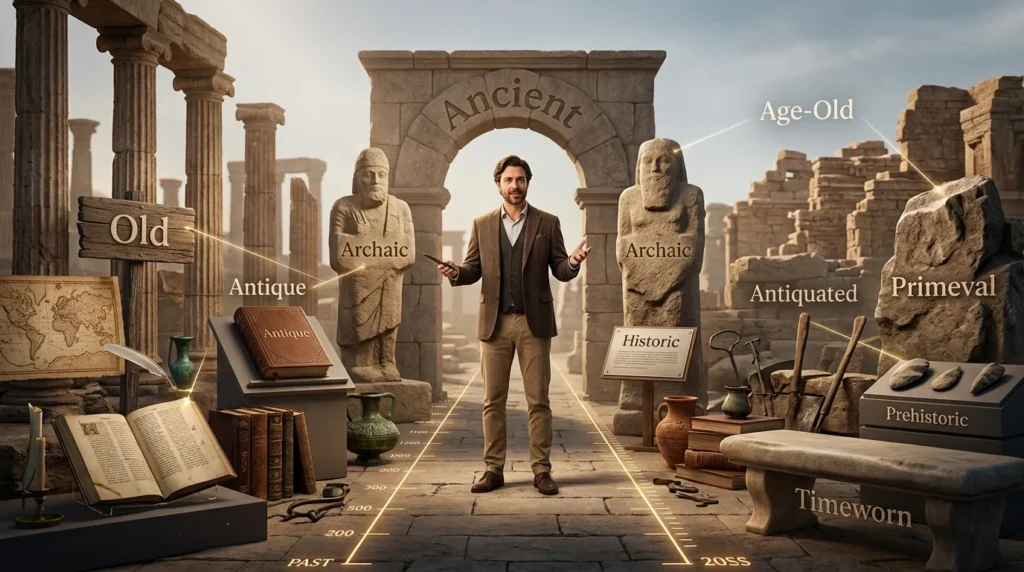
What Does “Ancient” Mean?
“Ancient” generally means very old, especially belonging to a distant period of history.
- The city contains ancient temples.
- Historians studied an ancient civilization.
- The museum displays ancient artifacts.
- The tradition has ancient origins.
- They discovered an ancient manuscript.
The word can refer to objects, civilizations, traditions, buildings, beliefs, languages, documents, customs, and periods of history.
It can also be used informally to describe something that is simply very old:
My phone is ancient.
Here, “ancient” is not being used literally. It means extremely old or outdated.
Common Synonyms for “Ancient”
| Synonym | Best Used For | Example |
|---|---|---|
| Old | General age | An old building |
| Antique | Old objects and collectibles | An antique table |
| Historic | Important past events or places | A historic site |
| Historical | Related to history | A historical document |
| Archaic | Old-fashioned or outdated | An archaic term |
| Age-old | Traditions and practices | An age-old tradition |
| Time-honored | Long-established customs | A time-honored tradition |
| Timeworn | Worn or aged by time | A timeworn building |
| Long-standing | Established for a long time | A long-standing tradition |
| Long-established | Existing for many years | A long-established practice |
| Primordial | Existing from the earliest times | Primordial forces |
| Primeval | Belonging to the earliest period | Primeval forests |
| Prehistoric | Before recorded history | Prehistoric animals |
| Antiquated | Very old and outdated | An antiquated system |
| Obsolete | No longer useful or current | An obsolete technology |
| Bygone | Belonging to the past | A bygone era |
| Former | Existing previously | A former settlement |
| Early | From an early historical period | Early civilizations |
| Medieval | Related to the Middle Ages | Medieval architecture |
| Classical | Related to ancient Greece or Rome | Classical art |
| Antique | Historically old object | Antique furniture |
| Venerable | Old and respected | A venerable institution |
| Hoary | Extremely old or ancient | A hoary legend |
| Immémorial | Existing beyond memory | A tradition of immemorial origin |
| Time-tested | Proven over a long period | A time-tested method |
| Traditional | Passed down over generations | Traditional customs |
| Ancestral | Connected to ancestors | Ancestral traditions |
| Ancestral-era | Related to an earlier generation | Ancestral practices |
| Primitive | Early or undeveloped | Primitive tools |
| Rudimentary | Basic and early in development | Rudimentary technology |
| Fossilized | Extremely old or rigid | Fossilized beliefs |
| Relic-like | Resembling an old surviving object | A relic-like structure |
| Antediluvian | Extremely old or outdated | Antediluvian ideas |
| Elder | Very old or earlier | An elder generation |
| Old-fashioned | Characteristic of an earlier period | Old-fashioned customs |
| Old-world | Characteristic of an earlier culture | Old-world architecture |
| Long-ago | From a distant past | A long-ago kingdom |
| Dated | No longer modern | A dated design |
| Outmoded | No longer fashionable or useful | An outmoded system |
| Extant | Still existing from an earlier time | Extant manuscripts |
Old
Old is the broadest and simplest synonym for “ancient.” It can refer to something that has existed for a long time, but it does not necessarily suggest extreme age.
Examples:
- They live in an old house.
- She found an old book.
- The village has an old church.
“Ancient” generally implies a much greater age than “old.”
Antique
Antique commonly refers to an old object, especially furniture, artwork, jewelry, or collectibles that have historical or aesthetic value.
Examples:
- The shop sells antique furniture.
- She inherited an antique clock.
- The museum contains several antique objects.
“Antique” is more specific than “ancient” and is usually associated with objects rather than civilizations or historical periods.
Historic
Historic means important or significant in history.
Examples:
- They visited a historic building.
- The city is known for its historic landmarks.
- The agreement was a historic achievement.
Something can be historic without being ancient. A building from a few hundred years ago may be historic because of what happened there.
Historical
Historical means related to history or the past.
Examples:
- The researcher examined historical records.
- The museum contains historical documents.
- She is interested in historical architecture.
“Historical” describes a connection to history, while “historic” often emphasizes importance.
Archaic
Archaic describes something belonging to an earlier period or something that is no longer commonly used.
Examples:
- The text contains archaic words.
- Some of these customs now seem archaic.
- The law contains several archaic provisions.
This word is particularly useful for language, customs, systems, and ideas.
Age-Old
Age-old means existing for a very long time, often for generations.
Examples:
- They followed an age-old tradition.
- The community preserved an age-old custom.
- The story is based on an age-old belief.
It works especially well with traditions, practices, wisdom, customs, and beliefs.
Time-Honored
Time-honored describes something respected because it has existed and been followed for a long time.
Examples:
- The ceremony follows a time-honored tradition.
- They use a time-honored method.
- The festival celebrates time-honored customs.
It usually has a positive or respectful tone.
Timeworn
Timeworn describes something that has become worn, faded, or old through long use or exposure to time.
Examples:
- The building had a timeworn appearance.
- He carried a timeworn leather bag.
- The story repeated a timeworn idea.
It can describe both physical objects and ideas that have been repeated for a long time.
Long-Standing
Long-standing means existing or continuing for a long period.
Examples:
- The organization has a long-standing tradition.
- They resolved a long-standing dispute.
- The two companies have a long-standing partnership.
It does not necessarily mean ancient, but it works well when emphasizing duration.
Long-Established
Long-established refers to something that has existed successfully or continuously for a long time.
Examples:
- The city has a long-established cultural tradition.
- It is a long-established institution.
- The company follows a long-established practice.
This is especially useful in professional and formal writing.
Primordial
Primordial means existing from the earliest stage or beginning of something.
Examples:
- The forest contains primordial ecosystems.
- The story explores primordial fears.
- They studied the planet’s primordial conditions.
It is a more sophisticated alternative to “ancient” and often suggests something fundamental or extremely early.
Primeval
Primeval means belonging to the earliest period of the world or Earth’s history.
Examples:
- They explored a primeval forest.
- The novel describes a primeval landscape.
- Scientists studied primeval rocks.
It often creates an image of something extremely old and untouched.
Prehistoric
Prehistoric refers to periods before written historical records existed.
Examples:
- Archaeologists discovered prehistoric tools.
- The museum displays prehistoric fossils.
- Researchers studied prehistoric settlements.
Not everything ancient is prehistoric. Many ancient civilizations left written records, so they are historical rather than prehistoric.
Antiquated
Antiquated means extremely old-fashioned or outdated.
Examples:
- The company uses an antiquated computer system.
- The procedure seems antiquated today.
- They replaced the antiquated equipment.
This word often has a negative meaning because it suggests that something is no longer suitable.
Obsolete
Obsolete means no longer useful, necessary, or current.
Examples:
- The technology is now obsolete.
- The old system became obsolete.
- Several obsolete procedures were removed.
“Obsolete” is about usefulness, not necessarily age. A relatively recent product can become obsolete.
Bygone
Bygone means belonging to a past time that has ended.
Examples:
- The museum recreates a bygone era.
- She enjoys reading about bygone civilizations.
- The town preserves memories of a bygone age.
It has a nostalgic or literary tone.
Former
Former means something that existed or was used previously.
Examples:
- The building was a former palace.
- They explored the former capital.
- The site was once a former settlement.
“Former” does not necessarily mean very old. It simply indicates that something belonged to an earlier period.
Early
Early can describe something from the beginning of a historical, cultural, or developmental period.
Examples:
- The museum displays early examples of pottery.
- Researchers studied early human settlements.
- The region contains early medieval structures.
It is useful when you know the relative period but do not want to imply extreme age.
Medieval
Medieval refers specifically to the Middle Ages, generally the period between antiquity and the early modern era in European history.
Examples:
- They visited a medieval castle.
- The book discusses medieval architecture.
- The city has several medieval structures.
It should not be used as a general synonym for anything old.
Classical
Classical commonly refers to the culture, art, literature, philosophy, and history of ancient Greece and Rome, especially their influential traditions.
Examples:
- She studies classical literature.
- The museum contains classical sculptures.
- The course covers classical philosophy.
“Classical” is more specific than “ancient.”
Venerable
Venerable means old and respected, often because of long history or tradition.
Examples:
- The university is a venerable institution.
- They visited a venerable temple.
- The organization has a venerable history.
It emphasizes respect rather than simply age.
Hoary
Hoary means extremely old, often to the point of being traditional, familiar, or worn by age.
Examples:
- The tale is based on a hoary legend.
- He repeated a hoary old argument.
- The tradition has hoary origins.
It has a literary or somewhat old-fashioned tone.
Traditional
Traditional describes something passed down through generations or associated with established customs.
Examples:
- They follow traditional practices.
- The ceremony includes traditional music.
- The community preserves traditional customs.
A tradition can be relatively recent, so “traditional” does not always mean ancient.
Ancestral
Ancestral refers to something connected with ancestors or earlier generations.
Examples:
- They returned to their ancestral home.
- The community preserves ancestral traditions.
- Researchers studied ancestral customs.
It emphasizes family, heritage, or generations rather than historical age alone.
Primitive
Primitive can describe something belonging to an early stage of development or something simple and undeveloped.
Examples:
- Early humans used primitive tools.
- The settlement had primitive structures.
- They developed a primitive form of technology.
Use this word carefully because it can sound judgmental when applied to cultures or societies.
Rudimentary
Rudimentary means basic, simple, or not fully developed.
Examples:
- The early system was rudimentary.
- They used rudimentary tools.
- The technology was still rudimentary.
It emphasizes simplicity or early development rather than age itself.
Fossilized
Fossilized can describe something extremely old or something that has become fixed and resistant to change.
Examples:
- The organization retained fossilized practices.
- The debate was based on fossilized assumptions.
- Scientists examined fossilized remains.
It can be literal or metaphorical.
Antediluvian
Antediluvian literally refers to the period before the biblical flood and is commonly used humorously or critically to describe something extremely old-fashioned.
Examples:
- The office still uses antediluvian technology.
- His views seem antediluvian.
- The building contains an antediluvian heating system.
It is a strong and often humorous word, so it is not appropriate for every context.
Old-Fashioned
Old-fashioned means characteristic of an earlier time and not modern.
Examples:
- They prefer old-fashioned values.
- The restaurant has an old-fashioned atmosphere.
- She enjoys old-fashioned recipes.
It usually describes style, behavior, ideas, or methods rather than literal extreme age.
Old-World
Old-world refers to qualities associated with earlier European or traditional cultures and styles.
Examples:
- The hotel has old-world charm.
- The building features old-world architecture.
- The restaurant combines modern food with old-world décor.
It is especially common in descriptions of architecture, culture, design, and atmosphere.
Dated
Dated means old-fashioned or no longer modern.
Examples:
- The website has a dated design.
- Some of the language sounds dated.
- The equipment looks dated.
It is useful when something appears old relative to current standards.
Outmoded
Outmoded means no longer suitable, fashionable, or effective because newer approaches have replaced it.
Examples:
- The company abandoned its outmoded procedures.
- The theory is considered outmoded.
- They replaced the outmoded equipment.
It emphasizes outdatedness rather than historical value.
Extant
Extant means still existing, especially something that has survived from an earlier period.
Examples:
- Several extant manuscripts remain.
- The castle is one of the few extant structures from that period.
- Researchers studied the extant records.
This is particularly useful in academic and historical writing.
Synonyms for Ancient in Historical Writing
When writing about history, the best alternatives depend on the specific period and subject.
Useful choices include:
- historic
- historical
- antique
- archaic
- prehistoric
- classical
- medieval
- primeval
- primordial
- bygone
- age-old
- early
- ancestral
For example:
The region contains many ancient structures.
Depending on the evidence, you could write:
The region contains many historic structures.
Or:
The region contains several medieval structures.
Or:
Archaeologists discovered prehistoric structures in the region.
Each word provides different information, so precision matters.
Synonyms for Ancient Traditions
When describing customs, beliefs, or practices that have survived for generations, consider:
- age-old
- time-honored
- traditional
- long-standing
- long-established
- ancestral
- venerable
- historic
Examples:
The community follows an age-old tradition.
The ceremony is based on a time-honored custom.
The community continues its ancestral practices.
These alternatives often sound more natural than simply repeating “ancient.”
Synonyms for Ancient Objects
For old objects, useful alternatives include:
- antique
- historic
- old
- timeworn
- relic
- artifact
- archaic
- dated
For example:
The museum contains ancient objects.
Could become:
The museum contains antique objects.
Or:
The museum contains historic artifacts.
“Artifact” is especially useful when discussing objects created or used by people in the past.
Synonyms for Ancient Civilizations
When discussing civilizations from the distant past, consider:
- early civilizations
- historic civilizations
- classical civilizations
- prehistoric societies
- early cultures
- ancient cultures
- early societies
Examples:
Researchers studied ancient civilizations.
Researchers studied early civilizations.
Researchers studied classical civilizations.
“Classical civilizations” is more specific and often refers to Greece and Rome, while “early civilizations” is broader.
Ancient vs. Old
“Ancient” and “old” are related, but “ancient” generally indicates much greater age.
This is an old house.
The house may be several decades or a century old.
This is an ancient house.
This suggests an extremely old structure, often with historical significance.
Therefore, “old” is broader, while “ancient” is stronger and more specific.
Ancient vs. Antique
“Antique” usually describes an old object that has collectible, artistic, or historical value.
The museum displays an ancient statue.
The store sells an antique table.
An ancient statue may be thousands of years old, while an antique table may be much younger.
Ancient vs. Historic
“Ancient” refers primarily to age.
“Historic” refers primarily to historical importance.
Something can be historic without being ancient.
For example, a building constructed within the last few centuries may be historic because an important event happened there.
Ancient vs. Archaic
“Archaic” often describes something from an earlier period that is no longer commonly used or has become outdated.
The text contains archaic expressions.
“Ancient” simply emphasizes age.
Thus, “archaic” can carry a sense of outdatedness that “ancient” does not necessarily have.
Ancient vs. Prehistoric
“Prehistoric” has a specific historical meaning.
It refers to periods before written records.
“Ancient” includes many societies that had written languages and historical records.
For example, ancient Egypt is generally considered an ancient civilization, while prehistoric human settlements existed before recorded history.
Ancient vs. Antiquated
“Antiquated” usually means outdated or no longer suitable.
The system is antiquated.
This does not necessarily mean the system is historically ancient. It means it is old-fashioned compared with current standards.
Ancient vs. Obsolete
“Obsolete” means no longer useful or current.
Age is not the main issue.
A technology can become obsolete within a few years.
Therefore, “obsolete” should not normally replace “ancient” when describing historical objects or civilizations.
Common Mistakes When Choosing Synonyms for “Ancient”
Using “historic” simply because something is old
Something may be old without being historically significant.
Use “historic” when historical importance is part of the meaning.
Using “prehistoric” for every ancient civilization
Prehistoric specifically refers to periods before written records.
Ancient civilizations such as Egypt and Rome had written histories, so “prehistoric” would be inaccurate in many contexts.
Using “antique” for people or civilizations
“Antique” is generally associated with objects and collectibles.
An “antique chair” is natural, but an “antique civilization” is not usually the best choice.
Using “obsolete” to mean very old
“Obsolete” means no longer useful or current, not simply old.
Using “archaic” as a neutral synonym
“Archaic” can imply that something is outdated or no longer suitable.
If you simply mean extremely old, “ancient” or “age-old” may be better.
Using “primitive” carelessly
“Primitive” can carry negative or judgmental implications when applied to cultures or societies. In historical writing, more precise terms such as “early,” “rudimentary,” or a specific historical period are often preferable.
How to Choose the Right Synonym for “Ancient”
The best synonym depends on what aspect of age you want to emphasize.
Use old for a general reference to age.
Use antique for old objects, furniture, art, or collectibles.
Use historic when something has historical importance.
Use historical when something is related to history.
Use archaic when something belongs to an earlier period or is outdated.
Use age-old for traditions and practices that have existed for generations.
Use time-honored when an old tradition has earned respect.
Use prehistoric for periods before written records.
Use primeval for something belonging to the earliest periods of Earth’s or humanity’s history.
Use primordial for something existing from the earliest beginning.
Use medieval for things associated specifically with the Middle Ages.
Use classical for ancient Greek and Roman culture and its traditions.
Use antiquated or outmoded when something is old-fashioned and no longer suitable.
Use extant when emphasizing that something from the past still survives.
This approach ensures that your word choice communicates more than simple age.
Examples of Synonyms for “Ancient” in Sentences
- The museum displays ancient artifacts.
- The museum displays antique furniture.
- The city contains several historic buildings.
- Researchers discovered prehistoric tools.
- The community follows an age-old tradition.
- The ceremony follows a time-honored custom.
- The document contains archaic language.
- They explored a primeval forest.
- The researchers examined primordial rocks.
- The university is a venerable institution.
- The region has a long-standing cultural tradition.
- The company abandoned its antiquated system.
- The technology is now obsolete.
- The story describes a bygone era.
- The museum preserves extant manuscripts.
- The building has an old-world appearance.
- The village retains its traditional customs.
- The family returned to its ancestral home.
- The text contains several archaic expressions.
- The researchers studied early human settlements.