

Quick Answer
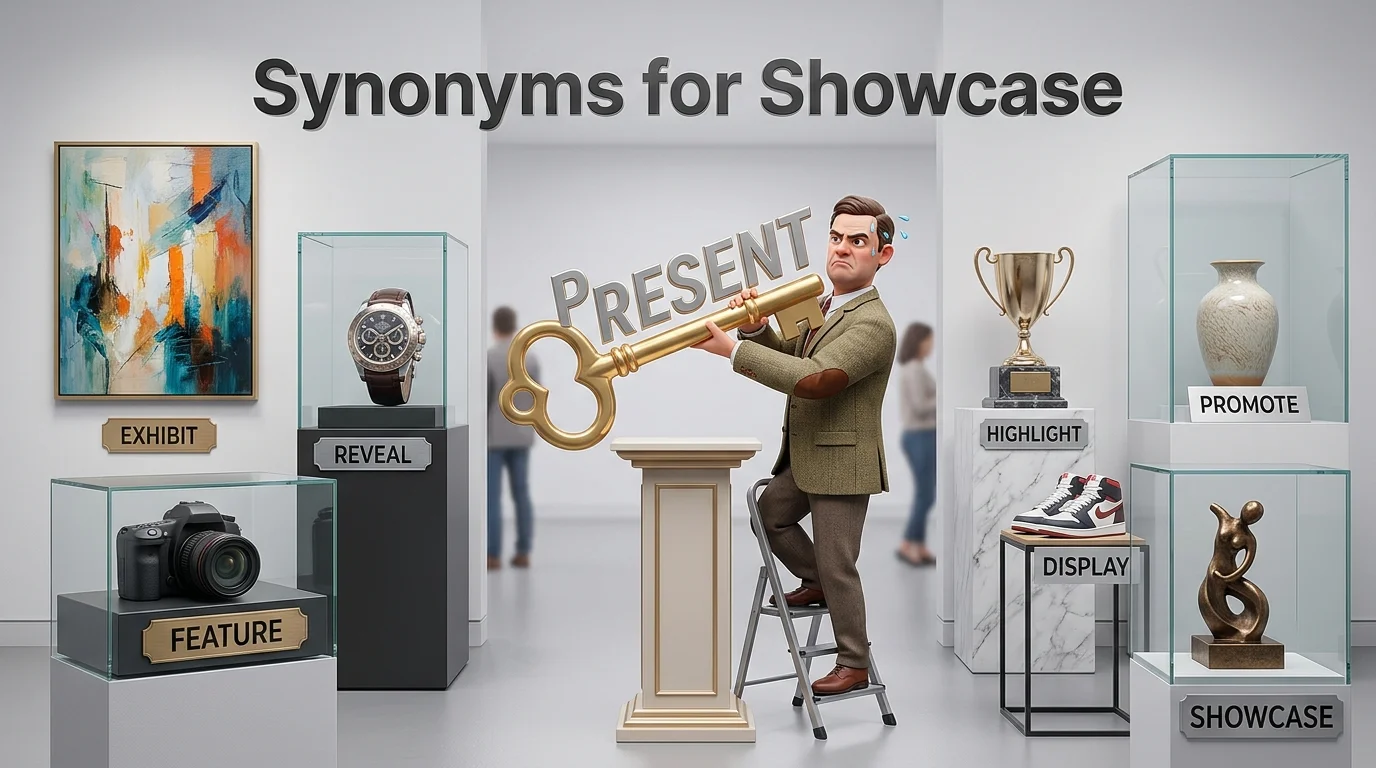
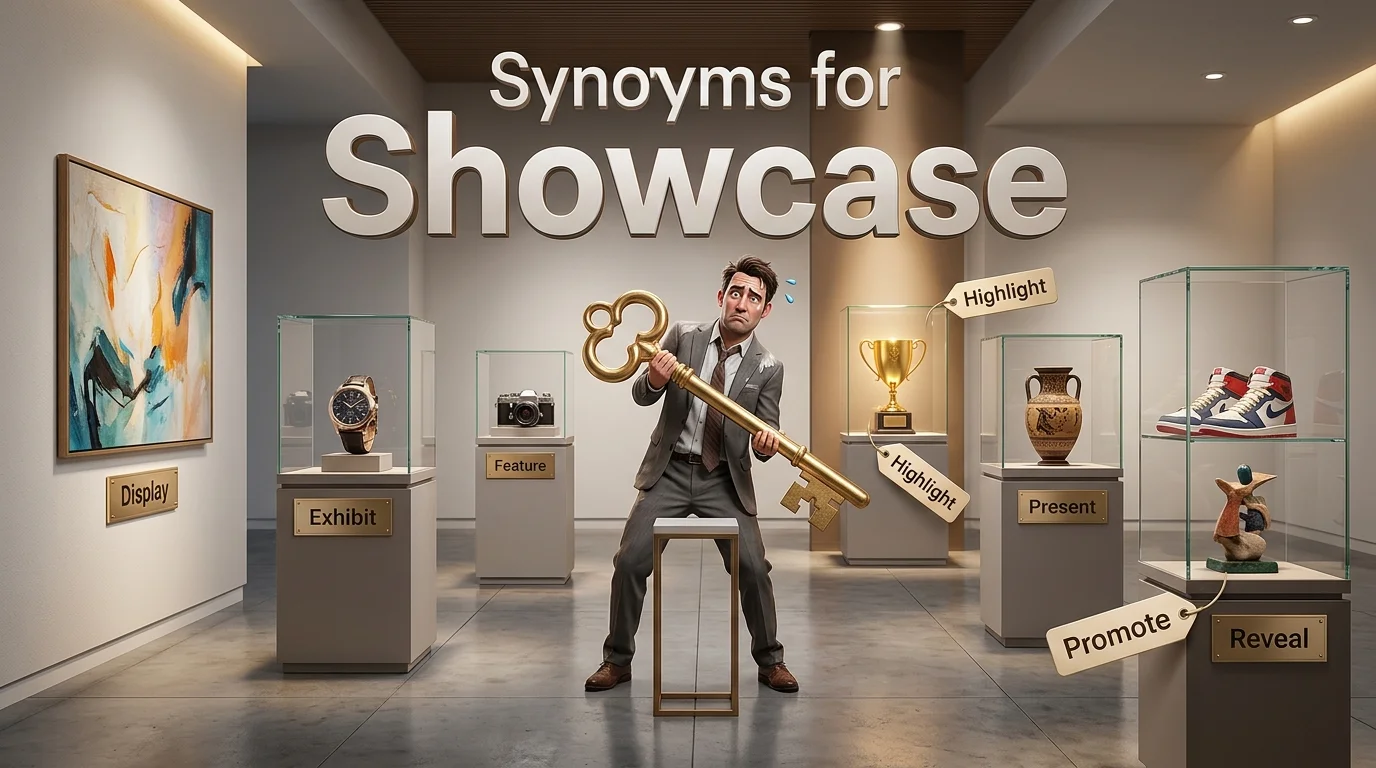
The best synonyms for showcase include display, exhibit, present, feature, highlight, demonstrate, reveal, promote, spotlight, emphasize, introduce, and demonstrate. Display is the closest general alternative, while highlight emphasizes an important quality, feature suggests giving something prominent attention, and demonstrate focuses on showing how something works.
Quick Synonym List
Closest Alternatives
- Display
- Exhibit
- Present
- Feature
- Highlight
- Demonstrate
- Reveal
- Spotlight
- Show
- Introduce
Promotional Alternatives
- Promote
- Advertise
- Publicize
- Market
- Promote
- Spotlight
- Emphasize
Contextual Alternatives
- Illustrate
- Demonstrate
- Represent
- Portray
- Unveil
- Expose
- Bring attention to
- Put on display
- Put forward
- Draw attention to
Closest Synonyms
Display
Meaning: To put something where people can see it.
How it differs: “Display” is probably the broadest and closest alternative to “showcase.” However, showcase often suggests that the thing being displayed is being presented especially attractively or prominently.
Tone: Neutral.
Best for: Products, artwork, information, photographs, objects, and achievements.
Example:
“The store displayed its latest collection.”
Watch out: “Display” does not always imply promotion or emphasis.
Exhibit
Meaning: To show something publicly, especially as part of an exhibition.
How it differs: “Exhibit” is strongly associated with museums, galleries, trade shows, and formal public displays.
Tone: Neutral to formal.
Best for: Artwork, historical objects, scientific material, and exhibitions.
Example:
“The museum exhibits paintings from local artists.”
Watch out: In ordinary conversation, “display” may sound more natural.
Present
Meaning: To show, introduce, or formally give information to an audience.
How it differs: “Present” emphasizes the act of bringing something before an audience rather than simply placing it on display.
Tone: Neutral to formal.
Best for: Ideas, projects, research, presentations, proposals, and products.
Example:
“The team presented its new marketing strategy.”
Watch out: “Present” has several unrelated meanings, so context matters.
Feature
Meaning: To give something a prominent place or special attention.
How it differs: “Feature” is especially useful when something is deliberately selected as an important part of a publication, website, event, or collection.
Tone: Neutral/professional.
Best for: Websites, magazines, advertisements, products, people, and events.
Example:
“The magazine features emerging fashion designers.”
Watch out: “Feature” does not always mean the same thing as physically displaying something.
Highlight
Meaning: To draw attention to something important, attractive, or noteworthy.
How it differs: “Highlight” focuses on importance or a particular quality rather than simply showing something.
Tone: Neutral and professional.
Best for: Achievements, benefits, features, strengths, and important information.
Example:
“The report highlights the company’s recent achievements.”
Watch out: Use “highlight” when emphasis matters.
Demonstrate
Meaning: To show something clearly, often by explaining or performing it.
How it differs: “Demonstrate” often means showing how something works or proving a point.
Tone: Professional/formal.
Best for: Skills, methods, products, processes, and abilities.
Example:
“The engineer demonstrated how the new machine works.”
Watch out: It is not always suitable when you simply mean “display.”
Reveal
Meaning: To make something previously hidden or unknown visible or known.
How it differs: “Reveal” emphasizes discovery or introduction rather than ordinary display.
Tone: Neutral/dramatic.
Best for: New products, information, designs, results, and announcements.
Example:
“The company revealed its latest smartphone.”
Watch out: Something must generally be new, hidden, or previously unknown for “reveal” to be the best choice.
Spotlight
Meaning: To give special attention or prominence to something.
How it differs: “Spotlight” is stronger than ordinary “showcase” when the focus is on drawing public attention.
Tone: Promotional and expressive.
Best for: People, achievements, products, causes, and events.
Example:
“The campaign spotlights small businesses in the community.”
Watch out: It is often more figurative than “display.”
Promotional Alternatives
Promote
Meaning: To actively encourage interest in something.
Example:
“The campaign promotes the company’s new service.”
“Promote” focuses on increasing attention, awareness, or sales rather than merely displaying something.
Advertise
Meaning: To publicly promote a product, service, or event.
Example:
“The company advertised its new collection online.”
Advertising normally has a commercial purpose.
Publicize
Meaning: To make something widely known.
Example:
“The organization publicized its new community program.”
This is particularly useful when the goal is widespread awareness.
Market
Meaning: To promote and sell a product or service to a particular audience.
Example:
“The company markets its products to young professionals.”
“Market” is more commercial and strategic than “showcase.”
Contextual Alternatives
Illustrate
Meaning: To make an idea clear by using an example, image, or demonstration.
Example:
“The chart illustrates the company’s growth.”
Use “illustrate” when the purpose is explanation rather than promotion.
Portray
Meaning: To represent someone or something in a particular way.
Example:
“The documentary portrays the challenges faced by small businesses.”
It is particularly useful for art, writing, film, photography, and media.
Unveil
Meaning: To reveal something new or previously concealed.
Example:
“The designer unveiled the new collection at the event.”
“Unveil” is more dramatic than “showcase.”
Emphasize
Meaning: To give special importance or attention to something.
Example:
“The presentation emphasizes the product’s safety features.”
This is a good choice when the focus is on a specific quality rather than the whole object.
Introduce
Meaning: To present something to people for the first time.
Example:
“The company introduced its latest product to the market.”
Use it when something is new to the audience.
Showcase as a Verb vs. Showcase as a Noun
The word showcase has two important grammatical uses.
Showcase as a Verb
As a verb, showcase means to present something prominently or attractively.
“The website showcases independent artists.”
Possible alternatives include:
- Display
- Feature
- Highlight
- Present
- Exhibit
- Demonstrate
- Promote
- Spotlight
Showcase as a Noun
As a noun, showcase can mean an event, opportunity, or setting where something is presented prominently.
“The festival was a showcase for emerging musicians.”
Possible alternatives include:
- Exhibition
- Presentation
- Display
- Demonstration
- Platform
- Event
- Presentation opportunity
The alternatives are not always interchangeable. A platform emphasizes an opportunity to gain attention, while an exhibition emphasizes a public display.
Synonyms vs. Near Synonyms
| Alternative | Relationship | Can Replace “Showcase”? | Tone | Best Context |
|---|---|---|---|---|
| Display | Close synonym | Usually | Neutral | General display |
| Exhibit | Close/contextual | Often | Formal | Museums and exhibitions |
| Present | Contextual | Often | Professional | Ideas and projects |
| Feature | Close/contextual | Often | Professional | Websites and publications |
| Highlight | Near synonym | Often | Neutral | Important qualities |
| Demonstrate | Contextual | Sometimes | Formal | Skills and processes |
| Reveal | Contextual | Sometimes | Dramatic | New information/products |
| Spotlight | Near synonym | Often | Promotional | Public attention |
| Promote | Related alternative | Sometimes | Commercial | Marketing |
| Advertise | Related alternative | Sometimes | Commercial | Advertising |
| Illustrate | Contextual | Rarely | Academic | Explaining ideas |
| Portray | Contextual | Rarely | Creative | Art and media |
| Unveil | Contextual | Sometimes | Dramatic | New launches |
Comparison Table
| Word/Phrase | Meaning | Tone | Strength | Best Use | Interchangeable? |
|---|---|---|---|---|---|
| Showcase | Present prominently | Positive/promotional | Strong | General presentation | — |
| Display | Put on view | Neutral | Moderate | Objects and information | Often |
| Exhibit | Show publicly | Formal | Moderate | Art and museums | Often |
| Feature | Give prominence | Professional | Strong | Websites and media | Often |
| Highlight | Draw attention to | Neutral | Strong | Qualities and achievements | Often |
| Present | Bring before an audience | Formal/neutral | Moderate | Ideas and projects | Often |
| Demonstrate | Show clearly/how it works | Professional | Specific | Skills and processes | Sometimes |
| Reveal | Make known | Dramatic | Strong | New things | Sometimes |
| Spotlight | Give special attention | Promotional | Strong | People and achievements | Often |
| Promote | Encourage interest | Commercial | Strong | Products and services | Sometimes |
| Advertise | Promote publicly | Commercial | Strong | Sales and marketing | Rarely |
| Unveil | Reveal something new | Dramatic | Strong | Launches | Sometimes |
How to Choose the Right Alternative
Choose display when you simply mean putting something where people can see it.
Choose feature when something receives a prominent position in a website, publication, event, or collection.
Choose highlight when you want to draw attention to a particular quality, achievement, or detail.
Choose demonstrate when you are showing how something works or proving a point.
Choose reveal when the information or product was previously unknown.
Choose spotlight when you want to emphasize someone or something and attract public attention.
Choose promote when the purpose is to generate interest, awareness, or sales.
Choose exhibit for formal public displays, especially in museums, galleries, and exhibitions.
Choose unveil when introducing something new in a dramatic or public way.
Sentence Transformations
Example 1
Original:
“The website showcases new artists.”
Better Alternative:
“The website features new artists.”
Why:
“Features” naturally communicates that the artists receive prominent placement on the website.
Example 2
Original:
“The museum showcases ancient artifacts.”
Better Alternative:
“The museum exhibits ancient artifacts.”
Why:
“Exhibits” is especially natural for museums and formal collections.
Example 3
Original:
“The presentation showcases the product’s main benefits.”
Better Alternative:
“The presentation highlights the product’s main benefits.”
Why:
“Highlights” emphasizes specific advantages.
Example 4
Original:
“The engineer showcased the machine.”
Better Alternative:
“The engineer demonstrated how the machine works.”
Why:
“Demonstrated” is more precise because the engineer is showing the machine’s operation.
Example 5
Original:
“The company showcased its new phone.”
Better Alternative:
“The company unveiled its new phone.”
Why:
“Unveiled” suggests that the phone is being introduced publicly for the first time.
Example 6
Original:
“The campaign showcases local businesses.”
Better Alternative:
“The campaign spotlights local businesses.”
Why:
“Spotlights” emphasizes giving these businesses special public attention.
Example 7
Original:
“The store showcases its best products.”
Better Alternative:
“The store displays its best products.”
Why:
“Displays” is the straightforward choice when products are physically arranged for customers to see.
Example 8
Original:
“The company showcases its new service to customers.”
Better Alternative:
“The company promotes its new service to customers.”
Why:
“Promotes” is better if the purpose is encouraging customer interest rather than simply showing the service.
Common Mistakes
1. Treating “showcase” and “display” as identical
They are close, but “showcase” often suggests deliberate presentation of something’s best or most attractive qualities.
2. Using “reveal” for something already public
“Reveal” normally suggests that something was previously unknown or hidden.
3. Using “advertise” for every type of presentation
An art gallery may showcase paintings without advertising them. “Advertise” specifically involves promotion or publicity.
4. Using “demonstrate” when nothing is being explained
A product can be displayed without anyone demonstrating how it works.
5. Confusing “feature” with “showcase”
“Feature” often means giving something a prominent place. It does not necessarily imply a special promotional presentation.
6. Using “portray” for physical displays
“Portray” generally concerns representation, especially in art, literature, film, photography, or media.
7. Using “unveil” for ordinary displays
“Unveil” has a sense of novelty or revelation. It is not the best choice for something that has been publicly available for months.
8. Choosing a synonym only because it sounds sophisticated
Words such as “unveil,” “portray,” and “publicize” should not replace “showcase” unless their specific meanings fit.
Grammar and Usage
Showcase can function as both a verb and a noun.
As a verb:
“The exhibition showcases local artists.”
The structure is usually:
showcase + object
“The website showcases its best content.”
As a noun:
“The event was a showcase for young musicians.”
The noun often appears with for when describing what or whom the event presents:
“The festival was a showcase for emerging talent.”
Another common structure is:
“a showcase of + noun”
For example:
“The exhibition was a showcase of modern design.”
The past tense is showcased, and the present participle is showcasing.
“The company showcased its latest technology.”
“The event is showcasing local talent.”
When Not to Use an Alternative
Sometimes showcase is already the most accurate choice.
Keep “showcase” when you mean that something is being presented prominently, attractively, or specifically to emphasize its strengths.
For example:
“The portfolio showcases her strongest design work.”
“Display” would still be understandable, but it loses some of the sense that the strongest work has been deliberately selected and presented.
Likewise, promote is not always appropriate. Promotion usually aims to create awareness or sales, while showcasing can simply involve presenting something prominently.
Do not use reveal unless the audience is learning something new.
Do not use demonstrate unless something is being shown clearly, often through action or explanation.
The original word is often better when its full meaning fits.
Writing Tips
A useful way to avoid repetition is to identify why something is being shown.
If you simply put it on view, use display.
If you give it a prominent position, use feature.
If you emphasize one quality, use highlight.
If you explain how it works, use demonstrate.
If you make something previously unknown public, use reveal or unveil.
If your goal is marketing, consider promote or advertise.
This approach creates more precise writing than randomly replacing “showcase” with words from a thesaurus.
Related Questions
What is another word for showcase?
Common alternatives include display, exhibit, feature, highlight, present, demonstrate, reveal, spotlight, promote, and unveil. The best choice depends on the context.
What is a formal synonym for showcase?
Exhibit, present, demonstrate, highlight, and feature can work in formal contexts, depending on what is being shown and why.
What is a professional synonym for showcase?
In professional writing, feature, highlight, present, demonstrate, and display are especially useful.
What is a synonym for showcase in marketing?
Useful choices include promote, advertise, feature, highlight, spotlight, and present. “Promote” is particularly suitable when the goal is generating interest or sales.
Is “display” the same as “showcase”?
Not exactly. “Display” simply means putting something where it can be seen. “Showcase” often adds the idea of presenting something prominently or emphasizing its best qualities.
What is the difference between “showcase” and “highlight”?
“Showcase” usually means presenting something prominently, while “highlight” means drawing particular attention to an important feature, quality, or achievement.
What is a synonym for showcase in a resume?
Depending on the sentence, useful choices include demonstrate, highlight, present, feature, and display.