
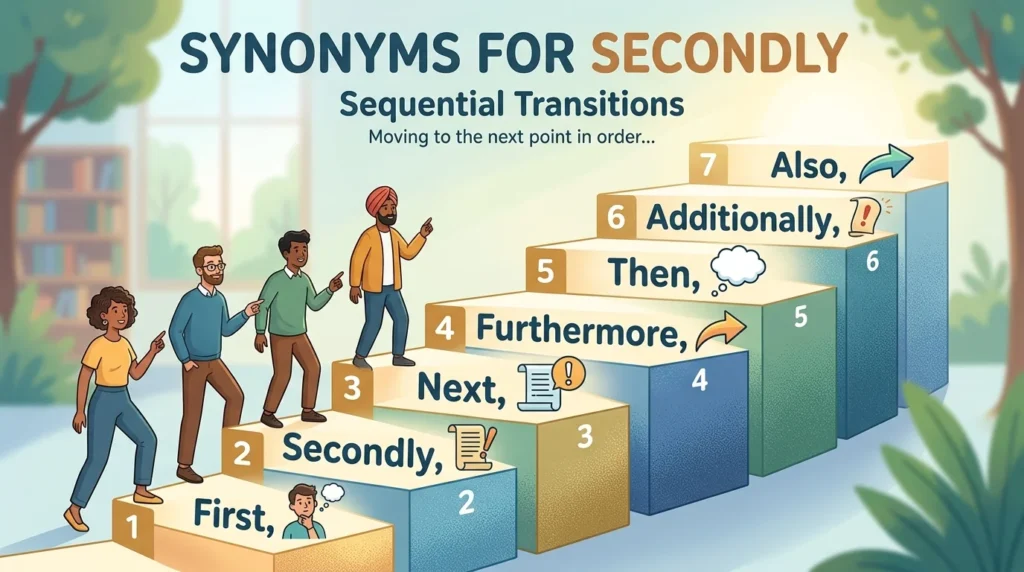
Quick Synonym List
For a second point in a list
- second
- next
- in the second place
- second of all
- another point is
- another consideration is
- the second point is
For sequence
- next
- then
- afterward
- subsequently
- following that
- after that
- thereafter
- later
For adding another idea
- additionally
- also
- furthermore
- moreover
- in addition
- besides
- as well
- another point is
- another consideration is
Formal alternatives
- second
- in the second place
- subsequently
- additionally
- furthermore
- moreover
- in addition
- another consideration is
Natural conversational alternatives
- next
- then
- also
- another thing is
- another point is
- besides
- on top of that
Key distinction: Secondly specifically signals that you are presenting the second item in an ordered series. Words such as furthermore and moreover add information but do not necessarily indicate that the idea is number two.
What Does “Secondly” Mean?
Secondly is an adverb used to introduce the second point, reason, argument, or item in an ordered list.
For example:
Firstly, the plan is expensive. Secondly, it would take too long.
Here, secondly tells the reader that the writer is moving from the first point to the second.
It is especially common in:
- essays
- speeches
- presentations
- formal arguments
- reports
- structured explanations
- academic writing
The word usually appears alongside firstly or first.
Example
Firstly, we need more information. Secondly, we need additional funding. Finally, we need more time.
The sequence is:
- Firstly
- Secondly
- Finally
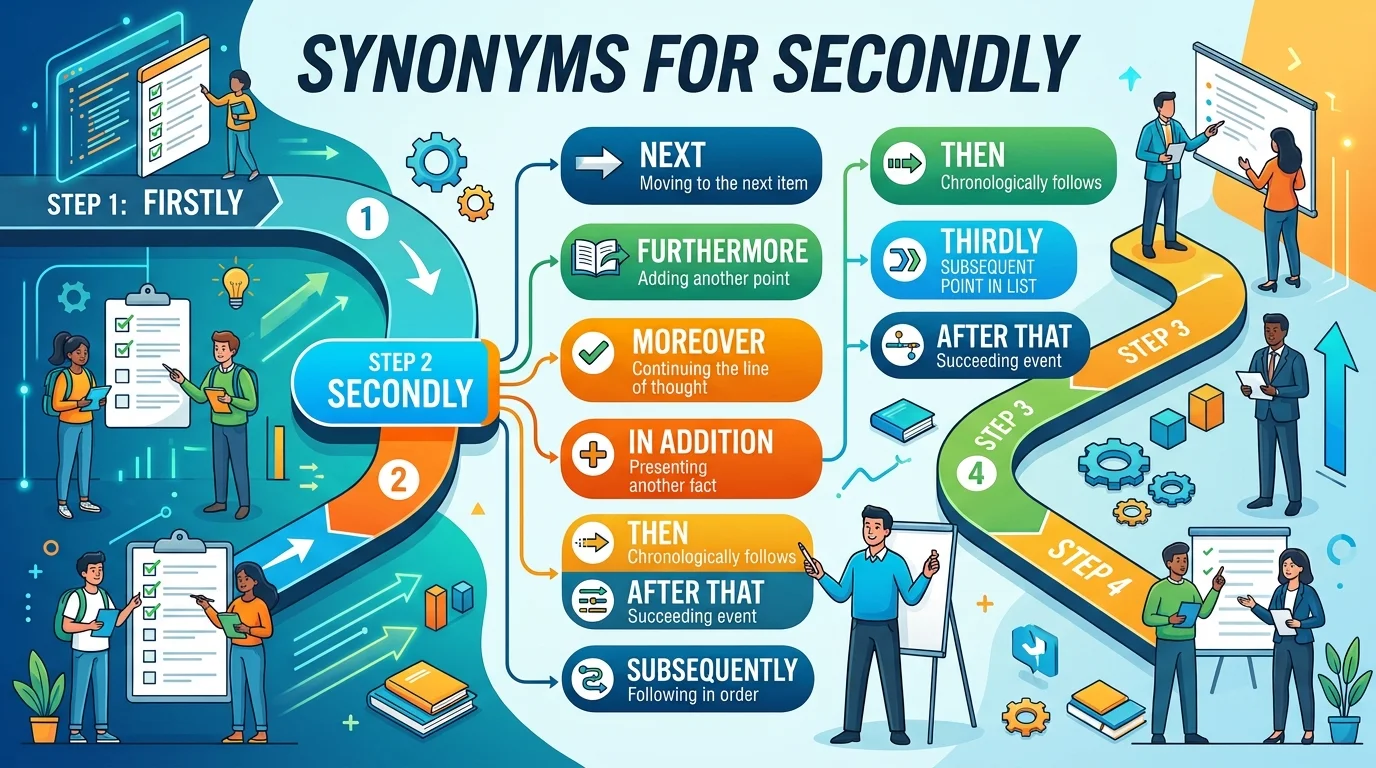
Is “Secondly” a Good Word to Use?
Yes. Secondly is grammatically correct and widely understood.
However, it is not always the most natural choice.
In many sentences, second, next, or simply a new paragraph with a clear transition works better.
Compare:
Firstly, the product is affordable. Secondly, it is easy to use. Thirdly, it is durable.
with:
First, the product is affordable. Second, it is easy to use. Third, it is durable.
The second version is shorter and often sounds more direct.
For conversational English:
First, let’s discuss the cost. Next, we’ll look at quality.
This sounds more natural than:
Firstly, let’s discuss the cost. Secondly, we’ll look at quality.
So the best alternative depends on register, structure, and meaning.
The Best Synonyms for Secondly
1. Second
Second is often the simplest and most direct replacement for secondly when introducing the second point.
- Meaning: the second item in an ordered sequence
- Tone: neutral
- Best for: essays, presentations, lists, arguments
- Interchangeability: very high
Example
First, the project is expensive. Second, it requires more staff.
This is concise and natural.
Second vs. Secondly
Firstly, the plan is risky. Secondly, it is expensive.
First, the plan is risky. Second, it is expensive.
Both are correct. Second is generally more concise.
2. Next
Next is one of the most natural alternatives when you are moving from one point or step to another.
- Meaning: following the current item or step
- Tone: neutral
- Best for: instructions, presentations, explanations, conversations
- Interchangeability: high when sequence matters
Example
First, check the settings. Next, restart the device.
Unlike secondly, next does not necessarily mean exactly the second item. It simply indicates what follows.
3. Then
Then indicates what happens or comes after something else.
- Meaning: after that; following the previous step
- Tone: neutral
- Best for: instructions, narratives, explanations
- Interchangeability: moderate
Example
First, mix the ingredients. Then, place the mixture in the oven.
Then focuses on sequence, not on numbering an argument.
4. In the Second Place
In the second place is a formal expression meaning as the second point or consideration.
Example
In the first place, the proposal is expensive. In the second place, it would require additional staff.
It can replace secondly in formal argumentative writing, although it may sound somewhat old-fashioned or formal in modern everyday English.
5. Second of All
Second of all introduces the second point in an informal or conversational list.
Example
First of all, we need to understand the problem. Second of all, we need to find a solution.
It is natural in speech but usually less suitable than second in polished academic writing.
6. Additionally
Additionally means that you are adding another fact, reason, or piece of information.
Example
The software is affordable. Additionally, it is easy to use.
It can sometimes replace secondly, but the meaning changes slightly.
Secondly = this is point number two.
Additionally = here is another piece of information.
If the order matters, second is more precise.
7. Furthermore
Furthermore introduces additional information that strengthens or develops the previous point.
Example
The policy would be expensive. Furthermore, it could be difficult to implement.
It is particularly common in:
- formal writing
- academic writing
- reports
- analytical essays
It is not a direct synonym for secondly because it does not necessarily identify the second point.
8. Moreover
Moreover adds another point, often one that reinforces the argument.
Example
The proposal is costly. Moreover, it offers few clear benefits.
It can be useful when the second idea provides additional support for the argument.
Secondly vs. Moreover
Secondly, the proposal is expensive.
simply marks the second point.
Moreover, the proposal is expensive.
adds a supporting point without saying it is number two.
9. In Addition
In addition is a clear and flexible way to introduce another idea.
Example
The building is centrally located. In addition, it has excellent public transport connections.
It is especially useful when you want to add information without emphasizing a numbered sequence.
10. Also
Also is a simple way to add another point.
Example
The phone is affordable. It is also easy to use.
It is more conversational and less formal than secondly, furthermore, or moreover.
Do not use also if the order of your points is important.
11. Another Point Is
Another point is explicitly tells the reader that you are moving to another idea.
Example
Another point is that the proposal would require additional funding.
This is useful when you want to avoid repetitive numbered transitions.
12. Another Consideration Is
Another consideration is works especially well in analytical and professional writing.
Example
Another consideration is the project’s long-term cost.
It is useful when presenting several factors rather than a simple numbered list.
13. Subsequently
Subsequently means afterward or later.
Example
The team completed the initial review and subsequently revised the proposal.
This is not normally a direct replacement for secondly. It indicates time or sequence, not the second argument in a list.
14. After That
After that is a natural phrase for describing sequence.
Example
First, submit the form. After that, wait for confirmation.
It is especially useful for instructions and step-by-step explanations.
15. Following That
Following that means after that event or step.
Example
We reviewed the results. Following that, we discussed possible solutions.
This is more formal than simply saying then.
16. Thereafter
Thereafter means after that time or event.
Example
The contract was signed, and the company thereafter began implementation.
It is formal and generally relates to time or subsequent action, not the second point of an argument.
17. Besides
Besides can introduce an additional reason or consideration.
Example
We should not buy the car. Besides, we cannot afford it.
It is more conversational than secondly and can sometimes suggest that the new point is an additional argument.
18. As Well
As well adds another item or fact.
Example:
The course teaches grammar and pronunciation as well.
It usually works better inside a sentence than as a formal paragraph transition.
19. On Top of That
On top of that is an informal expression used to add another point, often one that makes a situation more significant.
Example:
The apartment is expensive, and it’s far from work on top of that.
It is natural in conversation but generally too informal for academic essays.
Secondly by Context
Secondly in Essays
In essays, second, secondly, another point, and in addition can all work.
Traditional structure
Firstly, the policy could reduce costs. Secondly, it could improve efficiency. Finally, it could increase productivity.
More concise structure
First, the policy could reduce costs. Second, it could improve efficiency. Finally, it could increase productivity.
Less rigid structure
The policy could reduce costs. Another benefit is that it could improve efficiency. It could also increase productivity.
The last version avoids making the essay sound like a rigid numbered list.
Secondly in Academic Writing
Academic writing often benefits from precise transitions rather than excessive sequencing words.
Useful alternatives include:
- second
- additionally
- furthermore
- moreover
- in addition
- another consideration is
- another factor is
- a second consideration is
Example
Secondly, the study has several limitations.
Possible rewrite:
A second limitation is the small sample size.
This can be stronger because it identifies what the second point actually is.
Secondly in Professional Writing
In reports, proposals, and workplace documents, consider:
- second
- another consideration
- additionally
- in addition
- a second issue
- another factor
- another point
Example
Secondly, the proposed system would require staff training.
Professional alternative:
A second consideration is the staff training required for the proposed system.
This version is more specific.
Secondly in Presentations
For spoken presentations, second and next are usually easy for listeners to follow.
Example
First, let’s look at the problem. Second, we’ll examine the causes. Finally, we’ll discuss possible solutions.
Or:
First, let’s look at the problem. Next, we’ll examine the causes. Finally, we’ll discuss possible solutions.
Next can sound more conversational and natural when guiding an audience through a presentation.
Secondly in Instructions
Use next, then, or after that when explaining a process.
First, open the application. Secondly, enter your password.
A more natural instructional version is:
First, open the application. Next, enter your password.
Or:
First, open the application. Then, enter your password.
The reason is that instructions usually describe steps, not numbered arguments.
Secondly in Debate or Argument
When presenting arguments, second, secondly, and another point can all work.
Example
First, the proposal is expensive. Second, it would take years to implement.
If the second argument strengthens the first:
First, the proposal is expensive. Furthermore, it would take years to implement.
The choice depends on whether you want to emphasize order or additional support.
Formal Alternatives to Secondly
For formal writing, useful options include:
- second
- in the second place
- a second consideration is
- another consideration is
- additionally
- furthermore
- moreover
- in addition
- a second point is
- a second factor is
Best practice
Do not automatically choose the longest expression.
Second, the policy is expensive.
is usually clearer than:
In the second place, it should be noted that the policy is expensive.
Formal writing should be precise, not unnecessarily complicated.
Casual Alternatives to Secondly
For casual conversation, use:
- second
- next
- then
- also
- another thing is
- another point is
- besides
- on top of that
- and there’s also…
Example
First, the hotel is expensive. Secondly, it’s far from downtown.
Casual:
First, the hotel is expensive. Plus, it’s far from downtown.
Or:
First, the hotel is expensive. And it’s far from downtown, too.
Secondly vs. Second
These two are very close.
| Secondly | Second |
|---|---|
| Adverb | Adverb |
| Marks the second point | Marks the second point |
| Slightly more formal | More concise |
| Common in structured arguments | Common in speech and writing |
| Often paired with firstly | Often paired with first |
Example
Firstly, the service is slow. Secondly, it is expensive.
First, the service is slow. Second, it is expensive.
Both are correct.
For concise modern prose, first / second / third is often preferable.
Secondly vs. Next
Secondly identifies the second item.
Next identifies what comes after the current item.
First, collect the data. Secondly, analyze it.
This works as a numbered sequence.
First, collect the data. Next, analyze it.
This sounds more natural for instructions or a process.
Secondly vs. Then
Then focuses on sequence.
First, save the document. Then, close the program.
It does not necessarily indicate that the action is the second of a numbered list.
Secondly vs. Furthermore
These words perform different jobs.
Secondly = introduces point number two.
Furthermore = adds supporting information.
Compare:
Secondly, the plan is expensive.
Furthermore, the plan is expensive.
The first explicitly establishes order. The second simply adds information.
Secondly vs. Moreover
Moreover adds another argument, often with emphasis.
Secondly, the proposal lacks sufficient evidence.
Moreover, the proposal lacks sufficient evidence.
The first is a sequence marker. The second is an additive transition.
Secondly vs. Additionally
Additionally means also or in addition.
Secondly, the software requires regular maintenance.
Additionally, the software requires regular maintenance.
The first says this is the second point. The second simply adds another fact.
Comparison Table
| Alternative | Main function | Tone | Best use | Direct synonym? |
|---|---|---|---|---|
| Second | Marks point #2 | Neutral | Lists, essays, presentations | Yes |
| Next | Shows what follows | Neutral | Instructions, processes | Often |
| Then | Shows sequence | Neutral | Instructions, narratives | Sometimes |
| In the second place | Marks second consideration | Formal | Formal arguments | Yes |
| Second of all | Marks second point | Informal | Conversation | Yes |
| Additionally | Adds information | Formal/neutral | Reports, essays | Contextual |
| Furthermore | Adds supporting information | Formal | Academic/professional | Contextual |
| Moreover | Adds/reinforces a point | Formal | Arguments, essays | Contextual |
| In addition | Adds information | Neutral/formal | General writing | Contextual |
| Also | Adds information | Neutral | Everyday writing | Contextual |
| Another point is | Introduces another idea | Neutral | Essays, explanations | Contextual |
| Another consideration is | Introduces another factor | Formal | Analysis, business | Contextual |
| Subsequently | Indicates later action | Formal | Chronological writing | No |
| After that | Indicates next step | Neutral | Instructions | No |
| Besides | Adds another reason | Conversational | Arguments, conversation | Contextual |
| On top of that | Adds another point | Informal | Conversation | Contextual |
Sentence Transformations
1. Concise essay style
Original:
Firstly, the plan is expensive. Secondly, it is difficult to implement.
Better alternative:
First, the plan is expensive. Second, it is difficult to implement.
Why: Second is shorter while preserving the numbered structure.
2. Instructions
Original:
Firstly, open the application. Secondly, select your account.
Better alternative:
First, open the application. Next, select your account.
Why: Next is more natural for sequential instructions.
3. Adding information
Original:
Secondly, the building is difficult to access.
Alternative:
In addition, the building is difficult to access.
Why: Use in addition if you are adding another fact rather than emphasizing that it is specifically point two.
4. Academic argument
Original:
Secondly, the study has a small sample size.
Alternative:
A second limitation is the study’s small sample size.
Why: The rewrite names the category of the point instead of relying on a generic transition.
5. Professional writing
Original:
Secondly, the project will require additional staff.
Alternative:
A second consideration is the need for additional staff.
Why: This sounds structured and professional while making the point more specific.
6. Supporting argument
Original:
Secondly, the policy could increase costs.
Alternative:
Furthermore, the policy could increase costs.
Why: Furthermore works when the purpose is to add another supporting argument rather than number the point.
7. Casual conversation
Original:
Firstly, the restaurant is expensive. Secondly, it is far away.
Alternative:
First, the restaurant is expensive. Plus, it’s far away.
Why: Plus is natural in casual speech, while secondly sounds more structured.
8. Step-by-step process
Original:
Firstly, upload the file. Secondly, check the information.
Alternative:
First, upload the file. Then, check the information.
Why: Then naturally expresses what happens after the first step.
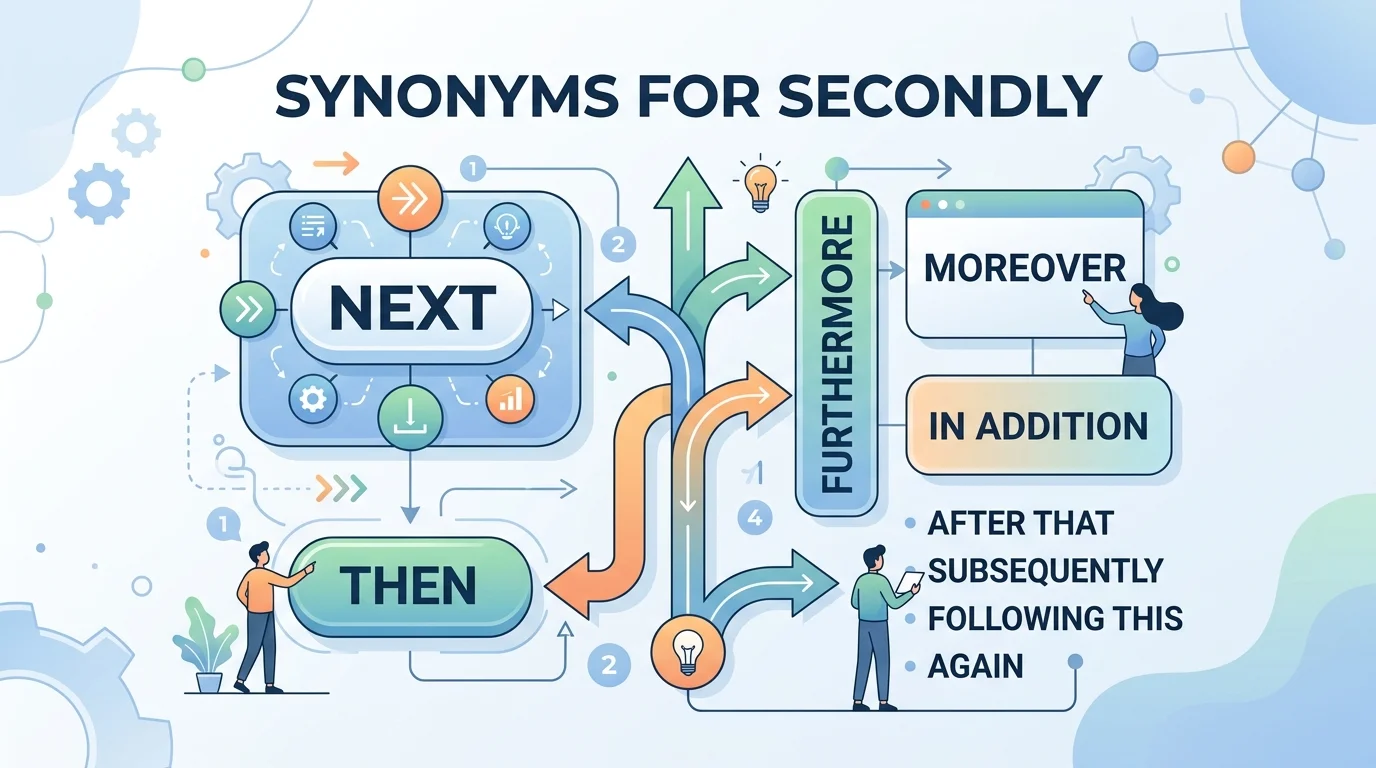
Grammar and Usage
“Secondly” Is an Adverb
Secondly functions as a sentence-level transition.
Common patterns include:
Firstly, X. Secondly, Y.
First, X. Second, Y.
Firstly, X; secondly, Y.
The proposal has two major problems. Secondly, it is too expensive.
The word commonly appears at the beginning of a sentence, followed by a comma.
“Firstly” and “Secondly”
A traditional sequence is:
- firstly
- secondly
- thirdly
- finally
Example:
Firstly, the plan is expensive. Secondly, it is complicated. Thirdly, it is difficult to maintain. Finally, it may not solve the underlying problem.
A more concise modern sequence is:
- first
- second
- third
- finally
Example:
First, the plan is expensive. Second, it is complicated. Third, it is difficult to maintain. Finally, it may not solve the underlying problem.
Both structures are grammatical.
Do You Need “Thirdly” After “Secondly”?
No.
You can use:
First, the system is expensive. Second, it is difficult to maintain. Finally, it is unreliable.
There is no requirement to use thirdly simply because you used secondly.
You can also avoid numbered transitions entirely:
The system is expensive, difficult to maintain, and unreliable.
Choose the structure that best fits the writing.
“Secondly” vs. “Secondarily”
Do not treat secondarily as a simple synonym for secondly.
Secondly = as the second point in a sequence.
Secondarily = in a secondary or less important way.
Example
Secondly, the proposal is expensive.
versus:
The issue is primarily financial and secondarily operational.
The meanings are different.
Common Mistakes
1. Using “secondly” when you mean “next”
For a process, next or then may be more natural.
First, open the file. Next, edit the document.
2. Using “furthermore” when the order matters
If you specifically mean point number two, use second or secondly.
3. Assuming “secondly” means “also”
It does not simply mean also. It indicates position in a sequence.
4. Using “secondly” for every additional point
If you have not established an ordered list, additionally, also, or in addition may be more appropriate.
5. Overusing “firstly, secondly, thirdly”
A long series of numbered transitions can make prose sound mechanical.
Instead, use descriptive transitions:
Another concern is…
A related issue is…
A final consideration is…
6. Using “secondarily” as a replacement
Secondarily has a different meaning related to secondary importance or status.
7. Assuming formal means better
Secondly is perfectly acceptable, but second, next, or then may produce clearer, more natural writing.
When “Secondly” Is the Best Choice
Keep secondly when you specifically want to make the order of your points obvious.
Formal argument
Firstly, the evidence is limited. Secondly, the methodology is unclear.
Structured presentation
Firstly, I’ll explain the problem. Secondly, I’ll discuss the causes.
Explicit list
The proposal has three main weaknesses. Firstly, it is expensive. Secondly, it is complex. Thirdly, it is difficult to maintain.
In these cases, the numbered structure is useful.
When to Avoid “Secondly”
Consider another transition when:
- you are giving instructions
- you are telling a story
- you are describing a process
- the points are not actually numbered
- the writing sounds repetitive
- you want to add supporting information rather than mark sequence
Example
Instead of:
Firstly, open the settings. Secondly, choose Privacy. Thirdly, select Notifications.
Try:
First, open the settings. Next, choose Privacy. Then, select Notifications.
The second version better matches the procedural nature of the instructions.
Which Synonym Should You Choose?
For the exact second point
Use second or secondly.
For the next step
Use next.
For what happens afterward
Use then or after that.
For an additional idea
Use additionally or in addition.
For another supporting argument
Use furthermore or moreover.
For another factor in an analysis
Use another consideration is.
For a formal second consideration
Use in the second place or a second consideration is.
For casual conversation
Use next, then, also, plus, or another thing is.
For chronological writing
Use subsequently, afterward, following that, or thereafter, depending on the time relationship.