

Quick Synonym List
Here are useful alternatives to obsession, grouped by meaning:
Closest and most general
- fixation
- preoccupation
- compulsion
- fixation
- fascination
- engrossment
- mania
- passion
- attachment
Strong interest or fascination
- fascination
- enthusiasm
- interest
- captivation
- engrossment
- absorption
- devotion
- enthusiasm
Romantic or emotional obsession
- infatuation
- enamoration
- passion
- attachment
- adoration
- longing
- desire
- love
Compulsive or unhealthy fixation
- compulsion
- addiction
- fixation
- mania
- dependency
- preoccupation
- craving
- dependence
Persistent thoughts
- preoccupation
- fixation
- rumination
- dwelling
- concern
- absorption
- brooding
Informal alternatives
- fixation
- thing
- craze
- fascination
- fixation
- addiction
- crush
- mania
Important: These words are not interchangeable in every sentence. Fascination can be positive, while obsession often suggests excessive or unhealthy intensity. Compulsion emphasizes an irresistible urge, while preoccupation emphasizes persistent attention.
What Does “Obsession” Mean?
Obsession is an intense, persistent preoccupation with a person, idea, activity, object, or concern.
It can describe a strong interest in everyday language:
- Her obsession with photography led her to start a business.
It can also describe persistent or intrusive thoughts or urges, especially in psychological contexts:
- He experienced obsessive thoughts about contamination.
The word can therefore range from strong enthusiasm to disturbing or compulsive preoccupation, depending on context.
Main meanings of obsession
| Meaning | Useful alternatives |
|---|---|
| Intense interest | fascination, passion, enthusiasm |
| Persistent focus | fixation, preoccupation, absorption |
| Romantic intensity | infatuation, passion, attachment |
| Compulsive urge | compulsion, craving, dependency |
| Unhealthy fixation | mania, fixation, addiction |
| Repetitive thinking | rumination, dwelling, brooding |
The key is to choose a word that preserves the original meaning rather than simply replacing obsession with a more unusual word.
The Best Synonyms for Obsession
1. Fixation
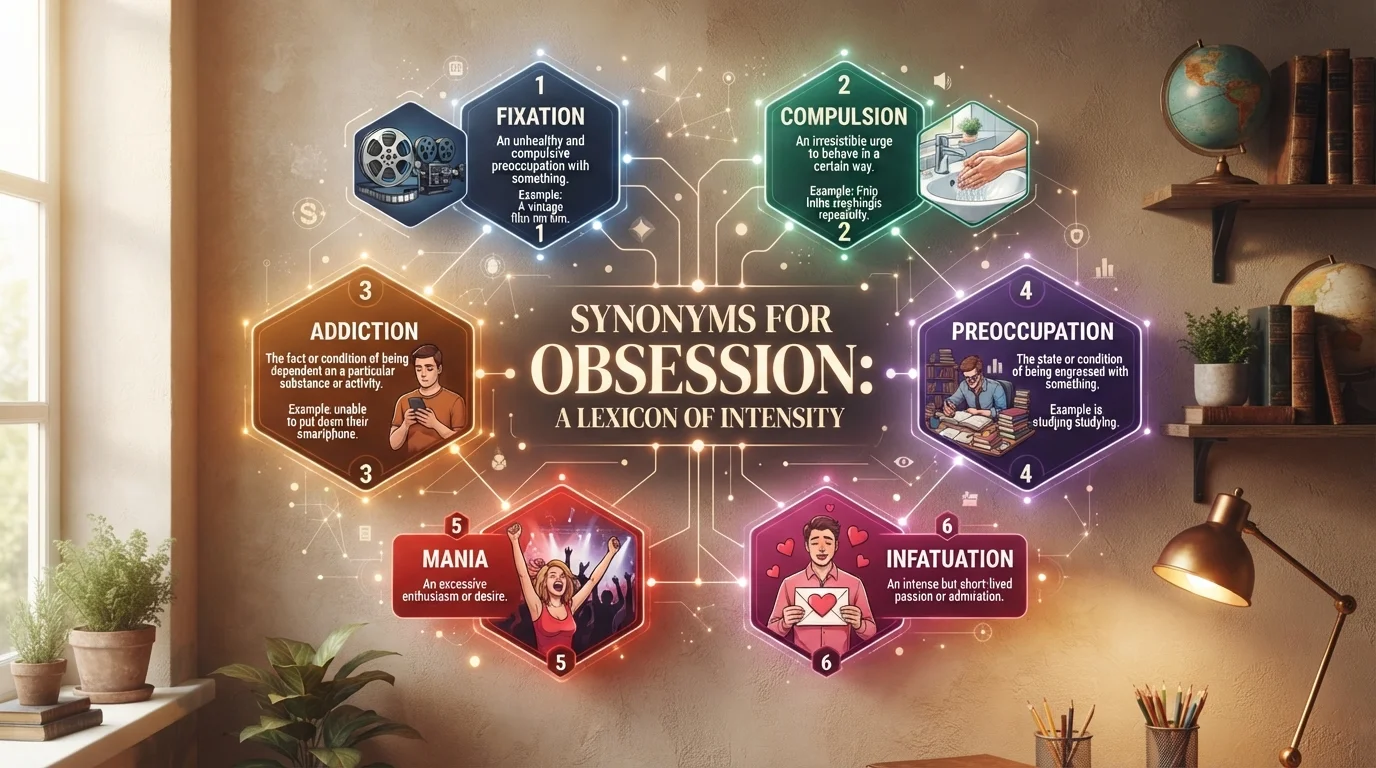
Fixation is one of the closest alternatives to obsession. It describes an unusually strong or persistent focus on something.
- Meaning: an intense and sustained focus
- Tone: neutral to negative
- Best for: people, ideas, goals, objects, concerns
- Interchangeability: usually interchangeable in many contexts
Example:
His fixation on perfection made it difficult for him to finish projects.
Obsession vs. fixation:
Fixation often sounds more focused and narrower. Obsession can describe a broader pattern of intense interest or preoccupation.
2. Preoccupation
Preoccupation means that something occupies much of a person’s attention or thoughts.
- Meaning: persistent concern or mental focus
- Tone: neutral to formal
- Best for: thoughts, worries, concerns, intellectual interests
- Interchangeability: context-dependent
Example:
Her preoccupation with the deadline prevented her from relaxing.
This is often a better choice than obsession when you want to sound measured rather than dramatic.
3. Compulsion
Compulsion refers to a powerful urge to do something, often despite knowing that you do not want to do it.
- Meaning: an irresistible or difficult-to-resist urge
- Tone: formal/psychological
- Best for: behaviors and urges
- Interchangeability: similar but not interchangeable
Example:
He felt a compulsion to check the door repeatedly.
Important: A compulsion is about an urge or behavior, whereas an obsession can refer to a persistent thought, idea, or focus.
4. Fascination
Fascination means an intense interest or attraction toward something.
- Meaning: powerful interest or curiosity
- Tone: usually positive or neutral
- Best for: subjects, people, ideas, places, activities
- Interchangeability: sometimes
Example:
Her fascination with astronomy began when she was a child.
Fascination is often a softer, more positive alternative to obsession.
Compare:
His obsession with trains worried his family.
His fascination with trains inspired a career in engineering.
The second sentence presents the interest more positively.
5. Infatuation
Infatuation usually describes an intense but often short-lived romantic attraction.
- Meaning: powerful romantic attraction
- Tone: often mildly negative or cautionary
- Best for: romantic interests
- Interchangeability: context-specific
Example:
Her infatuation with the actor faded after a few months.
Use infatuation when romantic attraction is central.
6. Passion
Passion describes an intense emotional enthusiasm for someone or something.
- Meaning: powerful enthusiasm, love, or desire
- Tone: usually positive
- Best for: hobbies, careers, art, relationships, causes
- Interchangeability: sometimes
Example:
His passion for music shaped his entire career.
Passion is usually more positive than obsession. It suggests energy and commitment without necessarily implying unhealthy behavior.
7. Mania
Mania can mean extreme enthusiasm or an excessive preoccupation with something. In medical contexts, however, mania has a specific clinical meaning and should not be used casually as though it simply means “obsession.”
- Meaning: extreme enthusiasm or, in clinical use, a distinct mental-health state
- Tone: strong
- Best for: extreme trends or enthusiasm; clinical contexts with appropriate precision
- Interchangeability: limited
Example:
The city experienced a brief mania for collectible sneakers.
Avoid using mania as a casual synonym for every strong interest.
8. Engrossment
Engrossment means being completely absorbed or occupied by something.
- Meaning: total absorption of attention
- Tone: formal/literary
- Best for: reading, work, activities, thoughts
- Interchangeability: context-dependent
Example:
She was so engrossed in the novel that she missed her stop.
This emphasizes absorption, not necessarily unhealthy fixation.
9. Absorption
Absorption describes complete attention or involvement in something.
- Meaning: complete mental involvement
- Tone: neutral to formal
- Best for: work, hobbies, reading, activities
- Interchangeability: context-dependent
Example:
His absorption in the project left little time for anything else.
Unlike obsession, absorption does not inherently suggest that the interest is excessive or unhealthy.
10. Addiction
Addiction describes dependence on a substance or behavior that is difficult to control and continues despite harmful consequences.
- Meaning: compulsive dependence
- Tone: strong
- Best for: substances and addictive behaviors
- Interchangeability: usually not interchangeable
Example:
Her addiction to gambling caused serious financial problems.
Don’t automatically replace obsession with addiction. An intense interest is not necessarily an addiction.
11. Attachment
Attachment describes a strong emotional bond or connection.
- Meaning: emotional connection or bond
- Tone: neutral
- Best for: people, objects, places, traditions
- Interchangeability: limited
Example:
He developed a strong attachment to the old house.
Attachment is generally less intense and less negative than obsession.
12. Devotion
Devotion means strong love, loyalty, or dedication.
- Meaning: deep commitment or dedication
- Tone: positive
- Best for: people, causes, beliefs, work
- Interchangeability: context-dependent
Example:
Her devotion to her family was evident in everything she did.
If the original sentence praises someone’s dedication, devotion may work better than obsession.
13. Preoccupation
Preoccupation deserves special attention because it is particularly useful in formal and professional writing.
Example:
The report reflects a growing preoccupation with cybersecurity.
It works well when you want to describe something that consistently occupies someone’s thoughts without making a strong judgment about whether the interest is unhealthy.
14. Infatuation
For romantic contexts, infatuation is often much more precise than obsession.
His obsession with her became difficult to manage.
can become:
His infatuation with her became difficult to manage.
But the words are not identical. Infatuation specifically suggests intense romantic attraction, often with an element of idealization or lack of realism.
15. Craze
Craze describes a widespread but usually temporary enthusiasm for something.
- Meaning: short-lived popular enthusiasm
- Tone: informal
- Best for: trends, products, activities, fashions
- Interchangeability: limited
Example:
The new fitness craze spread rapidly online.
A craze is generally social or widespread; an obsession can be completely personal.
16. Crush
Crush is an informal word for strong romantic attraction, usually toward someone.
- Meaning: informal romantic infatuation
- Tone: casual
- Best for: everyday conversation
- Interchangeability: context-specific
Example:
She had a huge crush on her classmate.
A crush is generally lighter and less serious than an obsession.
17. Rumination
Rumination refers to repeatedly thinking about something, especially a problem, event, worry, or negative experience.
- Meaning: repetitive thinking
- Tone: formal/psychological
- Best for: thoughts and worries
- Interchangeability: limited
Example:
Constant rumination about the mistake made it harder for him to move on.
Use rumination when the important feature is repetitive thinking, not simply intense interest.
18. Preoccupation with
The phrase preoccupation with is especially useful in academic, professional, and analytical writing.
The author’s obsession with social class is evident throughout the novel.
could become:
The author’s preoccupation with social class is evident throughout the novel.
The second version sounds more analytical and less emotionally charged.
Obsession Synonyms by Context
Obsession with a person
When someone is intensely focused on another person, the best word depends on the nature of that focus.
Possible alternatives:
- infatuation
- fixation
- attachment
- fascination
- passion
- preoccupation
- crush
- adoration
Examples:
She developed an infatuation with the musician.
His fixation on his former colleague became concerning.
She had a crush on her classmate.
His attachment to his mentor remained strong.
These words communicate different shades of meaning, so simply choosing the strongest-sounding word is not always appropriate.
Obsession with a hobby
For hobbies, positive alternatives are often better:
- passion
- enthusiasm
- fascination
- interest
- devotion
- dedication
- enthusiasm
- absorption
Example:
Instead of:
His obsession with photography grew every year.
You might write:
His passion for photography grew every year.
If the person’s interest is excessive, however, obsession or fixation may better preserve the original meaning.
Obsession with success
Useful alternatives include:
- preoccupation
- fixation
- drive
- ambition
- determination
- pursuit
- dedication
- single-mindedness
Example:
Her fixation on success left little room for rest.
Here, ambition would change the meaning because ambition can be healthy and goal-oriented, while fixation emphasizes excessive focus.
Obsession with appearance
Depending on the intended meaning:
- preoccupation
- fixation
- concern
- self-consciousness
- excessive concern
- appearance-consciousness
Example:
His preoccupation with his appearance affected his confidence.
Concern is much milder than obsession, while fixation retains more of the original intensity.
Obsession with an idea
Useful alternatives include:
- fixation
- preoccupation
- fascination
- absorption
- conviction
- dedication
- attachment
Example:
Her fixation on the theory influenced the direction of her research.
Obsession with a problem
The best alternatives often emphasize repetitive thought:
- preoccupation
- rumination
- fixation
- concern
- dwelling
- brooding
Example:
His constant rumination over the mistake prevented him from moving forward.
Formal and Academic Synonyms for Obsession
For academic or professional writing, consider:
- preoccupation
- fixation
- absorption
- persistent focus
- sustained interest
- intense interest
- strong emphasis
- persistent concern
- engrossment
- single-minded focus
Example
Informal:
The author is obsessed with the idea of identity.
More analytical:
The author shows a persistent preoccupation with identity.
Or:
The novel reflects a sustained interest in questions of identity.
The best choice depends on whether you want to preserve the negative intensity of obsession or simply describe repeated attention to a topic.
Positive Alternatives to Obsession
If obsession sounds too negative, consider:
- passion
- enthusiasm
- fascination
- devotion
- dedication
- interest
- commitment
- appreciation
- admiration
- love
- enthusiasm
- engagement
Example
Her obsession with painting helped her develop her skills.
A more positive version:
Her passion for painting helped her develop her skills.
The change does more than replace a word: it changes the emotional framing.
Negative or Strong Alternatives to Obsession
If you need to emphasize unhealthy or excessive intensity:
- fixation
- compulsion
- mania
- addiction
- dependency
- preoccupation
- craving
- unhealthy fixation
- excessive concern
- pathological preoccupation
Be careful with pathological, mania, and addiction. These can have specific clinical meanings and should not be used simply to make ordinary behavior sound more dramatic.
Obsession vs. Fixation vs. Preoccupation
These three words are among the closest alternatives, but they are not identical.
| Word | Main idea | Tone | Typical use |
|---|---|---|---|
| Obsession | Excessively intense focus | Often negative | People, ideas, activities |
| Fixation | Narrow, persistent focus | Neutral to negative | Specific person, idea, object |
| Preoccupation | Something constantly occupies attention | Neutral/formal | Thoughts, concerns, topics |
Quick rule
Choose obsession when the intensity itself matters.
Choose fixation when the focus is narrow and persistent.
Choose preoccupation when you want a more neutral or formal description of someone’s thoughts or attention.
Obsession vs. Fascination
Fascination is usually more positive.
She has an obsession with ancient history.
suggests unusually intense interest.
She has a fascination with ancient history.
suggests strong curiosity and interest without necessarily suggesting anything unhealthy.
Use fascination when:
- the interest is positive
- curiosity is central
- you don’t want to imply excess
- you’re writing in a neutral tone

Obsession vs. Passion
Passion emphasizes enthusiasm, dedication, and emotional energy.
His obsession with cooking consumed his free time.
His passion for cooking inspired him to open a restaurant.
The second sentence presents the interest as constructive.
Passion is therefore usually preferable when you are praising someone’s dedication.
Obsession vs. Compulsion
These words are frequently confused.
Obsession = a persistent thought, idea, image, or preoccupation.
Compulsion = a strong urge to perform an action.
For example:
She had an obsession with cleanliness.
describes an intense focus.
She felt a compulsion to clean repeatedly.
describes an urge to perform a behavior.
In psychological writing, the distinction is particularly important.
Obsession vs. Addiction
These are not simple synonyms.
Obsession centers on persistent focus or preoccupation.
Addiction involves dependence and impaired control, typically associated with substances or certain behaviors.
So:
He has an obsession with fitness.
does not automatically mean:
He has a fitness addiction.
The second statement makes a much stronger claim.
Obsession vs. Infatuation
Infatuation is primarily romantic or emotional.
She developed an infatuation with her coworker.
Obsession has a much wider range:
He developed an obsession with chess.
You can have an obsession with an activity, idea, person, object, or topic, but infatuation is normally associated with intense romantic attraction.
Obsession vs. Interest
Interest is much weaker.
She has an interest in architecture.
She has an obsession with architecture.
The first simply describes curiosity or attention. The second suggests unusually intense involvement.
Do not replace interest with obsession unless the stronger meaning is intended.
Sentence Transformations
Here are practical ways to replace obsession without losing the intended meaning.
1. General fixation
Original:
His obsession with perfection slowed the project down.
Better alternative:
His fixation on perfection slowed the project down.
Why: Fixation preserves the idea of excessive, narrow focus.
2. Formal writing
Original:
The author’s obsession with memory appears throughout the novel.
Better alternative:
The author’s preoccupation with memory appears throughout the novel.
Why: Preoccupation is more analytical and formal.
3. Positive interest
Original:
Her obsession with photography became a career.
Better alternative:
Her passion for photography became a career.
Why: Passion gives the sentence a more positive tone.
4. Romantic attraction
Original:
His obsession with the actress lasted for years.
Better alternative:
His infatuation with the actress lasted for years.
Why: Infatuation specifically identifies intense romantic attraction.
5. Compulsive behavior
Original:
She had an obsession with checking the locks.
Better alternative:
She felt a compulsion to check the locks.
Why: Compulsion focuses on the urge to perform the behavior.
6. Strong curiosity
Original:
His obsession with astronomy began in childhood.
Better alternative:
His fascination with astronomy began in childhood.
Why: Fascination communicates strong interest without automatically implying something unhealthy.
7. Repetitive thinking
Original:
Her obsession with the mistake prevented her from sleeping.
Better alternative:
Her rumination over the mistake prevented her from sleeping.
Why: Rumination specifically highlights repetitive thought.
8. Casual conversation
Original:
I have an obsession with that show.
Better alternative:
I’m addicted to that show.
Why: In casual speech, addicted is sometimes used hyperbolically to mean “I really enjoy it,” although it should not be used this way in precise or clinical writing.
Grammar and Usage
“Obsession with”
The standard construction is:
obsession with + noun
- obsession with money
- obsession with fame
- obsession with cleanliness
- obsession with appearance
Example:
His obsession with fame affected his decisions.
You can also use a gerund:
Her obsession with winning became exhausting.
“Obsessed with”
The adjective obsessed normally takes with:
She is obsessed with fashion.
He became obsessed with the project.
Not:
She is obsessed about fashion.
Obsessed with is the normal construction.
“Obsession over”
Obsession over is also possible, particularly when the object is an issue, event, or concern:
The public’s obsession over the scandal dominated the news.
However, obsession with is the more broadly useful construction.
Common Collocations with Obsession
Natural combinations include:
- an unhealthy obsession
- an intense obsession
- a growing obsession
- a lifelong obsession
- a personal obsession
- a national obsession
- a cultural obsession
- an apparent obsession
- an unhealthy fixation
- an obsession with money
- an obsession with success
- an obsession with appearance
- an obsession with perfection
- an obsession with celebrity
- an obsession with social media
- an obsession with cleanliness
Common verbs
- develop an obsession
- have an obsession
- develop a fixation
- become obsessed
- feed an obsession
- fuel an obsession
- overcome an obsession
- break an obsession
- struggle with an obsession
Common Mistakes
1. Treating every strong interest as an obsession
Not every hobby is an obsession.
Better: Use passion, interest, or enthusiasm when the interest is healthy and ordinary.
2. Using “addiction” too casually
An intense interest does not automatically constitute an addiction.
3. Confusing obsession and compulsion
A persistent thought is not necessarily a compulsion. A compulsion involves an urge to perform an action.
4. Using “infatuation” for non-romantic interests
You can have an obsession with mathematics, but infatuation with mathematics sounds unusual because infatuation is strongly associated with romantic attraction.
5. Assuming “fascination” means obsession
Fascination usually has a more positive meaning and does not necessarily imply excess.
6. Using “mania” as a universal synonym
Mania has a specific clinical meaning in mental-health contexts. Use it carefully.
7. Replacing “obsession” just to avoid repetition
Sometimes obsession is exactly the right word. A less common synonym can make a sentence less natural rather than better.
Which Synonym Should You Choose?
Use this quick decision guide:
| If you mean… | Choose… |
|---|---|
| Strong, excessive focus | obsession |
| Narrow persistent focus | fixation |
| Something constantly occupying attention | preoccupation |
| Strong curiosity | fascination |
| Positive dedication | passion |
| Romantic attraction | infatuation |
| Irresistible urge to act | compulsion |
| Repetitive thinking | rumination |
| Complete involvement | absorption |
| Emotional bond | attachment |
| Deep commitment | devotion |
| Dependence with loss of control | addiction |
| Temporary popular enthusiasm | craze |
| Casual romantic interest | crush |
| Extreme enthusiasm | mania — use carefully |
Editor’s Choice: The Most Useful Alternatives
If you need only a few reliable replacements, start with these:
Fixation
Best general replacement when the idea of excessive focus matters.
Preoccupation
Best formal or neutral alternative for something that occupies someone’s thoughts.
Fascination
Best positive alternative when strong curiosity or interest is intended.
Passion
Best positive alternative for intense dedication to a hobby, career, subject, or cause.
Infatuation
Best alternative for intense romantic attraction.