
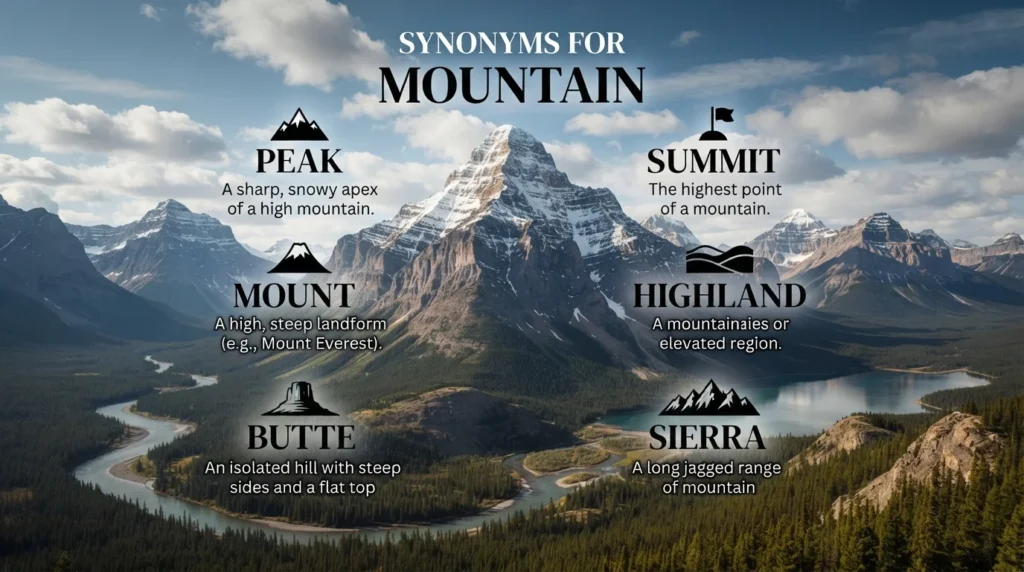
Quick Synonym List
Closest and general alternatives
- Peak
- Mount
- Summit
- Highland
- Elevation
- Upland
- Mountainous region
Specific mountain features
- Ridge
- Crag
- Bluff
- Escarpment
- Cliff
- Slope
- Foothill
- Spur
- Knoll
Mountain groups and regions
- Range
- Mountain range
- Massif
- Chain
- Highlands
- Cordillera
- Uplands
- Mountain system
Literary and descriptive alternatives
- Alp
- Mount
- Heights
- Highlands
- Promontory
- Eminence
- Mountaintop
Figurative alternatives
When mountain means something very large:
- Mass
- Heap
- Pile
- Huge quantity
- Vast amount
When it means a major difficulty:
- Obstacle
- Hurdle
- Barrier
- Challenge
- Difficulty
- Burden
What Does “Mountain” Mean?
A mountain is a large natural elevation of the Earth’s surface, usually rising prominently above the surrounding land.
“Snow covered the mountain.”
The word can also refer to a particular mountain as a named landform:
“Mount Rainier is one of the most recognizable mountains in the United States.”
But mountain has several figurative and extended uses.
It can describe a very large quantity:
“There was a mountain of paperwork on his desk.”
It can also describe a major difficulty:
“They had a mountain of problems to solve.”
Because these meanings differ, not every word associated with mountains is a true synonym for mountain.
For example, summit usually means the highest point of a mountain, while range refers to a group of mountains. Hill is related but normally describes a smaller elevation.
The Closest Synonyms for Mountain
1. Peak
Peak is one of the closest alternatives to mountain, especially when referring to a prominent high point or the highest part of a mountain.
Tone: Neutral
Best for: Geography, hiking, travel, nature writing
Example:
“The climbers reached the peak before noon.”
How it differs
A peak can refer to the highest point of a mountain, but it can also refer to the entire prominent mountain in some contexts.
“The peak was visible from the valley.”
However, peak has other meanings, such as the highest level of activity or performance:
“The company reached its peak in 2024.”
So context matters.
2. Mount
Mount is a traditional or literary alternative to mountain and is especially common in proper names.
Tone: Formal, literary, geographic
Best for: Named mountains and elevated landforms
Example:
“They climbed Mount Rainier.”
How it differs
As a common noun, mount can sound literary or old-fashioned:
“A distant mount rose above the plain.”
It is much more common as part of a proper name:
- Mount Everest
- Mount Rainier
- Mount Fuji
- Mount Kilimanjaro
3. Summit
A summit is specifically the highest point of a mountain or hill.
Tone: Neutral to formal
Best for: Climbing, geography, hiking, figurative writing
Example:
“The hikers finally reached the summit.”
How it differs
A summit is not exactly the same thing as a mountain.
The mountain is the entire landform.
The summit is its highest point.
Compare:
“They climbed the mountain.”
“They reached the summit.”
The second sentence tells us that they reached the top.
Summit can also mean a high-level meeting:
“The presidents attended an international summit.”
4. Highland
Highland refers to land that is relatively high above the surrounding area.
Tone: Neutral to formal
Best for: Geography, regions, landscapes
Example:
“The region contains extensive highlands.”
How it differs
A highland does not necessarily mean a single mountain. It can refer to an elevated region containing hills, mountains, plateaus, or other high terrain.
5. Upland
Upland means land situated at a higher elevation, especially compared with nearby low-lying land.
Tone: Neutral to formal
Best for: Geography, ecology, agriculture, environmental writing
Example:
“The village lies in the uplands above the river valley.”
How it differs
Like highland, upland is broader than mountain.
It describes elevated land rather than necessarily one large, steep landform.
Words for Specific Mountain Features
Sometimes the best replacement for mountain is not another general word but a term describing a particular physical feature.
Ridge
A ridge is a long, narrow elevation of land, often forming the top or connecting high points of mountains.
“They followed the ridge toward the summit.”
A ridge is not necessarily a whole mountain.
Crag
A crag is a steep or rugged rock formation, usually on a mountain or hillside.
“The climbers approached the rocky crag.”
It emphasizes exposed rock and ruggedness.
Bluff
A bluff is a steep cliff or high bank, especially beside water or flat land.
“The town sits on a bluff overlooking the river.”
A bluff is not normally a synonym for a large mountain.
Escarpment
An escarpment is a long, steep slope or cliff separating areas of different elevation.
“The road follows the base of the escarpment.”
This is primarily a geographical term.
Cliff
A cliff is a steep or nearly vertical rock or earth face.
“The trail passes beneath a towering cliff.”
A mountain may contain cliffs, but a cliff is not necessarily a mountain.
Foothill
A foothill is a smaller hill at the base of or near a mountain range.
“The town lies among the foothills of the Rockies.”
Foothill is useful when you specifically mean the lower hills surrounding a mountain system.
Spur
A spur is a ridge or projection extending from a mountain or hill.
“The trail climbs along a narrow spur.”
This is mainly a geographical or mountaineering term.
Knoll
A knoll is a small rounded hill.
“A grassy knoll overlooks the valley.”
It is generally much smaller than a mountain.
Words for Groups of Mountains
If you mean several mountains rather than one, a different word is usually needed.
Mountain Range
A mountain range is a connected group or chain of mountains.
“The Andes form one of the world’s longest mountain ranges.”
This is not a synonym for an individual mountain.
Range
Range is the shorter form commonly used when the context is clear.
“The mountain range stretches across the region.”
“The Rockies are a vast range.”
Massif
A massif is a compact group or massive block of mountains forming a distinct portion of a mountain system.
Tone: Technical, geographical
“The region is dominated by a large mountain massif.”
It is more specialized than mountain range.
Cordillera
A cordillera is an extensive system or chain of mountain ranges.
Tone: Technical, geographic
“The Andes are part of the great American Cordillera.”
This word is generally unsuitable as an everyday replacement for mountain.
Chain
Chain can describe a connected series of mountains.
“A chain of mountains stretches along the border.”
It is understandable and descriptive but less precise than range in many geographical contexts.
Literary and Descriptive Alternatives
Writers sometimes need a word that emphasizes height, grandeur, or landscape rather than simply naming the landform.
Alp
Alp can refer to a high mountain, especially in literary or European contexts.
It is also associated with the Alps, the major European mountain system.
“The village was surrounded by snow-covered alps.”
Use it carefully because it can sound literary or region-specific.
Heights
Heights can describe elevated land or high mountainous areas.
“They disappeared into the distant heights.”
It is more descriptive than technical.
Eminence
Eminence means a high place or elevated position.
“The castle stood on a rocky eminence.”
It can describe a hill or elevated location rather than a mountain specifically.
Promontory
A promontory is a high area of land projecting into another area, especially into the sea.
“The lighthouse stands on a rocky promontory.”
It should not normally replace mountain.
Mountain Synonyms by Meaning
| If you mean… | Better word | Why |
|---|---|---|
| A large natural elevation | Mountain | Broadest and clearest |
| A prominent high point | Peak | Emphasizes height |
| The highest point | Summit | Specifically the top |
| A named mountain | Mount | Common in geographic names |
| Elevated land | Highland | Refers to a broader region |
| Higher land | Upland | Contrasts with lowland |
| A long elevated formation | Ridge | Emphasizes shape |
| A rocky formation | Crag | Emphasizes exposed rock |
| A steep rock face | Cliff | Emphasizes verticality |
| Lower hills near mountains | Foothills | Refers to the base |
| A group of mountains | Range | Refers to multiple mountains |
| A compact mountain group | Massif | Geographic/technical term |
| A larger mountain system | Cordillera | Multiple connected ranges |
| A small rounded hill | Knoll | Much smaller than a mountain |
| A major difficulty | Obstacle | Figurative meaning |
| A huge quantity | Mass/heap/pile | Figurative quantity |
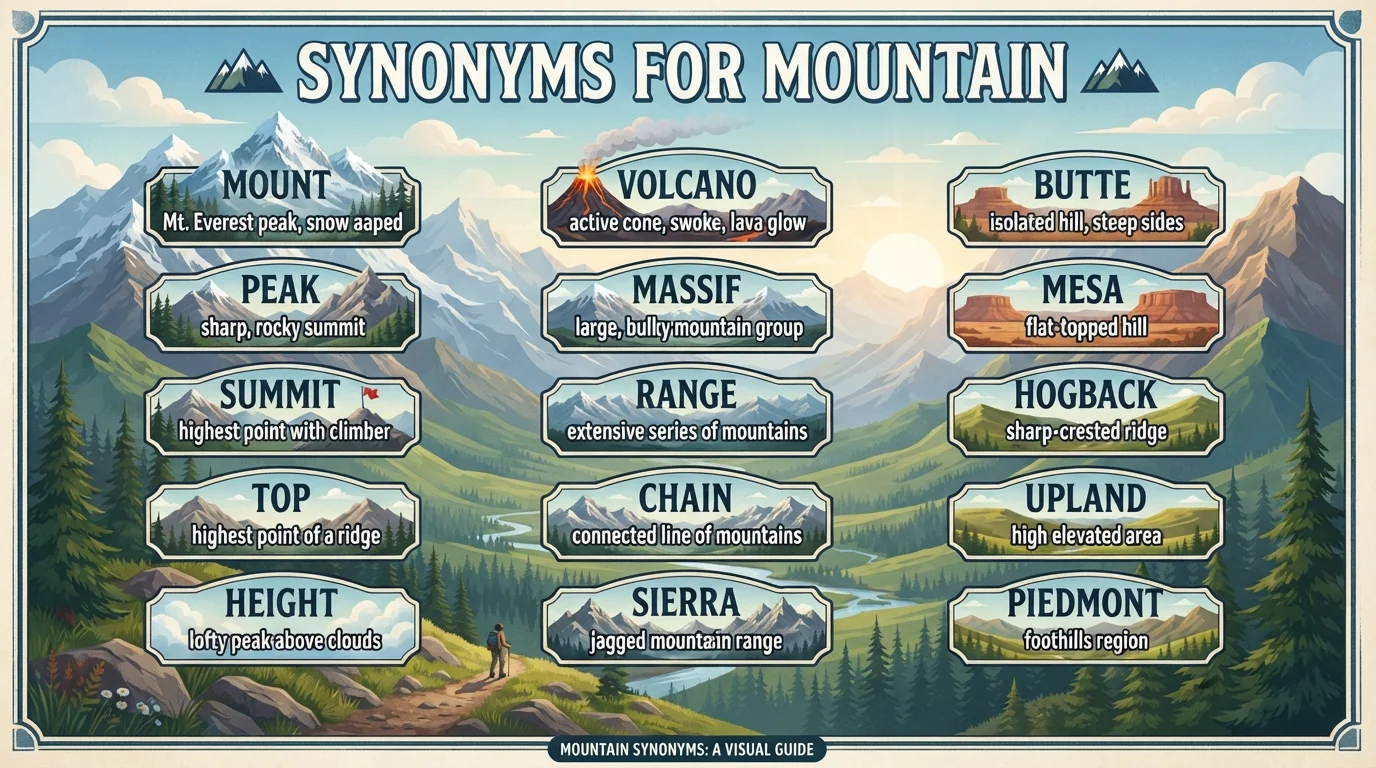
Mountain vs. Peak vs. Summit
These three words are often treated as interchangeable, but they are not identical.
Mountain
The complete elevated landform.
“The mountain rises above the valley.”
Peak
A prominent high point, often the highest point of a mountain.
“The peak was covered in snow.”
Summit
The highest point or top of a mountain.
“They reached the summit at sunrise.”
A useful way to remember the distinction is:
Mountain = whole landform
Peak = prominent high point
Summit = highest point/top
In everyday language, peak and summit can sometimes refer to the mountain itself, especially in descriptive writing, but their more precise meanings are narrower.
Mountain vs. Hill
Hill is one of the most common words people compare with mountain.
A mountain generally suggests greater elevation, prominence, or ruggedness.
A hill usually suggests a smaller or less imposing elevation.
Compare:
“They climbed the mountain.”
“They walked over the hill.”
The distinction is not based on one universal height measurement. Geographic naming conventions vary by region.
Therefore, hill can sometimes be a contextual alternative but should not be treated as a perfect synonym.
Mountain vs. Range
A mountain is an individual landform.
A range is a group or chain of mountains.
“Mount Rainier is a mountain.”
“The Cascade Range contains many mountains.”
Using range instead of mountain changes the number and scale of what you are describing.
Mountain vs. Highland
Mountain usually refers to a distinct elevated landform.
Highland refers more broadly to elevated terrain or a region of high land.
Compare:
“The mountain dominates the landscape.”
“The highlands are home to several small communities.”
A highland region can contain mountains, hills, plateaus, and valleys.
Figurative Synonyms for Mountain
Mountain has several important figurative uses.
1. Mountain = Major Obstacle
In expressions such as:
“They faced a mountain of challenges.”
Mountain means something very large, difficult, or overwhelming.
Possible alternatives include:
- Obstacle
- Barrier
- Hurdle
- Challenge
- Difficulty
- Burden
- Ordeal
- Problem
- Roadblock
- Struggle
Example
Original:
“The company faced a mountain of problems.”
Possible alternatives:
“The company faced a huge number of problems.”
“The company faced a major obstacle.”
“The company faced a daunting challenge.”
These alternatives are not identical. Mountain emphasizes scale, while obstacle emphasizes something that blocks progress.
Mountain = Huge Quantity
A mountain of something means a very large amount.
“She had a mountain of paperwork to complete.”
Possible alternatives include:
- A huge amount
- A vast amount
- A large quantity
- A pile
- A heap
- A mass
- Tons of
- Loads of
Example
“There was a mountain of laundry on the floor.”
Could become:
“There was a huge pile of laundry on the floor.”
Here, pile is often more natural because laundry is physically piled up.
Mountain = Something Very Large
In figurative writing, mountain can emphasize enormous size.
“A mountain of evidence supported the claim.”
Possible alternatives:
- Mass
- Vast quantity
- Huge amount
- Abundance
- Wealth
- Plenty
However, the best replacement depends on the noun.
“A mountain of evidence”
is natural and vivid.
“An abundance of evidence”
is more formal.
“A huge amount of evidence”
is more direct and neutral.
Mountain Synonyms in Different Contexts
In Geography
Use precise geographical terms:
- Mountain
- Peak
- Summit
- Range
- Massif
- Ridge
- Highland
- Upland
- Foothill
- Escarpment
Example:
“The mountain range contains several high peaks.”
In Hiking and Climbing
Common terms include:
- Mountain
- Peak
- Summit
- Ridge
- Crag
- Slope
- Foothill
- Mount
Example:
“The climbers reached the summit after several hours.”
In Travel Writing
Natural choices include:
- Mountain
- Peak
- Summit
- Highlands
- Range
- Alpine landscape
- Heights
Example:
“The hotel offers spectacular views of the surrounding peaks.”
In Academic or Scientific Writing
Prefer precise geographical terminology:
- Mountain
- Mountain range
- Massif
- Ridge
- Upland
- Highland
- Escarpment
- Elevation
Example:
“The study examines vegetation patterns across the mountain range.”
Avoid replacing technical terms simply for variety.
In Creative Writing
More expressive words may work:
- Heights
- Peaks
- Crags
- Highlands
- Mounts
- Alpine heights
- Rocky heights
Example:
“Beyond the dark crags, the first light appeared.”
These choices create imagery rather than simply providing a dictionary replacement.
Mountain Synonyms by Register
| Register | Useful alternatives |
|---|---|
| Neutral | Mountain, peak, hill, range |
| Professional | Mountain range, elevation, highland, upland |
| Academic | Massif, escarpment, cordillera, mountain system |
| Technical | Ridge, massif, elevation, escarpment |
| Literary | Mount, heights, crag, alp, eminence |
| Travel writing | Peaks, mountains, highlands, alpine heights |
| Casual | Mountain, hill, peak |
| Figurative | Obstacle, challenge, pile, heap, mass |
True Synonyms vs. Related Alternatives
| Word | Relationship | Can Replace “Mountain”? | Tone | Best Context |
|---|---|---|---|---|
| Peak | Near synonym | Sometimes | Neutral | Prominent high point |
| Mount | Close alternative | Sometimes | Literary/formal | Named mountains |
| Summit | Related term | Sometimes | Neutral | Mountain’s highest point |
| Hill | Related landform | Sometimes | Neutral | Smaller elevation |
| Highland | Broader term | No, usually | Neutral | Elevated region |
| Upland | Broader term | No, usually | Formal | Elevated land |
| Ridge | Narrower landform | No | Neutral | Long elevated formation |
| Crag | Specific feature | No | Literary | Rocky formation |
| Range | Group term | No | Neutral | Multiple mountains |
| Massif | Group/system term | No | Technical | Compact mountain group |
| Foothill | Specific location | No | Neutral | Lower mountainside area |
| Knoll | Smaller landform | No | Neutral | Small rounded hill |
| Escarpment | Specific landform | No | Technical | Steep elevation boundary |
| Heights | Descriptive | Sometimes | Literary | Elevated landscape |
| Obstacle | Figurative alternative | No | Neutral | Difficulty |
| Pile | Figurative alternative | No | Neutral | Large quantity |
This distinction matters because a thesaurus can list related geographical terms together even though they describe different things.
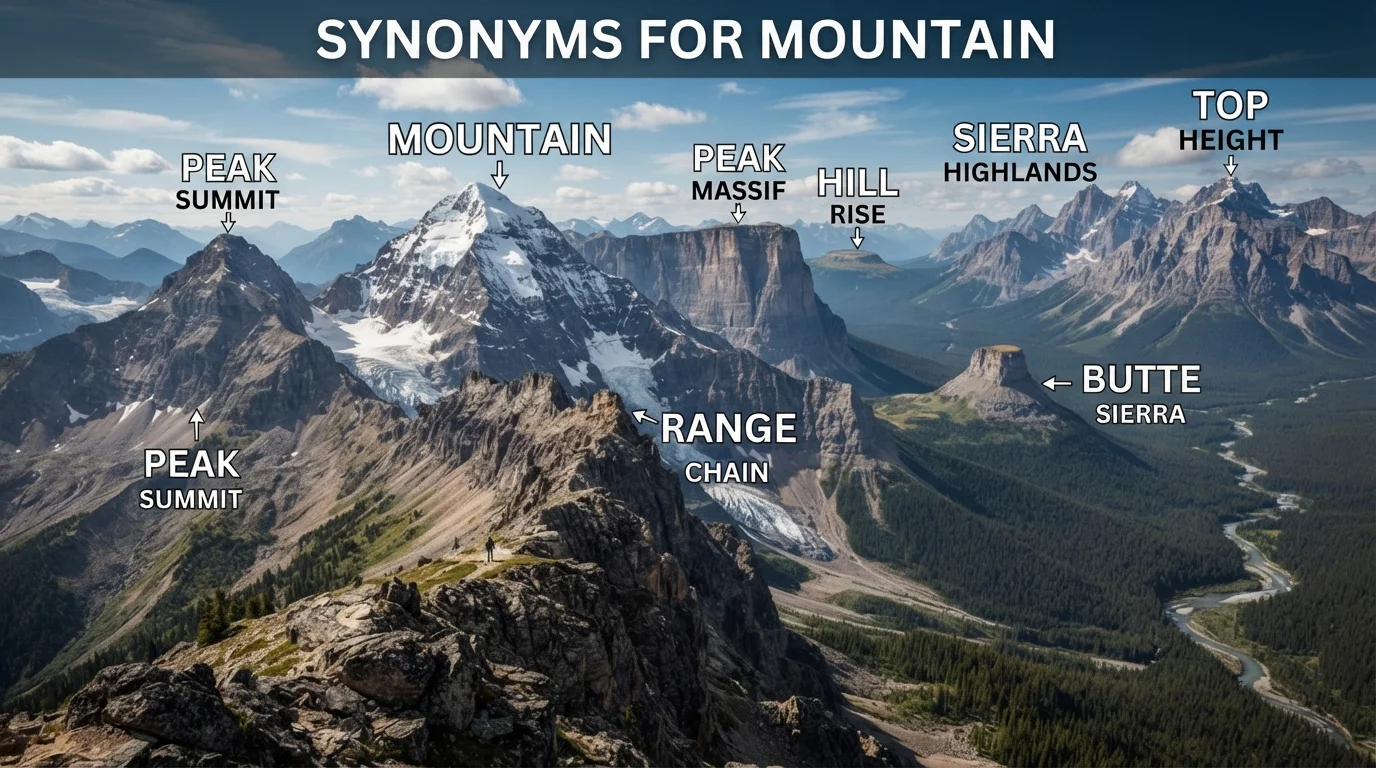
Sentence Transformations
1. General geography
Original:
“The mountain was visible from the town.”
Alternative:
“The peak was visible from the town.”
Why:
Peak works when the prominent upper part of the mountain is what you want to emphasize.
2. Reaching the top
Original:
“They climbed the mountain.”
Alternative:
“They reached the summit.”
Why:
Summit specifically emphasizes reaching the highest point.
3. A group of mountains
Original:
“The mountains stretch across the region.”
Alternative:
“The mountain range stretches across the region.”
Why:
Mountain range clearly identifies the mountains as a connected group.
4. Lower mountainous terrain
Original:
“The village sits below the mountains.”
Alternative:
“The village sits among the foothills.”
Why:
Foothills identifies the lower elevations at the base of a mountain system.
5. Elevated region
Original:
“They live in a mountainous area.”
Alternative:
“They live in the highlands.”
Why:
Highlands works when you mean a broad elevated region rather than individual mountains.
6. Technical geography
Original:
“The region contains several groups of mountains.”
Alternative:
“The region contains several massifs.”
Why:
Massif is a more specialized geographical term for a compact group or block of mountains.
7. Literary description
Original:
“Dark mountains surrounded the valley.”
Alternative:
“Dark crags surrounded the valley.”
Why:
Crags emphasizes rugged, exposed rock rather than simply height.
8. Figurative difficulty
Original:
“They faced a mountain of problems.”
Alternative:
“They faced a daunting challenge.”
Why:
The original is figurative and emphasizes scale. Daunting challenge shifts the focus toward difficulty.
9. Large quantity
Original:
“She had a mountain of paperwork.”
Alternative:
“She had a huge pile of paperwork.”
Why:
Pile works naturally because paperwork can physically form a pile.
10. Formal writing
Original:
“The area contains many mountains.”
Alternative:
“The area contains an extensive mountain system.”
Why:
Mountain system is more precise and formal when discussing a connected geographical structure.
Common Collocations With Mountain
Some combinations are much more natural than others.
Common adjective + mountain combinations
- high mountain
- tall mountain
- steep mountain
- rocky mountain
- snow-covered mountain
- snow-capped mountain
- rugged mountain
- remote mountain
- sacred mountain
- volcanic mountain
- coastal mountain
- towering mountain
- majestic mountain
- isolated mountain
Common noun + mountain combinations
- mountain peak
- mountain summit
- mountain range
- mountain slope
- mountain trail
- mountain pass
- mountain road
- mountain valley
- mountain village
- mountain climber
- mountain goat
- mountain landscape
- mountain region
- mountain terrain
Common verb + mountain combinations
- climb a mountain
- scale a mountain
- ascend a mountain
- descend a mountain
- cross a mountain
- reach the summit
- conquer a mountain
- hike through the mountains
- explore the mountains
- overlook the mountain
Common Mistakes
Mistake 1: Treating “summit” as a perfect synonym
A summit is specifically the highest point of a mountain or hill.
“They reached the summit.”
It does not normally mean the entire mountain.
Mistake 2: Using “range” for one mountain
A range consists of multiple mountains.
“The mountain is 4,000 meters high.”
Not:
“The range is 4,000 meters high.”
unless you are referring to a characteristic of the range itself.
Mistake 3: Assuming “hill” means exactly the same thing
A hill is generally a smaller elevation, although the distinction between hills and mountains is not based on one universal rule.
Mistake 4: Using “highland” for a single mountain
A highland normally refers to elevated terrain or a region rather than one particular mountain.
Mistake 5: Using technical terms just to sound sophisticated
Words such as massif, cordillera, and escarpment have specific meanings.
Do not replace mountain with them unless the geography actually fits.
Mistake 6: Using “peak” when you mean a whole mountain range
A peak is an individual high point. A range is a group of mountains.
Mistake 7: Overusing literary alternatives
Words such as crag, alp, and eminence can add atmosphere to creative writing, but they may sound unnatural in everyday communication.
Mistake 8: Replacing “mountain” simply to avoid repetition
Repetition is not automatically bad.
“The mountain rises above the valley. The mountain is covered in snow.”
may be clearer than forcing:
“The mountain rises above the valley. The massif is covered in snow.”
If you are still talking about the same mountain, repeating mountain can be more accurate.
When “Mountain” Is the Better Word
Mountain is often the best choice because it is:
- familiar;
- precise enough for everyday use;
- widely understood;
- natural in conversation;
- suitable for general writing.
Use a more specific alternative when it adds real information.
For example:
“The hikers reached the summit.”
is more informative than:
“The hikers reached the mountain.”
But:
“The mountain was covered in snow.”
does not necessarily need to become:
“The peak was covered in snow.”
If you mean the entire landform, mountain is the more accurate word.
How to Choose the Right Synonym
If you mean the whole landform
Use mountain.
If you mean the highest point
Use summit.
If you mean a prominent high point
Use peak.
If you mean a named mountain
Use Mount where it is part of the proper name.
If you mean elevated land generally
Use highland or upland.
If you mean a long elevated formation
Use ridge.
If you mean a rugged rocky formation
Use crag.
If you mean the lower hills near mountains
Use foothills.
If you mean several connected mountains
Use mountain range or range.
If you mean a compact group of mountains
Use massif.
If you mean a large difficulty
Use obstacle, challenge, barrier, or hurdle.
If you mean a very large quantity
Use pile, heap, mass, vast amount, or huge quantity, depending on the noun.
Editor’s Choice
For most readers, these are the most useful alternatives because each adds a distinct meaning rather than simply replacing mountain with a harder word.
Peak
Use when you want to emphasize a prominent or high point.
Summit
Use when you specifically mean the top of a mountain.
Range
Use when discussing a group or chain of mountains.
Highland
Use for a broad elevated region.
Ridge
Use when the shape of the elevated land matters.
These are not interchangeable in every sentence. Their value comes from their precision.