
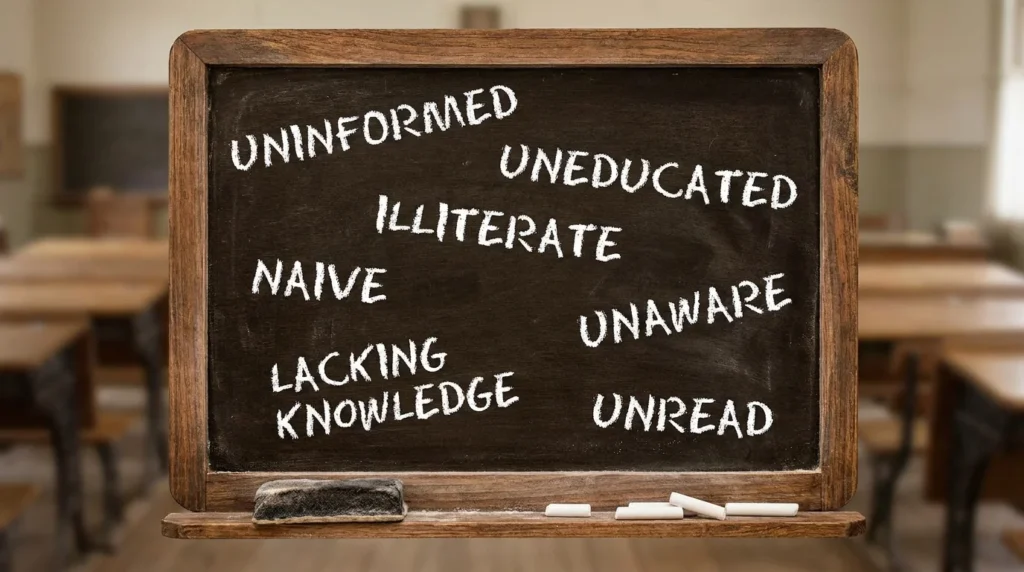
Quick Synonym List
Meaning: lacking knowledge
- Uninformed
- Unaware
- Unknowledgeable
- Ill-informed
- Misinformed
- Unfamiliar
- Unacquainted
- Inexperienced
- Unversed
- Uninitiated
- Naive
- Unschooled
- Untaught
- Uneducated
Meaning: lacking education
- Uneducated
- Unschooled
- Untaught
- Unlettered
- Illiterate
- Inexpert
- Untrained
Meaning: lacking awareness or understanding
- Unaware
- Oblivious
- Inattentive
- Unconscious
- Unmindful
- Inexperienced
- Naive
- Unfamiliar
Related negative descriptions
- Misguided
- Misinformed
- Prejudiced
- Narrow-minded
- Insensitive
- Inconsiderate
- Uncultured
- Unsophisticated
- Inexperienced
What Does “Ignorant” Mean?
Ignorant generally means lacking knowledge, information, education, or awareness about something.
He was ignorant of the risks involved.
Here, ignorant does not necessarily mean stupid. It simply means that the person does not know something.
However, in everyday speech:
He’s ignorant.
can sound like a harsh judgment about someone’s intelligence, education, or character.
That distinction matters when choosing a synonym.
The Main Meanings of “Ignorant”
1. Lacking knowledge about something
This is the most important sense.
She was ignorant of the new regulations.
Possible alternatives:
- uninformed
- unaware
- unfamiliar
- unknowledgeable
- ill-informed
- unversed
- unacquainted
2. Lacking education
He grew up in an environment where he received little formal education.
Possible alternatives:
- uneducated
- unschooled
- untaught
- unlettered
- illiterate
These words should be used carefully because they describe different things.
3. Lacking awareness
They were ignorant of the potential consequences.
Possible alternatives:
- unaware
- oblivious
- uninformed
- unmindful
- inexperienced
4. Showing a lack of knowledge or sophistication
In some contexts, ignorant can carry a stronger negative implication.
His ignorant comments offended the audience.
Here, the intended meaning may be closer to:
- uninformed
- misguided
- insensitive
- narrow-minded
- prejudiced
- uncultured
- insensitive
These are contextual alternatives, not exact synonyms.
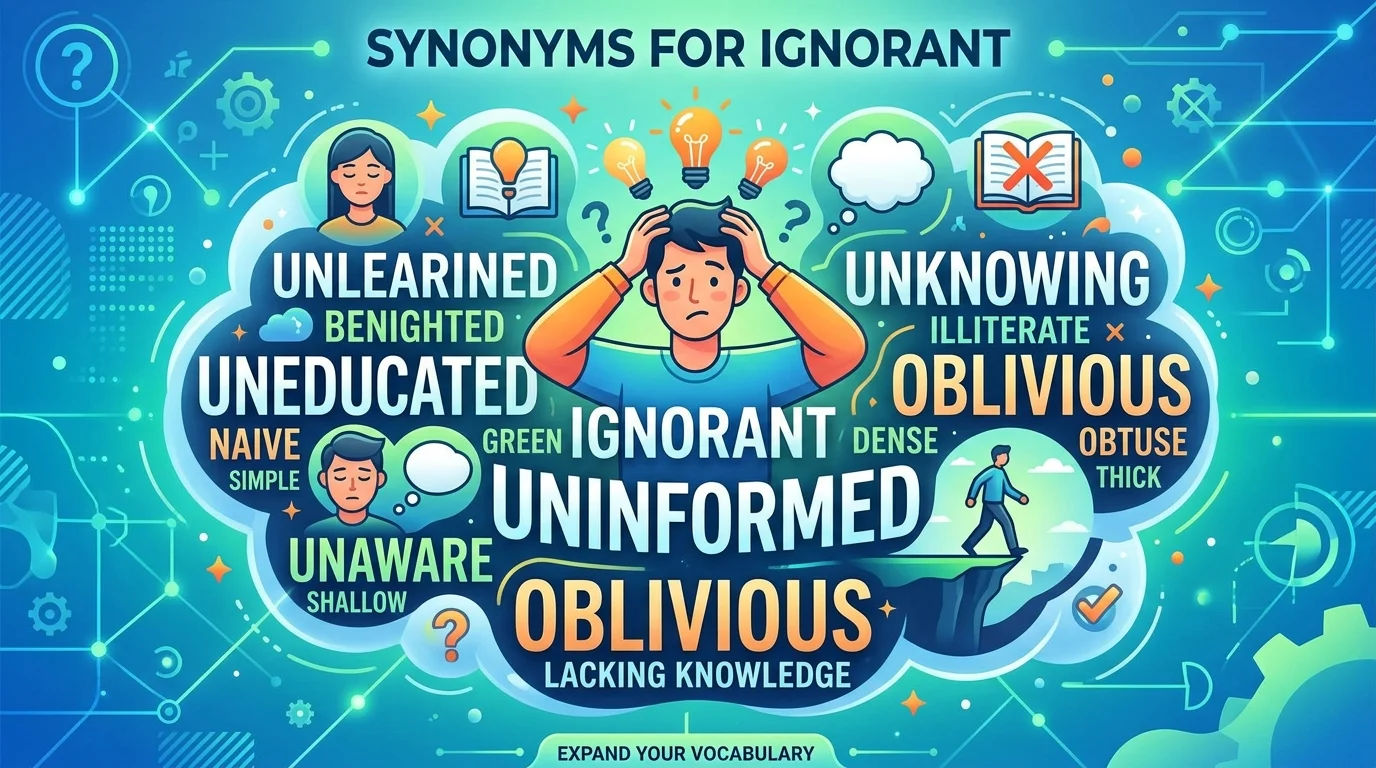
Closest Synonyms for Ignorant
Uninformed
Uninformed is one of the safest and most useful alternatives to ignorant.
It means lacking relevant information or knowledge.
The public was ignorant of the changes.
→ The public was uninformed about the changes.
Best for: professional, academic, neutral, and respectful writing.
Unlike ignorant, uninformed usually sounds less judgmental.
Unaware
Unaware means not knowing about something or not realizing something.
She was ignorant of the problem.
→ She was unaware of the problem.
This is especially useful when the person simply does not know that something exists or is happening.
Best for: lack of awareness.
Important distinction
He was unaware of the danger.
does not necessarily mean:
He lacked knowledge generally.
It describes a specific absence of awareness.
Unknowledgeable
Unknowledgeable means lacking knowledge about a particular subject.
He is ignorant about finance.
→ He is unknowledgeable about finance.
It is understandable and grammatically valid, but uninformed, inexperienced, or unfamiliar with may sound more natural depending on the sentence.
Ill-Informed
Ill-informed means having insufficient or incorrect information.
His ignorant opinion was based on false assumptions.
→ His ill-informed opinion was based on false assumptions.
This is particularly useful when someone’s understanding is incomplete or poorly supported.
Best for: opinions, decisions, arguments, public commentary.
Ill-informed vs. ignorant
Ignorant can mean simply lacking knowledge.
Ill-informed often suggests that someone has inadequate, incomplete, or unreliable information.
Misinformed
Misinformed means having incorrect information.
She was ignorant about how the system worked.
→ She was misinformed about how the system worked.
Be careful: ignorant ≠ misinformed.
An ignorant person may know nothing about a subject. A misinformed person knows something but has been given incorrect information.
Unfamiliar
Unfamiliar means not having knowledge or experience with something.
I am ignorant of the software.
→ I am unfamiliar with the software.
This is an excellent polite alternative in professional communication.
I’m unfamiliar with that procedure.
usually sounds much more natural and respectful than:
I’m ignorant of that procedure.
Unversed
Unversed means having little knowledge or experience in a particular subject.
She was ignorant of tax law.
→ She was unversed in tax law.
It is relatively formal and is most natural with a specific field.
unversed in economics
unversed in legal procedure
unversed in technical matters
Unacquainted
Unacquainted with means not familiar with something or someone.
He was ignorant of the local customs.
→ He was unacquainted with the local customs.
It has a formal tone and is less common in everyday conversation.
Inexperienced
Inexperienced means lacking practical experience.
The ignorant worker made several mistakes.
→ The inexperienced worker made several mistakes.
But these are not identical.
Someone can be knowledgeable but inexperienced, or experienced but poorly informed about a particular topic.
Synonyms for “Ignorant” in Academic Writing
Academic writing usually benefits from precise, neutral language rather than directly calling someone ignorant.
Useful alternatives include:
- Uninformed
- Ill-informed
- Unaware
- Unfamiliar with
- Unversed in
- Lacking knowledge of
- Lacking awareness of
- Insufficiently informed
- Not knowledgeable about
- Unacquainted with
- Inexperienced in
- Lacking understanding of
Example
Instead of:
Many people are ignorant of the issue.
Consider:
Many people are unaware of the issue.
Or:
Many people are insufficiently informed about the issue.
The second versions identify the knowledge gap without unnecessarily attacking the people being discussed.
Polite Synonyms for Ignorant
If you need to correct someone without sounding insulting, choose:
- Uninformed
- Unaware
- Unfamiliar with
- Inexperienced
- Not familiar with
- Lacking information about
- Lacking knowledge of
- Still learning about
- New to
- Unacquainted with
Example
Harsh:
You are ignorant about accounting.
Polite:
You may be unfamiliar with accounting procedures.
More constructive:
You may not have enough information about the accounting process yet.
These alternatives are especially useful at work, school, and in customer communication.
Synonyms for “Ignorant Person”
If you specifically need a noun describing someone who lacks knowledge, context matters greatly.
Possible terms include:
- Novice
- Beginner
- Learner
- Inexperienced person
- Newcomer
- Outsider
- Nonexpert
- Layperson
- Uninformed person
Novice
A novice is someone who is new to a subject or activity.
He is ignorant of programming.
→ He is a novice in programming.
This is much more neutral and often more useful.
Layperson
A layperson is someone without specialized knowledge in a particular professional or technical field.
The material is difficult for someone ignorant of medicine.
→ The material is difficult for a layperson unfamiliar with medicine.
A layperson is not necessarily ignorant. They simply aren’t a specialist.
Synonyms for Ignorant Meaning “Uneducated”
Uneducated
Uneducated means lacking formal education or having received limited education.
He was uneducated.
This is different from simply being ignorant about a particular topic.
A highly educated person can be ignorant about something outside their field.
Unschooled
Unschooled means having received little or no formal schooling.
It can also be used figuratively.
She was unschooled in political theory.
This sounds more formal or literary than uneducated.
Untaught
Untaught emphasizes that someone has not been taught something.
The children were ignorant of basic safety procedures.
→ The children were untaught in basic safety procedures.
This is less common in ordinary modern prose, so untrained or uninformed may often be better.
Unlettered
Unlettered is a formal or literary term for someone with little education or learning.
It is much less common in everyday English.
Illiterate
Illiterate should not be treated as a general synonym for ignorant.
Traditionally, it means unable to read or write.
Someone can be:
- highly educated but ignorant about a particular subject
- literate but uninformed
- illiterate but knowledgeable through oral or practical experience
Use illiterate only when literacy is genuinely the issue.
Synonyms for Ignorant Meaning “Unaware”
Sometimes the intended meaning is simply that someone doesn’t know what is happening.
Unaware
He was ignorant of the changes.
→ He was unaware of the changes.
Oblivious
Oblivious suggests being unaware, sometimes despite something being noticeable or important.
He was oblivious to the warning signs.
This is stronger than unaware and can imply that the person failed to notice something.
Unmindful
Unmindful means not paying attention to or not considering something.
They were unmindful of the consequences.
This often implies a failure to consider something rather than simply a lack of knowledge.
Synonyms for Ignorant When the Meaning Is Negative
Sometimes someone uses ignorant not merely to mean uninformed but to criticize someone’s attitude, comments, or behavior.
In those cases, the correct replacement may be more specific.
| Intended meaning | Better word |
|---|---|
| Lacks information | Uninformed |
| Doesn’t know | Unaware |
| Has wrong information | Misinformed |
| Has inadequate information | Ill-informed |
| Lacks experience | Inexperienced |
| Doesn’t understand | Uncomprehending |
| Shows little sensitivity | Insensitive |
| Holds narrow views | Narrow-minded |
| Holds unfair assumptions | Prejudiced |
| Behaves rudely | Boorish |
| Lacks refinement | Uncultured / unsophisticated |
| Lacks training | Untrained |
This is often better writing because it identifies the actual problem rather than using ignorant as a catch-all insult.
Ignorant vs. Uninformed
These are close, but uninformed is usually more neutral.
He was ignorant of the new policy.
He was uninformed about the new policy.
The first can sound more critical.
The second simply states that he did not have the relevant information.
Choose uninformed when you want a neutral or professional tone.
Ignorant vs. Unaware
Unaware focuses on knowledge of a particular fact, situation, or condition.
She was unaware of the change.
Ignorant can describe a broader lack of knowledge.
He was ignorant of basic financial principles.
Use unaware when the issue is a specific fact or situation.
Ignorant vs. Uneducated
These words are often incorrectly treated as identical.
Ignorant = lacking knowledge about something.
Uneducated = having limited formal education.
She is ignorant of quantum physics.
This does not tell us whether she is educated.
She is uneducated.
This makes a statement about her formal education.
Ignorant vs. Illiterate
These are not synonyms.
Ignorant means lacking knowledge.
Illiterate generally means unable to read or write.
He is ignorant about economics.
does not mean:
He cannot read.
Use illiterate only when literacy is the actual issue.
Ignorant vs. Naive
Naive means lacking experience or worldly knowledge, often resulting in overly trusting or simplistic assumptions.
She was naive about the realities of business.
This is not necessarily the same as being ignorant.
A person may know many facts yet still be naive because they lack experience.
Ignorant vs. Misinformed
This distinction is especially important.
Ignorant: does not know.
Misinformed: knows something incorrect.
He was ignorant of the facts.
He lacked the relevant information.
He was misinformed about the facts.
He had information, but it was wrong.
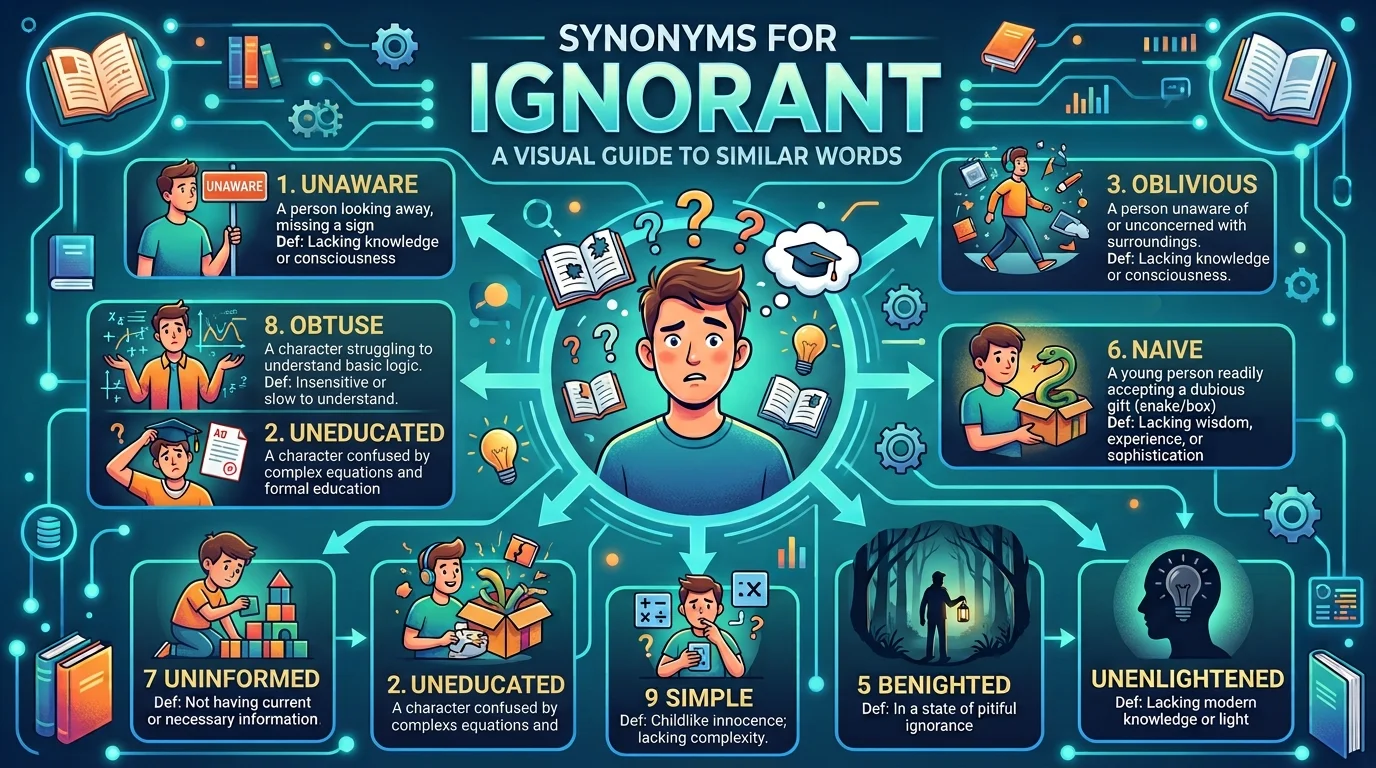
Context-Specific Alternatives
| Context | Best alternative |
|---|---|
| Ignorant of the facts | Unaware / uninformed |
| Ignorant about a subject | Unfamiliar / unknowledgeable |
| Ignorant of the law | Unaware / unfamiliar with the law |
| Ignorant of risks | Unaware / uninformed about the risks |
| Ignorant opinion | Ill-informed / misguided |
| Ignorant statement | Ill-informed / insensitive |
| Ignorant student | Uninformed / inexperienced |
| Ignorant beginner | Novice / inexperienced |
| Ignorant about technology | Unfamiliar with technology |
| Ignorant of history | Unfamiliar with history / lacking historical knowledge |
| Ignorant person | Uninformed person / nonexpert |
| Ignorant behavior | Insensitive / inconsiderate / uninformed |
| Ignorant attitude | Narrow-minded / prejudiced / uninformed |
| Ignorant of a procedure | Unfamiliar with the procedure |
| Ignorant of cultural norms | Unaware / unfamiliar with cultural norms |
Sentence Transformations
Original
He was ignorant of the rules.
Neutral:
He was unaware of the rules.
Professional:
He was not familiar with the rules.
Formal:
He was unacquainted with the applicable rules.
Original
She is ignorant about finance.
Neutral:
She is uninformed about finance.
Natural:
She is unfamiliar with finance.
Experience-focused:
She is inexperienced in financial matters.
Original
His ignorant comments caused controversy.
Neutral:
His ill-informed comments caused controversy.
If the problem was insensitivity:
His insensitive comments caused controversy.
If the problem was prejudice:
His prejudiced comments caused controversy.
Notice how the replacement becomes more precise.
Common Mistakes
Mistake 1: Assuming ignorant means stupid
It doesn’t necessarily mean that.
Someone can be intelligent but ignorant of a particular subject.
She is ignorant of the law.
means she lacks knowledge of the law—not that she lacks intelligence.
Mistake 2: Using “illiterate” as a synonym
Illiterate has a specific connection to reading and writing.
Don’t use it simply to mean uninformed or uneducated.
Mistake 3: Confusing ignorant with misinformed
An ignorant person lacks information.
A misinformed person has incorrect information.
The distinction can significantly change the meaning of a sentence.
Mistake 4: Using “unaware” for every situation
Unaware generally works best for a specific fact, situation, or condition.
unaware of the problem
unaware of the risks
unaware of the change
For a broader subject, unfamiliar with may sound more natural:
unfamiliar with tax law
Mistake 5: Using sophisticated words when a simple word is clearer
Words such as unversed, unacquainted, and unlettered can be useful, but they are not automatically better.
I’m unfamiliar with the software.
is usually clearer than:
I’m unversed in the software.
Grammar and Usage
Ignorant is an adjective.
Common patterns
ignorant of + noun
He was ignorant of the facts.
ignorant about + subject
She was ignorant about economics.
ignorant of how + clause
They were ignorant of how the system worked.
ignorant that + clause
This construction is possible but less common and often less natural than unaware that.
He was ignorant that the policy had changed.
More naturally:
He was unaware that the policy had changed.
Related forms
- ignorant — adjective
- ignorance — noun
- ignorantly — adverb
His ignorance of the rules caused problems.
He spoke ignorantly about the subject.
When “Ignorant” Is Better Than a Synonym
There are situations where ignorant is the most accurate word.
Use it when you specifically want to emphasize a lack of knowledge, especially when that lack of knowledge is important to the discussion.
The study examines how people can remain ignorant of risks despite having access to information.
Here, ignorant can communicate the concept more directly than unaware or unfamiliar.
It is also useful when discussing the general concept of ignorance:
Education can reduce ignorance about public health.
In these contexts, replacing the word merely for variation may actually make the writing less precise.
Decision Guide
Choose uninformed when you mean lacking relevant information.
Choose unaware when you mean not knowing about a particular fact or situation.
Choose unfamiliar when you mean having little knowledge or experience with something.
Choose ill-informed when you mean having inadequate or unreliable information.
Choose misinformed when you mean having incorrect information.
Choose unversed when you want a formal term for lacking knowledge of a subject.
Choose inexperienced when the real issue is lack of practical experience.
Choose uneducated when you specifically mean limited formal education.
Choose illiterate only when you specifically mean limited or absent ability to read and write.
Choose naive when you mean inexperienced or overly trusting.
Choose insensitive when the problem is a lack of awareness of other people’s feelings.
Choose narrow-minded when the problem is an unwillingness to consider different ideas.
Choose prejudiced when the person holds unfair preconceived judgments