
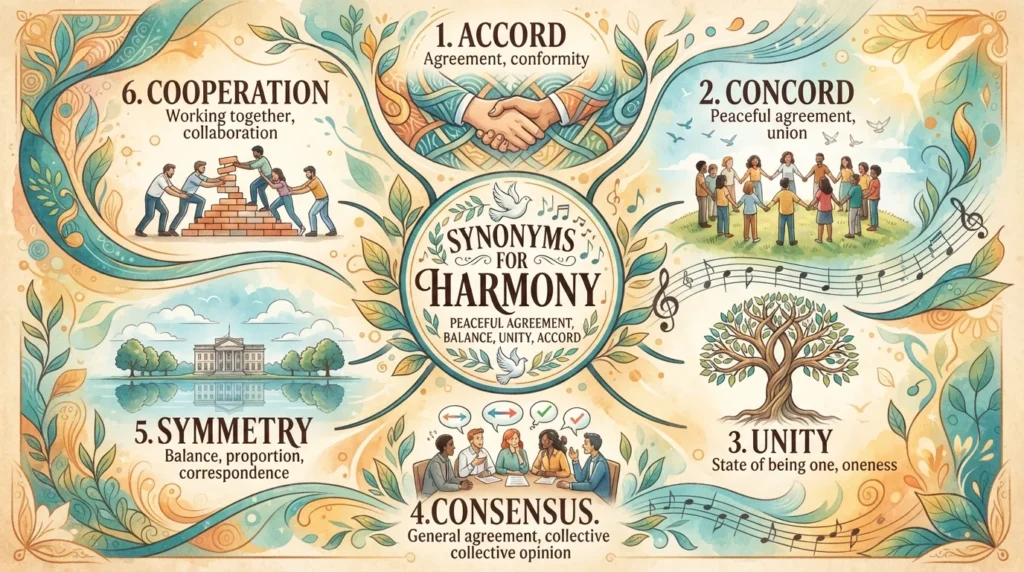
Quick Synonym List
Closest alternatives
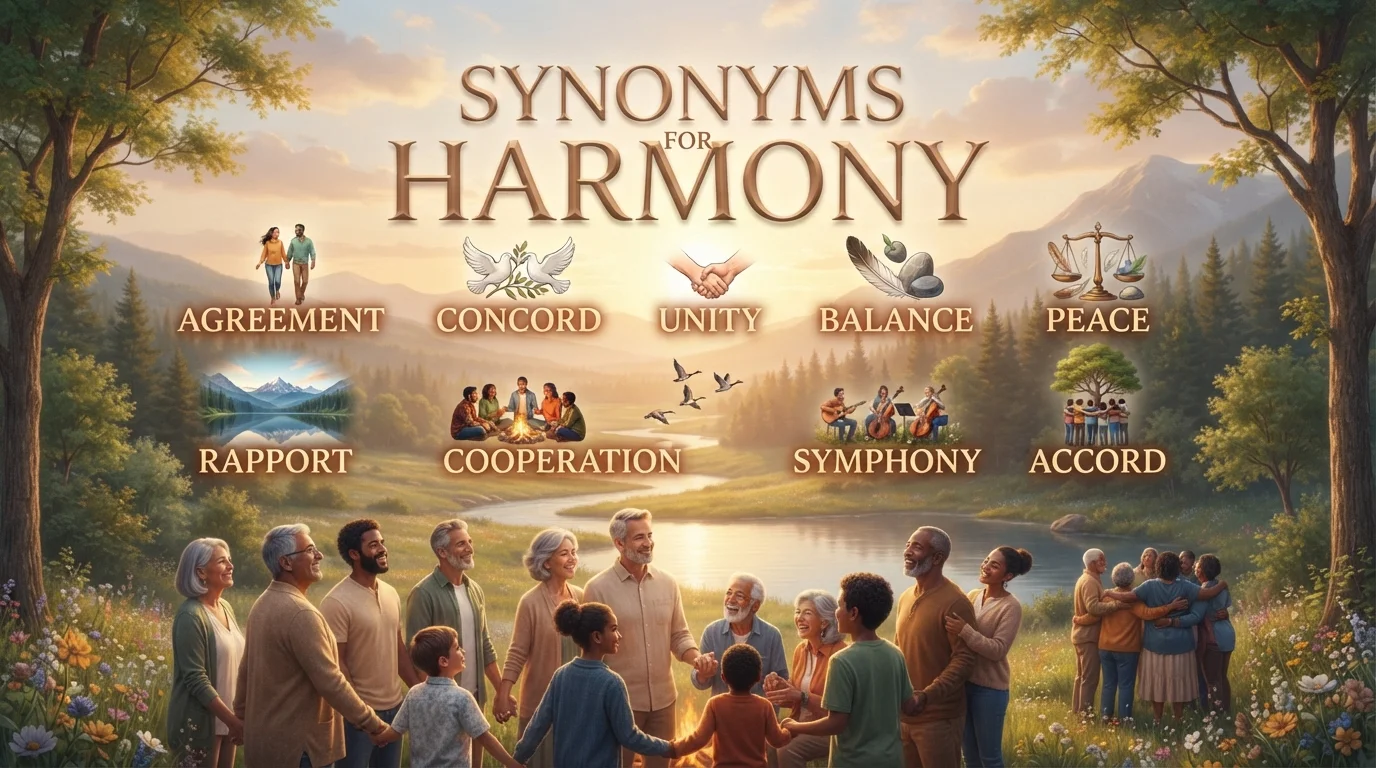
- Accord
- Agreement
- Concord
- Unity
- Peace
- Cooperation
- Cohesion
- Understanding
- Compatibility
- Balance
Harmony between people
- Agreement
- Accord
- Understanding
- Cooperation
- Collaboration
- Unity
- Solidarity
- Fellowship
- Camaraderie
- Teamwork
Peaceful relationships
- Peace
- Tranquility
- Amity
- Concord
- Goodwill
- Friendship
- Reconciliation
- Coexistence
- Rapport
- Mutual understanding
Balance and proportion
- Balance
- Equilibrium
- Symmetry
- Proportion
- Coordination
- Integration
- Coherence
- Unity
- Compatibility
- Complementarity
Music
- Consonance
- Accord
- Chord
- Blend
- Unison
- Concord
- Musical agreement
Ideas, colors, styles, or elements that fit together
- Compatibility
- Coherence
- Consistency
- Congruence
- Consonance
- Coordination
- Unity
- Balance
- Integration
- Complementarity
What Does “Harmony” Mean?
Harmony generally describes a state in which different people, things, ideas, sounds, or elements fit together well without conflict or unpleasant contrast.
The word has several important meanings.
Harmony between people
“The members of the team worked in harmony.”
Here, harmony means cooperation, agreement, and peaceful interaction.
Harmony as peace
“The two communities lived in harmony.”
Here, harmony means peaceful coexistence and the absence of serious conflict.
Harmony as balance
“The colors work together in harmony.”
Here, harmony means a pleasing and balanced relationship between different elements.
Harmony in music
“The singers performed in perfect harmony.”
Here, harmony refers to musical notes or voices sounding together in a pleasing relationship.
Harmony between ideas or systems
“The two theories are not in harmony.”
Here, harmony means agreement, consistency, or compatibility.
Because the meanings differ, a synonym that works for people may sound unnatural when describing music or design.
The Closest Synonyms for Harmony
Accord
Meaning: Agreement or a peaceful relationship between people or groups.
Tone: Neutral to formal.
Best for: People, organizations, countries, decisions, and opinions.
“The two sides reached an accord.”
How it differs: Accord is one of the closest alternatives to harmony when the meaning is agreement or cooperation.
Agreement
Meaning: A state in which people share the same opinion, decision, or position.
Tone: Neutral.
“The committee reached agreement on the proposal.”
How it differs: Agreement focuses on shared views or decisions. Harmony can suggest a broader, more positive relationship.
Concord
Meaning: Peace, agreement, or harmony between people or groups.
Tone: Formal or literary.
“The communities lived in concord.”
How it differs: Concord is very close to harmony but is less common in everyday English.
Unity
Meaning: The state of being joined together or acting as one.
Tone: Neutral to formal.
“The organization demonstrated remarkable unity.”
How it differs: Unity emphasizes togetherness, while harmony emphasizes peaceful or compatible relationships.
Peace
Meaning: A state without conflict, violence, or serious disagreement.
Tone: Neutral.
“The two communities lived together in peace.”
How it differs: Peace emphasizes the absence of conflict. Harmony often suggests positive cooperation in addition to peace.
Cooperation
Meaning: Working together toward a shared goal.
Tone: Neutral/professional.
“The project succeeded through cooperation between the two teams.”
How it differs: Cooperation emphasizes coordinated action rather than simply having a peaceful relationship.
Cohesion
Meaning: The quality of sticking together as a unified group.
Tone: Professional/academic.
“Strong team cohesion improved communication.”
How it differs: Cohesion focuses on how well parts or members hold together as a group.
Understanding
Meaning: Mutual awareness of and agreement with another person’s views, needs, or situation.
“The agreement was reached through mutual understanding.”
How it differs: Understanding often emphasizes empathy or shared recognition rather than complete agreement.
Compatibility
Meaning: The ability of people or things to exist, work, or function well together.
“The two systems have good compatibility.”
How it differs: Compatibility is particularly useful for technology, personalities, ideas, systems, and relationships.
Balance
Meaning: A stable or pleasing relationship between different elements.
“The design achieves a good balance of color and texture.”
How it differs: Balance is more appropriate than harmony when proportional relationships or competing elements are central.
Synonyms for Harmony Between People
When harmony describes people getting along well, these alternatives are especially useful.
Amity
Meaning: A friendly and peaceful relationship.
“The two neighboring communities maintained relations of amity.”
Tone: Formal.
Amity strongly suggests friendship and peaceful relations.
Rapport
Meaning: A comfortable and positive relationship in which people communicate well.
“The teacher quickly established rapport with her students.”
How it differs: Rapport focuses on interpersonal connection and communication.
It is not a general synonym for harmony in every context.
Camaraderie
Meaning: Friendly trust and companionship within a group.
“The players developed strong camaraderie during the season.”
Tone: Positive, conversational.
It works particularly well for teams, coworkers, military groups, and friends.
Fellowship
Meaning: Friendly association and shared community.
“The event encouraged fellowship among residents.”
It can have social, community, religious, or organizational uses.
Solidarity
Meaning: Unity and mutual support among people with a shared interest or purpose.
“The workers showed solidarity during the negotiations.”
Solidarity is stronger and more purposeful than ordinary harmony.
Goodwill
Meaning: Friendly or cooperative feelings toward another person or group.
“The agreement helped restore goodwill between the organizations.”
Goodwill describes a positive attitude rather than complete agreement.
Mutual Understanding
A phrase emphasizing that people understand each other’s views or needs.
“The two groups reached a mutual understanding.”
This is especially useful in professional, diplomatic, and interpersonal contexts.
Reconciliation
Meaning: The restoration of friendly relations after disagreement or conflict.
“The agreement marked an important step toward reconciliation.”
This is not a general synonym for harmony. It specifically involves repairing a previously damaged relationship.
Synonyms for Harmony Meaning Peaceful Coexistence
Peace
“The communities lived in peace.”
The simplest choice when the emphasis is on the absence of conflict.
Tranquility
Meaning: Calmness and freedom from disturbance.
“The village was known for its tranquility.”
Tranquility focuses on calmness rather than interpersonal agreement.
Coexistence
Meaning: The state of existing together without serious conflict.
“The policy encouraged peaceful coexistence.”
This is useful for different groups, cultures, species, or systems.
Amity
“The countries maintained a relationship of amity.”
This suggests friendly relations.
Concord
“The groups lived in concord.”
Formal and somewhat literary.
Goodwill
“The agreement helped create goodwill between the two sides.”
This emphasizes positive intentions or feelings.
Synonyms for Harmony as Balance
When harmony means that different parts work together in a balanced or pleasing way, use different vocabulary.
Equilibrium
Meaning: A state of balance between opposing or competing forces.
“The system eventually reached equilibrium.”
Tone: Formal/scientific.
Equilibrium is more technical than harmony.
Symmetry
Meaning: A balanced correspondence between parts.
“The building’s symmetry creates a sense of order.”
Symmetry does not always mean harmony. A design can be asymmetrical while still harmonious.
Proportion
Meaning: The relationship of parts to one another in size, amount, or degree.
“The colors are pleasing because of their proportion.”
Useful in art, design, architecture, and visual analysis.
Coordination
Meaning: The organized combination of different elements or activities.
“The colors require careful coordination.”
It emphasizes organization rather than the emotional or aesthetic quality of harmony.
Integration
Meaning: Combining separate elements into a unified whole.
“The design achieves a seamless integration of traditional and modern elements.”
This is especially useful in technical, professional, and academic contexts.
Coherence
Meaning: Logical or orderly connection between parts.
“The argument has strong internal coherence.”
Use coherence for ideas, writing, arguments, systems, and structures.
Congruence
Meaning: Agreement or correspondence between things.
“There was little congruence between the policy and its stated goals.”
This is formal and analytical.
Complementarity
Meaning: A relationship in which different elements complete or enhance one another.
“The two colors have a strong sense of complementarity.”
This is useful when differences contribute to a pleasing whole.
Harmony in Music
Harmony has a specialized musical meaning.
It refers to the way different notes sound together and relate to one another.
“The singers performed in harmony.”
Depending on the intended meaning, related terms include:
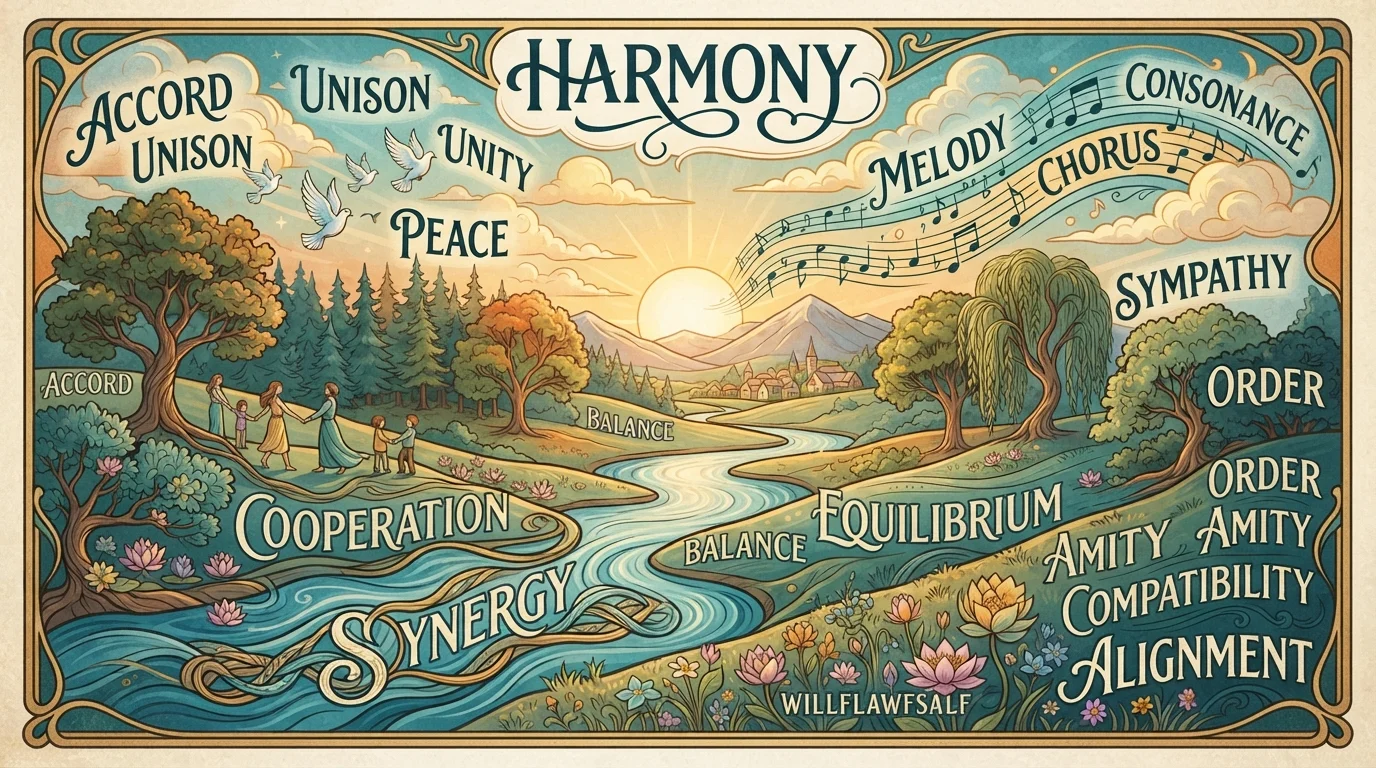
- Consonance
- Accord
- Chord
- Unison
- Blend
- Concord
- Musical agreement
Consonance
Meaning: A pleasing or stable combination of musical notes.
“The piece moves between consonance and dissonance.”
This is the most precise technical alternative when the musical meaning involves pleasing combinations of notes.
Chord
A chord is a specific combination of notes sounded together.
“The guitarist played a major chord.”
A chord is not a synonym for harmony in general.
Unison
Meaning: Two or more performers producing the same note or melody at the same pitch.
“The singers began in unison.”
Unison is related to harmony but is not identical to it.
Blend
In vocal or instrumental performance, blend describes how well different sounds combine.
“The choir has a beautiful vocal blend.”
This is especially useful when discussing performance quality.
Concord
In musical contexts, concord can describe harmonious or pleasing sounds.
“The composition moves between concord and tension.”
Harmony in Art, Design, and Color
In visual contexts, harmony describes elements that work together aesthetically.
Useful alternatives include:
- Balance
- Unity
- Coordination
- Compatibility
- Coherence
- Proportion
- Consistency
- Congruence
- Complementarity
- Integration
Color harmony
“The designer used a harmonious color palette.”
Possible alternatives:
“The designer used a balanced color palette.”
“The colors are well coordinated.”
“The colors work well together.”
Compatibility is useful when the emphasis is on whether colors or styles work together.
Balance is useful when the relationship between visual elements is central.
Unity is useful when the design feels like a coherent whole.
Harmony Between Ideas
Harmony can also describe ideas, beliefs, principles, or systems that agree.
“The two approaches are in harmony.”
Possible alternatives include:
- Agreement
- Accord
- Consistency
- Coherence
- Compatibility
- Congruence
- Consonance
- Alignment
- Correspondence
Alignment
Meaning: Agreement or consistency between goals, values, actions, or positions.
The policy is in alignment with the organization’s goals.
This is especially common in business and professional writing.
Consistency
Meaning: Agreement between different statements, actions, or elements without contradiction.
“The findings are consistent with earlier research.”
This is more precise than harmony in many academic contexts.
Consonance
Meaning: Agreement or compatibility between ideas, principles, or things.
“The proposal is in consonance with the organization’s values.”
This is formal.
Correspondence
Meaning: A relationship of similarity, agreement, or matching.
“There is a close correspondence between the two models.”
Useful in analytical and academic writing.
Harmony in Business and Professional Writing
In professional writing, harmony often refers to cooperation, alignment, or smooth relationships.
Depending on the intended meaning, consider:
- Collaboration
- Cooperation
- Coordination
- Alignment
- Agreement
- Consensus
- Cohesion
- Teamwork
- Unity
- Compatibility
- Rapport
For teams
“The team works in harmony.”
Possible alternatives:
“The team works collaboratively.”
“The team demonstrates strong cohesion.”
“The team works effectively together.”
For goals
“The departments are working in harmony.”
A more precise professional version might be:
“The departments are aligned on their goals.”
For decision-making
“The committee reached harmony on the proposal.”
This sounds unnatural.
Use:
“The committee reached agreement.”
or:
“The committee reached consensus.”
Consensus is often the better word when a group reaches a broadly shared decision.
Harmony vs. Agreement
These words overlap but are not identical.
Agreement means people share the same opinion, decision, or position.
Harmony can mean agreement, but it often suggests a broader state of peaceful cooperation.
Compare:
“The committee reached agreement.”
This tells us they agreed on something.
“The committee worked in harmony.”
This suggests that members cooperated smoothly.
A group can reach agreement on one decision without having a harmonious relationship overall.
Harmony vs. Peace
Peace emphasizes the absence of conflict.
Harmony often implies positive cooperation or compatibility.
Compare:
“The countries are at peace.”
This means they are not engaged in war or serious conflict.
“The communities live in harmony.”
This suggests that they coexist peacefully and may also cooperate or maintain positive relationships.
Harmony vs. Unity
Unity emphasizes togetherness.
Harmony emphasizes the quality of the relationship between different parts or people.
“The team showed unity.”
means the team stayed together.
“The team worked in harmony.”
suggests that its members worked together smoothly.
Unity and harmony can exist together, but they emphasize different things.
Harmony vs. Balance
Balance is about proportion or stability.
Harmony is about elements fitting together well.
“The design has excellent balance.”
focuses on distribution and proportion.
“The design has excellent harmony.”
focuses more broadly on how its elements work together aesthetically.
A harmonious design can be asymmetrical, so harmony does not require symmetry or equal balance.
Harmony vs. Consensus
Consensus means general agreement within a group.
“The committee reached consensus.”
Harmony describes a broader state of agreement, cooperation, or peaceful interaction.
Therefore:
- Consensus = shared decision or general agreement.
- Harmony = peaceful and compatible relationship.
Harmony vs. Cohesion
Cohesion describes how strongly members or parts hold together.
“The team has strong cohesion.”
Harmony suggests that those members or parts work together peacefully and effectively.
Cohesion is common in organizational, academic, and scientific writing; harmony is broader and often more positive or expressive.
True Synonyms vs. Related Alternatives
| Alternative | Relationship | Can Replace “Harmony”? | Tone | Best Context |
|---|---|---|---|---|
| Accord | Close synonym | Often | Neutral/formal | Agreement, relationships |
| Agreement | Close synonym | Sometimes | Neutral | Opinions, decisions |
| Concord | Very close synonym | Often | Formal/literary | Peace, agreement |
| Unity | Near synonym | Sometimes | Neutral/formal | Groups, communities |
| Peace | Near synonym | Sometimes | Neutral | Conflict-free relations |
| Cooperation | Contextual alternative | Sometimes | Professional | Working together |
| Cohesion | Contextual alternative | Sometimes | Academic/professional | Teams, groups |
| Understanding | Near synonym | Sometimes | Neutral | Relationships |
| Compatibility | Contextual alternative | Sometimes | Neutral/technical | People, systems, ideas |
| Balance | Near synonym | Sometimes | Neutral | Design, aesthetics |
| Equilibrium | Related alternative | Sometimes | Technical/formal | Systems, forces |
| Rapport | Related alternative | Sometimes | Professional | Interpersonal relationships |
| Amity | Close contextual alternative | Sometimes | Formal | Friendly relations |
| Camaraderie | Related alternative | Sometimes | Positive/casual | Teams, groups |
| Solidarity | Related alternative | Sometimes | Formal | Shared purpose |
| Reconciliation | Narrower alternative | No | Formal | Repairing relationships |
| Consensus | Related alternative | Sometimes | Professional | Group decisions |
| Consonance | Contextual synonym | Sometimes | Formal/technical | Music, ideas |
| Coordination | Contextual alternative | Sometimes | Professional | Activities, design |
| Coherence | Contextual alternative | Sometimes | Academic | Ideas, writing |
| Alignment | Contextual alternative | Sometimes | Professional | Goals, policies |
| Symmetry | Related alternative | No | Technical | Visual design |
| Proportion | Related alternative | No | Technical | Art, design |
| Tranquility | Related alternative | Sometimes | Literary | Calm environments |
Comparison Table: Which Word Should You Choose?
| Word/Phrase | Main Meaning | Tone | Strength | Best Use | Interchangeable? |
|---|---|---|---|---|---|
| Harmony | Peaceful or pleasing relationship | Neutral | Moderate | General use | — |
| Accord | Agreement or peaceful relations | Formal/neutral | Moderate | People, groups | Often |
| Agreement | Shared view or decision | Neutral | Moderate | Opinions, decisions | Sometimes |
| Concord | Peace and agreement | Formal/literary | Moderate | Relationships | Often |
| Unity | Togetherness | Neutral/formal | Strong | Groups, communities | Sometimes |
| Peace | Absence of conflict | Neutral | Strong | Countries, communities | Sometimes |
| Cooperation | Working together | Professional | Moderate | Teams, projects | Sometimes |
| Cohesion | Parts holding together | Academic/professional | Strong | Teams, groups | Sometimes |
| Consensus | General group agreement | Professional | Moderate | Decisions | Sometimes |
| Rapport | Positive interpersonal connection | Professional | Moderate | People | Sometimes |
| Balance | Stable proportion | Neutral | Moderate | Design, systems | Sometimes |
| Equilibrium | Technical balance | Formal/technical | Strong | Science, economics | No |
| Consonance | Agreement/pleasant combination | Formal/technical | Moderate | Music, ideas | Sometimes |
| Alignment | Agreement with goals or principles | Professional | Moderate | Business, policy | Sometimes |
| Coherence | Logical connection | Academic | Moderate | Ideas, writing | Sometimes |
| Compatibility | Ability to work together | Neutral/technical | Moderate | Systems, people | Sometimes |
| Amity | Friendly relations | Formal | Moderate | Groups, countries | Sometimes |
| Reconciliation | Restoration after conflict | Formal | Strong | Relationships | No |
Sentence Transformations
1. Peaceful relationships
Original:
“The two communities live in harmony.”
Alternative:
“The two communities live in peace.”
Why:
Peace emphasizes the absence of conflict, while harmony can also imply positive cooperation.
2. Group agreement
Original:
“The committee worked in harmony.”
Alternative:
“The committee worked in cooperation.”
Why:
Cooperation emphasizes the practical act of working together.
3. Professional writing
Original:
“The departments are working in harmony.”
Alternative:
“The departments are aligned on their goals.”
Why:
Alignment is more precise when the intended meaning is agreement about objectives.
4. Group decision
Original:
“The committee reached harmony on the proposal.”
Alternative:
“The committee reached consensus on the proposal.”
Why:
Consensus is the natural term for broad agreement within a group.
5. Interpersonal relationship
Original:
“The manager and employee work in harmony.”
Alternative:
“The manager and employee have a good rapport.”
Why:
Rapport specifically describes a positive interpersonal relationship.
6. Visual design
Original:
“The colors are in harmony.”
Alternative:
“The colors are well coordinated.”
Why:
Coordinated focuses on how the colors have been combined.
7. Musical context
Original:
“The singers performed in harmony.”
Alternative:
“The singers performed with beautiful consonance.”
Why:
Consonance is a more technical musical term for pleasing combinations of sounds.
8. Academic context
Original:
“The two theories are in harmony.”
Alternative:
“The two theories are consistent with each other.”
Why:
Consistent is more precise for ideas that do not conflict.
9. Friendly relations
Original:
“The countries maintained harmony.”
Alternative:
“The countries maintained cordial relations.”
Why:
Cordial relations specifically describes friendly diplomatic or interpersonal relations.
10. Balance in design
Original:
“The room has a sense of harmony.”
Alternative:
“The room has a balanced design.”
Why:
Balanced works well when visual proportion and distribution are the main ideas.
Common Collocations With Harmony
Common phrases include:
- live in harmony
- work in harmony
- coexist in harmony
- achieve harmony
- maintain harmony
- promote harmony
- restore harmony
- create harmony
- seek harmony
- bring harmony
- find harmony
- perfect harmony
- social harmony
- racial harmony
- family harmony
- workplace harmony
- political harmony
- economic harmony
- inner harmony
- natural harmony
- musical harmony
- visual harmony
- color harmony
- harmony between
- harmony with
- in harmony with
Examples:
“The communities lived in harmony.”
“The colors are in harmony with the surrounding design.”
“The team worked in perfect harmony.”
“The policy is not in harmony with the organization’s goals.”
Grammar and Usage
Harmony is primarily a noun.
Harmony between
Use between when describing the relationship between two or more people or things.
“There is harmony between the two groups.”
Harmony among
Use among when referring to several members of a group.
“The agreement created harmony among the team members.”
In harmony with
This is one of the most common constructions.
“The building is in harmony with its surroundings.”
It can describe people, ideas, nature, design, values, or systems.
Live in harmony
“Different communities can live in harmony.”
Work in harmony
“The departments need to work in harmony.”
Harmony with nature
“The design was created in harmony with nature.”
This phrase often refers to environmental compatibility or philosophical balance.
Common Mistakes
Mistake 1: Treating harmony as exactly the same as peace
Peace means an absence of conflict. Harmony can imply active cooperation and compatibility.
Mistake 2: Using unity when you mean agreement
Unity means togetherness, not necessarily agreement on every issue.
Mistake 3: Using balance as a universal synonym
Balance is especially useful for proportion and stability. It does not automatically describe peaceful relationships.
Mistake 4: Confusing harmony with consensus
Consensus is agreement within a group, usually about a decision or position. Harmony is broader.
Mistake 5: Using “consonance” in ordinary conversation
Consonance is formal and is especially associated with music or intellectual agreement.
Mistake 6: Assuming harmony requires complete agreement
People can work harmoniously while having different opinions. Harmony often means managing differences peacefully rather than eliminating them.
Mistake 7: Using reconciliation when no conflict existed
Reconciliation specifically suggests repairing a damaged relationship.
Mistake 8: Using tranquility for interpersonal harmony
Tranquility describes calmness. It does not necessarily mean people agree or cooperate.
When Not to Replace “Harmony”
Sometimes harmony is the most precise choice.
For example:
“The different instruments created harmony.”
Replacing it with agreement would sound unnatural.
Likewise:
“The communities live in harmony.”
has a broader meaning than:
“The communities agree.”
The second sentence suggests shared opinions rather than peaceful coexistence.
Similarly:
“The colors work in harmony.”
is more natural than:
“The colors work in agreement.”
The right synonym depends on the relationship being described.
How to Choose the Right Alternative
If people share the same view
Use agreement or accord.
If people cooperate peacefully
Use harmony, cooperation, or collaboration.
If a group has broad agreement about a decision
Use consensus.
If people have a friendly relationship
Use rapport, amity, goodwill, or camaraderie.
If different groups remain peaceful
Use peace, coexistence, amity, or concord.
If parts fit together aesthetically
Use balance, coordination, unity, or compatibility.
If ideas do not conflict
Use consistency, coherence, consonance, or alignment.
If music sounds pleasing together
Use consonance, concord, or blend, depending on the exact musical meaning.
If different forces are balanced
Use equilibrium.
Editor’s Choice
The most useful alternatives depend on the sense of harmony you need.
Accord
Best for agreement and peaceful relations.
Unity
Best for togetherness and collective purpose.
Cooperation
Best for people working together.
Balance
Best for visual, structural, or aesthetic harmony.
Consonance
Best for musical or formal intellectual contexts.
These are not rankings. Each alternative highlights a different aspect of harmony.