
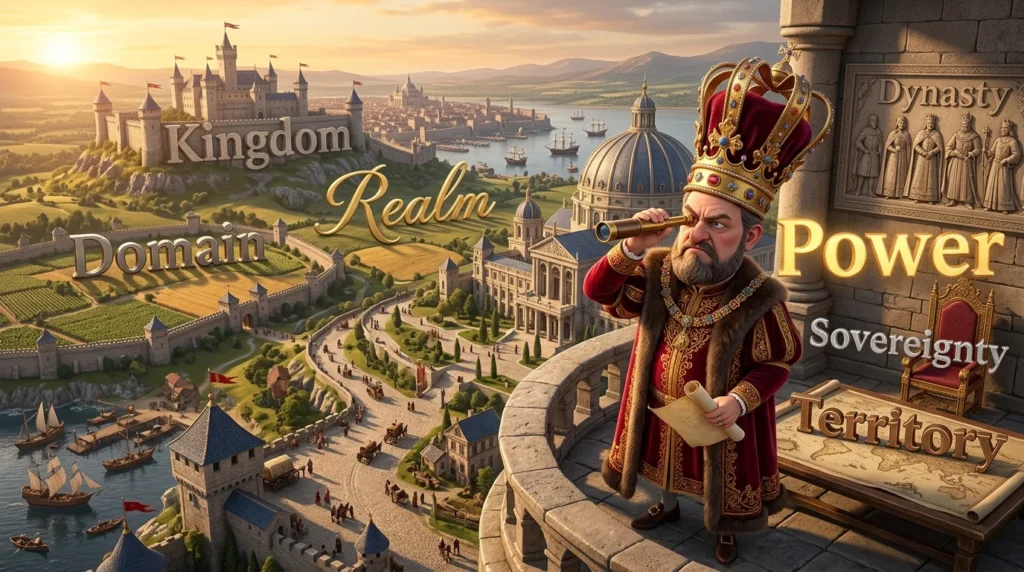
Quick Answer: What Are the Best Synonyms for Empire?
The best synonyms and related alternatives for empire include:
- Kingdom — a country or territory ruled by a monarch
- Realm — a kingdom, territory, or sphere of authority
- Dominion — an area controlled by a ruler or powerful authority
- Domain — an area of control, influence, or ownership
- Territory — a geographical area under control
- Dynasty — a succession of rulers from the same family
- Nation — a politically organized country or people
- State — an organized political territory
- Sovereignty — supreme political authority
- Federation — a union of states or regions
- Commonwealth — a political community or group of territories
- Realm — a sphere or region under authority
- Power — a politically or economically influential force
- Superpower — an exceptionally powerful state
- Dominance — control or superiority over others
- Hegemony — dominant influence over other states or groups
- Colossus — something exceptionally large or powerful
- Might — great power or strength
- Sphere of influence — an area where a power has significant influence
- Enterprise — a large business organization, especially in figurative use
The closest general alternatives are usually kingdom, realm, dominion, domain, and territory, but the right word depends on what aspect of empire you want to emphasize.
What Does “Empire” Mean?
An empire is traditionally a large political organization consisting of multiple territories, nations, or peoples controlled by a central authority.
For example:
The Roman Empire controlled vast territories across Europe, Africa, and Asia.
The word can also be used figuratively for a large and influential business or organization:
She built a successful media empire.
In this second meaning, empire suggests extensive wealth, influence, ownership, or power rather than literal political rule.
Main Meanings of “Empire”
1. A Large Political State
An empire can consist of multiple territories governed by one central authority.
The empire expanded rapidly across the region.
Useful alternatives:
- kingdom
- dominion
- realm
- state
- territory
2. A Historical Imperial Power
The word can refer to a historical political system or civilization.
The empire lasted for several centuries.
Useful related terms:
- dynasty
- imperial state
- kingdom
- civilization
- dominion
3. A Large Business Organization
In modern English, empire is frequently used metaphorically.
He built a business empire from a small company.
Possible alternatives:
- business network
- conglomerate
- corporation
- enterprise
- organization
4. A Sphere of Influence
Empire can also suggest extensive influence or dominance.
The company created an empire in the entertainment industry.
Possible alternatives:
- domain
- sphere of influence
- network
- power
- dominance
30+ Synonyms and Related Words for Empire
1. Kingdom
Kingdom is one of the closest alternatives when referring to a territory ruled by a monarch.
The ancient kingdom flourished for centuries.
However, kingdom is not identical to empire. An empire may contain multiple kingdoms or territories.
2. Realm
Realm refers to a kingdom, territory, or sphere of authority.
The ruler expanded his realm.
It can also be used figuratively:
She became a leading figure in the realm of technology.
3. Dominion
Dominion means control, authority, or a territory under a ruler’s control.
The king extended his dominion across the region.
It has a formal and historical tone.
4. Domain
Domain means an area of control, knowledge, activity, or influence.
The company established a dominant domain in the industry.
Unlike empire, it does not necessarily imply political rule.
5. Territory
Territory refers primarily to a geographical area under the control of a state, ruler, or organization.
The empire acquired new territory.
It is more geographically focused than empire.
6. Dynasty
A dynasty is a succession of rulers from the same family.
The dynasty ruled the region for generations.
A dynasty is not technically synonymous with an empire because it describes a ruling family or period of rule rather than the territory itself.
7. Nation
A nation is a politically organized people or country.
The nation became a major regional power.
It can sometimes replace empire when discussing a powerful state, but it does not necessarily imply imperial expansion.
8. State
State refers to a politically organized territory with its own government.
The state expanded its influence throughout the region.
It is a broad and neutral alternative.
9. Sovereignty
Sovereignty means supreme authority over a territory.
The country defended its sovereignty.
This refers to political authority rather than the state or empire itself.
10. Federation
A federation is a political union of states or regions under a central government.
The federation consisted of several semi-autonomous states.
It should not be used as a direct synonym for empire because the political structures are different.
11. Commonwealth
Commonwealth can refer to a political community or association of territories.
Several territories became part of the commonwealth.
It is often associated with political cooperation rather than imperial conquest.
12. Hegemony
Hegemony means dominant influence or leadership over other states or groups.
The country maintained regional hegemony.
It is particularly useful when empire means political or economic dominance rather than direct territorial control.
13. Superpower
A superpower is an exceptionally powerful country with major global influence.
The nation emerged as a global superpower.
This is a modern political term rather than a direct historical synonym for empire.
14. Power
Power can describe a state, organization, or individual with significant influence or authority.
The empire was one of the greatest powers of its era.
It is broader and less specific than empire.
15. Dominance
Dominance refers to superior power or control.
The company achieved dominance in the market.
It works especially well for figurative uses of empire.
16. Sphere of Influence
A sphere of influence is an area where a state or organization has substantial political, economic, or cultural influence.
The country expanded its sphere of influence.
Unlike an empire, direct ownership or political control is not necessarily implied.
17. Confederation
A confederation is an association of states or groups that cooperate while retaining significant independence.
The territories formed a confederation.
It is related to political organization but is not a direct synonym for empire.
18. Conglomerate
A conglomerate is a large organization made up of multiple businesses or companies.
The entrepreneur built a global business conglomerate.
This is especially useful when empire refers to a business organization.
19. Enterprise
Enterprise can refer to a business or large commercial organization.
She created a successful international enterprise.
It is a useful alternative to business empire in professional writing.
20. Corporation
A corporation is a legally recognized business organization.
He transformed the company into a multinational corporation.
It is more precise than empire when the subject is specifically a business.
21. Network
Network refers to a connected group of businesses, organizations, people, or operations.
She developed a vast media network.
It can replace empire when emphasizing connections rather than power.
22. Organization
Organization is a broad term for a structured group or institution.
The organization expanded internationally.
It is much more neutral than empire.
23. Civilization
Civilization refers to an advanced human society with developed political, cultural, and social systems.
The civilization left a lasting cultural legacy.
It can overlap with historical discussions of empires but does not mean the same thing.
24. Principality
A principality is a territory ruled by a prince or princess.
The small principality maintained its independence.
It is a specific political term rather than a general synonym.
25. Sultanate
A sultanate is a state ruled by a sultan.
The sultanate controlled important trade routes.
It may be appropriate when discussing particular historical political systems.
26. Caliphate
A caliphate historically refers to a political and religious system led by a caliph.
It is a specific historical and political term and should not be treated as a generic synonym for empire.
27. Imperial State
Imperial state is a formal descriptive phrase for a state that exercises imperial power.
The imperial state controlled numerous territories.
It is useful in historical and academic writing.
28. Colossus
Colossus figuratively describes something exceptionally large, powerful, or influential.
The company became an economic colossus.
It works especially well as a metaphorical alternative to empire.
29. Giant
Giant can describe a very large or powerful organization.
The technology giant expanded into new markets.
It is especially common in business journalism.
30. Powerhouse
Powerhouse describes an organization, country, or person with exceptional strength, success, or influence.
The company became an international powerhouse.
It is especially useful for modern business contexts.
31. Stronghold
A stronghold is a fortified place or a position of strength.
The region became a stronghold of the empire.
It is related to imperial power but is not a direct synonym.
32. Regime
Regime refers to a government or system of rule.
The regime controlled the region for decades.
It can be useful in historical contexts, although it often carries a different tone from empire.
Empire vs. Kingdom
An empire generally consists of multiple territories or peoples under centralized authority.
A kingdom is normally a territory ruled by a king or queen.
Compare:
The empire expanded across several kingdoms.
This shows why the two terms overlap but are not identical.
Empire vs. Realm
Realm is broader and can refer to a kingdom, territory, or sphere of influence.
The ruler expanded his realm.
Realm often sounds more literary or historical than empire.
Empire vs. Dominion
Dominion emphasizes control or authority over a territory.
The empire extended its dominion.
When the focus is on control rather than the political structure itself, dominion can be a strong alternative.
Empire vs. Domain
Domain generally means an area of control, expertise, ownership, or influence.
Technology became his domain.
Unlike empire, it does not inherently suggest political power or territorial expansion.
Empire vs. Dynasty
These words are frequently confused.
An empire is a political territory or system of power.
A dynasty is a succession of rulers from the same family.
For example:
The dynasty ruled the empire for several generations.
Empire vs. Hegemony
Empire can involve direct territorial control.
Hegemony focuses on dominance or influence over others.
A powerful country may have regional hegemony without formally controlling the territories around it.
Synonyms for Empire in Historical Writing
For historical contexts, the most useful words include:
- kingdom
- realm
- dominion
- dynasty
- imperial state
- territory
- sovereignty
- regime
- civilization
- sultanate
- principality
Example:
The empire controlled extensive territory.
Alternative:
The imperial state controlled extensive territory.
Synonyms for Empire in Business
When empire refers to a successful business organization, use:
- conglomerate
- corporation
- enterprise
- network
- organization
- business group
- powerhouse
- giant
Example:
She built a media empire.
Possible alternatives:
She built a media conglomerate.
She built a global media network.
She created a powerhouse media company.
Synonyms for Empire in Creative Writing
For dramatic or literary writing, consider:
- realm
- dominion
- kingdom
- colossus
- powerhouse
- stronghold
- dynasty
- sphere of influence
Example:
His empire stretched beyond the mountains.
More literary:
His dominion stretched beyond the mountains.
Synonyms for Empire in Modern Writing
For modern political or business contexts:
- superpower
- powerhouse
- giant
- conglomerate
- corporation
- network
- dominant power
- sphere of influence
These words often sound more natural than empire when discussing modern organizations.
Common Mistakes When Using Synonyms for Empire
Mistake 1: Treating “kingdom” and “empire” as identical
They overlap historically but describe different political structures.
Mistake 2: Using “dynasty” to mean territory
A dynasty is a ruling family or succession of rulers, not the territory they control.
Mistake 3: Using “domain” for every historical empire
Domain is much broader and can refer to knowledge, ownership, influence, or authority.
Mistake 4: Using “hegemony” when direct control is meant
Hegemony emphasizes influence and dominance. It does not necessarily mean direct political control.
Mistake 5: Using “corporation” for a historical empire
A corporation is a modern business structure. It should normally be used only when empire has a business-related meaning.
Choosing the Right Synonym for Empire
| If you mean… | Best choice |
|---|---|
| Territory ruled by a monarch | Kingdom |
| Historical area of authority | Realm |
| Controlled territory | Dominion |
| Area of influence or control | Domain |
| Geographical area | Territory |
| Family line of rulers | Dynasty |
| Political country | State |
| Exceptional global power | Superpower |
| Dominant influence | Hegemony |
| Large business group | Conglomerate |
| Large business | Corporation |
| Large influential company | Powerhouse |
| Connected group of businesses | Network |
| Exceptional size or power | Colossus |
Five Key Takeaways
- Kingdom, realm, dominion, domain, and territory are among the closest contextual alternatives to empire.
- Empire usually implies extensive political power, territorial control, or influence.
- Dynasty refers to a succession of rulers, not the territory they govern.
- For business contexts, conglomerate, corporation, enterprise, network, and powerhouse are often better alternatives.
- Hegemony is useful when the emphasis is on influence or dominance rather than direct territorial control.