
What Does Become Mean?
Become means to begin to be, grow into, change into, or develop into a particular state, condition, role, or identity.
Examples:
- She became a doctor.
- The weather became colder.
- He became more confident.
- The caterpillar became a butterfly.
- The situation became difficult.
- She wants to become successful.
The word can describe changes involving:
- Identity
- Profession
- Personality
- Condition
- Appearance
- Emotions
- Status
- Physical form
- Quality
- Circumstances
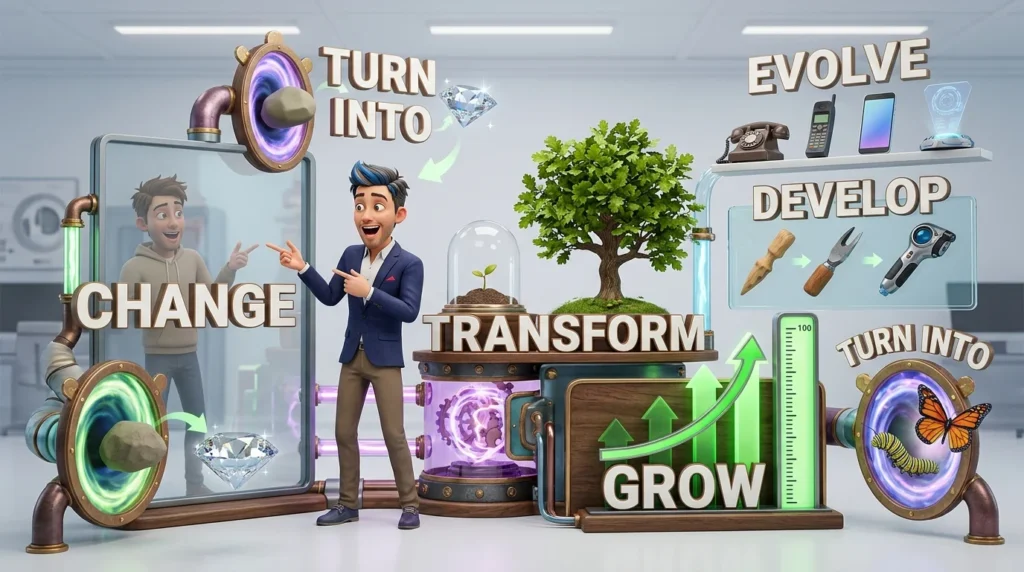
Quick Answer: Synonyms for Become
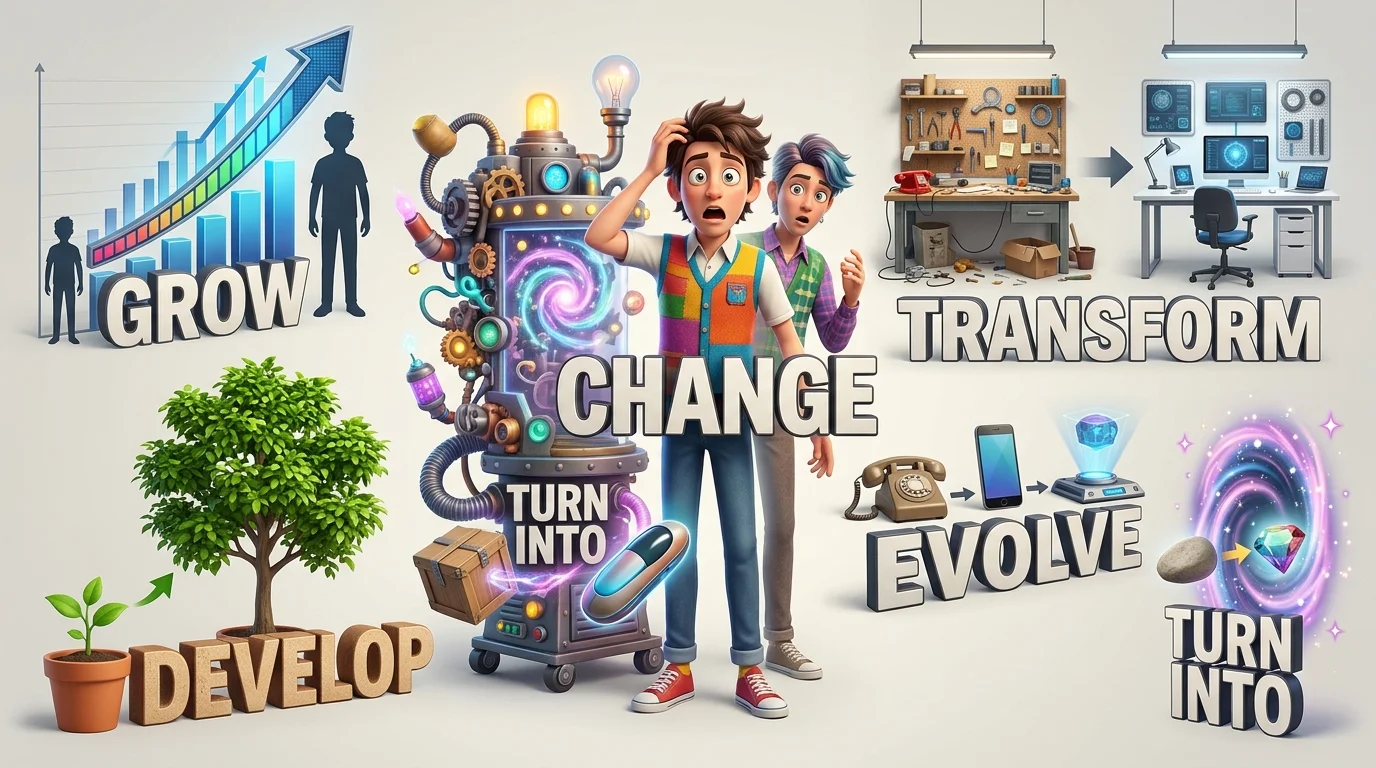
Here are 30+ useful synonyms and context-specific alternatives:
- Grow
- Develop
- Evolve
- Change
- Transform
- Turn into
- Turn
- Change into
- Convert into
- Transition
- Progress
- Advance
- Mature
- Emerge
- Arise
- Occur
- Reach
- Attain
- Achieve
- Assume
- Take on
- Acquire
- Gain
- Adopt
- Enter
- Move into
- Shift
- Adapt
- Graduate
- Flourish
- Improve
- Deteriorate
These are not all interchangeable. Some describe gradual development, some describe transformation, and others are appropriate only when become refers to a particular role, condition, or status.
1. Grow
Grow is one of the closest alternatives to become when a change happens gradually.
Example:
She became more confident.
She grew more confident.
It works particularly well with adjectives describing personality, emotions, abilities, and conditions.
Common examples:
- grow stronger
- grow older
- grow wiser
- grow confident
- grow impatient
- grow increasingly popular
Best for: Gradual changes over time.
2. Develop
Develop means to gradually acquire or form a quality, ability, condition, or characteristic.
Example:
He became an interest in photography.
A more natural construction is:
He developed an interest in photography.
Other examples:
She developed greater confidence.
The company developed into a major organization.
Best for: Skills, qualities, conditions, interests, businesses, and ideas.
3. Evolve
Evolve means to gradually develop or change into a more advanced, complex, or different form.
Example:
The small business became a global company.
The small business evolved into a global company.
It strongly emphasizes gradual development over time.
Best for: Businesses, ideas, systems, cultures, technologies, and organizations.
4. Change
Change is the broadest alternative when become describes a difference in condition, appearance, behavior, or state.
Example:
The weather became colder.
The weather changed.
However, change does not always preserve the exact meaning of become because it can describe alteration without specifying the resulting state.
5. Transform
Transform means to change something or someone significantly, often resulting in a substantially different form or condition.
Example:
The renovation transformed the old building.
For an intransitive construction:
The old building was transformed into a modern office.
Best for: Major changes, appearance, organizations, systems, and personal development.
6. Turn Into
Turn into is a natural phrase for changing from one thing or state into another.
Example:
The caterpillar became a butterfly.
The caterpillar turned into a butterfly.
It is especially common in everyday English.
Best for: Physical transformations and noticeable changes.
7. Turn
Turn can mean become when followed by an adjective or noun in certain constructions.
Examples:
The leaves turned yellow.
The milk turned sour.
He turned professional at the age of 20.
It is often more concise than become.
8. Change Into
Change into means to become something different, particularly in physical form or appearance.
Example:
The magician changed the paper into a flower.
The water changed into ice.
For personal transformation:
The experience changed her into a more confident person.
9. Convert Into
Convert into means to change something from one form, use, system, or condition into another.
Example:
The company converted the warehouse into offices.
It is more technical and specific than become.
Best for: Energy, currency, buildings, files, systems, and processes.
10. Transition
Transition means to move from one state, stage, role, or situation to another.
Example:
She became a manager.
She transitioned into a management role.
It emphasizes the process of moving between stages.
Best for: Careers, organizations, life stages, technology, and formal writing.
11. Progress
Progress means to move forward or develop toward a better, more advanced, or later stage.
Example:
The project became more advanced.
The project progressed significantly.
It does not replace become in every sentence, but it works when the change involves advancement.
12. Advance
Advance means to move forward or develop to a higher or later stage.
Example:
He became an experienced professional.
He advanced into a senior professional role.
It is particularly useful for careers, education, technology, and development.
13. Mature
Mature means to develop physically, mentally, emotionally, or professionally.
Example:
She became more mature with age.
She matured with age.
It emphasizes development rather than simply changing state.
14. Emerge
Emerge means to appear, become known, or develop into a recognizable position or form.
Example:
He became a leading figure in the industry.
He emerged as a leading figure in the industry.
It often suggests that a person, idea, trend, or situation becomes noticeable or established.
15. Arise
Arise means to come into existence or begin to occur.
Example:
A problem became apparent.
A problem arose.
It is useful when something comes into existence rather than when a person simply changes state.
16. Reach
Reach can replace become when someone or something arrives at a particular condition, stage, level, or point.
Example:
The company became profitable.
The company reached profitability.
Best for:
- reach maturity
- reach stability
- reach adulthood
- reach a certain level
- reach a stage
17. Attain
Attain means to achieve or reach a particular condition, level, status, or quality.
Example:
He became financially independent.
He attained financial independence.
It is more formal than become.
Best for: Goals, status, standards, maturity, and achievements.
18. Achieve
Achieve means successfully reach a desired result or state.
Example:
She became successful.
She achieved success.
Unlike become, achieve usually implies that the resulting state was accomplished through effort.
19. Assume
Assume means to take on a role, responsibility, position, or characteristic.
Example:
She became the company’s new director.
She assumed the role of the company’s new director.
It is particularly useful in formal and professional writing.
20. Take On
Take on means to accept or begin performing a new role, responsibility, or task.
Example:
He became the team leader.
He took on the role of team leader.
This is more natural in many workplace contexts than using become repeatedly.
21. Acquire
Acquire means to gain or obtain something over time.
Example:
She became knowledgeable about the subject.
She acquired extensive knowledge of the subject.
It focuses on obtaining a quality, skill, possession, or characteristic.
22. Gain
Gain means to obtain or develop something valuable or desirable.
Example:
He became more confident.
He gained confidence.
It is especially natural with nouns such as:
- gain experience
- gain confidence
- gain strength
- gain popularity
- gain knowledge
- gain recognition
23. Adopt
Adopt means to begin using or accepting a particular idea, behavior, method, or position.
Example:
The company became more environmentally conscious.
The company adopted a more environmentally conscious approach.
It describes a deliberate choice rather than a passive change.
24. Enter
Enter can express movement into a new stage, period, state, or condition.
Example:
The country became a period of economic growth.
A more natural sentence is:
The country entered a period of economic growth.
It is particularly useful with stages and periods.
25. Move Into
Move into means to begin operating or existing in a new area, role, stage, or condition.
Example:
The company became a technology business.
The company moved into the technology sector.
This is especially useful for business and career contexts.
26. Shift
Shift means to change from one position, condition, focus, or approach to another.
Example:
The company’s focus became more customer-oriented.
The company’s focus shifted toward customer needs.
It often emphasizes a change in direction rather than simple development.
27. Adapt
Adapt means to change in order to suit a new environment, condition, or situation.
Example:
The company became more flexible after the market changed.
The company adapted to the changing market.
It emphasizes responding successfully to change.
28. Graduate
Graduate can mean to progress from one stage to another, although its most common meaning relates to completing education.
Example:
The organization became a more sophisticated operation.
In specialized contexts, something can “graduate to” a more advanced stage.
The project graduated to a larger development phase.
This is less common than become and should be used selectively.
29. Flourish
Flourish means to develop successfully, grow strongly, or become successful.
Example:
The small business became successful.
The small business flourished.
It implies positive growth rather than merely becoming something.
30. Improve
Improve means to become better.
Example:
His skills became better over time.
His skills improved over time.
It works when become describes positive change.
31. Deteriorate
Deteriorate means to become worse in condition, quality, or effectiveness.
Example:
The situation became worse.
The situation deteriorated.
This is a useful precise alternative when the change is negative.
Synonyms for Become by Meaning
| Meaning of Become | Best Alternatives |
|---|---|
| General change | Change |
| Gradual change | Grow, develop |
| Long-term development | Evolve |
| Major transformation | Transform |
| Physical transformation | Turn into, change into |
| New role | Assume, take on |
| New stage | Enter, transition |
| Achieving a condition | Reach, attain |
| Achieving success | Achieve |
| Becoming better | Improve, flourish |
| Becoming worse | Deteriorate |
| Developing maturity | Mature |
| Becoming noticeable | Emerge |
| Changing direction | Shift |
| Adjusting to conditions | Adapt |
Synonyms for Become in Personal Development
When describing personal growth, useful alternatives include:
- Grow
- Develop
- Mature
- Evolve
- Progress
- Improve
- Advance
- Flourish
- Transform
Examples
She became more confident.
She grew more confident.
She developed greater confidence.
She matured emotionally.
She evolved into a confident leader.
Each sentence emphasizes a different aspect of development.
Synonyms for Become in Professional Writing
When describing career or workplace changes, consider:
- Assume
- Take on
- Transition into
- Move into
- Advance to
- Progress to
- Attain
- Enter
Examples
She became the department manager.
She assumed the role of department manager.
She took on the role of department manager.
She transitioned into a management position.
Synonyms for Become in Academic Writing
For academic writing, precise alternatives include:
- Develop
- Evolve
- Transform
- Transition
- Attain
- Reach
- Emerge
- Mature
- Shift
Example
Basic:
The theory became more widely accepted.
More precise:
The theory gained wider acceptance.
Or:
The theory emerged as a widely accepted explanation.
Synonyms for Become in Business Writing
Useful professional alternatives include:
- Develop
- Evolve
- Expand
- Transform
- Transition
- Grow
- Advance
- Shift
- Move into
- Enter
Example
The company became a major industry player.
Possible alternatives:
The company grew into a major industry player.
The company evolved into a major industry player.
The company emerged as a major industry player.
Become vs. Grow
Become is general.
Grow emphasizes gradual change or development.
She became impatient.
She grew impatient.
Both are natural, but grew impatient strongly suggests that the feeling developed over time.
Become vs. Develop
Develop emphasizes the formation or acquisition of something over time.
He became more skilled.
He developed greater skill.
The second focuses more on the process of gaining the skill.
Become vs. Evolve
Evolve strongly suggests gradual development.
The business became a global organization.
The business evolved into a global organization.
The second emphasizes the journey and development over time.
Become vs. Transform
Transform suggests a significant or fundamental change.
The old building became a modern office.
The old building was transformed into a modern office.
The second emphasizes the magnitude of the change.
Become vs. Turn Into
Turn into is often more conversational and vivid.
The caterpillar became a butterfly.
The caterpillar turned into a butterfly.
Both are natural, but turn into is particularly common when describing physical transformation.
Become vs. Achieve
These words are not interchangeable in every context.
She became successful.
She achieved success.
Become describes entering a new state.
Achieve emphasizes successfully reaching that state, often through effort.
Become vs. Attain
Attain is more formal and usually suggests reaching a desired level, status, or condition.
He became financially independent.
He attained financial independence.
The second sounds more formal and achievement-oriented.
Become vs. Assume
Assume works when someone takes on a role, responsibility, or position.
She became the director.
She assumed the position of director.
It does not normally replace become for physical or emotional changes.
Common Collocations With Become
Some of the most common expressions include:
- become aware
- become available
- become difficult
- become important
- become necessary
- become popular
- become successful
- become famous
- become independent
- become responsible
- become involved
- become interested
- become familiar
- become confident
- become stronger
- become weaker
- become better
- become worse
- become clear
- become apparent
- become known
- become possible
- become impossible
- become common
- become widespread
- become effective
- become established
- become successful
- become a leader
- become a professional
- become a member
- become a problem
Sentence Transformations
General Change
Original:
The weather became colder.
Alternative:
The weather grew colder.
Gradual Development
Original:
She became more confident.
Alternative:
She developed greater confidence.
Major Transformation
Original:
The small business became a global company.
Alternative:
The small business evolved into a global company.
Physical Transformation
Original:
The ice became water.
Alternative:
The ice turned into water.
Career Change
Original:
He became the team leader.
Alternative:
He assumed the role of team leader.
Negative Change
Original:
The situation became worse.
Alternative:
The situation deteriorated.
Common Mistakes When Using Become Synonyms
1. Using transform for every small change
Transform suggests a substantial change. It is too strong for minor changes.
2. Using achieve instead of become everywhere
Achieve usually implies reaching a desired result through effort.
3. Using evolve for sudden changes
Evolve normally suggests gradual development.
4. Using assume for physical transformation
You can assume a role, but you would not normally say something assumed into a butterfly.
5. Using develop when the change is sudden
Develop often implies gradual formation.
6. Using improve when the change is neutral
Improve specifically means becoming better.
7. Using deteriorate for every negative change
Deteriorate specifically means becoming worse in condition, quality, or effectiveness.
8. Confusing become with turn into
Turn into is particularly useful for transformation from one form or state into another, while become is much broader.
How to Choose the Right Synonym for Become
Use this quick decision guide:
- General change → Become / Change
- Gradual personal change → Grow
- Development of a quality or skill → Develop
- Long-term evolution → Evolve
- Major transformation → Transform
- Physical transformation → Turn into
- New role or responsibility → Assume / Take on
- New stage or period → Enter / Transition into
- Reaching a condition → Reach / Attain
- Reaching success → Achieve
- Becoming better → Improve
- Becoming worse → Deteriorate
- Becoming mature → Mature
- Becoming noticeable or established → Emerge
- Changing direction → Shift
- Adjusting to new conditions → Adapt
- Growing successfully → Flourish
Key Takeaways
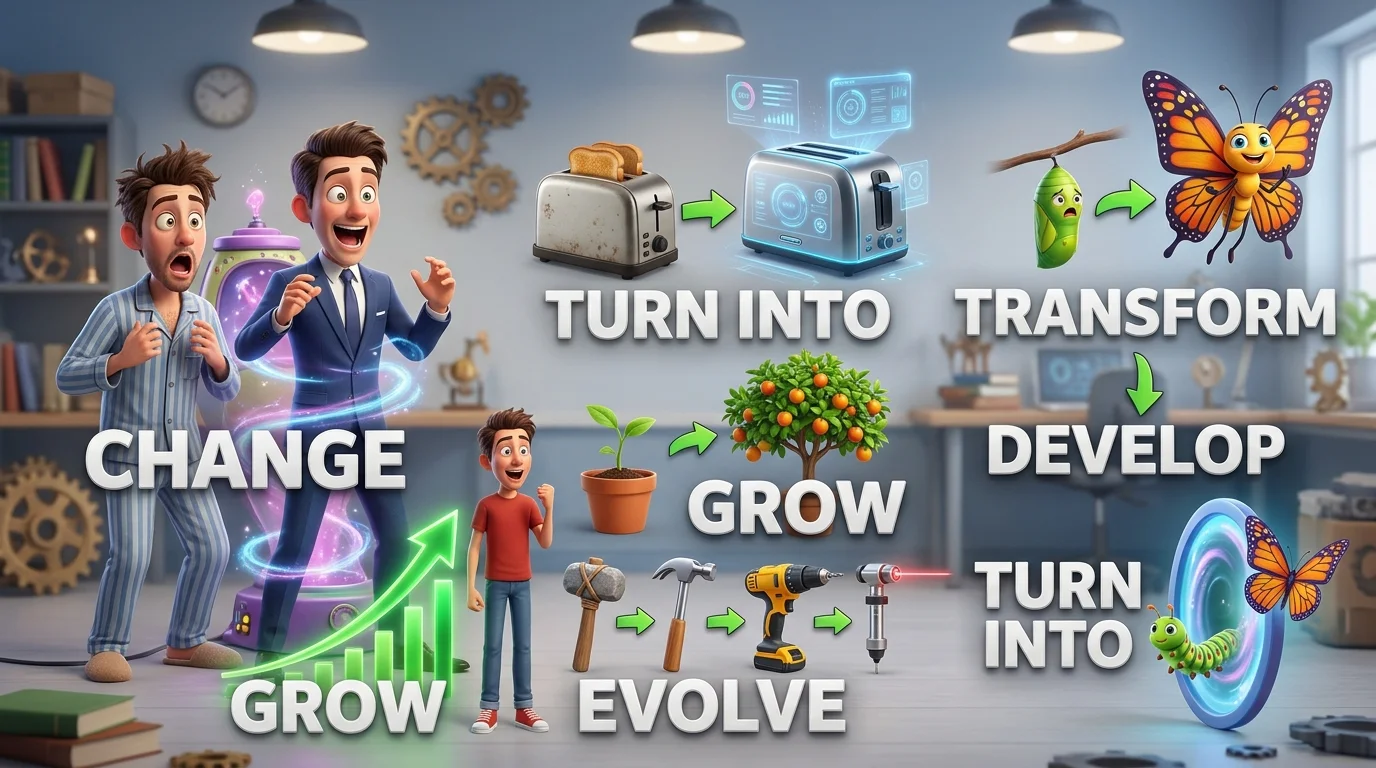
- Become is a broad verb that describes entering a new state, condition, role, or identity.
- Grow, develop, and evolve are especially useful when the change happens gradually.
- Transform, turn into, and change into are better when a significant or noticeable transformation occurs.
- Assume, take on, attain, and reach work in specific contexts involving roles, responsibilities, statuses, or conditions.
- Always choose the synonym according to the type, speed, direction, and purpose of the change rather than simply replacing become with any change-related verb.