
What Does “Ambiguous” Mean?
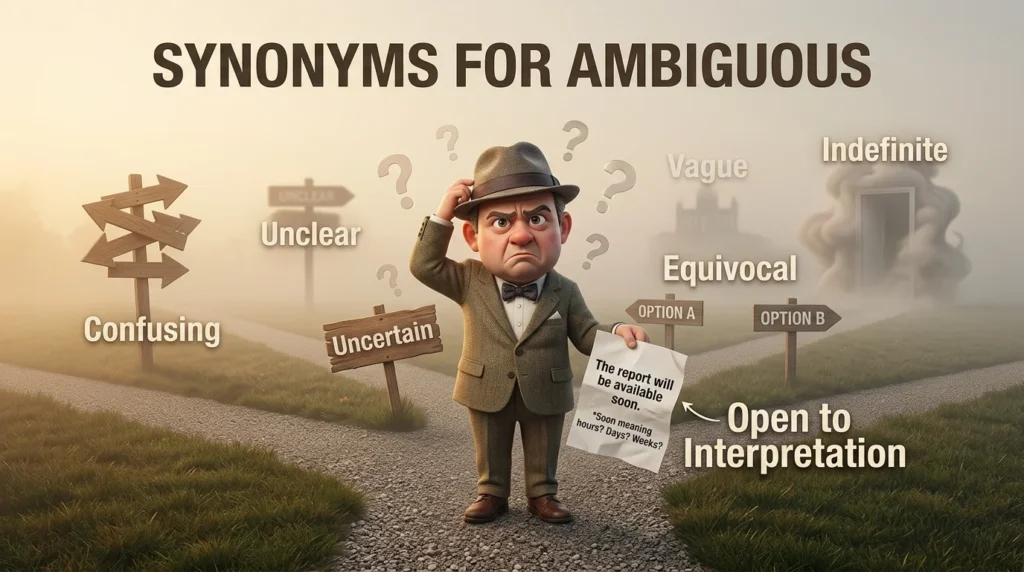
Ambiguous is an adjective used when something has more than one possible meaning or interpretation, making its intended meaning uncertain.
Examples
- His answer was ambiguous.
- The contract contains an ambiguous clause.
- Her message was ambiguous.
- The instructions were too ambiguous to follow.
The key idea is multiple possible interpretations.
For example:
“I saw the man with the telescope.”
This sentence can mean that I used a telescope to see the man or that the man had the telescope. The sentence is therefore ambiguous.
This is different from something that is simply difficult to understand.
Quick List of Synonyms for Ambiguous
Here are useful alternatives to ambiguous:
- Unclear
- Vague
- Uncertain
- Equivocal
- Indefinite
- Doubtful
- Obscure
- Confusing
- Puzzling
- Cryptic
- Ambivalent
- Open-ended
- Indeterminate
- Inconclusive
- Unresolved
- Unspecified
- Imprecise
- Fuzzy
- Murky
- Hazy
- Confounded
- Dubious
- Questionable
- Mysterious
- Enigmatic
- Baffling
- Perplexing
- Uncertainly worded
- Double-edged
- Two-sided
- Noncommittal
- Indistinct
- Interpretive
- Polysemous
- Open to interpretation
Not all of these are exact synonyms. Some emphasize lack of clarity, some multiple interpretations, some uncertainty, and others mystery or lack of precision.
1. Unclear
Unclear is the broadest and most natural alternative to ambiguous. It means something is difficult to understand or its meaning is not obvious.
Examples:
- The instructions were unclear.
- His response was unclear.
- It is unclear what she meant.
Best for: Everyday, professional, academic, and general writing.
Unlike ambiguous, unclear does not necessarily mean there are two or more possible interpretations.
2. Vague
Vague describes something that lacks specific details, precision, or definite boundaries.
Examples:
- He gave a vague answer.
- The instructions were too vague.
- She had only a vague idea of the plan.
Ambiguous vs. Vague
Ambiguous = can have multiple possible meanings.
Vague = lacks enough detail or precision.
For example:
“Meet me sometime later.”
This is vague because sometime later does not specify when.
“I’ll meet you at the bank.”
This can be ambiguous because bank could refer to a financial institution or the side of a river.
3. Uncertain
Uncertain means not known, definite, or sure.
Examples:
- The outcome remains uncertain.
- His intentions are uncertain.
- The future of the project is uncertain.
It focuses more on lack of certainty than multiple meanings.
4. Equivocal
Equivocal is a formal word describing language that is deliberately unclear, open to different interpretations, or unwilling to give a definite answer.
Examples:
- The politician gave an equivocal response.
- His statement was deliberately equivocal.
- She remained equivocal about the proposal.
Best for: Formal, academic, legal, political, and professional writing.
It can suggest deliberate avoidance of commitment.
5. Indefinite
Indefinite means not clearly fixed, defined, or limited.
Examples:
- The meeting was postponed for an indefinite period.
- He gave an indefinite answer.
- The boundaries remain indefinite.
It is useful when something lacks a clear limit or definition.
6. Doubtful
Doubtful means uncertain or unlikely to be true, correct, or successful.
Examples:
- His explanation is doubtful.
- It is doubtful whether the plan will succeed.
- The accuracy of the report is doubtful.
It usually emphasizes uncertainty or lack of confidence, rather than multiple meanings.
7. Obscure
Obscure describes something difficult to understand, identify, or interpret because it is not clear or well known.
Examples:
- The meaning of the poem is obscure.
- The document contains several obscure references.
- The author’s argument was obscure.
It often suggests that something is difficult to understand because it is hidden, complicated, or unfamiliar.
8. Confusing
Confusing means difficult to understand because something is unclear, complicated, contradictory, or poorly presented.
Examples:
- The instructions were confusing.
- His explanation was confusing.
- The situation became confusing.
It is common and natural in everyday English.
9. Puzzling
Puzzling describes something that is difficult to explain or understand.
Examples:
- Her sudden decision was puzzling.
- The results were puzzling.
- His response was rather puzzling.
It often suggests that something makes the reader or listener wonder what it means.
10. Cryptic
Cryptic means mysterious, difficult to understand, or expressed in a way that hides the meaning.
Examples:
- He sent me a cryptic message.
- Her answer was cryptic.
- The note contained a cryptic warning.
It is stronger and more mysterious than ordinary unclear.
11. Ambivalent
Ambivalent means having mixed or contradictory feelings about something.
Examples:
- She felt ambivalent about moving abroad.
- He was ambivalent about accepting the offer.
- The public remains ambivalent about the proposal.
Important Difference
Ambiguous usually describes language, meanings, statements, or situations.
Ambivalent usually describes mixed feelings or attitudes.
They are not interchangeable in most contexts.
12. Open-Ended
Open-ended describes something that does not have one fixed answer, outcome, or interpretation.
Examples:
- The interviewer asked an open-ended question.
- The discussion remained open-ended.
- The story has an open-ended conclusion.
It is not necessarily negative. An open-ended question may intentionally allow many answers.
13. Indeterminate
Indeterminate means not clearly established, decided, or determined.
Examples:
- The cause remains indeterminate.
- The results were indeterminate.
- The exact date is indeterminate.
This is more formal than unclear.
14. Inconclusive
Inconclusive means failing to provide a definite answer or result.
Examples:
- The evidence was inconclusive.
- The investigation produced inconclusive results.
- The test was inconclusive.
It is particularly useful when evidence does not establish one clear conclusion.
15. Unresolved
Unresolved describes an issue, question, or problem that has not been settled or answered.
Examples:
- Several questions remain unresolved.
- The dispute is still unresolved.
- The meaning of the statement remains unresolved.
It focuses on lack of resolution, not necessarily ambiguity.
16. Unspecified
Unspecified means not clearly stated, identified, or provided.
Examples:
- The contract contains an unspecified fee.
- The exact location remains unspecified.
- The reason for the decision was unspecified.
It is useful when information has simply not been provided.
17. Imprecise
Imprecise means lacking exactness, accuracy, or specificity.
Examples:
- His language was imprecise.
- The instructions were too imprecise.
- The report uses imprecise terminology.
Ambiguous vs. Imprecise
Ambiguous = allows multiple interpretations.
Imprecise = lacks exactness.
A statement can be imprecise without being ambiguous.
18. Fuzzy
Fuzzy is an informal word for something that is unclear, poorly defined, or difficult to understand.
Examples:
- The rules are still fuzzy.
- I have a fuzzy understanding of the process.
- The distinction between the two terms is fuzzy.
It is suitable for casual writing but usually not formal academic writing.
19. Murky
Murky means difficult to understand, explain, or determine.
Examples:
- The situation remains murky.
- The details of the deal are murky.
- His motives are still murky.
It often suggests that information is hidden, complicated, or uncertain.
20. Hazy
Hazy means unclear or poorly remembered, understood, or defined.
Examples:
- My memory of the event is hazy.
- The details remain hazy.
- His explanation left the issue hazy.
It is often used for memories, plans, ideas, and details.
21. Dubious
Dubious means uncertain, questionable, or unlikely to be trustworthy or true.
Examples:
- The claim is dubious.
- He provided a dubious explanation.
- The source’s reliability is dubious.
It often expresses skepticism, not simply ambiguity.
22. Questionable
Questionable means uncertain, doubtful, or open to criticism.
Examples:
- The report contains questionable information.
- His decision was questionable.
- The accuracy of the statement is questionable.
It often carries a negative or skeptical tone.
23. Mysterious
Mysterious describes something that is difficult to explain, understand, or identify.
Examples:
- She received a mysterious message.
- The circumstances remain mysterious.
- His disappearance was mysterious.
It emphasizes mystery, rather than multiple meanings.
24. Enigmatic
Enigmatic means mysterious, puzzling, or difficult to understand.
Examples:
- He gave an enigmatic smile.
- The author’s statement was enigmatic.
- She has an enigmatic personality.
It is more literary and sophisticated than unclear.
25. Baffling
Baffling means extremely confusing or difficult to understand.
Examples:
- The decision was baffling.
- His behavior was baffling.
- The results were completely baffling.
It emphasizes the strong reaction of confusion.
26. Perplexing
Perplexing means confusing and difficult to explain or understand.
Examples:
- The situation was perplexing.
- Her response was perplexing.
- The evidence presented a perplexing problem.
It is a formal-to-neutral alternative to confusing.

27. Noncommittal
Noncommittal describes someone or something that avoids giving a definite opinion, answer, or commitment.
Examples:
- He gave a noncommittal response.
- The company remained noncommittal about the merger.
- Her answer was deliberately noncommittal.
It is particularly useful when ambiguity comes from avoiding a clear position.
28. Indistinct
Indistinct means not clearly defined, recognized, or distinguished.
Examples:
- The image was indistinct.
- The boundaries were indistinct.
- His voice was indistinct.
It is often used for physical appearance, sounds, boundaries, or distinctions.
29. Open to Interpretation
The phrase open to interpretation means that something can reasonably be understood in different ways.
Examples:
- The final paragraph is open to interpretation.
- The law is open to interpretation.
- His comments are open to interpretation.
This is one of the most precise phrases when you specifically mean multiple possible interpretations.
30. Polysemous
Polysemous is a technical linguistic term describing a word that has multiple related meanings.
Example:
- The word “head” is polysemous because it has several related meanings.
It is not a general replacement for ambiguous. Instead, it describes a linguistic property.
31. Two-Sided
Two-sided can describe something that has two possible aspects, interpretations, or perspectives.
Examples:
- The issue is more two-sided than it first appears.
- His argument presented a two-sided view.
However, this is usually a contextual alternative rather than a direct synonym.
32. Double-Edged
Double-edged describes something that has two contrasting effects or implications.
Examples:
- The decision was double-edged.
- Social media can be a double-edged tool.
- His statement had a double-edged meaning.
It does not simply mean ambiguous; it suggests two opposing or contrasting sides.
33. Interpretive
Interpretive relates to explaining or assigning meaning to something.
Examples:
- The artwork allows for an interpretive reading.
- The passage invites an interpretive approach.
It should not normally be used as a direct synonym for ambiguous, but it can be useful when discussing texts with multiple possible readings.
Ambiguous vs. Unclear
These words are close but not identical.
| Word | Main Meaning |
|---|---|
| Ambiguous | Has multiple possible interpretations |
| Unclear | Difficult to understand or not obvious |
For example:
The instructions are unclear.
This simply means you do not understand them.
The instructions are ambiguous.
This suggests that the instructions could reasonably mean different things.
Ambiguous vs. Vague
This is another important distinction.
Vague means lacking detail.
Ambiguous means capable of more than one interpretation.
Vague:
“I’ll arrive later.”
The word later is not specific.
Ambiguous:
“I saw her duck.”
This could mean that I saw the woman lower her head, or that I saw the bird belonging to her.
Ambiguous vs. Uncertain
Ambiguous usually concerns meaning or interpretation.
Uncertain concerns knowledge, confidence, or outcome.
The sentence is ambiguous.
The outcome is uncertain.
The first concerns meaning; the second concerns what will happen.
Ambiguous vs. Equivocal
Equivocal is often used when someone gives an intentionally unclear or noncommittal response.
The politician gave an ambiguous answer.
This means the answer could be interpreted in different ways.
The politician gave an equivocal answer.
This can suggest that the politician deliberately avoided taking a clear position.
Ambiguous vs. Confusing
Confusing describes something that causes difficulty in understanding.
Ambiguous specifically points to multiple possible interpretations.
Something can be confusing without being ambiguous.
For example, a very technical scientific explanation may be confusing but perfectly precise.
Best Synonyms for Ambiguous by Context
| Context | Best Alternative |
|---|---|
| General meaning | Unclear |
| Lack of detail | Vague |
| Multiple meanings | Open to interpretation |
| Formal writing | Equivocal |
| Legal language | Indeterminate / unclear |
| Uncertain outcome | Uncertain |
| Unclear evidence | Inconclusive |
| Mysterious message | Cryptic |
| Difficult idea | Obscure |
| Mixed feelings | Ambivalent |
| Avoiding commitment | Noncommittal |
| Difficult to explain | Perplexing |
| Poor precision | Imprecise |
| Hidden details | Murky |
| Literary mystery | Enigmatic |
| No fixed answer | Open-ended |
| Linguistics | Polysemous |
Synonyms for Ambiguous in Formal Writing
For academic, legal, professional, and analytical writing, useful alternatives include:
- Equivocal
- Indeterminate
- Unclear
- Imprecise
- Inconclusive
- Unspecified
- Indefinite
- Obscure
- Noncommittal
Example
Instead of:
The results were ambiguous.
You might write:
The results were inconclusive.
if the evidence failed to establish a definite conclusion.
Or:
The wording was equivocal.
if the language allowed different interpretations.
Synonyms for Ambiguous in Casual Writing
In everyday English, these words are more natural:
- Unclear
- Vague
- Confusing
- Fuzzy
- Murky
- Puzzling
- Uncertain
Example
His message was really unclear.
Or:
Her answer was kind of vague.
These usually sound more natural in conversation than equivocal or indeterminate.
Strong Synonyms for Ambiguous
When something is particularly difficult to interpret, consider:
- Cryptic
- Obscure
- Enigmatic
- Perplexing
- Baffling
- Highly equivocal
- Deeply unclear
However, these words emphasize different qualities. Cryptic suggests hidden meaning, while baffling emphasizes confusion.
Common Mistakes When Using Synonyms for Ambiguous
Mistake 1: Treating “vague” as an exact synonym
Vague means lacking detail, while ambiguous means having multiple possible interpretations.
Mistake 2: Using “ambivalent” for unclear language
Ambivalent normally describes mixed or conflicting feelings, not unclear wording.
She was ambivalent about the offer.
This means she had mixed feelings.
Mistake 3: Using “uncertain” for every ambiguous statement
Uncertain often describes a lack of knowledge or confidence.
The outcome is uncertain.
That does not mean the outcome has multiple meanings.
Mistake 4: Using “confusing” when you mean “open to interpretation”
A statement may be perfectly understandable but still ambiguous because it has two possible meanings.
Mistake 5: Using “cryptic” for ordinary unclear writing
Cryptic suggests mystery, hidden meaning, or deliberately puzzling language. It is stronger than ordinary ambiguous.
How to Choose the Right Synonym for Ambiguous
Ask what makes the meaning difficult to determine:
- Does it have multiple possible meanings?
Use ambiguous or open to interpretation. - Does it lack specific details?
Use vague. - Is it simply difficult to understand?
Use unclear or confusing. - Is someone avoiding a definite answer?
Use equivocal or noncommittal. - Is the meaning mysterious or hidden?
Use cryptic or enigmatic. - Is the evidence unable to provide a definite conclusion?
Use inconclusive or indeterminate.
Sentence Transformations
Original
His answer was ambiguous.
General
His answer was unclear.
Lack of detail
His answer was vague.
Multiple interpretations
His answer was open to interpretation.
Formal
His answer was equivocal.
Mysterious
His answer was cryptic.
Difficult to understand
His answer was confusing.
Avoiding commitment
His answer was noncommittal.
Strongly puzzling
His answer was perplexing.
Five Key Takeaways
- Ambiguous specifically suggests that something has two or more possible interpretations.
- Unclear is the broadest and safest alternative for general writing.
- Vague means lacking detail, while ambiguous means open to multiple interpretations.
- Equivocal and noncommittal are useful when someone avoids giving a definite answer.
- Cryptic, enigmatic, obscure, and perplexing add stronger ideas of mystery or difficulty.