
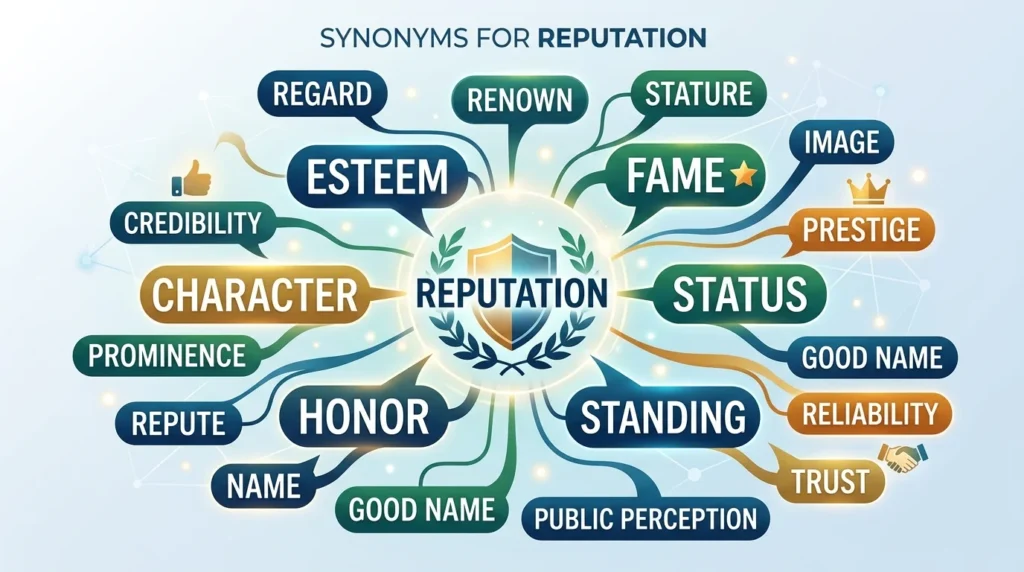
Quick synonym list
- standing — position or reputation within a community or profession
- image — the impression people have of someone or something
- status — social or professional position
- prestige — respect and admiration associated with high status
- credibility — the quality of being trusted or believed
- renown — widespread fame or recognition
- fame — being widely known
- recognition — being known or acknowledged for achievements
- respect — admiration or esteem
- regard — respect or favorable opinion
- esteem — high respect and admiration
- name — a person’s or organization’s public reputation
- character — moral qualities and integrity
- record — past performance or history that shapes reputation
- perception — how people understand or view someone or something
- public image — the impression presented to the public
- professional standing — reputation within a career or industry
- authority — recognized expertise or influence
- influence — ability to affect others because of one’s position or reputation
- distinction — recognition for excellence or achievement
- notoriety — widespread attention, usually for something negative
- infamy — a very bad reputation
- ill repute — a negative reputation
- disrepute — a loss of respect or trust
- good name — a favorable reputation
- honor — high respect based on good character or conduct
- trustworthiness — quality of being worthy of trust
- reliability — quality of being dependable
- professional image — how someone is perceived professionally
What Does “Reputation” Mean?
A reputation is the general opinion or belief that people have about a person, organization, place, product, or thing.
The company has a strong reputation for customer service.
She has a reputation for being reliable.
The restaurant built a reputation for excellent food.
A reputation develops from what people observe, experience, hear, or believe about something over time.
The word can be positive, negative, or neutral:
- a good reputation
- a strong reputation
- an excellent reputation
- a solid reputation
- a poor reputation
- a bad reputation
- a controversial reputation
- a growing reputation
- a worldwide reputation
Because reputation covers several ideas at once, the best synonym depends on whether you are talking about public perception, trust, respect, fame, moral character, professional standing, or past performance.
The Closest Synonyms for Reputation
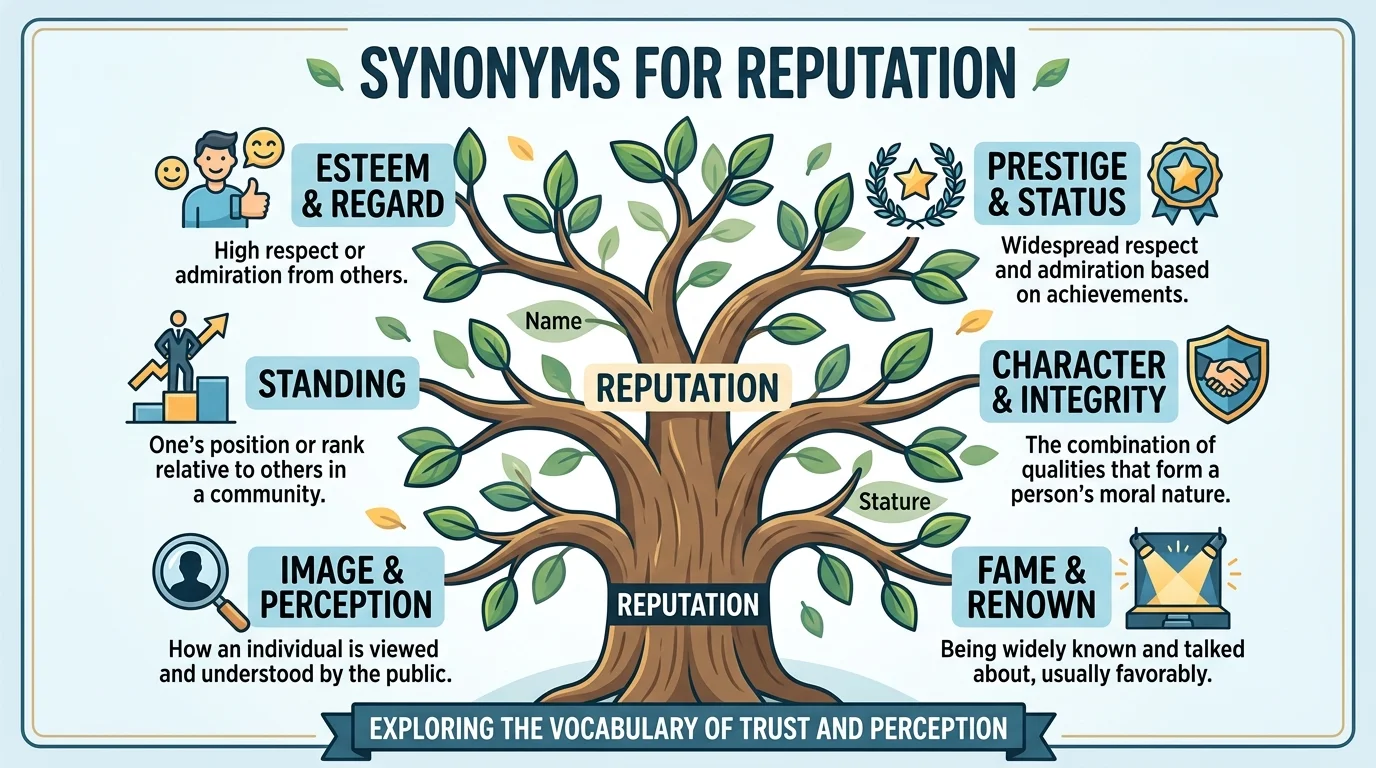
Standing
Standing is one of the closest alternatives to reputation, especially when discussing someone’s position within a profession, organization, or community.
She has an excellent reputation in the industry.
She has excellent standing in the industry.
Standing emphasizes the person’s position and the respect they have earned.
Best for: professionals, academics, organizations, communities, industries.
Common expressions include:
- professional standing
- social standing
- academic standing
- standing in the community
- standing among peers
Image
Image refers to the impression people have of a person, company, brand, or organization.
The company has a good reputation.
The company has a strong image.
There is an important distinction: a reputation develops from what people generally believe about an entity, while an image can be deliberately shaped through branding, advertising, public relations, or presentation.
Best for: brands, companies, celebrities, politicians, organizations, public figures.
Status
Status describes someone’s position, rank, or standing in society or a particular group.
The university has a strong reputation.
The university has high status.
However, status does not necessarily mean reputation. Someone can have high social status without being especially well regarded.
Best for: social position, professional position, prestige, rank.
Prestige
Prestige means the respect, admiration, or importance associated with high status or achievement.
The university has an excellent reputation.
The university has considerable prestige.
Prestige is strongly positive. You would not normally use it for a bad reputation.
Best for: universities, awards, professions, institutions, companies, positions.
Credibility
Credibility means the quality of being believable, trustworthy, and worthy of confidence.
The journalist has a strong reputation for accuracy.
The journalist has strong credibility.
This is more specific than reputation. A person can have a broad reputation that says nothing specifically about whether they are credible.
Best for: journalists, experts, researchers, businesses, sources, professionals, institutions.
Renown
Renown means widespread fame or recognition, usually resulting from notable achievements.
The scientist gained a reputation for groundbreaking research.
The scientist gained renown for groundbreaking research.
It is more formal and literary than fame.
Best for: artists, scholars, scientists, leaders, historical figures, achievements.
Fame
Fame means being widely known.
The actor developed a reputation around the world.
The actor gained fame around the world.
But fame only tells us that someone is well known. It does not necessarily tell us whether people think positively or negatively of them.
Compare:
He has a reputation for honesty.
This means people associate him with honesty.
He has fame.
This simply means he is widely known.
Reputation as Respect and Admiration
Sometimes reputation refers specifically to the respect someone has earned.
Respect
Respect means admiration or appreciation for someone’s qualities, abilities, or conduct.
She has a reputation as an excellent leader.
She has earned widespread respect as an excellent leader.
Respect is often personal or emotional, while reputation describes the broader public opinion.
Regard
Regard means respect, esteem, or a favorable opinion.
He is held in high regard by his colleagues.
This is a useful alternative when the focus is on how positively someone is viewed.
Common expression:
held in high regard
The professor is held in high regard by her students.
Esteem
Esteem means strong respect and admiration.
The researcher has a strong reputation among her peers.
The researcher is held in high esteem among her peers.
It is more formal than respect and often appears in professional or literary writing.
Honor
Honor can refer to the respect and good reputation associated with someone who behaves honorably.
His reputation for integrity earned him respect.
His honor and integrity earned him respect.
Honor is not a general synonym for reputation. It emphasizes moral worth, dignity, or respect.
Reputation as Public Perception
Perception
Perception means the way people understand, interpret, or view someone or something.
The company’s reputation has changed.
The public’s perception of the company has changed.
This is particularly useful in business, marketing, politics, psychology, and communications.
Reputation and perception overlap, but perception can be temporary or based on a particular issue.
Public Image
Public image means the impression a person, company, organization, or brand creates in the eyes of the public.
The company is trying to improve its reputation.
The company is trying to improve its public image.
This phrase is especially useful when discussing branding or public relations.
Impression
Impression means the idea or feeling someone or something creates in another person’s mind.
The business has a reputation for professionalism.
The business creates an impression of professionalism.
Impression can be formed after a single encounter, whereas reputation usually suggests a broader or longer-established opinion.
View
View can mean an opinion or judgment about someone or something.
The company has a poor reputation among customers.
Customers have a poor view of the company.
It is simple and conversational, but less precise than reputation in many professional contexts.
Reputation Based on Trust
Credibility
As noted earlier, credibility is particularly useful when reputation is based on whether someone or something can be trusted or believed.
The source has a reputation for accuracy.
The source has strong credibility.
Use it when the important question is:
“Can I trust this person, source, claim, or organization?”
Trustworthiness
Trustworthiness describes the quality of being worthy of trust.
The company has a reputation for honesty.
The company’s trustworthiness is widely recognized.
It focuses specifically on reliability, honesty, and integrity.
Reliability
Reliability means being dependable and consistently performing as expected.
The brand has a reputation for dependable products.
The brand has a reputation for reliability.
This is especially useful for products, services, employees, systems, and businesses.
Integrity
Integrity refers to strong moral principles and honesty.
The lawyer has a reputation for honesty and ethical behavior.
The lawyer is known for integrity.
Integrity is a quality that can contribute to a good reputation, but it is not itself a complete synonym for reputation.
Reputation Based on Achievement
Recognition
Recognition means being known, acknowledged, or appreciated for something.
The scientist developed a reputation for her research.
The scientist gained recognition for her research.
Recognition often focuses on achievements rather than overall public opinion.
Distinction
Distinction means excellence or a quality that makes someone notable.
He built a reputation as an outstanding scholar.
He achieved distinction as a scholar.
This is formal and often associated with academic, professional, or artistic achievement.
Authority
Authority can mean recognized expertise or influence in a particular field.
She has a reputation as an expert in linguistics.
She is an authority on linguistics.
This is stronger and more specific than reputation. Calling someone an authority implies recognized expertise.
Influence
Influence describes the ability to affect people’s opinions, decisions, or behavior.
The organization has a strong reputation in the industry.
The organization has considerable influence in the industry.
A good reputation can create influence, but the concepts are not identical.
Reputation Based on Past Behavior
Record
Record refers to someone’s history of actions, achievements, decisions, or performance.
The company has a reputation for delivering projects on time.
The company has a strong record of delivering projects on time.
Record is especially useful when the evidence for a reputation comes from measurable past performance.
Common phrases include:
- track record
- employment record
- safety record
- academic record
- performance record
- criminal record
Track Record
Track record is a particularly useful alternative when discussing proven past performance.
She has a reputation for successful projects.
She has a strong track record of successful projects.
It is common in business and professional writing.
Character
Character refers to the moral and personal qualities of an individual.
He has a reputation for honesty.
His character is known for its integrity.
Character is not exactly the same as reputation. Character concerns what someone is like, while reputation concerns what other people believe about them.
That distinction is important:
Character is who you are; reputation is what others think you are.
Negative Synonyms for Reputation
Not every synonym for reputation is positive.
Notoriety
Notoriety means being widely known for something negative or controversial.
The politician gained a reputation for corruption.
The politician gained notoriety for corruption.
It emphasizes undesirable fame.
Infamy
Infamy means widespread recognition for something extremely bad or disgraceful.
The dictator became known for his brutal reputation.
The dictator achieved infamy for his brutality.
It is much stronger than notoriety.
Disrepute
Disrepute means a loss or state of diminished respect or trust.
The organization fell into disrepute after the scandal.
This is especially common in formal writing.
Ill Repute
Ill repute means a bad reputation.
The establishment had a reputation for dishonesty.
The establishment was in ill repute.
It is formal and somewhat old-fashioned.
Bad Name
Bad name is a more conversational expression for a negative reputation.
The company has a bad reputation.
The company has a bad name.
The phrase give something a bad name is especially common:
A few dishonest sellers gave the industry a bad name.
Good Reputation: Useful Alternatives
When you specifically mean a positive reputation, these words can work well:
- good name
- standing
- esteem
- respect
- prestige
- credibility
- recognition
- distinction
- renown
- honor
- trust
- authority
- professional standing
Good Name
Good name means a favorable reputation.
The family worked hard to protect its reputation.
The family worked hard to protect its good name.
It is often associated with honor, trust, or respect.
Reputation in Business and Marketing
For companies and brands, several alternatives are especially useful.
| Word | What it emphasizes |
|---|---|
| reputation | overall public opinion |
| brand image | how a brand is perceived |
| credibility | trust and believability |
| standing | position within an industry |
| prestige | respect and status |
| recognition | being known or acknowledged |
| perception | how customers or the public view it |
| track record | demonstrated past performance |
| reliability | consistent dependability |
| authority | recognized expertise |
For example:
The company has a strong reputation for quality.
Depending on your intended meaning:
The company has a strong track record for quality.
The company has strong credibility among customers.
The company enjoys high standing in the industry.
The company has a premium brand image.
Each version communicates something slightly different.
Reputation in Professional Writing
When writing a résumé, cover letter, professional bio, or business report, useful alternatives include:
- professional standing
- credibility
- track record
- recognition
- expertise
- authority
- respect
- professional image
- reputation for excellence
- industry standing
Example
Instead of:
She has a good reputation as a project manager.
You could write:
She has a strong track record in project management.
Or:
She has earned widespread recognition for successful project delivery.
Or:
She has established strong professional standing in the field.
The best choice depends on whether you want to emphasize results, recognition, or respect.
Reputation vs. Image
These words are close but not identical.
Reputation is the broader opinion people have about someone or something.
Image is the impression or identity associated with them.
The company has a reputation for reliable service.
The company has a modern brand image.
A company can deliberately build an image, but its reputation ultimately depends on how people actually perceive its behavior and performance.
Use reputation when discussing established public opinion.
Use image when discussing presentation, branding, or perception.
Credibility
Credibility is narrower than reputation.
The doctor has an excellent reputation.
This could include bedside manner, expertise, professionalism, and many other qualities.
The doctor has excellent credibility.
This specifically emphasizes that people trust the doctor’s knowledge, statements, or expertise.
Use credibility when trust and believability are central.
Reputation vs. Prestige
Prestige implies high status and admiration.
The university has an excellent reputation.
The university has considerable prestige.
A university can have a strong reputation for affordability, research, or student support without necessarily being prestigious.
Prestige is therefore a narrower, strongly positive term.
Reputation vs. Fame
Fame means widespread recognition.
Reputation means what people generally think or believe about someone or something.
A person can be:
- famous but poorly regarded
- famous and highly respected
- relatively unknown but highly respected within a profession
For example:
The actor is famous.
only tells us that the actor is widely known.
The actor has a reputation for professionalism.
tells us what people believe about the actor’s conduct.
Reputation vs. Standing
Standing is especially useful when reputation exists within a specific group or field.
She has an excellent reputation among scientists.
She has excellent standing among scientists.
The second sentence emphasizes her position and respect within that professional community.
Use standing for:
- academic standing
- professional standing
- social standing
- standing among peers
- standing within an industry
Reputation vs. Character
These concepts are frequently confused.
Character concerns a person’s underlying moral qualities.
Reputation concerns the opinion others have about that person.
Someone can have excellent character but a poor reputation because of misinformation.
Likewise, someone can have a good reputation while behaving badly in private.
So these words should not be treated as exact synonyms.
Reputation vs. Notoriety
Notoriety is a form of reputation, but it is negative.
The criminal has a reputation for violence.
The criminal has notoriety for violence.
The second version emphasizes widespread negative attention.
Do not use notoriety as a neutral synonym for reputation.
Sentence Transformations
Original
The company has a strong reputation for quality.
Possible rewrites:
The company has a strong standing for quality.
The company has a strong track record of delivering quality.
The company is widely recognized for quality.
The most natural choice depends on what you want to emphasize.
Original
She has a good reputation among her colleagues.
She is held in high regard by her colleagues.
She has earned the respect of her colleagues.
She enjoys strong standing among her colleagues.
Original
The university has an excellent reputation.
The university enjoys considerable prestige.
The university is highly regarded.
The university has an excellent standing in the academic community.
Original
The journalist has a reputation for accuracy.
The journalist has strong credibility.
The journalist is respected for accuracy.
The journalist has established a strong record of accurate reporting.
Original
The brand’s reputation was damaged by the scandal.
The brand’s image was damaged by the scandal.
The brand’s credibility was damaged by the scandal.
The brand fell into disrepute after the scandal.
Each version emphasizes a different consequence.
Original
The scientist gained a reputation for her research.
The scientist gained recognition for her research.
The scientist achieved renown for her research.
The scientist earned distinction through her research.
Grammar and Usage
Reputation + for
One of the most common patterns is:
reputation + for + noun/gerund
a reputation for honesty
a reputation for excellence
a reputation for producing reliable products

Reputation + as
Use reputation as when identifying the role, type, or identity associated with someone or something.
She has a reputation as an excellent teacher.
He has a reputation as a skilled negotiator.
Reputation + among
Use reputation among to identify the group that holds the opinion.
He has a strong reputation among his peers.
The company has an excellent reputation among customers.
Reputation + with
Reputation with can also identify a particular audience.
The firm has a strong reputation with investors.
Build a reputation
She built a reputation for solving difficult problems.
Develop a reputation
The restaurant developed a reputation for excellent service.
Earn a reputation
He earned a reputation as a reliable leader.
Gain a reputation
The company gained a reputation for innovation.
Have a reputation
She has a reputation for being honest.
Damage a reputation
The scandal damaged his reputation.
Protect a reputation
The organization worked to protect its reputation.
Restore a reputation
The company launched a campaign to restore its reputation.
Ruin a reputation
One serious mistake can ruin a reputation.
Common Mistakes
Mistake 1: Treating fame as a positive reputation
Being famous only means being widely known.
Someone can have fame without respect.
Mistake 2: Using prestige for a bad reputation
Prestige is strongly positive.
You cannot normally say:
The company has prestige for dishonesty.
Use notoriety, infamy, or a bad reputation instead.
Mistake 3: Confusing image with reputation
A company can create an image through marketing, but reputation reflects broader public opinion.
Mistake 4: Using credibility for every type of reputation
Credibility specifically concerns whether someone or something is believable or trustworthy.
Mistake 5: Confusing character with reputation
Character describes personal qualities; reputation describes public opinion.
Mistake 6: Using notoriety neutrally
Notoriety almost always carries a negative meaning.
If someone is widely known for an achievement, use renown, recognition, or fame.
Mistake 7: Overusing “prestigious”
Not everything with a good reputation is prestigious.
A local business can have an excellent reputation for customer service without being prestigious.
Mistake 8: Using “status” when you mean trust
Status describes position or rank. If the important idea is trust, credibility or trustworthiness is more accurate.
Which Synonym Should You Choose?
Use this quick guide:
Want the broadest alternative?
Use standing or image, depending on context.
Want to emphasize trust?
Use credibility or trustworthiness.
Want to emphasize respect?
Use esteem, regard, or respect.
Want to emphasize high status?
Use prestige.
Want to emphasize being widely known?
Use fame or renown.
Want to emphasize achievement?
Use recognition or distinction.
Want to emphasize past performance?
Use record or track record.
Want to emphasize moral qualities?
Use character or integrity.
Want to emphasize public perception?
Use image, perception, or public image.
Want to describe a negative reputation?
Use notoriety, infamy, disrepute, or ill repute, depending on severity.
Best Synonym by Context
| Context | Best choices |
|---|---|
| general reputation | standing, image |
| professional reputation | professional standing, credibility |
| business reputation | standing, credibility, brand image |
| brand reputation | brand image, public perception |
| reputation for honesty | credibility, trustworthiness, integrity |
| reputation for excellence | distinction, recognition, prestige |
| reputation among peers | standing, regard, esteem |
| reputation based on results | track record, record |
| worldwide reputation | renown, fame |
| famous reputation | renown, fame |
| respected reputation | esteem, regard, standing |
| bad reputation | disrepute, ill repute, bad name |
| infamous reputation | notoriety, infamy |
| moral reputation | character, honor, integrity |
| public perception | image, perception, public image |
When “Reputation” Is Better Than a Synonym
There are many situations where reputation remains the clearest and most natural word.
Use reputation when you mean the overall opinion people have about a person, organization, product, or place.
For example:
The restaurant has a reputation for excellent food and friendly service.
Replacing reputation with credibility would focus too much on trust.
Replacing it with prestige would incorrectly suggest status.
Replacing it with fame would emphasize being known rather than being well regarded.
Replacing it with image might suggest branding rather than an established public judgment.
Sometimes the broadness of reputation is exactly what makes it the right word.