
Quick Answer: What Are the Best Synonyms for Dance?
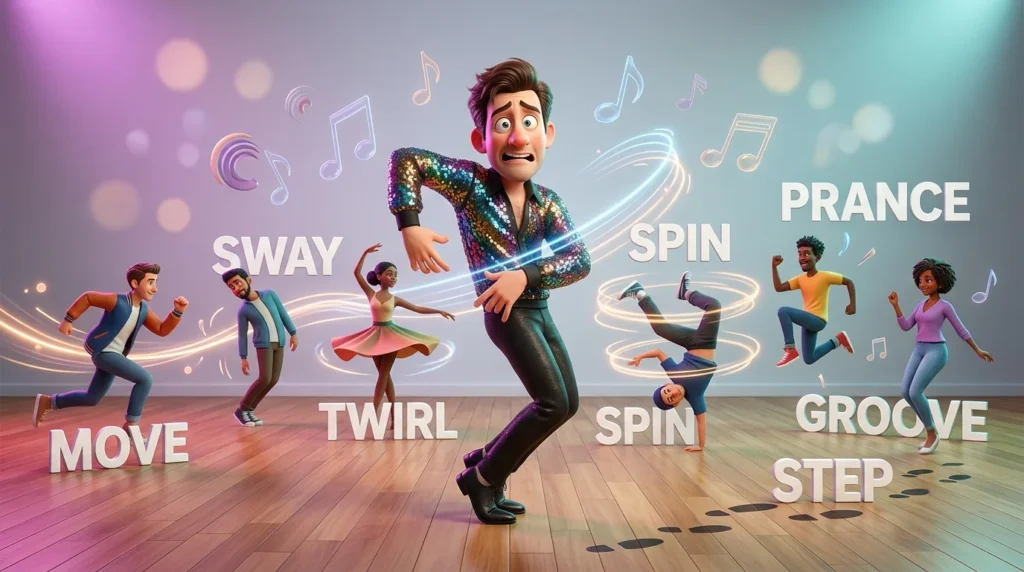
Some of the best synonyms and related alternatives for dance include:
- Move — to change position or move rhythmically
- Sway — to move gently from side to side
- Twirl — to spin around
- Spin — to rotate around
- Groove — to move rhythmically, especially to music
- Boogie — to dance energetically and casually
- Jig — to perform a lively dance with quick movements
- Waltz — to perform or move in a waltz-like manner
- Prance — to move energetically with exaggerated steps
- Step — to move or perform a dance step
- Sashay — to walk or move in a confident, rhythmic way
- Glide — to move smoothly and effortlessly
- Shuffle — to move with short sliding steps
- Hop — to jump lightly on one foot or with small movements
- Leap — to jump or move through the air
- Frolic — to play or move energetically
- Perform — to present a dance for an audience
- Celebrate — to dance as part of a celebration
- Cavort — to jump or move around energetically
- Revel — to celebrate or enjoy oneself enthusiastically
The closest general alternatives are usually move, groove, sway, perform, and boogie, but the best choice depends on the specific kind of dancing you mean.
What Does “Dance” Mean?
Dance can function as both a verb and a noun.
As a verb, it means to move the body rhythmically, usually in response to music.
They danced together all night.
As a noun, it refers to an organized sequence of movements, a performance, or a social event involving dancing.
We attended a traditional dance.
The word can describe everything from a formal ballet performance to someone casually moving to their favorite song.
Different Meanings of “Dance”
1. To Move Rhythmically
The most common meaning is moving the body in rhythm with music.
Everyone started to dance when the music began.
Useful alternatives include:
- move
- groove
- boogie
- sway
- step
2. A Formal Performance
Dance can refer to an artistic or choreographed performance.
The dancers performed a beautiful dance.
Useful alternatives include:
- performance
- routine
- choreography
- presentation
- number
3. A Specific Type of Dance
Dance can refer to a particular form such as a waltz, tango, ballet, or jig.
They learned a traditional folk dance.
In this context, the most useful alternative may be the name of the specific dance itself.
4. A Social Event
A dance can also mean an event where people gather to dance.
The school is hosting a spring dance.
Possible alternatives include:
- ball
- social
- celebration
- dance party
- formal
30+ Synonyms and Alternatives for Dance
1. Move
Move is the broadest alternative to dance. It can describe physical movement generally, including rhythmic movement.
She moved gracefully to the music.
Unlike dance, however, move does not necessarily imply dancing.
Best for: general movement, casual writing, and descriptions.
2. Sway
Sway means to move gently from side to side.
The couple swayed slowly to the music.
It is ideal for slow, gentle, romantic, or relaxed dancing.
Best for: slow dancing, gentle movement, music, romantic scenes.
3. Twirl
Twirl means to turn around quickly or repeatedly.
The dancer twirled across the stage.
It describes one particular type of movement rather than dancing as a whole.
Best for: ballet, ballroom dancing, spinning movements, graceful scenes.
4. Spin
Spin means to rotate around a central point.
She spun around when the music changed.
It is similar to twirl but can sound faster, stronger, or more physical.
5. Groove
Groove is an informal word meaning to dance or move rhythmically to music.
Everyone was grooving to the beat.
It is especially natural in casual American English.
Tone: informal and energetic.
6. Boogie
Boogie is a playful, informal synonym for dance.
Come on, let’s boogie!
It usually suggests energetic and enjoyable dancing.
Tone: very casual, playful, and fun.
7. Jig
A jig is a lively dance involving quick movements and steps.
He performed a traditional Irish jig.
As a verb:
They jigged around the room.
It is more specific than dance.
8. Waltz
Waltz refers to a particular formal dance characterized by flowing movements and a three-beat rhythm.
The couple waltzed across the ballroom.
It can also be used metaphorically to describe moving confidently or effortlessly.
9. Prance
Prance means to move with energetic, exaggerated steps.
The children pranced around the room.
It can describe playful movement rather than conventional dancing.
10. Step
Step can refer to a particular movement in dancing.
The instructor demonstrated the next step.
As a verb:
She stepped to the rhythm.
It is particularly useful when describing choreography.
11. Sashay
Sashay means to walk or move in a confident, often slightly exaggerated way.
She sashayed across the dance floor.
It often carries a playful or stylish tone.
12. Glide
Glide means to move smoothly and effortlessly.
The dancers glided across the stage.
It is excellent for describing ballet, skating-like movements, ballroom dancing, and elegant performances.
13. Shuffle
Shuffle means to move with short steps while keeping the feet close to the ground.
He shuffled across the floor to the beat.
It can also refer to specific dance styles.
14. Hop
Hop means to jump lightly, often on one foot.
The children hopped and danced around the room.
It describes a particular movement rather than dancing generally.
15. Leap
Leap means to jump or spring through the air.
The dancer leaped across the stage.
It is especially appropriate for ballet, contemporary dance, and theatrical performances.
16. Frolic
Frolic means to play, jump, or move energetically in a joyful way.
The children frolicked to the music.
It is not a direct synonym for dance, but it works when the movement is playful and energetic.
17. Perform
Perform works when dancing is being presented to an audience.
The group performed beautifully on stage.
It is broader than dance because people can perform many things besides dancing.
18. Cavort
Cavort means to jump or move around energetically and playfully.
The children cavorted around the garden.
It is more literary and expressive than dance.
19. Revel
Revel means to celebrate, enjoy oneself, or take great pleasure in something.
The crowd reveled in the music.
It does not directly mean dance, but it can describe the broader celebratory atmosphere surrounding dancing.
20. Celebrate
Dancing is often part of celebration.
Everyone danced to celebrate the victory.
In certain contexts, celebrate can describe the purpose behind the dancing rather than the movement itself.
21. Bounce
Bounce means to move repeatedly up and down.
The crowd bounced to the music.
It is informal and works well for energetic dancing.
22. Rock
Rock can mean moving rhythmically, especially to music.
She rocked to the beat.
It is common in casual English.
23. Shimmy
Shimmy means to move the body or shoulders rapidly from side to side.
She shimmied across the dance floor.
It often describes playful or expressive dancing.
24. Strut
Strut means to walk confidently with an exaggerated posture.
He strutted onto the dance floor.
It does not directly mean dance, but it can describe a stylish movement associated with performance.
25. March
March means to walk with regular, deliberate steps.
The dancers marched to the rhythm.
It can describe choreographed movement, especially in group performances.
26. Romp
Romp means to move or play energetically.
The children romped around while music played.
It is playful rather than technically dance-specific.
27. Trot
Trot means to move at a quick pace using short steps.
The performers trotted across the stage.
It is generally not a direct synonym for dance but may work in playful descriptions.
28. Flutter
Flutter means to move lightly and rapidly.
Her costume fluttered as she danced.
As a movement verb, it can add a delicate or artistic quality to creative writing.
29. Choreograph
Choreograph means to design and arrange dance movements.
She choreographed the entire performance.
It is related to dance but does not mean simply “to dance.”
30. Waltz Around
The phrase waltz around can describe moving casually or confidently from place to place.
He waltzed around the office as if he owned the place.
This can be literal or figurative.
Dance Synonyms by
Context
Synonyms for Dance in a Casual Context
For everyday conversation, use:
- boogie
- groove
- move
- rock
- bounce
- sway
- shuffle
Example:
We danced all night.
Casual alternatives:
We grooved all night.
We boogied all night.
We moved to the music all night.
Synonyms for Dance in Formal Writing
For formal or professional writing, consider:
- perform
- execute
- choreograph
- move
- present
- perform a routine
Example:
The dancers performed a traditional routine.
This is more appropriate for professional descriptions than slang such as boogie.
Synonyms for Dance in Creative Writing
Creative writing gives you more freedom.
Useful choices include:
- glide
- twirl
- sway
- spin
- prance
- whirl
- leap
- flutter
- sashay
- cavort
Example:
She danced across the moonlit floor.
More vivid:
She glided across the moonlit floor.
Or:
She twirled beneath the soft lights.
Synonyms for Dance in Romantic Writing
For romantic scenes, useful alternatives include:
- sway
- glide
- twirl
- spin
- move together
- waltz
Example:
They danced slowly under the lights.
Alternative:
They swayed gently beneath the lights.
The second sentence creates a more specific visual image.
Synonyms for Dance in Energetic Contexts
Use:
- boogie
- groove
- bounce
- jump
- hop
- jig
- cavort
- prance
- rock
Example:
The crowd danced to the energetic music.
Alternative:
The crowd bounced and grooved to the energetic music.
Dance vs. Move
These words are related but not identical.
Dance specifically suggests rhythmic or expressive body movement, usually connected with music.
Move has a much broader meaning.
Compare:
She danced across the room.
She moved across the room.
The first clearly suggests dancing. The second simply describes changing location.
Dance vs. Groove
Groove is an informal alternative that specifically suggests rhythmic movement to music.
They danced to the song.
They grooved to the song.
The second sounds more relaxed and informal.
Dance vs. Sway
Sway describes gentle side-to-side movement.
They danced together.
They swayed together.
The second gives a clearer impression of slow, gentle movement.
Dance vs. Twirl
Twirl describes spinning.
She danced across the floor.
She twirled across the floor.
A person can dance without twirling, but twirling can be one part of dancing.
Dance vs. Perform
Perform focuses on presenting something to an audience.
The dancers danced beautifully.
The dancers performed beautifully.
The second sentence emphasizes the presentation or show rather than simply the act of dancing.
How to Use “Dance” as a Verb
Common structures include:
Dance + adverb
She danced gracefully.
They danced energetically.
Dance + preposition
They danced to the music.
She danced with her partner.
He danced across the stage.
Dance + object
Dance can sometimes take an object in expressions such as:
She danced the waltz.
They danced a traditional routine.
How to Use “Dance” as a Noun
Examples include:
- a traditional dance
- a modern dance
- a beautiful dance
- a slow dance
- a formal dance
- a dance performance
- a dance routine
- a dance class
- a dance competition
Example:
She performed a traditional dance.
Common Mistakes When Choosing a Synonym for Dance
Mistake 1: Using “move” as a perfect replacement
Move is much broader than dance.
Better:
The children danced to the music.
Use move only when the broader meaning is intended.
Mistake 2: Using “twirl” for every type of dance
A twirl specifically involves spinning.
Better:
She twirled during the final part of the routine.
Mistake 3: Using “boogie” in formal writing
Boogie is highly informal.
Better for formal writing:
The performers danced energetically.
Mistake 4: Confusing “choreograph” with “dance”
A choreographer creates or arranges dance movements.
She choreographed the performance.
This does not necessarily mean she performed in it.
Mistake 5: Using “sway” for fast dancing
Sway generally suggests gentle side-to-side movement.
For energetic dancing, consider:
- groove
- bounce
- boogie
- jig
- jump
Best Dance Synonyms at a Glance
| Synonym | Main Meaning | Tone |
|---|---|---|
| Move | General physical movement | Neutral |
| Sway | Gentle side-to-side movement | Neutral |
| Twirl | Spin around | Descriptive |
| Spin | Rotate | Neutral |
| Groove | Move rhythmically to music | Casual |
| Boogie | Dance energetically | Very casual |
| Jig | Perform a lively dance | Specific |
| Waltz | Perform a formal dance | Formal |
| Glide | Move smoothly | Elegant |
| Shuffle | Move with sliding steps | Neutral |
| Prance | Move with energetic steps | Playful |
| Sashay | Move confidently | Playful |
| Leap | Jump through the air | Dramatic |
| Shimmy | Shake or move rapidly | Playful |
| Perform | Present a dance | Formal |
| Choreograph | Arrange dance movements | Professional |
| Frolic | Play or move joyfully | Literary |
| Cavort | Move energetically | Literary |
Five Key Takeaways
- Dance has several meanings, so its best synonym depends on whether you mean rhythmic movement, a performance, a specific dance, or a social event.
- Move is the broadest alternative, while groove and boogie are informal words for dancing to music.
- Sway, twirl, spin, glide, shuffle, and leap describe specific types of dance movement rather than dance as a whole.
- Perform and choreograph are useful in professional or performance-related contexts but do not mean exactly the same thing as dance.
- For creative writing, choose a more specific verb such as glide, twirl, sway, prance, or sashay when you want the reader to visualize the movement.