
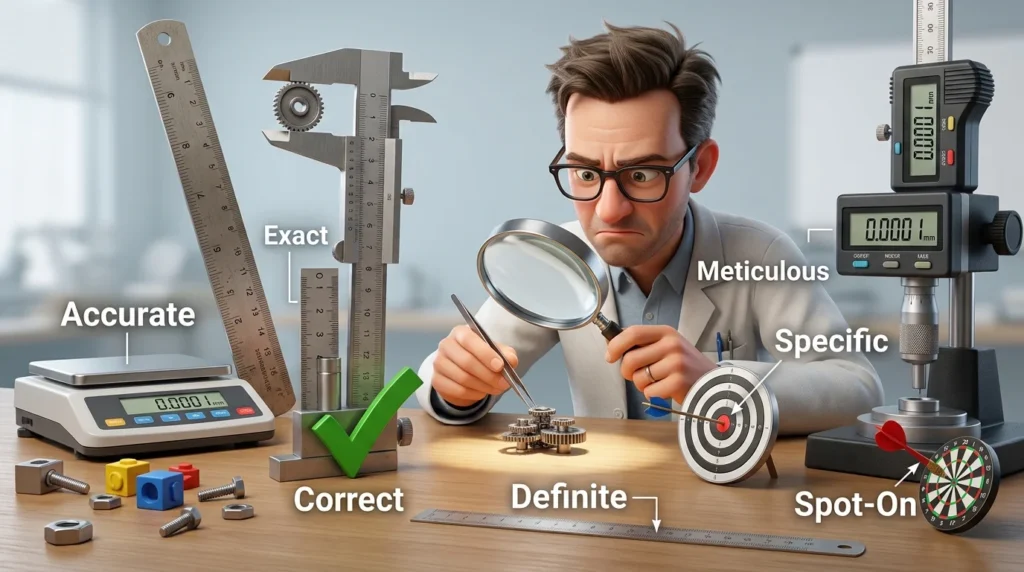
Quick Answer: What Are the Best Synonyms for Precise?
The best synonym depends on the intended meaning:
- Exact — completely correct or matching a specific value
- Accurate — correct and free from error
- Specific — clearly defined rather than general
- Definite — clearly established or certain
- Explicit — stated clearly and directly
- Detailed — containing many specific pieces of information
- Exacting — requiring very high standards of accuracy or performance
- Meticulous — extremely careful and attentive to detail
- Correct — free from mistakes
- Clear-cut — easy to understand and not ambiguous
- Particular — referring to one specific thing
- Pinpoint — extremely exact or narrowly identified
- Rigorous — conducted with strict accuracy and care
- Thorough — complete and carefully done
- Definitive — authoritative, final, or conclusive
The most direct everyday replacements for precise are usually exact, accurate, specific, and clear, but the best choice depends on the sentence.
What Does “Precise” Mean?
Precise generally means very exact, clearly defined, or carefully accurate.
It can describe information, measurements, language, instructions, movements, timing, locations, or actions.
For example:
The scientist recorded a precise measurement.
Here, precise suggests that the measurement was expressed with a high degree of exactness.
Another example:
Please give me precise instructions.
In this sentence, precise means the instructions should be specific, clear, and not vague.
The Main Meanings of “Precise”
The word precise has several closely related meanings.
1. Exact
When precise means exact, it refers to something that is expressed or identified with very little uncertainty.
- the precise amount
- the precise location
- the precise time
- the precise number
Best synonyms: exact, specific, definite, pinpoint.
2. Accurate
Precise can also describe something that is carefully measured or stated correctly.
- precise calculations
- precise measurements
- precise data
Best synonyms: accurate, correct, exact, reliable.
3. Specific
When talking about language or information, precise can mean specific rather than broad or vague.
- a precise explanation
- precise instructions
- precise wording
Best synonyms: specific, explicit, clear, detailed.
4. Careful and Detailed
When describing someone’s work, precise can emphasize careful attention to small details.
- precise craftsmanship
- precise work
- precise movements
Best synonyms: meticulous, careful, exacting, detailed.
30+ Synonyms for Precise With Meanings
1. Exact
Exact is one of the closest synonyms for precise. It emphasizes complete conformity to a particular number, measurement, description, or standard.
Example:
We need the exact address before sending the package.
Best for: measurements, numbers, locations, times, amounts, and facts.
2. Accurate
Accurate means correct and free from errors. It is especially useful when the important idea is correctness rather than the level of detail.
Example:
The report contains accurate information.
Precise vs. accurate: Something can be precise without being accurate if it is expressed in great detail but is actually wrong.
3. Specific
Specific means clearly identified or limited to a particular thing rather than general.
Example:
Please provide a specific example.
Best for: instructions, requests, information, examples, and descriptions.
4. Definite
Definite means clearly established, certain, or not vague.
Example:
We need a definite answer by Friday.
It works particularly well when precise refers to certainty or clearly defined information.
5. Explicit
Explicit means clearly and directly expressed, leaving little room for misunderstanding.
Example:
The manager gave explicit instructions about the procedure.
Best for: instructions, statements, rules, explanations, and warnings.
6. Detailed
Detailed emphasizes the amount of information provided.
Example:
She gave us a detailed explanation of the process.
A detailed explanation may be precise, but the two words are not identical. Detailed focuses on completeness of information, while precise focuses more strongly on exactness.
7. Meticulous
Meticulous describes someone or something characterized by extreme care and attention to detail.
Example:
He is meticulous when checking financial records.
Best for: people, work, research, editing, craftsmanship, and procedures.
8. Exacting
Exacting means demanding a very high level of accuracy, quality, or performance.
Example:
The job requires exacting attention to detail.
It is especially useful when discussing demanding standards.
9. Correct
Correct simply means free from error.
Example:
Make sure the information is correct.
Although correct can replace precise in some situations, it does not always communicate the same level of exactness.
10. Clear
Clear means easy to understand or free from confusion.
Example:
The instructions are clear and easy to follow.
Use clear when the primary concern is understanding rather than numerical exactness.
11. Pinpoint
Pinpoint means extremely exact or accurately identified.
Example:
The researchers pinpointed the source of the problem.
It is particularly effective when talking about locations, causes, moments, or specific points.
12. Particular
Particular refers to one specific person, thing, situation, or detail.
Example:
She had a particular reason for leaving.
It can replace precise when the intended meaning is “specific,” but not when precise means mathematically exact.
13. Rigorous
Rigorous means extremely thorough, strict, and careful.
Example:
The study followed a rigorous research method.
It is a strong choice for academic, scientific, and professional contexts.
14. Thorough
Thorough means complete and carefully carried out.
Example:
The technician conducted a thorough inspection.
Thorough emphasizes completeness more than exactness.
15. Definitive
Definitive means authoritative, conclusive, or providing a final answer.
Example:
The study provides a definitive explanation of the phenomenon.
Use it when precise is connected with certainty or finality.
16. Unambiguous
Unambiguous means having only one clear meaning and therefore not open to multiple interpretations.
Example:
The contract should contain unambiguous language.
This is useful when discussing precise communication.
17. Well-defined
Well-defined means clearly described, established, or understood.
Example:
The project has well-defined objectives.
This is especially useful in academic, business, mathematical, and technical writing.
18. Measured
Measured can describe language or behavior that is carefully controlled and deliberate.
Example:
She gave a measured response to the criticism.
It is not a universal synonym for precise, but it works when careful control is the intended meaning.
19. Careful
Careful emphasizes avoiding mistakes and paying attention.
Example:
The engineer made careful calculations.
It is broader and less exact than precise.
20. Methodical
Methodical means systematic, organized, and orderly.
Example:
He took a methodical approach to solving the problem.
It is a useful alternative when precision comes from following a structured process.
21. Factual
Factual means based on facts rather than opinions or imagination.
Example:
The article provides factual information.
It is related to accuracy but is not a direct synonym for precise.
22. Reliable
Reliable means dependable or consistently trustworthy.
Example:
The instrument provides reliable results.
A reliable measurement is not necessarily maximally precise, so context matters.
23. Narrow
Narrow can mean limited to a small range or specific scope.
Example:
The researchers focused on a narrow set of variables.
It works when precise refers to a tightly defined scope.
24. Well-defined
Well-defined is particularly useful for concepts, categories, goals, boundaries, and technical definitions.
Example:
The experiment requires a well-defined hypothesis.
25. Particularized
Particularized means made specific or adapted to particular circumstances.
Example:
The recommendations were particularized for different customer groups.
This word is more formal and much less common than specific.
26. Discerning
Discerning means showing good judgment and the ability to recognize subtle differences.
Example:
A discerning editor can identify small inconsistencies.
It may overlap with precision when discussing judgment, but it is not a general synonym.
27. Sharp
Sharp can mean clearly defined or highly focused in certain contexts.
Example:
The photograph has sharp details.
It can also describe thinking:
She has a sharp understanding of the issue.
28. Focused
Focused means concentrated on a particular subject, objective, or area.
Example:
The report provides a focused analysis of the problem.
It is a contextual alternative rather than a direct synonym.
29. Fine
In expressions such as fine detail or fine distinctions, fine can communicate subtle precision.
Example:
The artist paid attention to every fine detail.
30. Punctilious
Punctilious means extremely attentive to details, rules, or formal requirements.
Example:
The editor was punctilious about grammar and formatting.
It is formal and often carries the sense of being exceptionally strict about details.
Precise vs. Exact
These two words are very close, but there is a useful distinction.
Precise emphasizes a high level of exactness or specificity.
Exact often emphasizes complete correctness or an identical match.
Compare:
- The scientist made a precise measurement.
- Give me the exact measurement.
The first emphasizes the quality of the measurement. The second emphasizes the specific value.
In many everyday sentences, however, they are interchangeable.
Precise vs. Accurate
This distinction is especially important in technical and scientific writing.
Accurate means correct.
Precise means highly exact or consistent in detail.
For example, imagine a scale that repeatedly shows 10.25 kg when the actual weight is 10.00 kg. Its readings may be precise because they are highly consistent, but they are not accurate because they are incorrect.
Therefore:
- Accuracy = correctness
- Precision = exactness or consistency of detail
The distinction matters in science, statistics, engineering, research, and data analysis.
Precise vs. Specific
Specific means clearly identified rather than general.
Precise usually suggests a greater degree of exactness.
Compare:
Give me a specific answer.
This means you should avoid being vague.
Give me a precise answer.
This suggests that the answer should be exact and carefully defined.
A specific answer is not automatically precise.
Precise vs. Detailed
These words frequently overlap but emphasize different qualities.
Precise = exact and carefully defined.
Detailed = containing a lot of information.
For example:
She gave a precise answer.
The answer was exact.
She gave a detailed answer.
The answer contained substantial information.
An answer can be detailed but still vague. Likewise, it can be precise without being long.
Precise vs. Meticulous
Precise usually describes the quality of an action, result, measurement, or statement.
Meticulous often describes the way someone works.
Compare:
The surgeon made a precise incision.
The surgeon was meticulous in preparing for the procedure.
The first describes exactness. The second describes careful attention to detail.
Best Synonyms for Precise in Different Contexts
In Academic Writing
Use:
- exact
- accurate
- specific
- rigorous
- well-defined
- explicit
- detailed
Example:
The researchers used precise terminology to describe the results.
Possible alternatives:
The researchers used exact terminology to describe the results.
The researchers used specific terminology to describe the results.
The researchers used well-defined terminology to describe the results.
In Professional Writing
Useful choices include:
- accurate
- specific
- exact
- clear
- explicit
- detailed
- well-defined
Example:
Please provide precise instructions for completing the task.
Alternative:
Please provide clear and specific instructions for completing the task.
In Scientific Writing
The strongest choices often include:
- accurate
- exact
- precise
- rigorous
- reliable
- consistent
- quantitative
Example:
The device provides precise measurements.
Depending on meaning, you might write:
The device provides accurate measurements.
or
The device provides highly consistent measurements.
The correct choice depends on what you are trying to communicate.
In Casual Conversation
More natural alternatives include:
- exact
- clear
- specific
- correct
- particular
Example:
Do you know the precise time?
More conversational:
Do you know the exact time?
For Instructions
The best alternatives are:
- clear
- specific
- explicit
- detailed
- exact
Example:
The teacher gave precise instructions.
Natural alternatives:
The teacher gave clear instructions.
The teacher gave specific instructions.
The teacher gave explicit instructions.
For Measurements
Use:
- exact
- accurate
- precise
- specific
- measured
Example:
We need a precise measurement.
Depending on meaning:
We need an exact measurement.
We need an accurate measurement.
These alternatives should not be treated as identical in technical contexts.
Sentence Transformations Using Synonyms for Precise
Original:
The engineer made a precise calculation.
Using accurate:
The engineer made an accurate calculation.
Using exact:
The engineer made an exact calculation.
Using meticulous:
The engineer used a meticulous approach to the calculation.
Using rigorous:
The engineer used a rigorous method for the calculation.
Using careful:
The engineer made a careful calculation.
Each version changes the emphasis slightly.
Grammar: How to Use “Precise” Correctly
Precise is an adjective.
Common structures include:
Precise + noun
- precise information
- precise instructions
- precise measurements
- precise language
- precise details
- precise calculations
- precise location
Be + precise
Try to be precise when describing the problem.
More precise
This definition is more precise.
Most precise
This is the most precise measurement available.
Precisely
The adverbial form is precisely.
The machine measures the temperature precisely.
Precisely can also mean “exactly.”
That is precisely what I meant.
Common Mistakes When Using Synonyms for Precise
Mistake 1: Treating “accurate” and “precise” as always identical
They overlap, but technical contexts distinguish them.
Better: Use accurate for correctness and precise for exactness or consistency.
Mistake 2: Using “detailed” when you mean “exact”
A detailed statement can contain lots of information without being exact.
Better: Use exact or precise when exactness is important.
Mistake 3: Using “meticulous” for measurements
Meticulous normally describes a person, process, or manner of working.
Instead of:
a meticulous measurement
you may often mean:
a precise measurement
Mistake 4: Assuming “specific” always means “precise”
Specific means clearly identified, but it does not necessarily mean highly exact.
For example:
She asked for a specific topic.
The topic can be specific without requiring numerical precision.
Mistake 5: Overusing “exact”
In formal writing, repeating exact in every sentence can make the language monotonous.
Depending on context, alternatives such as specific, well-defined, accurate, explicit, or meticulous may communicate the intended meaning better.
When You Should Not Replace “Precise”
Sometimes precise is the best word and should remain unchanged.
For example:
The instrument provides precise measurements.
Replacing it with clear changes the meaning.
Similarly:
The surgeon made a precise incision.
Replacing precise with specific sounds unnatural because specific does not communicate physical exactness in the same way.
Always consider the intended meaning before substituting a synonym.
Choosing the Right Synonym for Precise
Use this simple decision guide:
| If you mean… | Best choice |
|---|---|
| Completely exact | Exact |
| Free from error | Accurate |
| Clearly identified | Specific |
| Clearly stated | Explicit |
| Full of information | Detailed |
| Extremely careful | Meticulous |
| High standards | Exacting |
| Strictly careful | Rigorous |
| Easy to understand | Clear |
| Clearly established | Definite |
| Extremely narrowly identified | Pinpoint |
| Complete and careful | Thorough |
| Final or conclusive | Definitive |
| Clearly defined | Well-defined |
Five Key Takeaways
- Exact is one of the closest everyday synonyms for precise, especially for numbers, measurements, times, and locations.
- Accurate emphasizes correctness, while precise emphasizes exactness, specificity, or consistency.
- Specific is best when the opposite of precise is vague or general.
- Meticulous describes careful attention to detail, while detailed emphasizes the amount of information.
- The best synonym depends on context, so choose a word based on the exact meaning you want rather than simply replacing precise with the first word in a thesaurus.