
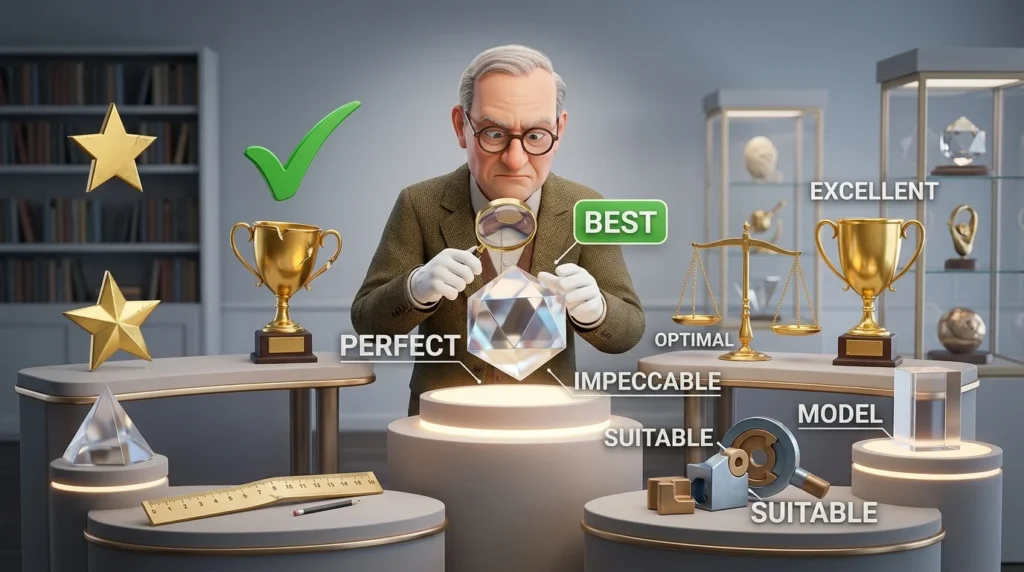
What Does “Ideal” Mean?
Ideal generally means perfect, most suitable, or highly desirable for a particular purpose.
Examples
- This is an ideal location for a family.
- She is the ideal candidate for the position.
- Morning is the ideal time to exercise.
- The weather was ideal for a picnic.
- They are looking for an ideal solution to the problem.
The exact meaning changes depending on context.
Quick List of Synonyms for Ideal
Here are some of the most useful alternatives:
- Perfect
- Optimal
- Best
- Excellent
- Exemplary
- Outstanding
- Exceptional
- Superior
- Desirable
- Suitable
- Appropriate
- Fitting
- Right
- Favorable
- Advantageous
- Beneficial
- Preferable
- Impeccable
- Flawless
- Model
- Paragon
- Prime
- First-rate
- First-class
- Top-notch
- Unbeatable
- Ultimate
- Dream
- Perfectly suited
- Well-suited
- Optimal
- Most suitable
- Highly desirable
- Exemplary
- Aspirational
- Visionary
- Quintessential
- Matchless
- Peerless
- Unrivaled
Not every word above can replace ideal in every sentence. The right choice depends on the intended meaning.
1. Perfect
Perfect is one of the closest synonyms for ideal when something has no significant flaws or represents the highest possible standard.
Examples
- This is the ideal solution.
- This is the perfect solution.
- She would be the ideal person for the job.
- She would be the perfect person for the job.
Difference
Ideal can mean especially suitable without literally being flawless.
Perfect more strongly suggests the absence of faults.
2. Optimal
Optimal means the best or most effective under particular circumstances.
It is especially useful in technical, academic, scientific, and professional writing.
Examples
- We need to find the optimal solution.
- The system operates under optimal conditions.
- Morning may be the optimal time for the procedure.
Ideal vs. Optimal
Ideal can have a broader or more subjective meaning.
Optimal usually emphasizes the best practical result.
3. Best
Best is a simple and direct alternative to ideal.
Examples
- This is the ideal option for beginners.
- This is the best option for beginners.
- We are looking for the ideal location.
- We are looking for the best location.
Best is especially useful in everyday English.
4. Excellent
Excellent means extremely good or of very high quality.
Examples
- The hotel provides an ideal experience for families.
- The hotel provides an excellent experience for families.
- She is an excellent candidate for the position.
However, excellent describes quality, while ideal often describes suitability.
5. Exemplary
Exemplary means serving as a model of excellence or something worthy of imitation.
Examples
- She is an exemplary employee.
- His behavior was exemplary.
- The school provides an exemplary model of education.
This word is particularly useful in formal writing.
6. Outstanding
Outstanding describes something that is exceptionally good or impressive.
Examples
- She is an outstanding candidate.
- The university offers outstanding facilities.
- He delivered an outstanding performance.
Outstanding focuses on exceptional quality rather than suitability.
7. Exceptional
Exceptional means unusually excellent or significantly better than normal.
Examples
- She has exceptional leadership skills.
- The company provides exceptional service.
- He is an exceptional candidate.
Use this when you want to emphasize unusually high quality.
8. Superior
Superior means better in quality, performance, or ability than something else.
Examples
- The new system provides superior performance.
- This material offers superior durability.
- They developed a superior solution.
Unlike ideal, superior often involves comparison.
9. Desirable
Desirable means wanted, attractive, or considered beneficial.
Examples
- The location is highly desirable.
- Experience in this field is desirable.
- The property has several desirable features.
This is one of the strongest alternatives when ideal means something that people want.
10. Suitable
Suitable means appropriate or well-matched for a particular purpose.
Examples
- This room is ideal for meetings.
- This room is suitable for meetings.
- We need an ideal candidate.
- We need a suitable candidate.
Difference
Suitable means good enough or appropriate.
Ideal generally suggests a stronger level of suitability.
11. Appropriate
Appropriate means suitable or correct for a particular situation.
Examples
- This is an appropriate solution.
- Choose an appropriate method for the study.
- The manager selected an appropriate response.
It is particularly useful in professional and academic writing.
12. Fitting
Fitting means appropriate or suitable.
Examples
- She was a fitting choice for the role.
- The award was a fitting recognition of his work.
- This would be a fitting conclusion to the project.
It often works when the focus is on appropriateness.
13. Right
Right is a simple, natural alternative when ideal means the most suitable choice.
Examples
- This is the right time to begin.
- She is the right person for the job.
- We found the right solution.
It is less formal but extremely common.
14. Favorable
Favorable means beneficial, positive, or advantageous.
Examples
- The weather conditions were favorable.
- The company operates in a favorable market.
- The results were favorable.
It is useful when ideal describes positive conditions.
15. Advantageous
Advantageous means providing a benefit or creating a favorable situation.
Examples
- The location is advantageous for businesses.
- The agreement provides advantageous conditions.
- Flexible working hours can be advantageous for employees.
It is particularly useful in formal and business writing.
16. Beneficial
Beneficial means producing a positive effect or advantage.
Examples
- Exercise creates an ideal environment for healthy development.
- Regular exercise is beneficial to health.
- The changes could be beneficial for the company.
Beneficial emphasizes positive effects rather than perfection.
17. Preferable
Preferable means more desirable or suitable than another option.
Examples
- This method is preferable to the traditional approach.
- A quiet environment is preferable for studying.
- The second option may be preferable.
Use preferable when making a comparison.
18. Impeccable
Impeccable means completely free from faults or mistakes.
Examples
- She has impeccable manners.
- The restaurant provides impeccable service.
- His professional record is impeccable.
It is stronger and more specific than ideal.
19. Flawless
Flawless means without any defects, mistakes, or imperfections.
Examples
- She delivered a flawless performance.
- The design is flawless.
- His execution of the plan was flawless.
Use it when the absence of mistakes is important.
20. Model
Model can describe a person, system, or example that represents an excellent standard.
Examples
- She is a model employee.
- The program is a model of effective leadership.
- He became a model student.
It often means something worthy of imitation.
21. Paragon
Paragon is a formal word for a person or thing that is considered a perfect example of a particular quality.
Examples
- She is a paragon of professionalism.
- The building is a paragon of modern design.
- He was considered a paragon of honesty.
This word is more literary and formal than ideal.
22. Prime
Prime can mean excellent, important, or of the highest quality.
Examples
- This is a prime location for a new business.
- The company operates in a prime market.
- This is a prime example of effective design.
It is especially common with words such as location, example, opportunity, condition, and position.
23. First-Rate
First-rate means excellent or of very high quality.
Examples
- The hotel offers first-rate service.
- She is a first-rate professional.
- The company provides first-rate products.
It is common in professional and everyday English.
24. First-Class
First-class means excellent or of the highest quality.
Examples
- The school provides first-class education.
- They offer first-class customer service.
- He received first-class training.
25. Top-Notch
Top-notch is an informal way to say extremely good or excellent.
Examples
- The restaurant offers top-notch food.
- She is a top-notch designer.
- We received top-notch service.
It works well in casual and promotional writing but is less suitable for formal academic writing.
26. Unbeatable
Unbeatable means extremely difficult to surpass or better.
Examples
- The company offers unbeatable prices.
- They provide an unbeatable combination of quality and value.
- This location offers unbeatable convenience.
It is often used in advertising and persuasive writing.
27. Ultimate
Ultimate can mean the highest, greatest, or most important possible example.
Examples
- The product provides the ultimate convenience.
- They are searching for the ultimate solution.
- This guide is designed to provide the ultimate experience.
It can sound promotional, so use it carefully in objective writing.
28. Dream
Dream is an informal and expressive alternative when something is extremely desirable.
Examples
- This house would be the ideal home for us.
- This house would be our dream home.
- She found her dream job.
It emphasizes strong personal desire.
29. Well-Suited
Well-suited means particularly appropriate for a specific purpose.
Examples
- She is well-suited for the position.
- The software is well-suited to small businesses.
- This environment is well-suited for learning.
This is one of the most precise alternatives when ideal means highly appropriate.
30. Quintessential
Quintessential means representing the most typical or perfect example of something.
Examples
- The building is the quintessential example of modern architecture.
- He is the quintessential professional.
- The town represents the quintessential small American community.
This word is more sophisticated and often appears in formal or descriptive writing.

Synonyms for “Ideal” by Context
| Context | Best Alternatives |
|---|---|
| Ideal candidate | suitable, well-suited, perfect, exemplary |
| Ideal solution | optimal, best, effective, perfect |
| Ideal location | perfect, suitable, favorable, prime |
| Ideal conditions | optimal, favorable, perfect |
| Ideal opportunity | perfect, excellent, advantageous |
| Ideal person | perfect, exemplary, model |
| Ideal example | perfect, exemplary, quintessential |
| Ideal situation | perfect, optimal, favorable |
| Ideal environment | suitable, optimal, favorable |
| Ideal choice | best, right, preferable |
| Ideal result | optimal, perfect, desirable |
| Ideal time | perfect, optimal, right |
Synonyms for Ideal in Academic Writing
Academic writing usually benefits from precise alternatives rather than exaggerated words.
Useful choices include:
- Optimal
- Suitable
- Appropriate
- Preferable
- Desirable
- Favorable
- Exemplary
- Optimal
- Most appropriate
- Well-suited
Example
Original:
The ideal method was selected for the experiment.
Possible alternatives:
The optimal method was selected for the experiment.
The most appropriate method was selected for the experiment.
The most suitable method was selected for the experiment.
In academic writing, optimal, appropriate, and suitable are often more precise than perfect.
Synonyms for Ideal in Business Writing
In business contexts, useful alternatives include:
- Optimal
- Suitable
- Appropriate
- Advantageous
- Desirable
- Favorable
- Prime
- Perfect
- Well-suited
- Best
Examples
This is an ideal location for the new office.
Possible alternatives:
This is a prime location for the new office.
This is a suitable location for the new office.
This is an advantageous location for the new office.
Each version emphasizes something slightly different.
Synonyms for Ideal in Professional Writing
For professional writing, these are particularly useful:
Well-suited — emphasizes compatibility.
Appropriate — emphasizes correctness.
Optimal — emphasizes the best possible result.
Suitable — emphasizes practical fit.
Desirable — emphasizes attractiveness or preference.
Advantageous — emphasizes benefits.
Example
She is the ideal candidate for the position.
Professional alternatives:
She is well-suited to the position.
She is an excellent candidate for the position.
She is the most suitable candidate for the position.
Synonyms for Ideal in Casual English
In everyday conversation, simpler words usually sound more natural:
- Perfect
- Best
- Right
- Great
- Excellent
- Dream
- Suitable
Examples
Saturday would be the ideal day.
Casual:
Saturday would be perfect.
That’s the ideal place for dinner.
Casual:
That’s the perfect place for dinner.
“Ideal” vs. “Perfect”
These words are often interchangeable, but they are not always identical.
Ideal means best or most suitable according to a particular standard.
Perfect suggests complete excellence or absence of flaws.
Examples
This is the ideal location for the office.
The location is especially suitable.
This is the perfect location for the office.
The statement sounds stronger and more absolute.
“Ideal” vs. “Optimal”
Optimal is more technical and objective.
Example
We need an ideal solution.
This can suggest the solution we would most like to have.
We need an optimal solution.
This emphasizes the best achievable result under specific conditions.
For academic, scientific, and technical writing, optimal is often more precise.
“Ideal” vs. “Suitable”
Suitable means appropriate or good enough for a particular purpose.
Ideal usually suggests a stronger level of suitability.
Example
This room is suitable for meetings.
The room can be used for meetings.
This room is ideal for meetings.
The room is especially well-suited to meetings.
“Ideal” vs. “Desirable”
Desirable means wanted or attractive.
Example
The property is in an ideal location.
The location is especially suitable.
The property is in a desirable location.
The location is attractive or sought after.
“Ideal” vs. “Exemplary”
Exemplary means serving as a model of excellence.
Example
She is an ideal employee.
She fits the desired qualities.
She is an exemplary employee.
She demonstrates qualities that others should imitate.
Common Phrases With Ideal
Ideal candidate
Alternatives:
- Perfect candidate
- Suitable candidate
- Well-suited candidate
- Best candidate
- Strong candidate
- Most appropriate candidate
Ideal solution
Alternatives:
- Optimal solution
- Best solution
- Perfect solution
- Most effective solution
- Preferred solution
Ideal situation
Alternatives:
- Perfect situation
- Optimal situation
- Best-case scenario
- Favorable situation
- Desirable situation
Ideal location
Alternatives:
- Perfect location
- Prime location
- Suitable location
- Desirable location
- Convenient location
Ideal opportunity
Alternatives:
- Perfect opportunity
- Excellent opportunity
- Great opportunity
- Valuable opportunity
- Favorable opportunity
Ideal conditions
Alternatives:
- Optimal conditions
- Perfect conditions
- Favorable conditions
- Suitable conditions
- Best conditions
Common Mistakes When Using Synonyms for Ideal
1. Using “perfect” when you only mean suitable
If something is simply appropriate, suitable may be more accurate than perfect.
This tool is suitable for beginners.
This does not necessarily mean the tool is flawless.
2. Using “optimal” without a clear standard
Optimal implies the best result according to particular criteria.
For example:
The optimal temperature for the process is 20°C.
This makes sense because there is a measurable standard.
In subjective situations, ideal may be more natural.
3. Using “excellent” when suitability is the main point
Something can be excellent but unsuitable.
For example, an advanced piece of software may be excellent but not ideal for a complete beginner.
4. Using “desirable” when something is simply appropriate
Desirable emphasizes attractiveness or preference.
Suitable emphasizes practical appropriateness.
5. Overusing “ultimate”
The word ultimate is often promotional and exaggerated.
In objective or academic writing, optimal, appropriate, or most suitable may be better.
How to Choose the Right Synonym for Ideal
Ask what you mean before choosing an alternative.
Do you mean “perfect”?
Use perfect, flawless, or impeccable.
Do you mean “best possible”?
Use optimal, best, or superior.
Do you mean “appropriate”?
Use suitable, appropriate, fitting, or well-suited.
Do you mean “desirable”?
Use desirable, preferable, or favorable.
Do you mean “excellent”?
Use excellent, outstanding, exceptional, or first-rate.
Do you mean “a model example”?
Use exemplary, model, paragon, or quintessential.

Do you mean “advantageous”?
Use beneficial, favorable, or advantageous.
Sentence Transformations
Original
This is the ideal solution to the problem.
Alternatives:
This is the optimal solution to the problem.
This is the best solution to the problem.
This is the most suitable solution to the problem.
Original
She is the ideal candidate for the position.
Alternatives:
She is the perfect candidate for the position.
She is the most suitable candidate for the position.
She is well-suited to the position.
She is an excellent candidate for the position.
Original
The weather was ideal for the event.
Alternatives:
The weather was perfect for the event.
The weather was favorable for the event.
The weather conditions were optimal for the event.