
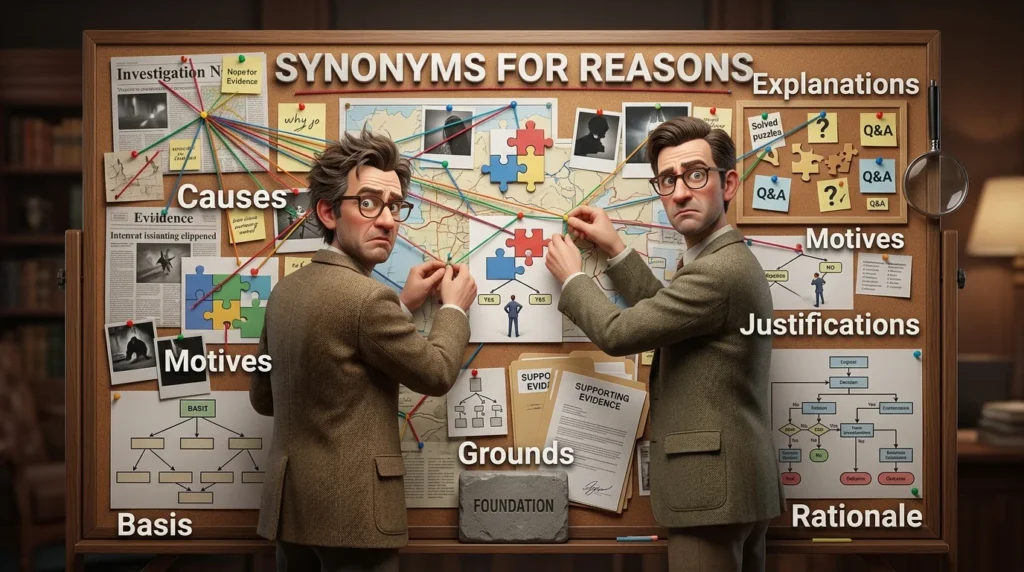
What Does “Reasons” Mean?
Reasons are explanations, causes, motives, or grounds that explain why something happens, exists, or is done.
Examples
She gave several reasons for leaving the company.
There are many reasons why people choose to study abroad.
The manager explained the reasons behind the decision.
The exact meaning of reasons depends on the situation.
Sometimes it means causes:
There are several reasons for the decline.
Sometimes it means motives:
He explained his reasons for making the decision.
Sometimes it means justifications:
She provided several reasons for changing the policy.
Quick List of Synonyms for Reasons
Here are some of the most useful alternatives:
Causes
Motives
Explanations
Grounds
Factors
Purposes
Justifications
Rationales
Considerations
Arguments
Basis
Incentives
Drivers
Influences
Circumstances
Conditions
Excuses
Objectives
Intentions
Aims
Logic
Evidence
Considerations
Foundations
Determinants
Not all of these have exactly the same meaning. The best choice depends on what kind of reason you are describing.
Best Synonyms for Reasons
1. Causes
Causes are things that make an event or situation happen.
Example:
Researchers investigated the causes of climate change.
Use causes when you are explaining why something occurred.
Reason: broad explanation
Cause: something that produces an effect
2. Motives
Motives are the intentions or desires that cause someone to take an action.
Example:
The police investigated his motives for committing the crime.
This word is especially useful when discussing human behavior, decisions, or actions.
3. Explanations
Explanations are statements or information that make something understandable.
Example:
She provided several explanations for her absence.
An explanation does not necessarily mean a cause. It can simply clarify something.
4. Grounds
Grounds means a basis or set of reasons supporting a decision, action, or belief.
Example:
The company terminated the contract on legal grounds.
It is common in formal, legal, and academic writing.
5. Factors
Factors are circumstances or elements that contribute to a result.
Example:
Several factors contributed to the company’s success.
This is especially useful when there is more than one contributing influence.
6. Purposes
A purpose is the reason something is done or the goal it is intended to achieve.
Example:
The purpose of the study is to examine consumer behavior.
Purpose is not always interchangeable with reason.
Reason: Why something happens or is done.
Purpose: What someone hopes to achieve by doing it.
7. Justifications
Justifications are reasons offered to show that an action, decision, or belief is reasonable or acceptable.
Example:
The manager gave several justifications for the policy change.
This word often suggests that someone is defending a decision.
8. Rationales
A rationale is a logical explanation or underlying reasoning behind a decision or approach.
Example:
The report explains the rationale behind the new strategy.
Rationale is especially useful in academic, business, and professional writing.
9. Considerations
Considerations are factors that someone thinks about before making a decision.
Example:
Cost and safety were important considerations when choosing the equipment.
This word works particularly well in decision-making contexts.
10. Arguments
An argument can mean a reason or set of reasons used to support a position.
Example:
The author presents several arguments in favor of the proposal.
This is common in academic and persuasive writing.
Formal Synonyms for Reasons
If you are writing an academic paper, report, business document, or formal essay, consider:
Grounds
Rationale
Factors
Considerations
Justifications
Causes
Motives
Basis
Determinants
Arguments
Example
Informal:
There are many reasons for the change.
More formal:
There are several factors contributing to the change.
Or:
Several considerations influenced the decision.
Or:
The report identifies the rationale behind the change.
Academic Synonyms for Reasons
Academic writing often benefits from precise alternatives to reasons.
Useful choices include:
Causes
Factors
Explanations
Rationale
Grounds
Motives
Determinants
Influences
Considerations
Arguments
Examples
The study investigates the causes of population growth.
Several factors influence academic performance.
The researchers proposed several explanations for the unexpected results.
The article examines the rationale behind the proposed policy.
Economic conditions were important determinants of the outcome.
Synonyms for Reasons in an Essay
When writing an essay, the best alternative depends on your argument.
To Explain Why Something Happened
Use:
Causes
Factors
Influences
Circumstances
Conditions
Determinants
Example:
Several factors contributed to the decline in employment.
To Explain Someone’s Decision
Use:
Motives
Considerations
Grounds
Rationale
Justifications
Example:
The author’s rationale for supporting the policy is clearly explained.

To Support an Argument
Use:
Arguments
Grounds
Evidence
Basis
Justifications
Example:
The researchers provide strong evidence for their conclusion.
Note that evidence is not always a synonym for reason. Evidence supports a claim, while a reason explains or supports it.
Reasons vs. Causes
These words are closely related but not identical.
Reasons can explain why something happened or why someone acted.
She gave several reasons for leaving.
Causes usually refer to things that produce an event or result.
Researchers studied the causes of the disease.
A person has reasons, while an event usually has causes.
Reasons vs. Motives
A motive is specifically connected to the intention behind an action.
He had several reasons for moving abroad.
His main motive was to find better employment.
A reason can be practical, emotional, logical, or accidental. A motive generally describes the underlying intention behind someone’s behavior.
Reasons vs. Explanations
An explanation makes something understandable.
She gave an explanation for the delay.
A reason can be the actual basis for the delay.
Traffic was the reason for the delay.
An explanation may contain one or more reasons, but the words are not always interchangeable.
Reasons vs. Factors
Factors are contributing elements.
Several factors caused the decline.
This sounds more analytical than:
Several reasons caused the decline.
In academic and professional writing, factors is often useful when multiple elements contribute to an outcome.
Reasons vs. Justifications
A reason explains why something happened or was done.
A justification is a reason intended to demonstrate that something was reasonable or acceptable.
Compare:
She gave her reasons for leaving the company.
She gave her justifications for breaking the agreement.
The second sentence suggests that she is defending or attempting to legitimize her action.
Reasons vs. Rationale
Rationale refers to the logical basis behind a decision, policy, plan, or approach.
The manager explained the rationale behind the decision.
This is more formal and often more precise than reasons in professional writing.
Reasons vs. Purposes
These words are often confused.
A reason answers:
Why?
A purpose answers:
What is the intended goal?
Example:
The reason for the meeting was to discuss the budget problem.
The purpose of the meeting was to create a new budget.
The reason explains why the meeting happened; the purpose describes what it was intended to accomplish.
Reasons vs. Excuses
An excuse is a reason given to explain or defend a mistake, failure, delay, or unwanted behavior. It can sometimes imply that the reason is weak or unconvincing.
He gave several reasons for being late.
He gave several excuses for being late.
The second sentence may suggest skepticism about whether those explanations are legitimate.
Best Synonym for Reasons by Context
| Context | Best Alternative |
|---|---|
| Why something happened | Causes |
| Why someone acted | Motives |
| Explaining something | Explanations |
| Formal basis for a decision | Grounds |
| Contributing elements | Factors |
| Intended goal | Purpose |
| Defending a decision | Justifications |
| Logical basis | Rationale |
| Decision-making | Considerations |
| Supporting a position | Arguments |
| Supporting evidence | Basis |
| Something influencing an outcome | Influences |
| Business performance | Drivers |
| Something determining an outcome | Determinants |
Synonyms for “Reasons Why”
The phrase reasons why can sometimes be replaced with more concise expressions.
Common alternatives
Causes of
Factors behind
Factors contributing to
Explanations for
Motives behind
Grounds for
Basis for
Rationale for
Influences on
Drivers of
Examples
Original:
The article explains the reasons why people migrate.
Alternative:
The article explains the causes of migration.
Or:
The article examines the factors behind migration.
Or:
The article explores the factors that influence migration.
Synonyms for “For This Reason”
If you mean for this reason, useful alternatives include:
Therefore
Thus
Consequently
As a result
Because of this
Due to this
For this purpose
Accordingly
Hence
Example
The roads were flooded. For this reason, the school was closed.
Alternative:
The roads were flooded. Therefore, the school was closed.
Or:
The roads were flooded. As a result, the school was closed.
These expressions are not synonyms for the noun reasons, but they are useful alternatives to the phrase for this reason.
Synonyms for “Reasons Behind”
When discussing the underlying explanation for something, you can use:
Causes of
Factors behind
Motives behind
Rationale behind
Basis for
Explanation for
Drivers of
Influences on
Examples
Researchers investigated the reasons behind the decline.
Researchers investigated the causes of the decline.
Researchers examined the factors behind the decline.
Researchers explored the drivers of the decline.
Professional Alternatives to “Reasons”
In workplace communication, these alternatives can make writing more precise:
Factors
Considerations
Rationale
Grounds
Basis
Motives
Drivers
Justifications
Example
Instead of:
Please explain the reasons for the delay.
You could write:
Please explain the factors contributing to the delay.
Or:
Please provide the rationale for the delay.
The best version depends on what information you want.
Common Mistakes When Using Synonyms for Reasons
Mistake 1: Using “purpose” for every reason
A purpose is an intended objective, not simply any explanation.
Incorrect:
The purpose for the accident was heavy rain.
Better:
The cause of the accident was heavy rain.
Mistake 2: Using “motive” for situations without intention
A motive usually belongs to a person or intentional action.
The motive behind the decision was financial gain.
But:
The cause of the storm was atmospheric instability.
A storm does not have a motive.
Mistake 3: Using “excuse” when you mean “reason”
Excuse can imply that the explanation is questionable.
If you want neutral language, use reason or explanation.
Mistake 4: Using “rationale” in casual conversation
Rationale is correct, but it sounds formal.
In everyday speech, simply saying:
What’s your reason?
is usually more natural than:
What’s your rationale?
Mistake 5: Using “factors” when there is only one direct cause
Factors usually suggest contributing elements.
If one thing directly caused an event, cause may be more precise.
How to Choose the Right Synonym
Before replacing reasons, ask what you are actually describing.
Is something causing an event?
Use cause.
Is a person intentionally doing something?
Use motive.
Are you explaining something?
Use explanation.
Are multiple elements contributing to an outcome?
Use factors.
Are you defending a decision?
Use justification.
Are you describing the logical basis for a decision?
Use rationale.
Are you discussing something considered before making a decision?
Use consideration.
Are you supporting an argument?
Use argument or grounds.
Are you describing an intended goal?
Use purpose.
Sentence Transformations
Original
There are several reasons for the company’s success.
Alternatives
There are several factors contributing to the company’s success.
Several factors explain the company’s success.
There are several causes of the company’s success.
The company’s success can be attributed to several factors.
The second and fourth versions are often more natural in formal writing.
Original
She explained her reasons for leaving.
Alternatives
She explained her motives for leaving.
She provided an explanation for her departure.
She explained the rationale behind her decision.
Each version has a slightly different emphasis.