
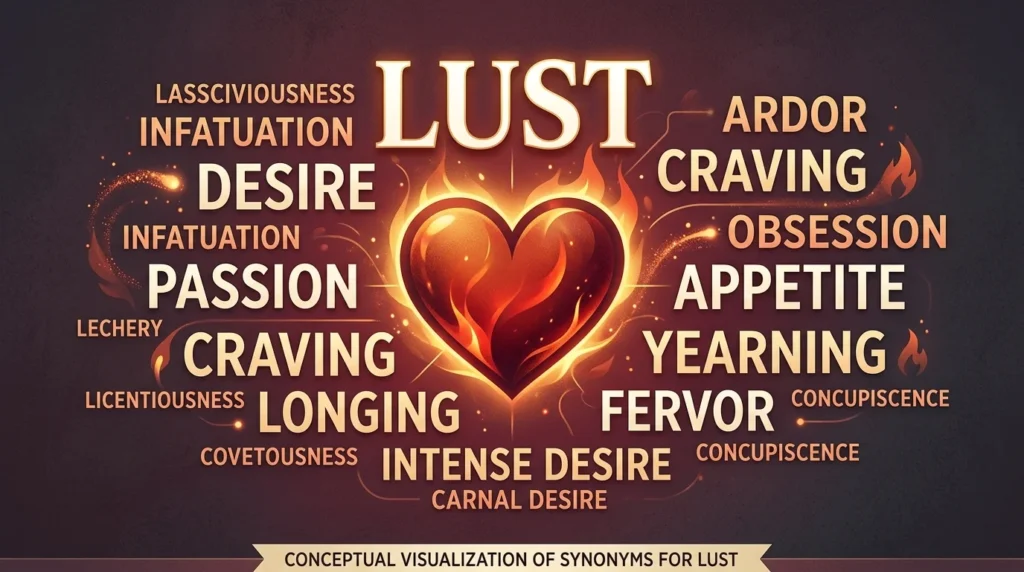
Quick Synonym List
| Synonym | Meaning / emphasis | Tone |
|---|---|---|
| Sexual desire | Desire for sexual intimacy | Neutral |
| Desire | Strong wish or attraction | Neutral |
| Passion | Intense romantic or sexual feeling | Positive/neutral |
| Libido | Sexual drive | Clinical/psychological |
| Arousal | Sexual excitement or stimulation | Clinical |
| Longing | Strong desire for someone or something | Emotional |
| Yearning | Deep, persistent longing | Literary/emotional |
| Craving | Powerful desire | Informal/general |
| Infatuation | Intense romantic attraction | Often temporary |
| Attraction | Feeling drawn toward someone | Neutral |
| Lecherousness | Excessive or inappropriate sexual desire | Negative |
| Concupiscence | Intense sexual desire | Formal/literary |
| Amorousness | Romantic or sexual inclination | Literary |
| Wantonness | Unrestrained or sexually immoral behavior | Formal/negative |
| Lasciviousness | Strongly sexual or lustful behavior | Formal/negative |
| Carnal desire | Physical/sexual desire | Formal/literary |
What Does “Lust” Mean?
Lust is a noun meaning very strong sexual desire or intense physical attraction.
He was driven by lust rather than genuine affection.
The word can also be used more broadly to describe an intense desire for something, although this use is usually less common today:
a lust for power
a lust for wealth
a lust for adventure
As a verb, to lust after means to strongly desire someone or something, traditionally with a sexual implication.
He lusted after the actress.
The important distinction is that lust is generally stronger and more physical than ordinary desire.
Synonyms for Lust Meaning “Sexual Desire”
Sexual Desire
Sexual desire is the clearest neutral equivalent.
The character struggles with intense lust.
→ The character struggles with intense sexual desire.
Unlike lust, this expression doesn’t necessarily carry a negative moral judgment.
Desire
Desire is broader than lust.
He felt a strong desire for her.
This could mean sexual attraction, romantic affection, or another type of desire depending on context.
Libido
Libido refers specifically to a person’s sexual drive or sexual energy.
Stress can affect libido.
It is especially appropriate in psychology, medicine, relationships, and health-related writing.
It isn’t always interchangeable with lust: libido refers more broadly to sexual drive, whereas lust can describe an immediate or intense desire.
Arousal
Arousal refers to a state of sexual excitement, including physiological responses.
The medication may affect sexual arousal.
This is more technical than lust and often describes a state or response, rather than a desire directed toward a person.
Synonyms for Lust Meaning “Passion”
Passion
Passion is one of the most useful alternatives when you want a more positive or romantic tone.
Their relationship was based on passion.
Unlike lust, passion doesn’t necessarily suggest purely physical desire. It can include emotional intensity and romantic attachment.
Compare:
Their relationship was driven by lust.
This suggests strong physical desire.
Their relationship was driven by passion.
This can suggest physical attraction plus emotional intensity.
Amorousness
Amorousness describes a tendency toward romantic or sexual affection.
His amorousness was obvious to everyone around him.
It has a literary or somewhat old-fashioned quality.
Carnal Desire
Carnal desire emphasizes physical or sexual appetite.
The novel explores the conflict between spiritual devotion and carnal desire.
This expression is especially useful in literary, philosophical, or religious writing.
Synonyms for Lust Meaning “Longing”
Not every use of lust is explicitly sexual.
When the emphasis is on an intense desire for something, consider:
- longing
- yearning
- craving
- hunger
- appetite
- eagerness
- ambition
- desire
Longing
Longing describes a deep emotional desire for someone or something.
She felt a longing to return home.
It is generally more emotional and less sexual than lust.
Yearning
Yearning suggests an especially deep or persistent longing.
He had a deep yearning for freedom.
It is often more poetic than desire.
Craving
Craving means a powerful desire, traditionally associated with food but applicable more broadly.
She had a craving for adventure.
It can imply urgency or intensity without necessarily being sexual.
Hunger
Hunger can be used metaphorically for intense desire.
He had a hunger for success.
It is vivid and powerful, but context determines whether the meaning is literal or figurative.
Synonyms for Lust With a Negative Meaning
Sometimes lust carries criticism, especially when it suggests uncontrolled, excessive, or inappropriate sexual desire.
In that case, stronger alternatives include:
- lecherousness
- lasciviousness
- wantonness
- concupiscence
- depravity
- licentiousness
These words are not neutral synonyms. They add a strongly negative judgment.
Lecherousness
Lecherousness means excessive or inappropriate sexual desire, particularly when someone’s behavior toward others is considered improper.
His lecherous behavior made the employees uncomfortable.
This is considerably more negative than lust.
Lasciviousness
Lasciviousness describes behavior, appearance, or thoughts that show strong and often inappropriate sexual desire.
The novel was criticized for its depiction of lascivious behavior.
This is formal and strongly negative.
Wantonness
Wantonness traditionally refers to unrestrained behavior, particularly sexual behavior, though it can have broader meanings involving recklessness or lack of restraint.

Concupiscence
Concupiscence is a formal or literary word for strong sexual desire. It is particularly associated with religious, theological, philosophical, and historical writing.
The text discusses the struggle between reason and concupiscence.
It’s an accurate synonym in some contexts, but it would sound unnatural in ordinary conversation.
Lust vs. Desire
These words overlap, but desire is broader.
Desire can refer to:
- sexual attraction
- romantic affection
- ambition
- possessions
- experiences
- goals
- food
- personal preferences
I desire a better life.
He desired her.
Lust is much more strongly associated with intense physical or sexual desire.
He lusted after her.
The word can also describe an excessive appetite for something:
a lust for power
Simple rule
Use desire when you want a broad or neutral term.
Use lust when you specifically want to emphasize intense physical or sexual appetite.
Lust vs. Passion
These are often confused.
Lust emphasizes physical or sexual desire.
Passion emphasizes intense feeling and can include romance, emotional attachment, enthusiasm, or sexual attraction.
Their relationship was based on lust.
suggests physical attraction.
Their relationship was based on passion.
could suggest a deeper emotional intensity.
You can therefore have passion without lust, and lust without emotional passion.
Lust vs. Attraction
Attraction is considerably broader and more neutral.
I feel attracted to her.
does not necessarily imply overwhelming sexual desire.
I feel lust for her.
is much more intense and explicitly physical.
Use attraction when you want to describe being drawn to someone without implying excessive desire.
Lust vs. Infatuation
Infatuation refers to an intense but often temporary romantic fascination.
His infatuation with her faded after a few months.
It can involve sexual attraction, but it usually emphasizes idealization or emotional fascination, rather than purely physical desire.
Compare
- lust → intense physical desire
- attraction → being drawn toward someone
- infatuation → intense, often temporary romantic fascination
- passion → powerful emotional or romantic feeling
- love → deeper emotional attachment
Lust vs. Libido
These are particularly different in professional contexts.
Libido refers to sexual drive or sexual appetite generally.
Lust usually describes an intense experience or desire, often directed toward a particular person.
The medication reduced his libido.
This means his general sexual drive decreased.
He felt lust for her.
This describes a particular intense sexual attraction.
For medical or psychological writing, libido is usually more precise.
Synonyms for “Lust for Power”
When lust is used figuratively, the meaning changes.
Lust for power means an intense and often excessive desire for control, authority, or influence.
Possible alternatives:
- hunger for power
- thirst for power
- desire for power
- craving for power
- ambition
- drive for power
- obsession with power
- appetite for power
Hunger for power
His lust for power consumed him.
→ His hunger for power consumed him.
This preserves the intensity while avoiding the sexual meaning.
Thirst for power
Her thirst for power was obvious.
This is vivid and commonly used in figurative writing.
Ambition
Ambition is more neutral and positive.
His ambition drove him to seek leadership.
It would be misleading to replace lust for power with ambition if the original sentence deliberately suggests greed or excessive desire.
Synonyms for “Lust for Life”
The expression lust for life is different from sexual lust.
It generally means a powerful enthusiasm for living, experiences, and enjoyment.
Possible alternatives include:
- zest for life
- enthusiasm for life
- love of life
- vitality
- joie de vivre
- appetite for life
- exuberance
- energy
- eagerness
Zest for life is usually the best natural alternative.
She has a remarkable lust for life.
→ She has a remarkable zest for life.
Here, zest preserves the positive energy without the sexual association.
Formal and Academic Alternatives
For formal writing, avoid replacing lust with an obscure word merely to sound sophisticated.
Useful choices include:
- sexual desire
- sexual attraction
- libido
- erotic desire
- physical desire
- carnal desire
- concupiscence
- amorous desire
The best choice depends on your subject.
Psychology
Use:
- libido
- sexual desire
- sexual motivation
- sexual attraction
Literature
Use:
- passion
- desire
- carnal desire
- erotic desire
- yearning
- concupiscence
Religious or theological writing
Use:
- concupiscence
- carnal desire
- sinful desire
- sexual temptation
Everyday writing
Use:
- desire
- attraction
- passion
- sexual desire
- longing
Casual Alternatives
In informal conversation, people may use:
- attraction
- desire
- crush
- chemistry
- passion
- craving
- obsession
However, these aren’t exact synonyms.
Crush generally describes romantic infatuation.
Chemistry describes mutual attraction or interpersonal connection.
Obsession emphasizes excessive preoccupation.
None should automatically replace lust.
Synonyms for Lust in Literature
Writers often choose a synonym according to the emotional effect they want.
| Word | Effect |
|---|---|
| Lust | Raw physical desire |
| Desire | Broad, restrained |
| Passion | Intense and romantic |
| Yearning | Deep emotional longing |
| Longing | Sad or persistent desire |
| Craving | Urgent, powerful desire |
| Ardor | Intense enthusiasm or passion |
| Amorousness | Romantic/sexual inclination |
| Carnal desire | Physical, bodily desire |
| Concupiscence | Formal, theological, literary |
| Lasciviousness | Excessive or inappropriate sexuality |
Ardor
Ardor means intense enthusiasm, passion, or devotion.
He pursued her with considerable ardor.
It can imply romantic passion but is not exclusively sexual.
Sentence Transformations
“He was driven by lust.”
Depending on the intended meaning:
He was driven by sexual desire.
He was driven by passion.
He was driven by physical attraction.
He was driven by an intense desire.
He was driven by carnal desire.
“She felt lust for him.”
Possible alternatives:
She felt strong sexual desire for him.
She felt intense attraction toward him.
She felt passionate desire for him.
She felt a deep physical attraction to him.
The most neutral rewrite is strong sexual desire.
“His lust for power was dangerous.”
Possible alternatives:
His hunger for power was dangerous.
His thirst for power was dangerous.
His craving for power was dangerous.
His obsession with power was dangerous.
His ambition was dangerous.
The first four preserve the negative intensity better than ambition.
Grammar and Usage
Lust can function as both a noun and a verb.
Lust as a noun
He was consumed by lust.
She felt lust for him.
His lust for power was obvious.
Common constructions include:
- lust for someone
- lust for something
- sexual lust
- physical lust
- intense lust
- uncontrolled lust
- forbidden lust
- lust and love
- lust for power
- lust for wealth
- lust for life
Lust as a verb
The common construction is:
lust after + noun
He lusted after her.
It can also be used with for:
He lusted for power.
The verb is relatively strong and can sound literary or judgmental.
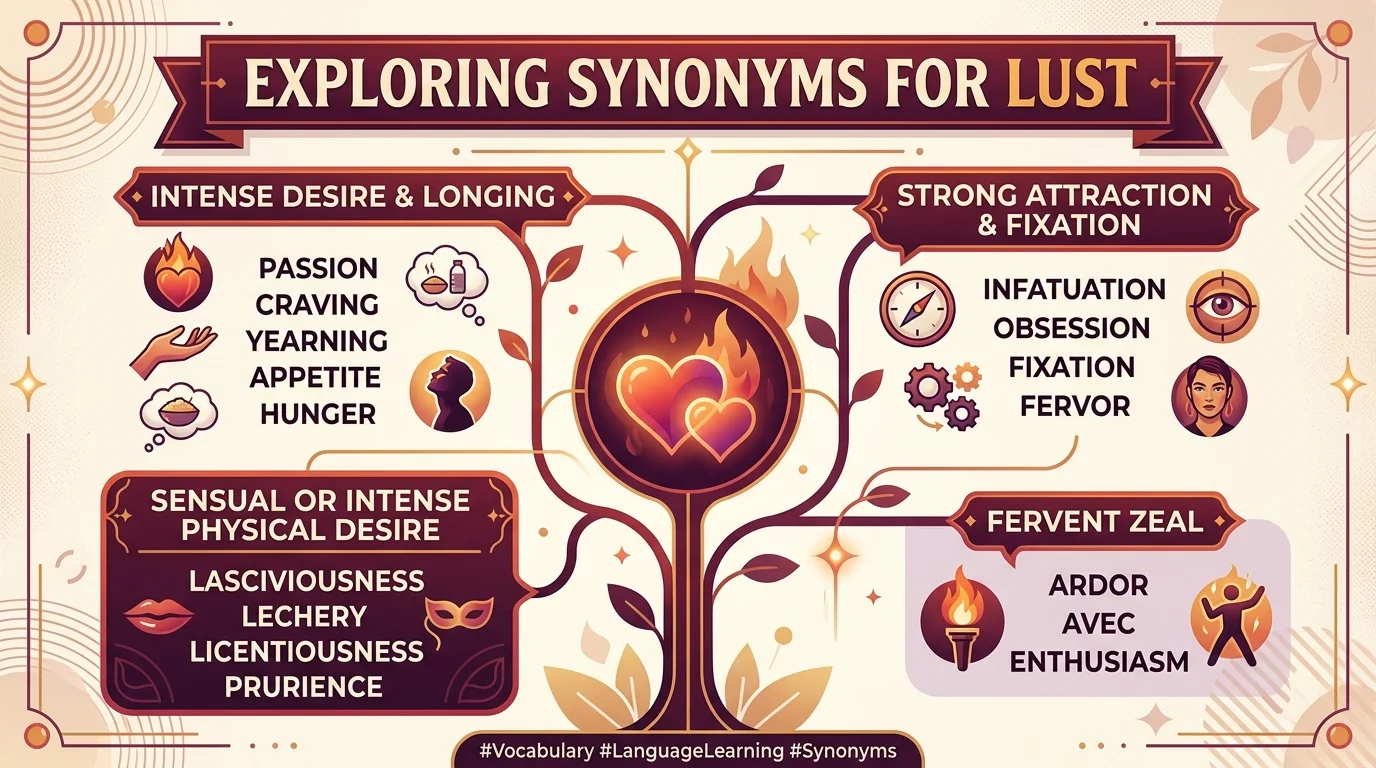
Lustful
The adjective is lustful:
He gave her a lustful look.
Related forms include:
- lust — noun/verb
- lustful — adjective
- lustfully — adverb
- lustfulness — noun
Common Mistakes
1. Treating lust and love as synonyms
They are not.
Lust primarily emphasizes physical or sexual desire.
Love can involve emotional attachment, care, commitment, affection, or intimacy.
2. Using libido to describe a particular attraction
Libido usually refers to general sexual drive rather than desire for a particular person.
3. Using passion when you specifically mean sexual desire
Passion is broader and may include emotional intensity.
4. Using infatuation as a direct replacement
Infatuation emphasizes romantic fascination, often temporary, rather than simply physical desire.
5. Using lecherousness neutrally
Lecherousness carries a strong negative judgment. Don’t use it unless inappropriate or excessive sexuality is intended.
6. Assuming “lust” is always negative
In many contexts it has a negative or morally charged quality, but phrases such as lust for life can be strongly positive.
How to Choose the Right Synonym
Use this quick guide:
- Neutral sexual desire → sexual desire
- General desire → desire
- Romantic intensity → passion
- Sexual drive → libido
- Sexual excitement → arousal
- Being drawn to someone → attraction
- Temporary romantic fascination → infatuation
- Deep emotional desire → yearning
- Persistent longing → longing
- Powerful appetite → craving
- Inappropriate sexual desire → lecherousness
- Formal/literary sexual desire → concupiscence
- Physical or bodily desire → carnal desire
- Unrestrained sexual behavior → wantonness/lasciviousness
- Intense desire for power → hunger/thirst for power
- Enthusiasm for living → zest for life
When “Lust” Is Better
Sometimes lust is more precise than any substitute.
If a writer wants to emphasize raw, immediate, physical desire, lust communicates that intensity efficiently.
The story explores the tension between love and lust.
Replacing lust with attraction would weaken the contrast.
The story explores the tension between love and attraction.
This changes the meaning considerably.
Likewise:
He had a lust for power.
has a stronger and more critical tone than:
He had an ambition for power.
The original word can therefore be the best choice when intensity, physicality, or excess is important.