
Quick Answer
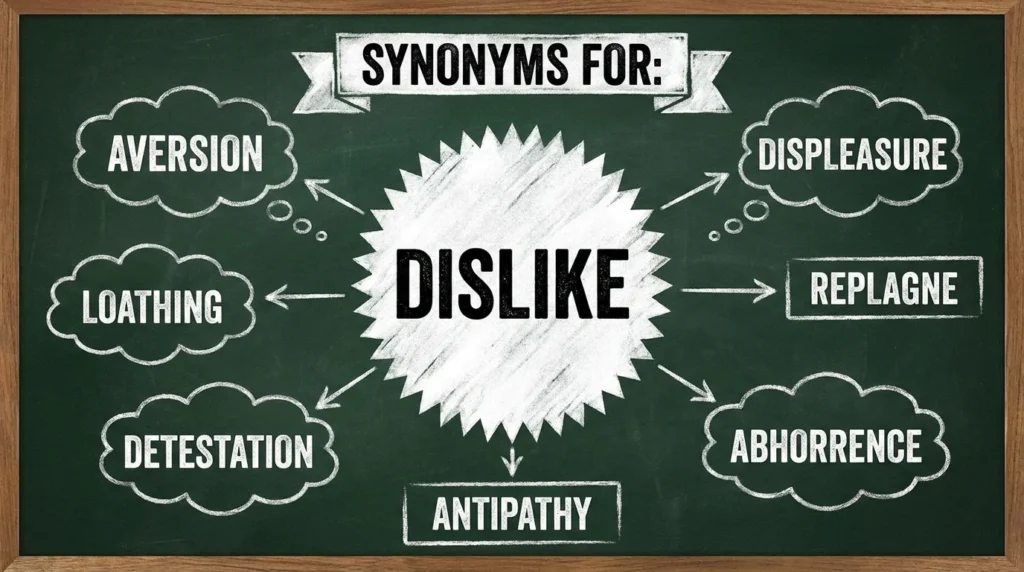
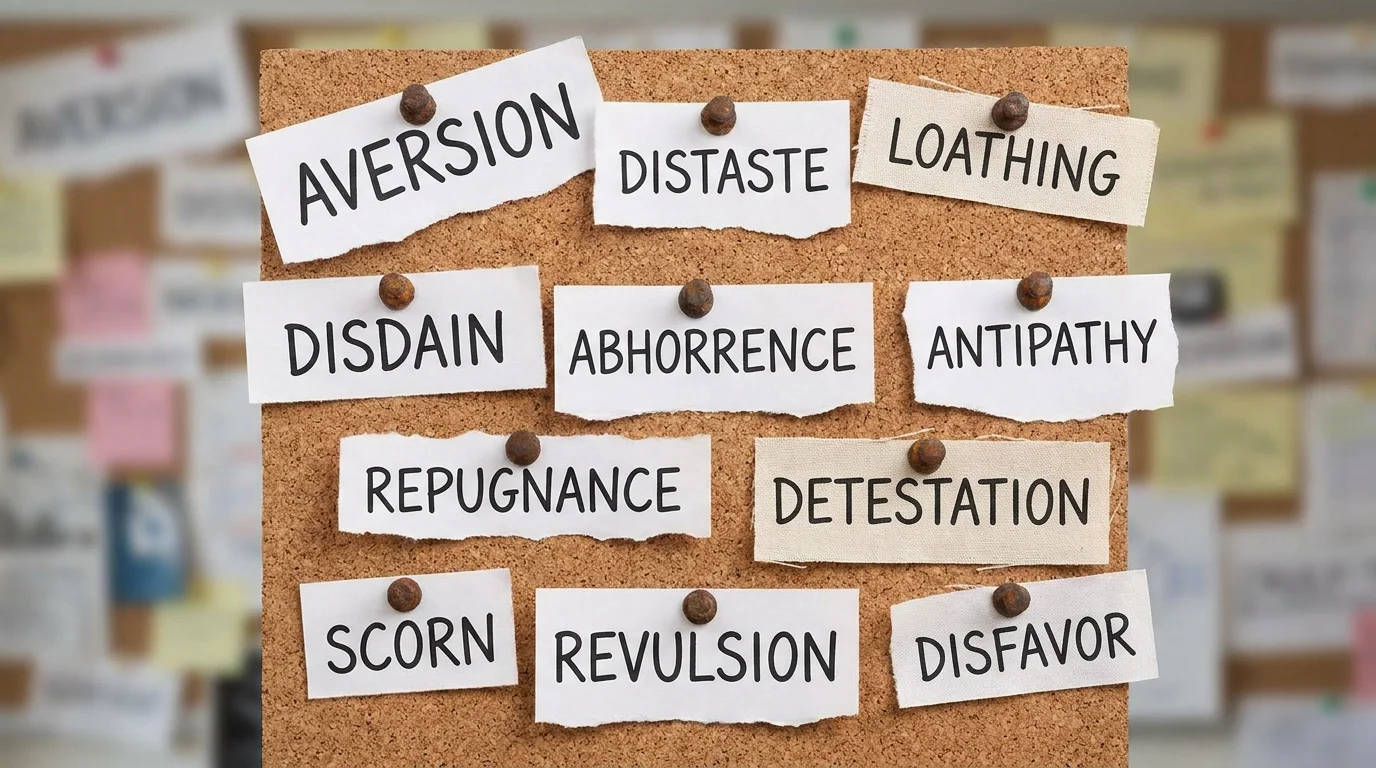
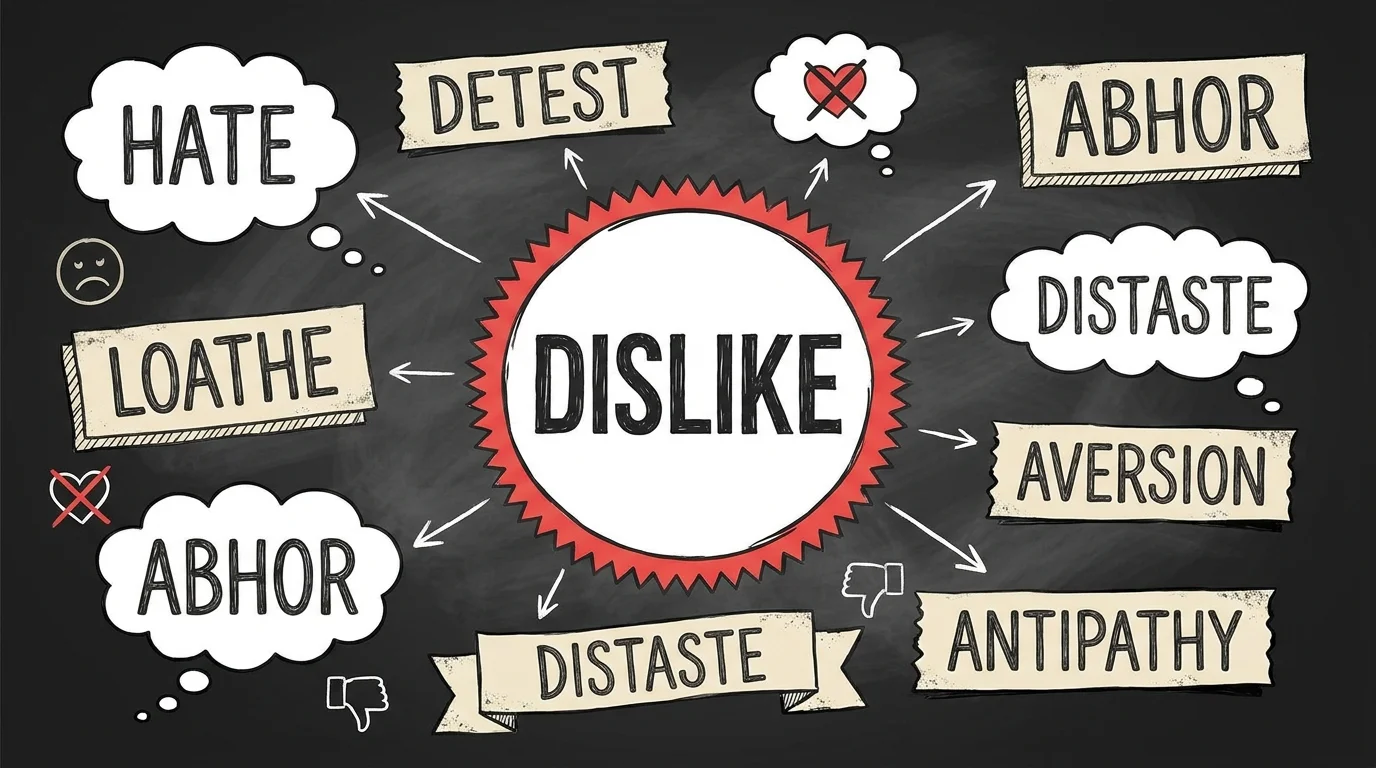
Common synonyms for dislike include hate, detest, loathe, resent, detest, abhor, despise, object to, disapprove of, be annoyed by, be uncomfortable with, be opposed to, have an aversion to, and not care for.
The best synonym depends on the strength and type of negative feeling. For mild dislike, use not care for or be unenthusiastic about. For strong dislike, use detest, loathe, abhor, or despise. For disagreement with an idea or action, object to or disapprove of may be more accurate.
Quick Synonym List
Here are useful alternatives for dislike:
- Hate
- Detest
- Loathe
- Abhor
- Despise
- Resent
- Disapprove of
- Object to
- Oppose
- Not care for
- Be averse to
- Have an aversion to
- Be uncomfortable with
- Be annoyed by
- Be irritated by
- Be unhappy with
- Be dissatisfied with
- Be unenthusiastic about
- Be reluctant about
- Reject
- Avoid
- Shun
- Take exception to
- Have no liking for
- Feel negatively about
- Be put off by
- Be bothered by
- Be displeased with
- Be hostile toward
- Be antagonistic toward
What Does “Dislike” Mean?
Dislike means to have a negative feeling toward someone or something or to not enjoy, approve of, or prefer it.
It can describe anything from a mild lack of preference to a fairly strong negative reaction.
Examples:
- I dislike crowded places.
- She dislikes being interrupted.
- He dislikes the new policy.
- They dislike working late.
- I dislike the taste of bitter coffee.
The word dislike is usually less intense than hate, detest, or loathe, which makes it useful when you want to express a negative opinion without sounding extremely emotional.
Closest Synonyms for Dislike
Hate
Hate is one of the strongest and most common everyday alternatives to dislike. It can describe intense negative feelings toward a person, thing, activity, or situation.
Example:
I hate waiting in long lines.
Best for: Strong everyday negative feelings.
Detest
Detest means to strongly dislike something or someone.
Example:
She detests dishonesty.
It is stronger and more formal-sounding than ordinary dislike.
Loathe
Loathe means to dislike something intensely.
Example:
He loathes being treated unfairly.
It often expresses deep personal disgust or strong emotional rejection.
Abhor
Abhor means to strongly hate or find something morally or personally unacceptable.
Example:
Many people abhor cruelty to animals.
It is more formal and is often used for serious behavior or situations.
Despise
Despise means to dislike someone or something intensely, often with a strong feeling of contempt.
Example:
She despises people who take advantage of others.
Unlike simple dislike, despise can suggest that you consider the person or thing beneath respect.
Mild Synonyms for Dislike
Not every negative feeling is strong enough for hate. These alternatives work better when you want a softer tone.
Not Care For
Not care for is a polite and indirect way to say that you do not like something.
Example:
I don’t really care for spicy food.
This is useful in everyday conversations when you want to sound less harsh.
Be Unenthusiastic About
This means to have little excitement, interest, or positive feeling toward something.
Example:
The employees were unenthusiastic about the proposed changes.
Be Uncomfortable With
Use this phrase when something makes you feel uneasy rather than simply unpleasant.
Example:
I am uncomfortable with the way the situation was handled.
Be Put Off By
This informal expression means that something makes you lose interest or feel less positive about it.
Example:
I was put off by the rude customer service.
Have No Liking For
This is a more formal or literary way of saying that you do not like something.
Example:
He had no liking for unnecessary conflict.
Strong Synonyms for Dislike
Detest
- Strength: Very strong
- Tone: Formal to neutral
- Example: She detests dishonesty.
Loathe
- Strength: Very strong
- Tone: Strong, emotional
- Example: I loathe being lied to.
Abhor
- Strength: Extremely strong
- Tone: Formal
- Example: They abhor violence.
Despise
- Strength: Extremely strong
- Tone: Strong, sometimes contemptuous
- Example: He despises corruption.
Hate
- Strength: Strong
- Tone: Everyday
- Example: I hate wasting time.
Formal and Professional Alternatives
In professional writing, simply saying I dislike this can sometimes sound too personal or informal. Consider these alternatives when the context calls for a more measured tone.
Disapprove Of
Use disapprove of when you believe something is wrong, inappropriate, or unacceptable.
Example:
The manager disapproved of the employee’s behavior.
Object To
Use object to when you actively express disagreement with something.
Example:
Several residents objected to the proposed development.
Be Opposed To
This indicates disagreement with an idea, policy, action, or proposal.
Example:
The organization is opposed to the proposed changes.
Be Dissatisfied With
This is useful when you are unhappy because something has failed to meet expectations.
Example:
Customers were dissatisfied with the quality of the service.
Take Exception To
This formal phrase means to strongly object to something, especially a particular statement or action.
Example:
The author took exception to the criticism.
Synonyms for Dislike Based on Context
Dislike a Person
When you dislike someone personally, these words may fit:
- Dislike
- Disapprove of
- Resent
- Despise
- Detest
- Loathe
- Be hostile toward
- Have an aversion to
Example:
She dislikes her former colleague.
A stronger version would be:
She resents her former colleague.
This suggests anger or bitterness rather than simple dislike.
Dislike an Activity
For activities you do not enjoy, use:
- Not enjoy
- Not care for
- Be unenthusiastic about
- Be reluctant to
- Avoid
- Hate
- Detest
Example:
I don’t enjoy public speaking.
Dislike a Food or Drink
For preferences involving food, softer expressions are usually more natural:
- Not like
- Not care for
- Not enjoy
- Have an aversion to
- Dislike
Example:
I don’t care for black coffee.
Dislike an Idea or Proposal
For disagreement with an idea, use:
- Object to
- Oppose
- Disapprove of
- Reject
- Take exception to
- Be against
Example:
The committee opposed the proposal.
Dislike a Situation
Depending on the reason, you might use:
- Be unhappy with
- Be dissatisfied with
- Be uncomfortable with
- Object to
- Be frustrated by
- Be bothered by
- Be annoyed by
Example:
Employees were dissatisfied with the new schedule.
True Synonyms vs. Related Alternatives
Not every related word means exactly the same thing.
| Word | Main Meaning | Strength |
|---|---|---|
| Dislike | Have a negative preference | Mild–medium |
| Hate | Feel very strong dislike | Strong |
| Detest | Dislike intensely | Very strong |
| Loathe | Feel intense dislike | Very strong |
| Abhor | Strongly reject or hate | Very strong |
| Despise | Hate with contempt | Very strong |
| Resent | Feel bitterness about something | Medium–strong |
| Object to | Express disagreement | Medium |
| Disapprove of | Consider something wrong | Medium |
| Avoid | Stay away from something | Not necessarily emotional |
| Oppose | Actively disagree with something | Strong disagreement |
| Dislike | Simply not like something | Mild–medium |
Dislike vs. Hate
Dislike is generally weaker than hate.
- I dislike rainy weather.
- I hate being stuck in traffic.
The first sentence expresses a negative preference. The second communicates a much stronger reaction.
Dislike vs. Detest
Detest is much stronger than dislike.
- I dislike loud music.
- I detest dishonesty.
Use detest when the negative feeling is intense.
Dislike vs. Resent
These words describe different emotions.
Dislike means you do not like someone or something.
Resent means you feel anger or bitterness because of something you believe is unfair or harmful.
Compare:
- I dislike my neighbor.
- I resent my neighbor for damaging my property.
The second sentence gives a specific reason for the negative emotion.
Dislike vs. Disapprove
Dislike is mainly about personal preference or feeling.
Disapprove is about judging something negatively or believing it is inappropriate.
Examples:
- I dislike the color.
- I disapprove of his behavior.
You can dislike something without believing it is wrong.
Dislike vs. Object To
Object to means to actively disagree with or protest against something.
Example:
Many residents objected to the construction plan.
This is different from simply saying:
Many residents disliked the construction plan.
Object to suggests active disagreement rather than only a personal feeling.
Dislike vs. Avoid
Dislike describes a feeling.
Avoid describes an action.
Example:
I dislike crowded restaurants.
This tells us how you feel.
I avoid crowded restaurants.
This tells us what you do.
You may avoid something because you dislike it, but the words are not interchangeable.
How to Choose the Right Synonym
Use this quick decision guide:
| If you mean… | Best choice |
|---|---|
| Mildly don’t like | Not care for |
| Strong everyday dislike | Hate |
| Very strong dislike | Detest |
| Deep emotional dislike | Loathe |
| Moral rejection | Abhor |
| Dislike with contempt | Despise |
| Bitterness or anger | Resent |
| Disagreement with a proposal | Object to |
| Believing something is wrong | Disapprove of |
| Active disagreement | Oppose |
| Unhappiness with quality or service | Be dissatisfied with |
| Feeling uneasy | Be uncomfortable with |
| Staying away from something | Avoid |
Sentence Transformations
Here are different ways to rewrite sentences using appropriate alternatives.
Original
I dislike this restaurant.
Alternative:
I don’t care for this restaurant.
Original
She dislikes dishonest people.
Alternative:
She has an aversion to dishonest people.
Original
He dislikes the new policy.
Alternative:
He objects to the new policy.
Original
They dislike the decision.
Alternative:
They disapprove of the decision.
Original
I dislike waiting.
Alternative:
I am unenthusiastic about waiting.
Original
She dislikes unfair treatment.
Alternative:
She resents being treated unfairly.
Original
He dislikes violence.
Alternative:
He abhors violence.
Original
I dislike working late.
Alternative:
I don’t care for working late.
Original
The customers disliked the service.
Alternative:
The customers were dissatisfied with the service.
Grammar: How to Use “Dislike” Correctly
Dislike can function as both a verb and a noun.
Dislike as a Verb
The common structure is:
Subject + dislike + noun
I dislike noise.
It can also be followed by a gerund:
She dislikes waiting.
For a person or thing:
He dislikes his new supervisor.
Dislike as a Noun
As a noun, dislike means a feeling of not liking something.
Example:
She has a strong dislike of dishonesty.
Another common structure is:
His dislike for the proposal was obvious.
Common Mistakes
Using “Hate” for Every Situation
Hate is much stronger than dislike.
Less appropriate:
I hate this minor inconvenience.
Better:
I dislike this inconvenience.
Confusing “Disapprove” With “Dislike”
Disapproval usually involves judgment.
I disapprove of cheating.
This means you consider cheating wrong or unacceptable.
Using “Avoid” as a Direct Synonym
Avoidance is an action, not simply a feeling.
I avoid crowded places.
This does not directly mean:
I dislike crowded places.
The reasons may be completely different.
Using “Resent” Without a Reason
Resentment normally involves anger, unfairness, or bitterness.
She resents being ignored.
It is stronger and more specific than ordinary dislike.
Using “Abhor” in Casual Conversation
Abhor sounds formal and intense.
Instead of:
I abhor this sandwich.
A natural everyday sentence would usually be:
I really don’t like this sandwich.
Confusing “Dislike” With “Disagree”
You can disagree with an opinion without personally disliking the person who expressed it.
I disagree with his argument.
This does not necessarily mean:
I dislike him.
When Not to Replace “Dislike”
Sometimes dislike is actually the best word.
Do not replace it just to make your writing sound more sophisticated.
Use dislike when:
- The negative feeling is mild or moderate.
- You want a neutral tone.
- You are discussing personal preferences.
- You do not want to exaggerate.
- The exact intensity is unclear.
For example:
I dislike unnecessary meetings.
This is often better than:
I despise unnecessary meetings.
The second sentence may sound unnecessarily dramatic.
Writing Tips
Choose synonyms according to emotion, intensity, context, and tone.
For everyday writing, dislike, hate, not care for, and not enjoy are natural choices.
For professional writing, consider disapprove of, object to, oppose, or be dissatisfied with when they accurately describe the situation.
For strong emotional writing, detest, loathe, abhor, or despise can be effective, but use them carefully.
Most importantly, do not choose a synonym simply because it sounds more advanced. The best word is the one that communicates the exact meaning you intend.
Related Questions
What is a mild synonym for dislike?
Not care for is a common mild and polite alternative to dislike. Other options include not enjoy and be unenthusiastic about.
What is a strong synonym for dislike?
Detest, loathe, abhor, and despise are strong synonyms. Their exact meaning differs depending on whether the feeling involves hatred, moral rejection, or contempt.
What is a formal word for dislike?
Detest, abhor, disapprove of, object to, and have an aversion to can work in formal contexts, depending on the intended meaning.
What is the opposite of dislike?
Common opposites include like, enjoy, love, appreciate, admire, and prefer.
Is “hate” stronger than “dislike”?
Yes. In most everyday contexts, hate expresses a significantly stronger negative feeling than dislike.
What is a synonym for dislike in professional writing?
Depending on the context, disapprove of, object to, oppose, or be dissatisfied with may be more appropriate than simply using dislike.
What is the difference between dislike and resentment?
Dislike means you do not like someone or something. Resentment usually involves anger or bitterness caused by something you consider unfair, offensive, or harmful.
Key Takeaways
- Dislike is a general and relatively moderate word for having a negative feeling toward something.
- Hate, detest, loathe, abhor, and despise express increasingly strong negative feelings.
- Resent suggests bitterness or anger, often because of perceived unfairness.
- Object to, oppose, and disapprove of are better when the issue involves disagreement or judgment.
- The best synonym depends on the meaning, intensity, context, grammar, and tone of your sentence.