
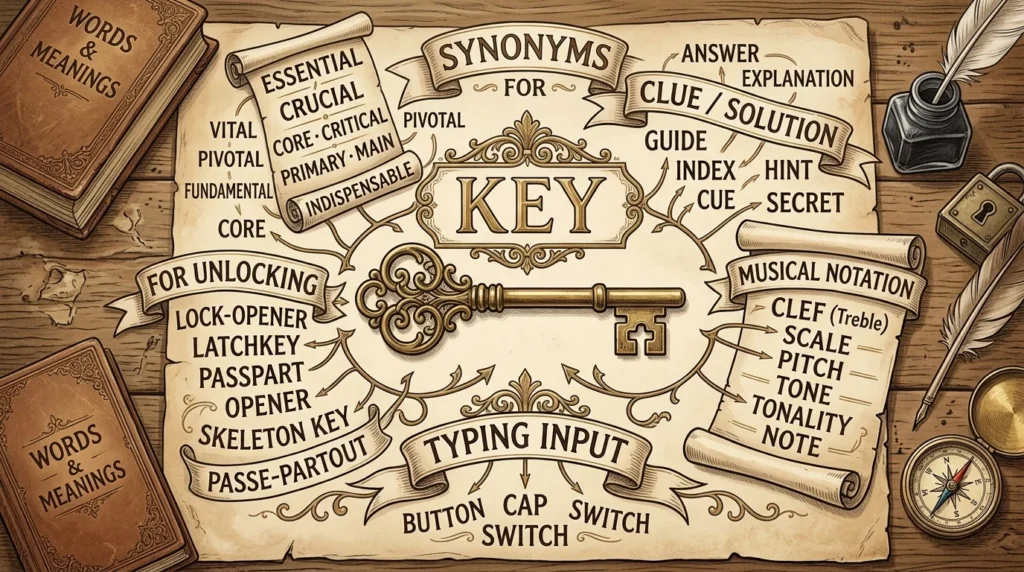
Quick Synonym List
When “key” means important
- important
- crucial
- essential
- vital
- critical
- central
- fundamental
- significant
- major
- pivotal
- indispensable
- necessary
- influential
- decisive
- consequential
- primary
- principal
- core
- foundational
- instrumental
- integral
- strategic
- substantial
- paramount
- indispensable
- leading
When “key” means a solution or means
- answer
- solution
- method
- means
- way
- approach
- strategy
- mechanism
- tool
- secret
- formula
- technique
When “key” means a physical object
- key
- keycard
- access card
- passkey
- opener
These are not interchangeable in every context.
When “key” means a guide or legend
- legend
- guide
- index
- reference
- code
- glossary
When “key” means a keyboard control
- button
- control
- key
- keyboard control
Again, the correct replacement depends on the specific meaning.
What Does “Key” Mean?
Key is a highly versatile English word with several unrelated meanings. This matters when looking for synonyms because a word such as crucial can replace key in:
a key factor
but not in:
a key to the front door.
The main meanings include:
- Important or essential
- a key factor in the decision
- A solution or means of achieving something
- Education is the key to success.
- A physical device used to open something
- I lost my house key.
- A keyboard button
- Press the Enter key.
- A guide or legend explaining symbols
- Use the map key to identify the trails.
- A musical tonality
- The song is written in the key of G.
- A system, code, or identifier
- The database uses a unique key.
The first sense—important or essential—is the one most often intended when people search for synonyms for key.
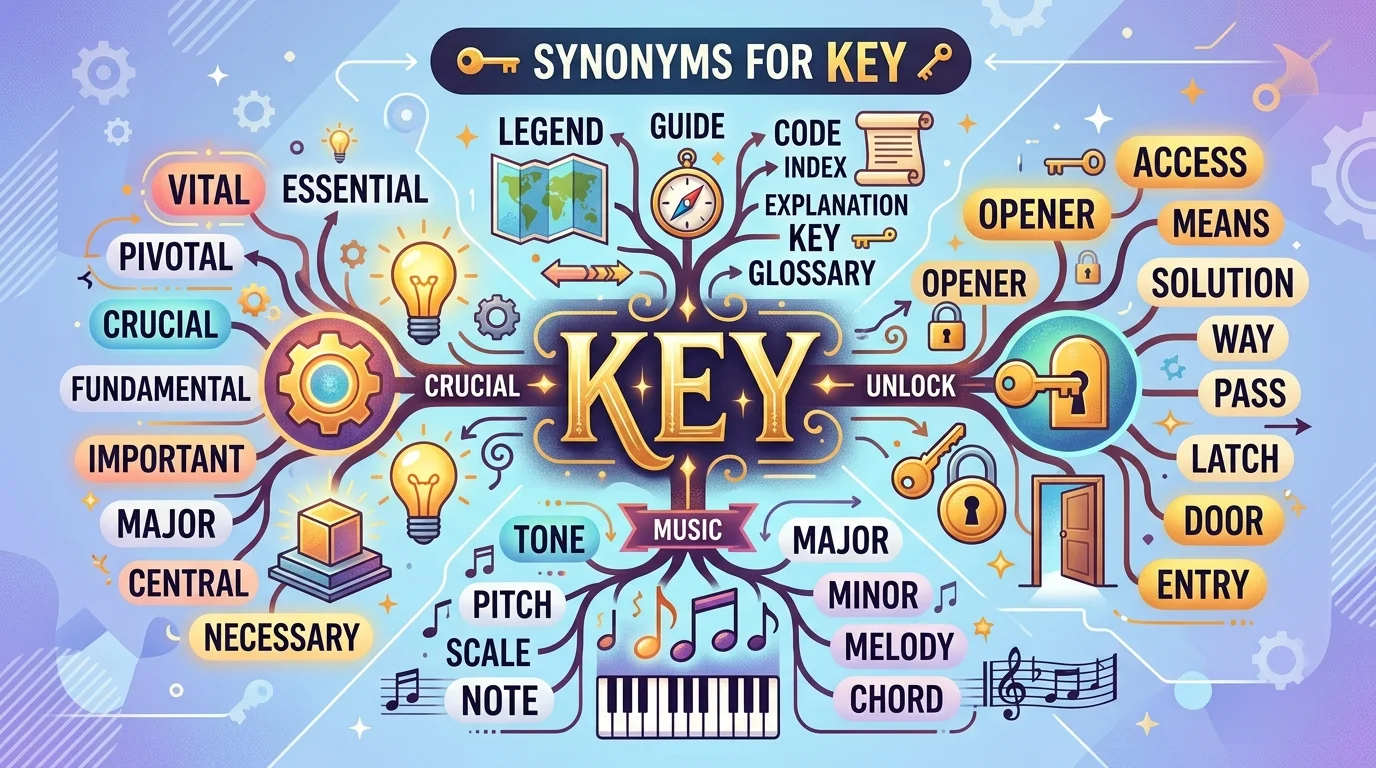
Synonyms for “Key” Meaning Important
1. Important
Meaning: Having considerable value, influence, or significance.
Tone: Neutral
Best for: General writing
Communication is key to a successful team.
Communication is important to a successful team.
Interchangeability: Usually interchangeable, although key can suggest a particularly important role within a larger system.
2. Crucial
Meaning: Extremely important to a result or outcome.
Tone: Strong, professional
Best for: Decisions, outcomes, problems, strategies, research
Timing was crucial to the project’s success.
Interchangeability: Usually interchangeable when key means highly important.
Nuance: Crucial is often stronger than ordinary key.
3. Essential
Meaning: Absolutely necessary.
Tone: Neutral to formal
Best for: Requirements, resources, qualities, processes
Clear communication is essential for effective teamwork.
Interchangeability: Context-dependent.
Essential implies necessity. Key can simply mean highly important.
4. Vital
Meaning: Extremely important or necessary.
Tone: Strong, professional
Best for: Health, survival, success, operations, major decisions
Accurate data is vital to the analysis.
Interchangeability: Often interchangeable.
5. Critical
Meaning: Extremely important, especially to success, safety, or a decision.
Tone: Strong, professional
Best for: Business, technology, safety, analysis, emergencies
Security is a critical part of the system.
Interchangeability: Usually interchangeable in formal contexts.
Watch out: Critical can also mean judgmental or relating to criticism.
6. Central
Meaning: At the center of an issue, activity, or argument.
Tone: Neutral, academic
Best for: Ideas, themes, issues, arguments, roles
Trust is central to the relationship.
Interchangeability: Often, but not always.
Central emphasizes position or importance within a larger structure.
7. Fundamental
Meaning: Basic and essential to the nature or functioning of something.
Tone: Formal, academic
Best for: Principles, concepts, skills, theories
Critical thinking is a fundamental skill.
Interchangeability: Context-dependent.
Fundamental suggests something forms a foundation, not merely that it is important.
8. Significant
Meaning: Important enough to have an effect or deserve attention.
Tone: Neutral, professional, academic
Best for: Findings, changes, differences, events, factors
The study identified a significant factor affecting performance.
Interchangeability: Often, but significant can emphasize measurable or noticeable importance.
9. Pivotal
Meaning: Extremely important because it determines or strongly influences what happens next.
Tone: Formal, strong
Best for: Events, decisions, people, moments, developments
Her decision was pivotal to the project’s success.
Interchangeability: Context-dependent.
Pivotal is stronger and emphasizes a turning point or decisive influence.
10. Fundamental
Access to reliable information is fundamental to good decision-making.
This is particularly useful when key describes something that forms a basic foundation.
11. Indispensable
Meaning: So important or necessary that it cannot be done without.
Tone: Strong, formal
Best for: People, resources, tools, skills
Her expertise was indispensable to the team.
Interchangeability: Sometimes.
This is stronger than key because it suggests something cannot reasonably be omitted.
12. Integral
Meaning: Necessary to make something complete or functioning properly.
Tone: Formal, professional
Best for: Components, roles, parts, processes
Collaboration is an integral part of the process.
Interchangeability: Often, but with a specific nuance.
Integral suggests that something is an essential part of a whole.
13. Instrumental
Meaning: Important in producing a particular result.
Tone: Formal, professional
Best for: People, actions, factors, developments
Her research was instrumental in improving the process.
Interchangeability: Context-dependent.
Instrumental focuses on causing or helping produce an outcome.
14. Decisive
Meaning: Having the power to determine an outcome.
Tone: Strong, formal
Best for: Factors, actions, moments, evidence, votes
The final piece of evidence was decisive.
Interchangeability: Not always.
Use decisive when the thing actually determines the result, not simply when it is important.
15. Primary
Meaning: First in importance, rank, or order.
Tone: Neutral, professional
Best for: Objectives, concerns, causes, responsibilities
Safety is our primary concern.
Interchangeability: Sometimes.
Primary emphasizes priority rather than importance alone.
16. Principal
Meaning: First or most important.
Tone: Formal
Best for: Reasons, causes, objectives, figures, considerations
Cost was the principal reason for the change.
Interchangeability: Often.
Watch out: Principal is commonly confused with principle.
17. Core
Meaning: Central, basic, or most important part.
Tone: Neutral, professional
Best for: Values, ideas, skills, activities, functions
Communication is a core skill for effective leaders.
Interchangeability: Often.
18. Foundational
Meaning: Providing the basic foundation on which something develops.
Tone: Formal, academic
Best for: Knowledge, skills, principles, concepts
Reading is foundational to language development.
Interchangeability: Context-dependent.
It emphasizes a foundation rather than importance in general.
19. Paramount
Meaning: More important than anything else.
Tone: Very formal
Best for: Priorities, concerns, principles
Public safety is paramount.
Interchangeability: Only when key means extremely important.
This is usually too formal for casual writing.
“Key” as a Noun: A Solution or Means
Consider:
Practice is the key to improving your writing.
Here, key does not simply mean “important.” It means something like the means, method, or solution that enables a desired result.
Useful alternatives include:
- solution
- answer
- means
- method
- approach
- strategy
- way
- tool
- technique
- formula
- secret
- mechanism
But grammar matters.
Key to success
Practice is the key to success.
Possible alternatives:
Practice is the means to success.
Practice is a way to achieve success.
Practice is an important factor in achieving success.
These do not have exactly the same tone or structure.
“Key to” Synonyms
The expression key to has several useful alternatives.
Key to success
- essential to success
- crucial to success
- important for success
- central to success
- fundamental to success
- instrumental in achieving success
- a major factor in success
- a foundation for success
- a pathway to success
- a means of achieving success
Example
Preparation is key to success.
Could become:
Preparation is essential to success.
Preparation is crucial to success.
Preparation is a major factor in success.
Preparation provides a foundation for success.
The best option depends on whether you mean necessity, influence, or foundation.
“Key Factor” Synonyms
The phrase key factor is extremely common.
Alternatives include:
- important factor
- crucial factor
- critical factor
- major factor
- significant factor
- central factor
- primary factor
- decisive factor
- contributing factor
- influential factor
- determining factor
- main consideration
- major consideration
- driving factor
Important distinction
Key factor does not always mean decisive factor.
Cost was a key factor in the decision.
This means cost played an important role.
Cost was the decisive factor in the decision.
This means cost determined the outcome.
“Key Role” Synonyms
Instead of:
She played a key role in the project.
You could use:
- played an important role
- played a crucial role
- played a central role
- played a major role
- played a pivotal role
- was instrumental in the project
- made a significant contribution
- was essential to the project
Nuance
Played a pivotal role suggests especially strong influence.
Was instrumental emphasizes helping produce the result.
Played a central role emphasizes importance within the overall activity.
“Key Point” Synonyms
Depending on context:
- main point
- central point
- important point
- essential point
- primary point
- major point
- core idea
- main idea
- takeaway
- central argument
- principal argument
- critical observation
Example
The key point is that the system needs more testing.
Possible rewrite:
The main point is that the system needs more testing.
For a presentation:
The main takeaway is that the system needs more testing.
For academic writing:
The central argument is that the system needs more testing.
“Key Issue” Synonyms
Useful alternatives include:
- main issue
- central issue
- major issue
- critical issue
- important issue
- primary concern
- central concern
- major concern
- pressing issue
- fundamental problem
- core problem
Choose carefully:
- pressing issue = urgent issue
- critical issue = extremely important issue
- central issue = issue at the heart of the matter
- fundamental problem = basic underlying problem
“Key Skills” Synonyms
Depending on your intended meaning:
- essential skills
- core skills
- fundamental skills
- important skills
- critical skills
- foundational skills
- primary skills
- core competencies
- essential competencies
- priority skills
For a resume or professional document, core competencies can be more specific than key skills.
“Key” in Formal and Academic Writing
When key means important, formal alternatives include:
- crucial
- essential
- critical
- fundamental
- significant
- central
- pivotal
- primary
- principal
- integral
- instrumental
- indispensable
- paramount
- foundational
Example
Less specific:
The study identified several key factors.
More precise:
The study identified several significant factors.
Or:
The study identified several factors that strongly influenced the outcome.
The second version may be preferable when you want to explain rather than label.
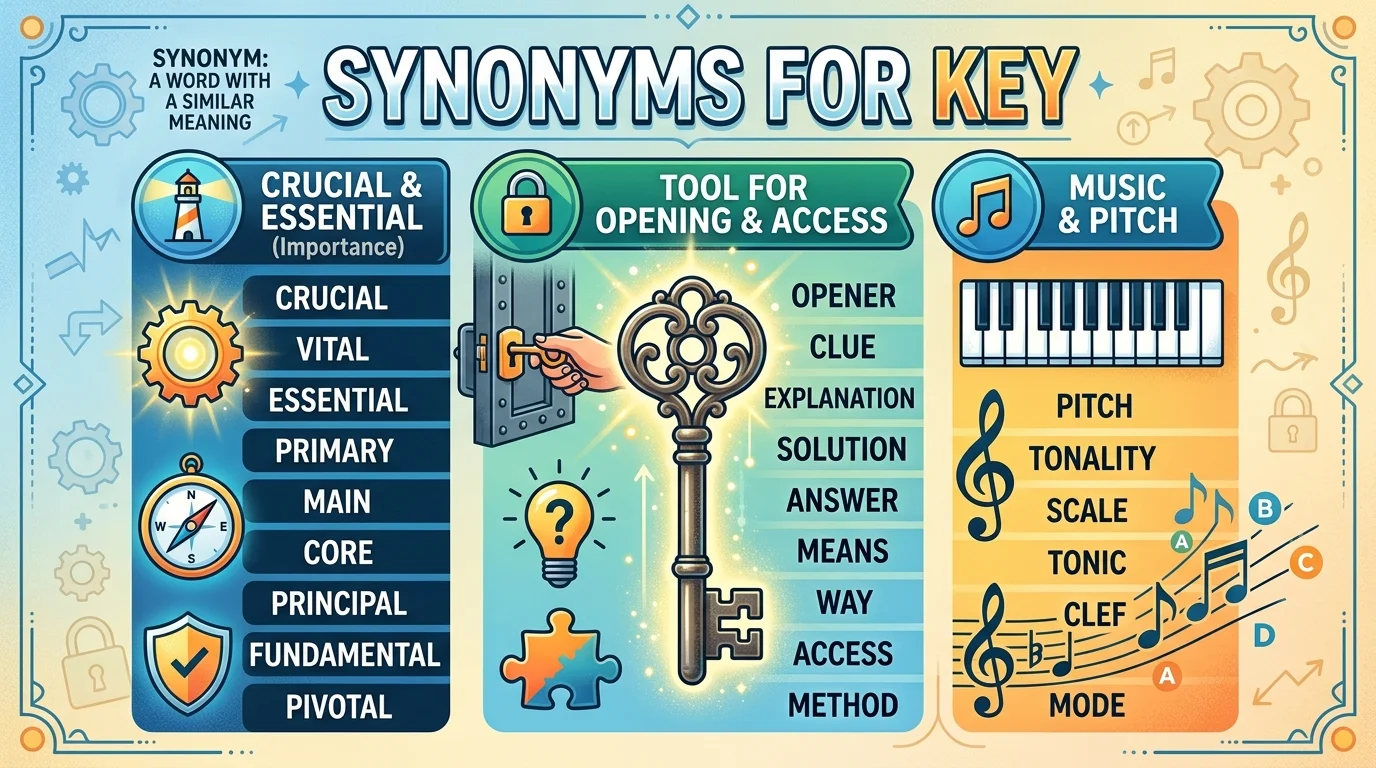
“Key” in Business Writing
Common alternatives include:
- critical
- strategic
- essential
- important
- central
- core
- primary
- major
- pivotal
- instrumental
Examples
Customer retention is a key priority.
Customer retention is a strategic priority.
Data security is a critical concern.
Communication is a core business skill.
The partnership played an instrumental role in our growth.
Avoid replacing every instance of key with a stronger-sounding word. Key is already natural and professional.
“Key” in Academic Writing
Academic alternatives can include:
- central
- significant
- fundamental
- crucial
- primary
- principal
- pivotal
- integral
- foundational
- influential
Example
A key finding of the study was the relationship between sleep and performance.
Possible rewrite:
A significant finding of the study was the relationship between sleep and performance.
Or:
A central finding of the study was the relationship between sleep and performance.
Use significant only when you mean important or noteworthy—not automatically in the statistical sense.
Physical “Key” Synonyms
When key means the object used to open a lock, there are fewer true synonyms.
Depending on the object, you might use:
- key
- house key
- car key
- door key
- keycard
- access card
- passkey
- security key
- key fob
- opener
These are not exact synonyms.
For example:
I forgot my key.
You cannot automatically replace it with:
I forgot my access card.
An access card is a different type of access device.
“Key” as a Map Legend
In maps and diagrams, key can mean a guide explaining symbols.
The closest alternatives are:
- legend
- guide
- symbol guide
- reference
- index
Example
Check the map key to identify the symbols.
Check the map legend to identify the symbols.
Here, legend is often the most natural replacement.
“Key” as a Keyboard Button
When key refers to a physical or virtual keyboard control, possible alternatives include:
- button
- keyboard button
- control
- keyboard control
But key is usually the most precise technical term.
Press the Enter key.
Changing this to button may be less accurate because a keyboard key is not necessarily a button in the ordinary sense.
“Key” in Music
In music, key refers to the tonal center or system of pitches around which a piece is organized.
There is no simple everyday synonym.
You might explain it as:
- tonal center
- tonality
- musical tonality
But these are related technical concepts rather than universal replacements.
The song is in the key of C major.
Do not replace key with tonal center mechanically, especially in beginner-friendly writing.
“Key” in Computing and Data
In computing, key can refer to an identifier used to access or distinguish data.
Depending on the context, related terms include:
- identifier
- ID
- unique identifier
- access key
- lookup key
- primary key
- database key
- authentication key
- security key
These are specialized technical terms, not general synonyms.
For example:
The database uses a primary key to uniquely identify each record.
Here, replacing key with identifier may change the technical meaning.
Key vs. Important
These words overlap heavily, but they are not always identical.
Important is broad.
Key often suggests that something has an important role in a particular outcome, process, or structure.
Compare:
She is an important employee.
This says she has considerable value.
She is a key employee.
This suggests she has a particularly important role in the organization.
In many sentences, important is the safest direct replacement. But key can sound more focused and functional.
Key vs. Crucial
Crucial is usually stronger.
Communication is key to success.
Communication is crucial to success.
Both are natural.
But crucial can imply that success depends heavily on that factor.
Use crucial when the high level of importance matters.
Key vs. Essential
Essential means necessary.
Training is key to using the equipment safely.
Training is essential to using the equipment safely.
The second sentence suggests training is required, not merely highly important.
This distinction matters.
Key = highly important
Essential = necessary
Key vs. Critical
Critical usually carries stronger urgency or consequence.
Accurate records are key to the investigation.
Accurate records are critical to the investigation.
The second sentence suggests that inaccurate records could seriously undermine the investigation.
Key vs. Pivotal
Pivotal suggests that something strongly changes or determines the outcome.
Her research played a key role in the project.
Her research played a pivotal role in the project.
The second sentence gives her research greater influence and suggests it was central to how the project developed.
Key vs. Central
Central emphasizes being at the heart of something.
Trust is key to their relationship.
Trust is central to their relationship.
The second version emphasizes that trust is one of the relationship’s defining elements.
Comparison Table: Best Alternatives
| Alternative | Main idea | Strength | Best use | Direct replacement? |
|---|---|---|---|---|
| Important | Has considerable value | Medium | General writing | Usually |
| Crucial | Extremely important | High | Outcomes, decisions | Often |
| Essential | Absolutely necessary | High | Requirements | Sometimes |
| Vital | Extremely important/necessary | High | Success, safety | Often |
| Critical | Extremely important or urgent | High | Business, safety, analysis | Often |
| Central | At the heart of something | Medium-high | Ideas, roles, themes | Often |
| Fundamental | Basic and foundational | High | Principles, skills | Sometimes |
| Significant | Important or noteworthy | Medium-high | Research, changes, findings | Often |
| Pivotal | Determines or strongly influences outcome | Very high | Decisions, events | Sometimes |
| Indispensable | Cannot reasonably be omitted | Very high | People, resources | Rarely |
| Integral | Essential part of a whole | High | Components, processes | Sometimes |
| Instrumental | Helps produce an outcome | High | Actions, people, factors | Sometimes |
| Decisive | Determines the outcome | Very high | Evidence, factors, decisions | Sometimes |
| Core | Central or basic | Medium-high | Skills, values, functions | Often |
| Primary | First in importance | Medium-high | Objectives, concerns | Sometimes |
Sentence Transformations
1. Key factor
Original:
Cost was a key factor in the decision.
Alternative:
Cost was a major factor in the decision.
Why: Major is a natural replacement when you want to emphasize importance without suggesting that cost alone determined the decision.
2. Key role
Original:
She played a key role in the project.
Alternative:
She played a pivotal role in the project.
Why: Pivotal suggests her contribution had especially strong influence.
3. Key reason
Original:
Price was a key reason for the change.
Alternative:
Price was a primary reason for the change.
Why: Primary emphasizes that price ranked first among the reasons.
4. Key skill
Original:
Communication is a key skill for managers.
Alternative:
Communication is an essential skill for managers.
Why: Essential is stronger and suggests managers need this skill.
5. Key finding
Original:
The key finding was that sleep improved performance.
Alternative:
The central finding was that sleep improved performance.
Why: Central works particularly well in academic or analytical writing.
6. Key to success
Original:
Preparation is key to success.
Alternative:
Preparation is crucial to success.
Why: Crucial preserves the importance meaning and adds emphasis.
7. Key issue
Original:
Security is a key issue for the company.
Alternative:
Security is a critical issue for the company.
Why: Critical suggests the issue has serious consequences.
8. Key component
Original:
Testing is a key component of the process.
Alternative:
Testing is an integral component of the process.
Why: Integral emphasizes that testing is an essential part of the whole process.
Common Collocations With “Key”
These are especially common:
- key factor
- key role
- key point
- key issue
- key reason
- key skill
- key element
- key component
- key feature
- key benefit
- key challenge
- key objective
- key priority
- key finding
- key consideration
- key difference
- key decision
- key player
- key aspect
- key part
- key takeaway
- key message
- key principle
- key driver
- key indicator
Rather than replacing every occurrence, consider whether the original collocation is already the clearest choice.
Common Mistakes
1. Treating every meaning of “key” as interchangeable
You cannot use crucial for every sense.
a key factor → a crucial factor ✓
a key to the door → a crucial to the door ✗
2. Confusing “key” with “essential”
They overlap, but essential means necessary, while key can simply mean highly important.
3. Using “decisive” too freely
A decisive factor determines the outcome. A key factor may simply influence it.
4. Overusing “crucial”
If everything is crucial, nothing sounds especially important. Use it when the level of importance justifies it.
5. Using “significant” when you mean statistically significant
In academic and scientific writing, statistically significant has a specific technical meaning. Don’t use significant casually when discussing statistical results.
6. Confusing “principal” and “principle”
Principal = main or most important.
The principal reason
Principle = a rule, belief, or fundamental idea.
A moral principle
7. Replacing “key” with unnecessarily complicated vocabulary
Communication is paramount to organizational efficacy.
This is not automatically better than:
Communication is key to organizational success.
Precision and naturalness matter more than sounding sophisticated.
Which Synonym for “Key” Should You Choose?
Use this quick decision guide:
- General importance → important
- Very important to an outcome → crucial
- Necessary → essential
- Extremely important or necessary → vital
- Urgent or high-stakes importance → critical
- At the heart of an issue → central
- Basic foundation → fundamental
- Important or noteworthy → significant
- Strongly determines an outcome → pivotal or decisive
- Cannot be done without → indispensable
- Essential part of a whole → integral
- Helps produce a result → instrumental
- Most important or first in priority → primary or principal
- Central/basic part → core
- A way of achieving something → means, method, approach, or solution
- Map symbol guide → legend
- Physical access device → key, keycard, key fob, or access card, depending on the object
When “Key” Is Better Than Its Synonyms
Sometimes key is the strongest choice precisely because it is simple.
Compare:
There are three key reasons for the change.
with:
There are three paramount reasons for the change.
The second sounds unnatural because paramount does not fit the context well.
Likewise:
Communication is key to good teamwork.
is concise, familiar, and natural.
Replacing it with:
Communication is fundamental to effective collaborative interaction.
does not necessarily improve the sentence.
The goal of using synonyms is precision and variety, not replacing common words with longer ones.