
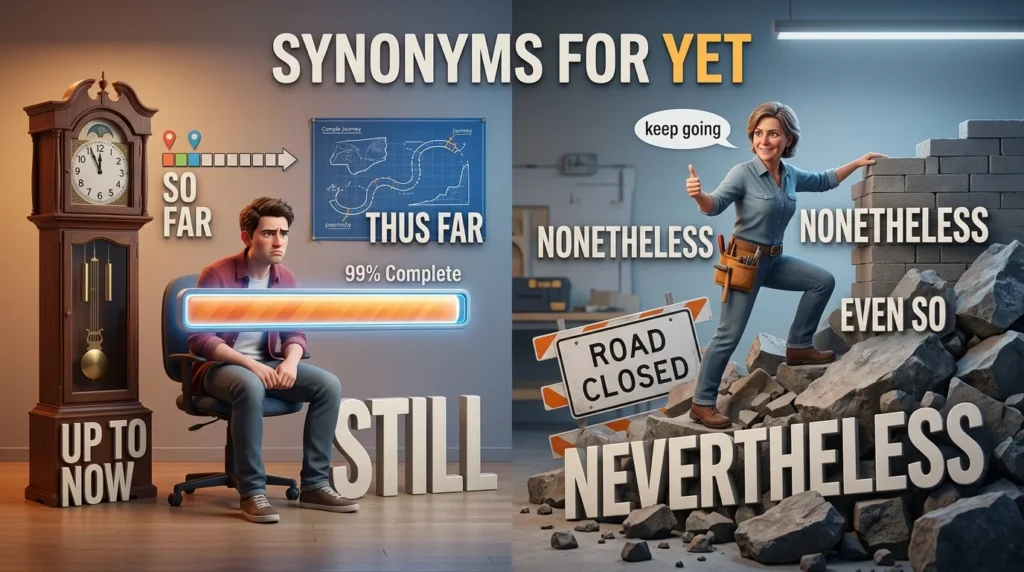
Quick Answer: Synonyms for Yet
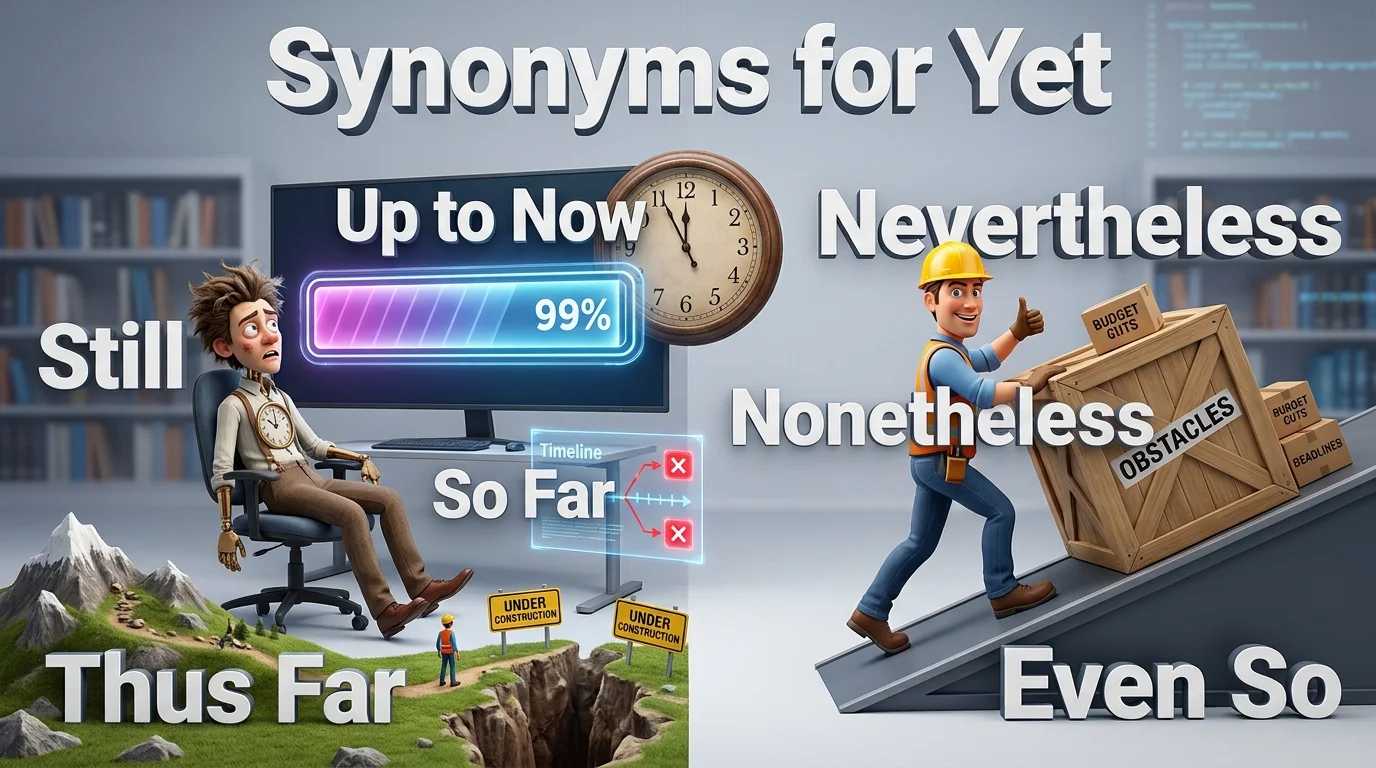
Here are useful synonyms and alternatives for yet:
- Still
- Nevertheless
- Nonetheless
- However
- Even so
- Despite that
- In spite of that
- So far
- Up to now
- Until now
- Until then
- To date
- As of now
- Thus far
- Hitherto
- Previously
- Already
- Again
- Another
- Once more
- Even now
- At this point
- So soon
- At present
- Nevertheless
- Notwithstanding
- All the same
- Regardless
- By this time
- Up to this point
The correct alternative depends on which meaning of yet is being used.
Best Synonyms for Yet
1. Still
Still is one of the closest alternatives to yet when talking about a situation that continues or has not changed.
Example:
“She hasn’t arrived yet.”
→ “She still hasn’t arrived.”
The grammar changes slightly, but the meaning remains similar.
2. However
However is useful when yet introduces a contrast.
Example:
“He was tired, yet he continued working.”
→ “He was tired; however, he continued working.”
However is especially common in formal and academic writing.
3. Nevertheless
Nevertheless means despite what has just been mentioned.
Example:
“The task was difficult, yet she completed it.”
→ “The task was difficult; nevertheless, she completed it.”
It often sounds more formal and emphatic than “yet.”
4. Nonetheless
Nonetheless has almost the same meaning as nevertheless.
Example:
“The plan was risky, yet they approved it.”
→ “The plan was risky; nonetheless, they approved it.”
It is common in formal writing.
5. Even So
Even so introduces a contrasting result despite the previous statement.
Example:
“The weather was terrible. Yet, they went outside.”
→ “The weather was terrible. Even so, they went outside.”
This phrase is natural in both spoken and written English.
6. So Far
So far works when yet means “up to this point.”
Example:
“We haven’t received any response yet.”
→ “We haven’t received any response so far.”
It is especially useful with present-perfect constructions.
7. Up to Now
Up to now means from the past until the present moment.
Example:
“She hasn’t experienced any problems yet.”
→ “She hasn’t experienced any problems up to now.”
This is useful when emphasizing the period leading to the present.
8. Until Now
Until now emphasizes that something has been true or has not happened before the present moment.
Example:
“I hadn’t understood the problem yet.”
Depending on the sentence, this can become:
“I hadn’t understood the problem until now.”
The meaning can change slightly, so context matters.
9. Thus Far
Thus far means “up to this point” and is more formal than “so far.”
Example:
“The project has been successful thus far.”
It is especially useful in professional, academic, and formal writing.
10. To Date
To date means “up to the present time.”
Example:
“No solution has been found yet.”
→ “No solution has been found to date.”
It is particularly common in business and formal writing.
11. As of Now
As of now refers to the current situation.
Example:
“We haven’t received the documents yet.”
→ “As of now, we haven’t received the documents.”
It emphasizes the current status.
12. Even Now
Even now emphasizes that something remains true or continues at the present time.
Example:
“Even now, he doesn’t understand what happened.”
It can sometimes overlap with the continuing sense of “yet.”
13. Hitherto
Hitherto means “until now” or “up to this time.”
Example:
“The hitherto unknown process was eventually discovered.”
This is a formal and somewhat old-fashioned word.
14. At This Point
At this point can replace some uses of “yet” when referring to the current stage of a situation.
Example:
“We don’t know the answer yet.”
→ “At this point, we don’t know the answer.”
It is especially common in conversation and professional communication.
15. All the Same
All the same means despite what has been said or despite a particular circumstance.
Example:
“The journey was exhausting. All the same, we enjoyed it.”
It is similar to nevertheless and even so.
16. Regardless
Regardless means without being affected by a particular circumstance.
Example:
“It was expensive, yet they bought it.”
A related alternative:
“It was expensive. Regardless, they bought it.”
However, “regardless” does not replace every use of “yet.”
17. Notwithstanding
Notwithstanding means despite or in spite of something.
Example:
“Notwithstanding the difficulties, the project succeeded.”
It is formal and frequently used in legal or professional writing.
18. Despite That
Despite that can introduce a contrasting result.
Example:
“He knew the risks, yet he continued.”
→ “He knew the risks. Despite that, he continued.”
19. In Spite of That
This phrase has a similar meaning to despite that.
Example:
“The evidence was weak. In spite of that, the case continued.”
20. Another
When yet appears before a noun in the phrase yet another, it can sometimes be replaced by another, although the emphasis changes.
Example:
“Yet another problem appeared.”
→ “Another problem appeared.”
The original version often expresses frustration, surprise, or emphasis.
Yet Meaning “Still”: Best Alternatives
When yet appears in a negative sentence to mean something has not happened up to now, consider:
- Still
- So far
- Up to now
- Until now
- To date
- Thus far
- As of now
- At this point
- Even now
Examples
“She hasn’t finished yet.”
→ “She still hasn’t finished.”
“She hasn’t finished yet.”
→ “She hasn’t finished so far.”
“No decision has been made yet.”
→ “No decision has been made to date.”
The alternatives are related, but their grammatical structure can differ.
Yet Meaning “However”: Best Alternatives
When yet connects two contrasting ideas, use:
- However
- Nevertheless
- Nonetheless
- Even so
- All the same
- Despite that
- In spite of that
- Notwithstanding
Example
“The problem was serious, yet they remained calm.”
Possible alternatives:
“The problem was serious; however, they remained calm.”
“The problem was serious; nevertheless, they remained calm.”
“The problem was serious. Even so, they remained calm.”
Yet Meaning “Another”: Best Alternatives
When yet means something additional or emphasizes repetition, it commonly appears in phrases such as:
- Yet another
- Yet again
- Yet more
- Yet another time
Examples:
“Yet another mistake was found.”
“Yet again, the system failed.”
Here, yet adds emphasis, often expressing surprise, frustration, or repetition.
Yet vs. Still
Yet and still can overlap, but they are not always interchangeable.
Yet
Often refers to something expected but not completed by a particular point in time.
“She hasn’t arrived yet.”
Still
Often emphasizes that a situation continues.
“She is still waiting.”
Compare:
- “He hasn’t finished yet.”
- “He is still working.”
Both indicate continuation, but the grammatical focus is different.
Yet vs. However
These words can both express contrast, but their grammatical behavior differs.
Yet:
“He was tired, yet he continued.”
However:
“He was tired; however, he continued.”
“However” often functions as a sentence connector, while “yet” can function as a coordinating conjunction.
Yet vs. Nevertheless
Both can introduce contrast.
Yet is usually shorter and more conversational.
Nevertheless sounds more formal and emphatic.
Compare:
“The task was difficult, yet we finished it.”
“The task was difficult; nevertheless, we finished it.”
The second sentence sounds more formal.
Yet vs. Nonetheless
Nonetheless is almost interchangeable with nevertheless.
Both mean approximately:
despite that / nevertheless / even so
Example:
“The evidence was limited; nonetheless, the researchers continued.”
Yet vs. So Far
These are only interchangeable in certain contexts.
Yet:
“She hasn’t responded yet.”
So far:
“She hasn’t responded so far.”
“So far” focuses more explicitly on the period from the beginning of the situation until now.
Formal Synonyms for Yet
For academic, professional, or formal writing, consider:
- Nevertheless
- Nonetheless
- However
- Thus far
- To date
- Hitherto
- Notwithstanding
- Up to now
- Until now
- As of now
Example
Casual:
“The results aren’t available yet.”
Formal:
“The results are not available to date.”
Or:
“The results have not been obtained thus far.”
Casual Alternatives for Yet
In everyday conversation, these are often more natural:
- Still
- So far
- Even so
- Up to now
- Another
- Again
- At this point
Examples
“I haven’t done it yet.”
“I still haven’t done it.”
“We don’t know yet.”
“We don’t know so far.”
“Yet another problem!”
“Another problem!”
Synonyms for “Not Yet”
The phrase not yet usually means something has not happened up to the present time.
Useful alternatives include:
- Still not
- Not so far
- Not up to now
- Not at this point
- Not as of now
- Not to date
- Not thus far
Examples
“The report isn’t ready yet.”
→ “The report is still not ready.”
“The report isn’t ready yet.”
→ “The report isn’t ready as of now.”
The most natural everyday alternative is often still not.
Synonyms for “Yet Again”
Yet again means something has happened another time, often with emphasis or frustration.
Alternatives include:
- Again
- Once again
- Once more
- Another time
- For another time
- Repeatedly
Example
“He made the same mistake yet again.”
→ “He made the same mistake once again.”
The phrase “yet again” often carries stronger emotional emphasis.
Synonyms for “Yet Another”
Useful alternatives include:
- Another
- One more
- An additional
- Another additional
- Still another
Example
“Yet another problem occurred.”
→ “Another problem occurred.”
However, “yet another” often communicates frustration, surprise, or repetition, so simply using “another” may weaken the original tone.
Common Mistakes When Using Synonyms for Yet
Mistake 1: Replacing Every “Yet” with “Still”
“Still” and “yet” overlap, but they have different grammatical patterns.
“She hasn’t arrived yet.”
“She’s still waiting.”
Both are correct, but they are structured differently.
Mistake 2: Using “However” Without Correct Punctuation
In formal writing:
“He was tired; however, he continued.”
Or:
“He was tired. However, he continued.”
Using “however” incorrectly between two independent clauses can create a punctuation error.
Mistake 3: Treating “So Far” and “Yet” as Completely Identical
They overlap in some negative sentences but are not universally interchangeable.
“She hasn’t replied yet.”
“She hasn’t replied so far.”
The second sentence emphasizes the period up to the present.
Mistake 4: Using “Hitherto” in Casual Conversation
“Hitherto” is formal and somewhat old-fashioned.
In ordinary conversation, until now or so far is much more natural.
Mistake 5: Removing the Emphasis from “Yet Another”
“Yet another” often communicates repeated frustration or surprise.
“Another problem” is more neutral.
How to Choose the Right Synonym for Yet
Ask what yet means in your sentence.
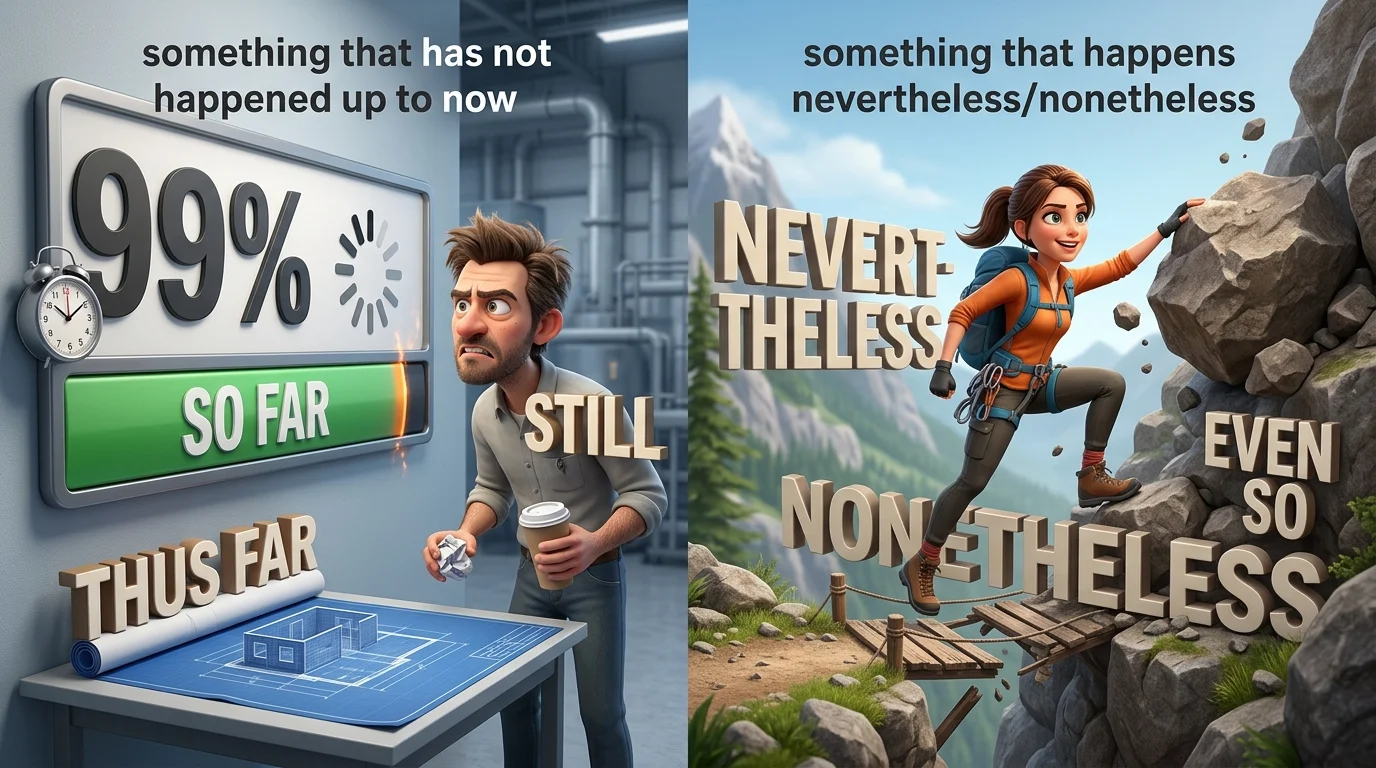
Does it mean something has not happened up to now?
Use still, so far, up to now, to date, or thus far.
Does it introduce a contrast?
Use however, nevertheless, nonetheless, or even so.
Does it emphasize another occurrence?
Use again, once more, or another.
Does it emphasize the current situation?
Use as of now or at this point.
Do you need a formal alternative?
Use nevertheless, nonetheless, thus far, to date, or hitherto.
5 Key Takeaways
- Yet has several meanings, so there is no single synonym that works in every sentence.
- When “yet” means up to now, useful alternatives include still, so far, up to now, to date, and thus far.
- When “yet” expresses contrast, alternatives include however, nevertheless, nonetheless, and even so.
- In phrases such as “yet another” and “yet again,” the word adds emphasis, repetition, surprise, or frustration.
- The best replacement depends on meaning, grammar, formality, and the relationship between ideas in the sentence.